Découvrez ce qu’ont de particulier les téléphones VoIP, comment ils fonctionnent et pourquoi ils sont essentiels pour les communications modernes. Apprenez leurs principaux avantages et comment les connecteurs RJ45 de LINK-PP les soutiennent.
Learn how LLDP (Link Layer Discovery Protocol) enhances PoE systems through intelligent power negotiation, efficient energy management, and device discovery in modern Ethernet networks.
RDMA over Converged Ethernet enables fast, low-latency data transfers using standard Ethernet hardware, reducing CPU usage and improving network efficiency.
Découvrez les différences clés entre IEEE 802.3af (PoE), 802.3at (PoE+) et 802.3bt (PoE++). Comprenez les niveaux de puissance, la compatibilité et les applications avec les solutions magnétiques PoE de LINK-PP.
Learn what a Powered Device (PD) is in PoE networks, how it receives power from a PSE, and explore LINK-PP’s PoE-ready components like LPJK6072AONL and LP41223NL.
Learn the difference between PSE and PD in PoE networks, how detection & classification work, and which LINK-PP PoE RJ45 products suit your WAP, camera or VoIP deployment.
Découvrez ce qu’il faut savoir sur les commutateurs EoR (End-of-Row), comment fonctionne cette architecture, ses avantages et inconvénients, les différences entre EoR et ToR, les bonnes pratiques de déploiement, ainsi que les modules optiques recommandés.
Learn what a ToR (Top-of-Rack) switch is, how ToR architecture works, and why it’s the preferred networking model in modern data centers. Includes benefits, use cases, and compatible optical transceiver solutions from LINK-PP.
Le WLAN couvre tous les réseaux locaux sans fil, tandis que le Wi-Fi est un type spécifique de WLAN utilisant des normes définies pour des connexions rapides et fiables.
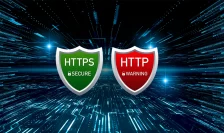
HTTP vs HTTPS : HTTPS chiffre les données pour une transmission sécurisée, tandis que HTTP laisse les informations exposées. Choisissez HTTPS pour la confidentialité, la confiance et la conformité.
Comparez les transceivers 100G LR4, CWDM4 et PSM4 afin de déterminer le meilleur choix pour votre réseau en fonction de la distance, du coût et des exigences en matière de câblage.
Découvrez ce qu’est un plan arrière, comment les canaux de plan arrière prennent en charge l’Ethernet haute vitesse 40G/100G, les normes clés et les défis de conception. Apprenez comment les connecteurs LINK-PP RJ45 améliorent les performances du plan arrière.
Découvrez la norme IEEE 802.3bj pour l’Ethernet 100G relative aux interconnexions par plan arrière et par câble cuivre. Explorez les technologies PAM4, FEC, les PHY KP4/KR4/CR4, ainsi que la manière dont les modules LINK-PP prennent en charge les réseaux haute vitesse.
Explication de VLAN contre SVI : le VLAN segmente les réseaux au niveau de la couche 2, tandis que le SVI permet le routage inter-VLAN au niveau de la couche 3 pour la communication entre les VLAN.
Découvrez le rôle du Gearbox dans les transceivers optiques modernes. Apprenez comment il permet l’alignement des canaux, la conversion de débit et le « breakout » pour les réseaux 50 G, 100 G et 200 G.
What Frame Check Sequence (FCS) means, how CRC-32 detects corrupted Ethernet frames, and why FCS errors are commonly associated with cable faults, fiber issues, or optical transceiver problems.
Discover how optical cross‑connect (OXC) enables all‑optical switching in DWDM/OTN networks, with LINK‑PP SFP modules ensuring seamless integration and superior performance.
Learn what Dispersion Compensation Fiber (DCF) is, how it reduces chromatic dispersion, where it is used, and why it matters in modern optical networks.
Learn what OEO means in optical communication, how optical-electrical-optical regeneration works, and when it is used in DWDM networks and optical links. Keywords:
Learn what a Fiber Optical Light Source is, how it works, its types, and how to choose the right one for accurate fiber testing and network performance.
Discover the LQ‑SW40‑SR4C 40GBASE‑SR module: high-speed, low-power, QSFP+ optics for multimode fibre networks. Perfect for data centres and network upgrades.
Learn what hyperconverged infrastructure HCI is, how it compares with virtualization and dHCI, and when Nutanix, Sangfor, or SFP-based designs fit best.
Understand SFP+ 40km (10GBASE-ER) modules, including specs, SMF compatibility, and how to choose the right extended-reach optical transceiver for your network.