What are SFP ports on a switch? Learn how SFP ports support fiber and Ethernet connections, how they compare with RJ45 and SFP+, and which module you need.
What Frame Check Sequence (FCS) means, how CRC-32 detects corrupted Ethernet frames, and why FCS errors are commonly associated with cable faults, fiber issues, or optical transceiver problems.
Discover the LQ‑SW40‑SR4C 40GBASE‑SR module: high-speed, low-power, QSFP+ optics for multimode fibre networks. Perfect for data centres and network upgrades.
Discover how optical cross‑connect (OXC) enables all‑optical switching in DWDM/OTN networks, with LINK‑PP SFP modules ensuring seamless integration and superior performance.
XLPPI electrical interface connects 40G QSFP+ modules to network hardware using four lanes, ensuring high-speed, reliable data transfer and compatibility.
Discover how LINK-PP RJ45 Magjack improves QoS stability by enhancing signal integrity, reducing EMI, and ensuring reliable transmission for modern networks.
L’interopérabilité dans les réseaux signifie que des dispositifs et des systèmes provenant de différents fournisseurs peuvent se connecter, partager des données et fonctionner ensemble de manière transparente à l’aide de normes communes.
Résolvez les problèmes réseau courants dans les réseaux de centres de données, notamment les pannes, les vitesses lentes et les erreurs de configuration, grâce à des conseils pratiques de dépannage.
Explore the roles of LSRs and LERs in MPLS networks. Learn their functions, differences, and how LINK-PP products support high-speed, reliable label-switched paths.
Découvrez les différences entre les architectures de réseau P2P, P2MP, MP2P et MP2MP. Apprenez comment les transceivers optiques LINK-PP permettent une connectivité efficace et à haut débit.
Le jitter en optique provoque un flou d'image et des erreurs de données dans les systèmes optiques. Découvrez ses types, effets, causes, ainsi que les méthodes de mesure et de réduction du jitter.
Découvrez les différences entre les modulateurs photoniques en silicium et les modulateurs optiques traditionnels, leurs principes de fonctionnement, leurs avantages et leur rôle dans les transceivers optiques de nouvelle génération.
What Frame Check Sequence (FCS) means, how CRC-32 detects corrupted Ethernet frames, and why FCS errors are commonly associated with cable faults, fiber issues, or optical transceiver problems.
Discover how optical cross‑connect (OXC) enables all‑optical switching in DWDM/OTN networks, with LINK‑PP SFP modules ensuring seamless integration and superior performance.
Learn what Dispersion Compensation Fiber (DCF) is, how it reduces chromatic dispersion, where it is used, and why it matters in modern optical networks.
Learn what OEO means in optical communication, how optical-electrical-optical regeneration works, and when it is used in DWDM networks and optical links. Keywords:
Déverrouillez une connectivité flexible et haute densité à 100 G/112 G. Le LQ-LW112-LR4C est un transceiver QSFP28 à double débit de 10 km prenant en charge à la fois les normes 100GBASE-LR4 et 112GBASE-OTU4 sur fibre monomode (SMF).
La prise RJ45 magnétique industrielle LPJ4014CNL offre un blindage EMI robuste, des contacts dorés et des certifications, garantissant une connectivité fiable des dispositifs IoT dans tout environnement.
Explore how LINK-PP’s LS-DW4010-40I SFP+ DWDM transceiver enhances LTE fronthaul and backhaul with 10G speed, 40 km reach and industrial temperature performance.
Découvrez comment les lasers, les modulateurs et les photodiodes constituent le cœur des transcepteurs optiques, permettant une transmission de données haute vitesse et à faible latence à travers les réseaux mondiaux.
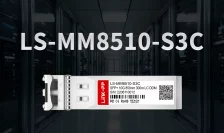
Découvrez le LINK-PP LS-MM8510-S3C, un transcepteur conforme à la spécification MSA 100% et entièrement compatible avec le module Juniper EX-SFP-10GE-SR. Économisez jusqu’à 60% sans compromettre les performances. Prise en charge DDM/DOM. Idéal pour les centres de données et les réseaux d’entreprise.
Explorez le transcepteur SFP28 industriel LINK-PP LS-SM3125-10I, offrant un débit de 25 Gb/s sur fibre monomode jusqu’à 10 km à 1310 nm, avec prise en charge DOM et fonctionnement dans une plage étendue de températures, adapté aux infrastructures cœur de réseau et aux liaisons front-haul 5G.
Le transcepteur optique LINK-PP LS-SM311G-10C 1 G fournit un débit de 1,25 Gbps, une portée de 10 km, une large compatibilité et des performances fiables pour les réseaux fibre optique.
L’émetteur-récepteur optique LINK-PP LS-MM8510-S3C correspond à l’émetteur-récepteur Aruba J9150D en termes de vitesse, de compatibilité et de fiabilité, offrant un remplacement économique et transparent.
Subscribe to LINK-PP
newsletter
Don’t miss anything. Get all the latest posts delivered straight to your inbox.