
















If you’ve ever delved into the world of fiber optics, you’ve likely encountered a alphabet soup of acronyms. Two that often cause confusion are SFP and SFF. While they sound similar, they represent fundamentally different types of optical modules.
Mixing them up can lead to incorrect purchases and network design flaws. This guide will cut through the jargon, clearly explaining the differences, applications, and how to choose the right component for your needs. We’ll also highlight how ССЫЛКА-PP‘s high-quality оптические модули provide reliable solutions.
➤ Ключевые выводы
SFP transceivers are small. You can swap them while devices are on. This makes them great for new networks.
SFF transceivers stay in place and cannot be swapped when on. They work well for older or less flexible setups.
Pick SFP if your network needs upgrades and flexibility. It supports faster speeds and many connection types.
SFF costs less and is good for steady, fixed connections. It is best when you do not need upgrades often.
Always check if your device works with the transceiver. SFP ports give you more choices for future upgrades than SFF.
➤ What is an SFP? (The Plug-and-Play Workhorse)
SFP, which stands for Малогабаритный подключаемый модуль (SFP), is the most common optical transceiver you’ll find in modern networking equipment like switches, routers, and network cards. Its key feature is its горячезаменяемые nature.
Think of an SFP module as a specialized “cartridge” for your network device. You can easily insert or remove it without powering down the entire system, making upgrades and maintenance a breeze.
Common SFP Form Factors include:
SFP (1 Гбит/с)
SFP+ (10 Гбит/с)
SFP28 (25 Гбит/с)
QSFP+ (40 Гбит/с)
QSFP28 (100 Гбит/с)
Key Characteristics of SFP:
Pluggable: Inserts into a dedicated SFP port/cage.
Hot-Swappable: Can be replaced on the fly.
Interchangeable: Allows for flexibility in choosing fiber type (multi-mode/single-mode) and wavelength for different distances.
Widely Used: The industry standard for modular connectivity.
➤ What is SFF? (The Soldered Specialist)
Here’s where the confusion usually lies. In this context, SFF does not mean “Small Form Factor” in a general sense. Instead, it refers specifically to a Small Form Factor оптического модуля with solder pins.
Unlike the pluggable SFP, a Модуль SFF is permanently soldered directly onto a host board (like a network interface card or a media converter). It is not designed to be user-replaceable.
Common SFF Form Factors include:
SFF (e.g., 2×5, 2×7)
SFP (Wait, what? Yes, the pluggable SFP form factor was actually developed to replace the older, soldered SFF designs, which is a primary source of the naming confusion).
Key Characteristics of SFF (Soldered Type):
Soldered: Permanent attachment to the печатная плата via pins.
Не являются модульными: Not removable or interchangeable by the end-user.
Экономичное решение: Often cheaper for OEMs to integrate into fixed-configuration devices.
Lower Profile: Since it doesn’t need a protective cage, it can save space on a board.
➤ SFP vs SFF: Head-to-Head Comparison Table
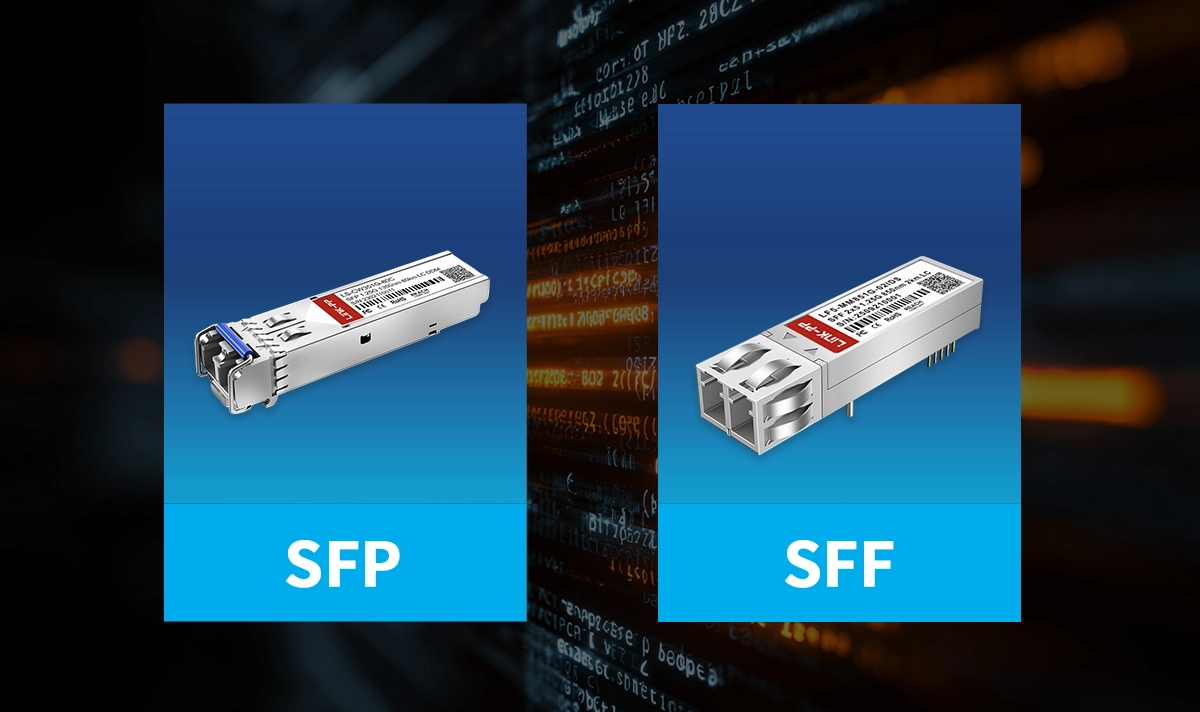
To visualize the differences, here’s a direct comparison:
Характеристика | SFP (модули малого форм-фактора) | SFF (Soldered Small Form Factor) |
|---|---|---|
Интерфейс | Pluggable; slides into a port | Soldered; pins are welded to the PCB |
Горячая замена | ✅ Да | ❌ Нет |
User-Replaceable | ✅ Yes, easily | ❌ No, requires technical soldering |
Гибкость | High; can be swapped for different types | None; fixed function |
Распространенные случаи использования | Network switches, routers, modular systems | Embedded systems, fixed NICs, media converters |
Cost Perspective | Higher per module, but offers flexibility | Lower per unit, but fixed in application |
Пример | ССЫЛКА-PP SFP-1G-SX (1G Multi-mode) | Soldered onto a specialty PCB |
➤ Application Scenarios: Where You’ll Find Them
Choosing SFP (Pluggable) is ideal when you need:
Гибкость: You want to change a port’s fiber type (e.g., from multi-mode to single-mode) easily.
Масштабируемость: You’re building a network that may need to upgrade from 1G to 10G in the future.
Maintenance: You need the ability to quickly replace a faulty module without replacing the entire switch or card.
SFF (Soldered) is typically used when:
Cost is a primary driver: For a fixed-function, high-volume device (e.g., a преобразователь среды передачи or an embedded system), soldering the transceiver is cheaper.
Space is extremely limited: The lower profile of a soldered component is necessary.
The device has a single, permanent purpose: There is no need to ever change the transceiver type.
➤ Finding the Right Module for Your Needs
For the vast majority of network administrators and IT managers, Модули SFP will be the primary focus due to their flexibility and dominance in the market.
When sourcing SFPs, it’s crucial to choose reliable, compatible, and high-performance modules from a trusted supplier. This is where ССЫЛКА-PP excels. We offer a wide range of модулей, совместимых со спецификацией MSA, optical transceivers that ensure full compatibility with major OEMs like Cisco, Juniper, HPE, and more.
For your standard network switch applications, consider these high-performance ССЫЛКА-PP модели:
LS-MM851G-S5C: A reliable 1000BASE-SX module for multi-mode fiber connections up to 550m.
LS-SM3110-10C: A high-performance 10GBASE-LR module for 10 Gigabit single mode fiber applications.
Using quality modules like these is essential for оптимизации производительности сети и minimizing data transmission errors.
➤ Conclusion and Key Takeaway
The core difference is simple: SFP is pluggable; SFF (in this context) is soldered.
If you can pull it out of a switch with your fingers, it’s an SFP.
If it’s a small chip permanently attached to a circuit board, it’s a soldered SFF .
Understanding this distinction is crucial for making informed purchasing and design decisions. For your scalable, enterprise-level networking needs, the pluggable SFP (and its faster cousins SFP+, QSFP28) is the undisputed king.
Ready to optimize your network’s connectivity? 🔗
Explore our extensive catalog of compatible, high-quality SFP modules to find the perfect solution for your data center, enterprise network, or fiber internet setup. Свяжитесь с нашими экспертами уже сегодня for personalized advice and ensure you get the right оптический трансивер LINK-PP for maximum performance and value.
➡️ Browse Our Range of SFP Modules & Get a Quote Today!
➤ Часто задаваемые вопросы (FAQ)
What is the main difference between SFP and SFF transceivers?
You can swap SFP transceivers while your device is on. SFF transceivers stay fixed in the device. SFP gives you more flexibility for upgrades. SFF works best in setups that do not change often.
Which transceiver should you choose for future upgrades?
Pick SFP if you want to upgrade your network later. You can change SFP modules for faster speeds or new connections. SFF does not let you upgrade easily.
Are SFP transceivers compatible with all network devices?
SFP transceivers work with devices that have SFP ports. Always check your device manual. SFF transceivers only fit in devices made for them.
Do SFP and SFF transceivers support the same data speeds?
No. SFP transceivers support higher speeds, up to 10Gbps or more. SFF transceivers usually reach up to 1Gbps. SFP is better for fast networks.
Is there a big price difference between SFP and SFF transceivers?
SFF transceivers often cost less at first. SFP transceivers may cost more, but you save money when you upgrade. You do not need to buy a new device with SFP.



