Der zentrale Verwaltungsserver (Central Management Server) vereinfacht das Servermanagement und ermöglicht sichere, zentralisierte Steuerung, Aktualisierungen und Überwachung mehrerer Systeme an einem Ort.
Discover the differences between P2P, P2MP, MP2P, and MP2MP network architectures. Learn how LINK-PP optical transceivers enable efficient, high-speed connectivity.
Dispersion compensation in optical systems corrects chromatic dispersion, ensuring clear, accurate signals in fiber optic communication and imaging applications.
In-band Network Telemetry embeds real-time monitoring data in each packet, enabling instant network insights, troubleshooting, and performance analysis.
Learn what Multipoint-to-Point (MP2P) architecture is, how it works, and how LINK-PP optical transceivers enhance data efficiency in modern fiber networks.
Remote network monitoring enables real-time network management, security, and troubleshooting from any location, supporting both remote teams and multiple site.
Erfahren Sie, wie LINK-PP’s LS-DW4010-40I SFP+ DWDM-Transceiver LTE-Fronthaul und -Backhaul mit 10G-Geschwindigkeit, 40 km Reichweite und industrieller Temperaturleistung verbessert.
OSI vs TCP/IP: OSI is ideal for learning network concepts, while TCP/IP is used for real-world networking. Compare their layers, uses, and main differences.
Learn what the SFF-8402 specification is, how it defines the SFP28 interface standard, and why it is essential for 25G / 28G optical module interoperability and system reliability.
Explore how Smart Industry 4.0 Networks enable intelligent manufacturing through high-speed Ethernet, fibre optics, IIoT, and edge computing integration.
Semiconductor material properties determine optical module speed, efficiency, and reliability by affecting bandgap, carrier mobility, and thermal conductivity.
Erfahren Sie, wie RJ45-Magjack-Steckverbinder eine robuste Ethernet-Kommunikation zwischen SPSen und SCADA-Hosts in der industriellen Automatisierung ermöglichen und so Signalintegrität sowie Systemzuverlässigkeit gewährleisten.
Erfahren Sie, wie optische Module die Leistung von SPS-Systemen verbessern und eine Hochgeschwindigkeits-, Langstreckenkommunikation sowie zuverlässige industrielle Automatisierungsnetzwerke ermöglichen.
VLAN vs. VXLAN: Vergleichen Sie Skalierbarkeit, Flexibilität und Kosten, um die beste Netzwerksegmentierung für kleine Installationen oder große, cloudbasierte Umgebungen auszuwählen.
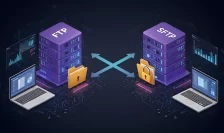
FTP vs. SFTP: Vergleichen Sie Sicherheit, Verschlüsselung und Anwendungsfälle, um das beste Protokoll für sichere und effiziente Dateiübertragungen auszuwählen.
Erfahren Sie, wie die 25-Gbit/s-SFP28-Optikmodule von LINK-PP hyperskalare Rechenzentren mit hoher Bandbreite, geringer Latenz und Energieeffizienz optimieren. Lernen Sie wesentliche Vorteile und Einsatzgebiete kennen.
What Frame Check Sequence (FCS) means, how CRC-32 detects corrupted Ethernet frames, and why FCS errors are commonly associated with cable faults, fiber issues, or optical transceiver problems.
Discover how optical cross‑connect (OXC) enables all‑optical switching in DWDM/OTN networks, with LINK‑PP SFP modules ensuring seamless integration and superior performance.
Learn what Dispersion Compensation Fiber (DCF) is, how it reduces chromatic dispersion, where it is used, and why it matters in modern optical networks.
Learn what OEO means in optical communication, how optical-electrical-optical regeneration works, and when it is used in DWDM networks and optical links. Keywords:
Discover the LQ‑SW40‑SR4C 40GBASE‑SR module: high-speed, low-power, QSFP+ optics for multimode fibre networks. Perfect for data centres and network upgrades.
Learn what hyperconverged infrastructure HCI is, how it compares with virtualization and dHCI, and when Nutanix, Sangfor, or SFP-based designs fit best.
Understand SFP+ 40km (10GBASE-ER) modules, including specs, SMF compatibility, and how to choose the right extended-reach optical transceiver for your network.