
















In the relentless pursuit of faster data speeds, the leap to 100 Gigabit Ethernet (100GbE) was a monumental one. Two key form factors emerged to carry this heavy load: the CFP (C Form-factor Pluggable) and the QSFP28 (Quad Small Form-factor Pluggable 28). While both serve the same ultimate goal—blazing-fast data transmission—they are designed for vastly different environments and needs.
Choosing the wrong one can lead to unnecessary power consumption, wasted space, and higher costs. This guide will demystify these two technologies, compare their strengths and weaknesses, and help you make an informed decision for your data center or telecommunications infrastructure. Let’s dive in!
✅ The Contenders: A Deep Dive into Each Form Factor
1. CFP: The First Generation Powerhouse
The CFP, standing for C Form-factor Pluggable, was among the first modules developed for 100G applications. The “C” initially stood for the Latin letter Cente, representing 100. It’s a large form factor designed to handle the complexity and thermal management of early 100G technology.
Key Characteristics of CFP:
Size: Large (approximately 144.75 mm x 82 mm x 13.6 mm).
Power Consumption: Relatively high (often >24W), due to its size and older technology.
Applications: Primarily found in long-haul DWDM networks, telecom carrier switches, and early-generation 100G optics deployments where size was less of a constraint than capability.
2. QSFP28: The Density & Efficiency Champion
The QSFP28 is the evolution of the highly successful QSFP+ form factor. The “28” signifies its support for 28 Gbps per lane, and “Quad” means it uses four lanes to achieve 4x28G=112G, which is used for 100GbE. It was developed later than CFP, benefiting from advances in integration and efficiency.
Key Characteristics of QSFP28:
Size: Small (approximately 72.5 mm x 18.35 mm x 8.5 mm).
Power Consumption: Significantly lower (typically 3.5W – 5W for SR4/LR4), a crucial factor for modern data centers.
Applications: The undisputed king for modern high-density switch applications, data center interconnect (DCI), and enterprise networking. It is the standard for new deployments.
✅ Head-to-Head: CFP vs QSFP28 Comparison Table
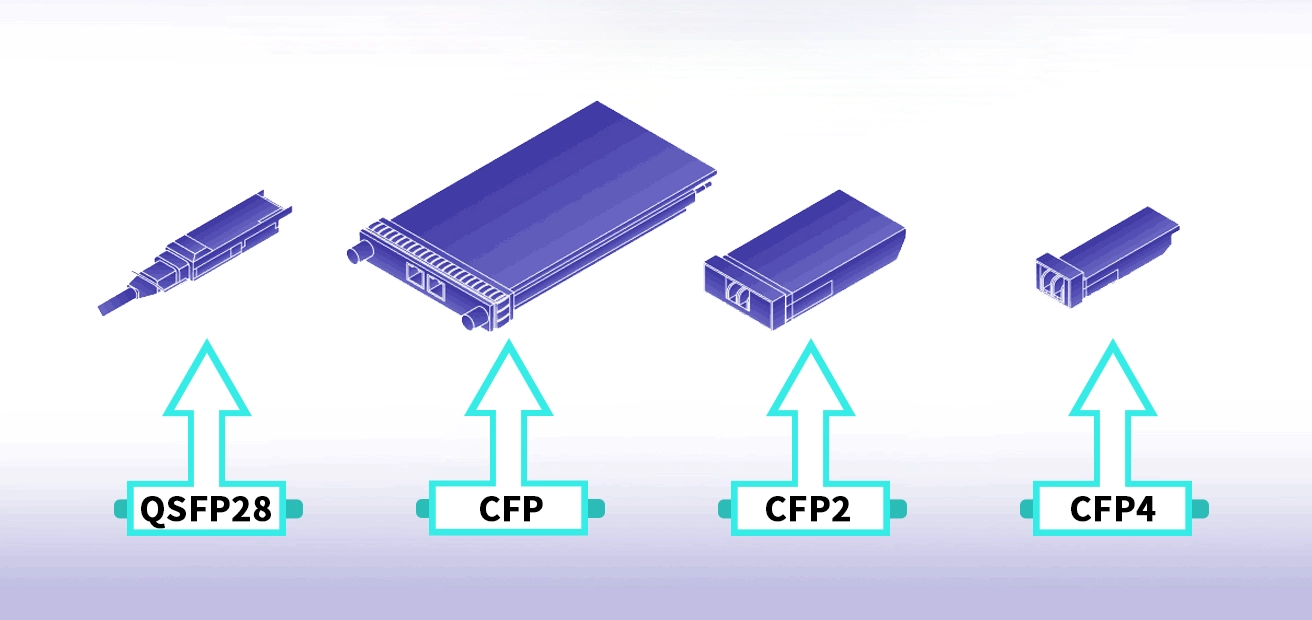
The best way to understand their differences is through a direct comparison. This table breaks down the critical factors for network architects.
Feature | CFP | QSFP28 | Winner 🏆 |
|---|---|---|---|
Form Factor Size | Large | Compact | QSFP28 |
Port Density | Low (1-2 ports per line card) | Very High (up to 36 ports per switch) | QSFP28 |
Power Consumption | High (>24W) | Low (~3.5W) | QSFP28 |
Primary Application | Long-Haul Telecom, Early 100G | Data Centers, Cloud Networking | Tie (Context-specific) |
Thermal Management | Complex, requires more cooling | Simpler, easier to cool | QSFP28 |
Cost (Current Market) | Generally higher, becoming niche | Lower, economies of scale | QSFP28 |
Technology Generation | First Generation | Second Generation, More Advanced | QSFP28 |
✅ Choosing the Right 100G Transceiver for Your Needs: A Practical Guide
So, which one is right for you? The answer lies in your specific use case.
Choose CFP if:
You are maintaining or upgrading legacy network equipment that specifically has CFP slots.
Your application involves very long-distance, DWDM-based transport where specific CFP-based designs are already entrenched.
Port density and power are not primary concerns.
Choose QSFP28 if:
You are building or expanding a modern data center or cloud infrastructure.
High port density and low power consumption are your top priorities for scalability and reducing TCO.
You need a cost-effective, future-proof solution for data center interconnect and spine-leaf architectures. It is the de facto industry standard.
For the vast majority of new deployments, QSFP28 is the clear and recommended choice. Its superior density, efficiency, and cost-effectiveness make it the backbone of modern high-speed networking.
✅ LINK-PP: Your Partner for High-Performance QSFP28 Solutions
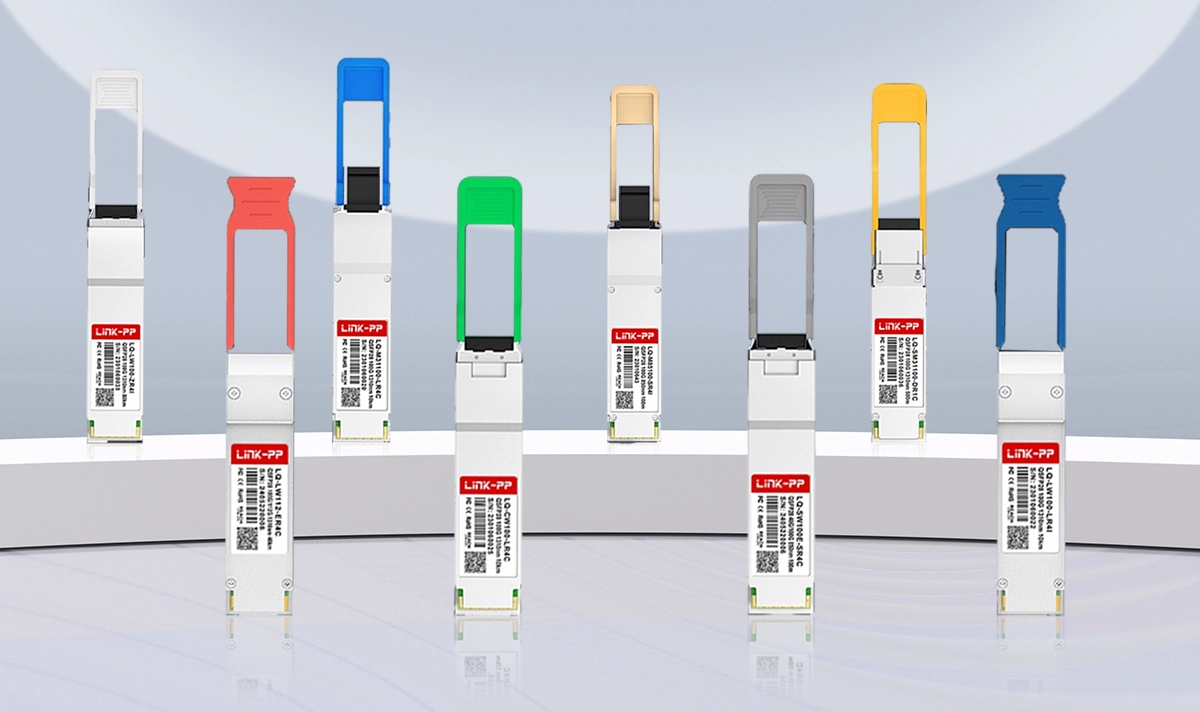
At LINK-PP, we specialize in providing reliable, high-performance, and compliant optical transceivers that meet the rigorous demands of today’s networks. We understand that choosing the right fiber optic module is just the first step; you need a trusted supplier to deliver it.
For your 100G connectivity needs, we highly recommend our flagship QSFP28 module:
This high-quality 100G transceiver is designed for long-reach data center applications, supporting links up to 10km over monomode (SMF). It is fully MSA-compliant, ensuring seamless interoperability with major switch brands, and is rigorously tested for performance and reliability.
Why choose LINK-PP optics?
100% MSA Compliant: Guaranteed compatibility.
Rigorous Quality Testing: Every module is tested for optimal performance.
Cost-Effective: Save significantly compared to OEM pricing.
Lifetime Warranty: We stand behind our products.
✅ Conclusion and Next Steps
The evolution from CFP to QSFP28 mirrors the broader trend in networking: doing more with less. While the CFP played a vital historical role, the QSFP28’s compact size, efficiency, and density have made it the undeniable winner for next-generation data centers.
Ready to optimize your 100G network with the right optics?
➡️ Browse our extensive range of certified QSFP28 transceivers on the LINK-PP website. Explorer maintenant ➞
➡️ Pour une consultation gratuite sur vos besoins réseau spécifiques, Contactez nos experts techniques ➞
✅ FAQ
Les transceivers CFP et QSFP28 peuvent-ils être utilisés de manière interchangeable ?
Non, vous ne pouvez pas utiliser les transceivers CFP et QSFP28 de manière interchangeable. Ils ont des formes de module différentes, des types de connecteurs distincts et des exigences de compatibilité spécifiques. Vérifiez toujours les spécifications de votre équipement réseau pour déterminer quel module correspond à vos besoins.
Quel transceivers est meilleur pour les réseaux économes en énergie ?
Les transceivers QSFP28 sont meilleurs pour les réseaux économes en énergie. Leur conception compacte et leur faible consommation d'énergie en font un choix idéal pour réduire les coûts opérationnels dans les centres de données modernes.
Les transceivers CFP conviennent-ils aux applications à courte distance ?
Les transceivers CFP ne sont généralement pas utilisés pour les distances courtes. Ils sont conçus pour la transmission à longue distance et les applications à haut débit, comme les réseaux métropolitains ou les connexions entre centres de données.
Comment choisir entre CFP et QSFP28 pour votre réseau ?
Évaluez les priorités de votre réseau. Optez pour QSFP28 pour une haute densité de ports et une efficacité énergétique. Privilégiez CFP si vous avez besoin de transmission à longue distance et de débit ultra-élevé. Les déploiements mixtes peuvent également équilibrer ces avantages.
Les transceivers QSFP28 prennent-ils en charge la compatibilité descendante ?
Oui, les transceivers QSFP28 prennent en charge la compatibilité descendante avec les modules SFP, SFP+ et SFP28. Cette flexibilité vous permet d'intégrer ces modules dans vos infrastructures réseau existantes sans problème.
See Also
Join Us in the LINK-PP Community Today
Un guide complet pour sélectionner les transceivers optiques 100G QSFP28 : SR4, LR4, CWDM4 et plus
Pourquoi choisir les émetteurs-récepteurs LINK-PP 100G pour une connectivité haute vitesse



