
















In the high-speed world of optical communication, data travels at the speed of light. But what happens when this flawless stream of photons encounters a subtle, yet critical, imperfection? This imperfection is known as jitter, and it’s one of the most significant factors determining the performance and reliability of your network.
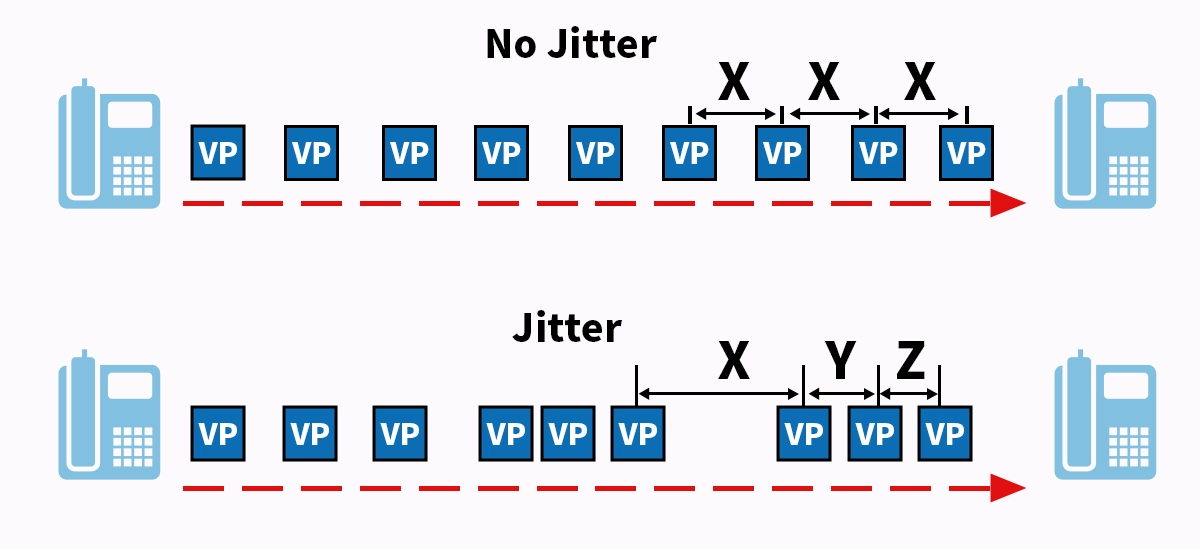
Simply put, jitter is the deviation in the timing of a signal’s edges from their ideal positions. Imagine a perfectly metronomic drummer suddenly speeding up and slowing down erratically—the music becomes distorted. Similarly, jitter distorts the digital “rhythm” of your data, leading to errors and potential system failure.
In this article, we’ll demystify jitter, explore its root causes, classify its types, and provide actionable strategies for mitigation. Understanding how to reduce jitter in optical networks is crucial for anyone designing, managing, or relying on high-speed data infrastructure.
🚀 What Exactly is Jitter? The “When” Matters More Than the “What”
In digital signals, information is decoded at specific, predetermined intervals. The receiver samples the signal, expecting a ‘1’ or a ‘0’ at a precise moment. Jitter introduces uncertainty into this timing. A rising edge that arrives too early or too late can cause the receiver to sample the wrong value, resulting in a Bit Error Rate (BER).
Jitter is typically measured in Unit Intervals (UI) or picoseconds (ps). One UI is the time period of a single bit. For a 10Gbps signal, 1 UI is 100 picoseconds. Even a few picoseconds of jitter can be catastrophic at multi-gigabit data rates.
🚀 The Usual Suspects: Common Sources of Jitter in Optical Links
Jitter doesn’t appear out of nowhere. It’s generated by various components and phenomena within a communication system:
❌ Random Jitter (RJ): Caused by random, unpredictable noise sources like thermal noise and shot noise in optical components and electronics. It is unbounded and follows a Gaussian distribution.
📊 Deterministic Jitter (DJ): This is predictable and has a specific cause. It can be further broken down as shown in the table below.
The table below summarizes the primary components of Deterministic Jitter:
Jitter Type | Abbreviation | Primary Cause | Characteristics |
|---|---|---|---|
Data-Dependent Jitter | DDJ | Inter-symbol interference (ISI), bandwidth limitations of the fiber and transceiver. | Pattern-dependent; linked to the sequence of ‘1’s and ‘0’s. |
Periodic Jitter | PJ | Power supply noise, crosstalk from adjacent channels, or clock source imperfections. | Repetitive, sinusoidal timing variations. |
Bounded Uncorrelated Jitter | BUJ | Crosstalk from other data streams that are not correlated with the main signal. | Unpredictable but has a finite peak-to-peak value. |
Understanding the different types of jitter and their root causes is the first step toward effective mitigation. A robust system design must account for both the random and deterministic components.
🚀 Why Should You Care? The Real-World Impact of Jitter
Uncontrolled jitter directly translates to network performance degradation. The consequences include:
Increased Bit Error Rate (BER): This is the most direct impact. As jitter increases, the “eye” in an eye diagram closes, making it harder for the receiver to correctly distinguish bits.
System Instability: Intermittent link failures and “flapping” connections can often be traced back to marginal jitter tolerance.
Reduced Operational Reach: A link that works perfectly at 1 km might fail at 10 km due to jitter accumulation over the fiber.
Protocol Compliance Failures: Standards like Ethernet, Fibre Channel, and OTN have strict jitter generation and tolerance masks. Exceeding these limits means your equipment is not interoperable.
For network engineers, managing jitter tolerance in high-speed transceivers is non-negotiable for maintaining a healthy and scalable network.
🚀 The Heart of the Link: How Optical Transceivers Influence Jitter
The optical transceiver is a critical hub for jitter generation and management. Every component inside a transceiver can contribute to the total jitter budget:
Laser Driver & Modulator: Imperfections in driving the laser can introduce timing skew and pattern-dependent jitter.
Photo Detector & Amplifier (TIA): On the receive end, the conversion of light back to an electrical signal is susceptible to noise, generating random jitter.
CDR Circuits (Clock and Data Recovery): This is the transceiver’s “jitter filter.” A high-quality CDR cleans up the incoming signal by extracting a clean clock and retiming the data, effectively reducing input jitter.
Choosing transceivers with superior components and robust CDR circuitry is paramount. This is where the importance of high-quality, compliant optical modules becomes evident.
For applications demanding uncompromising signal integrity, the LINK-PP PSM4-100G-LR4 transceiver is engineered for exceptionally low jitter generation. Ses CDR avancés et ses optiques haute linéarité garantissent que vos liens 100G restent stables et sans erreur, même sur de longues distances, répondant directement à des défis tels que le jitter dans les réseaux optiques 100G.
Conclusion : La gestion du jitter est synonyme d'excellence réseau
Jitter Le jitter fait inévitablement partie des communications optiques haute vitesse, mais il n'est pas insurmontable. En comprenant sa nature, en choisissant des composants de qualité comme ceux de LINK-PP, et en respectant des principes d'ingénierie solides, vous pouvez garantir que vos flux de données restent clairs, précis et fiables.
Prêt à éliminer le jitter de vos liens optiques critiques ?
Découvrez l'intégralité de la gamme de transcepteurs optiques LINK-PP haute performance et à faible jitter et parlez à nos experts techniques pour trouver la solution parfaite répondant aux exigences strictes de votre application. Visitez notre site web [link-pp.com] or contactez-nous dès aujourd'hui pour une consultation !
🚀 FAQ
Quelle est la cause principale du jitter en optique ?
Vous observez souvent du jitter lorsque des parties de votre système optique se déplacent rapidement. Ce mouvement peut provenir de secousses, de vibrations ou de changements environnementaux. Même de petits mouvements rapides peuvent créer du jitter.
Que fait le jitter à vos images ou données ?
Le jitter peut flouter vos images ou les rendre tremblantes. Vous pouvez également rencontrer des erreurs dans vos données. Le jitter rend votre système moins fiable et peut réduire la qualité de vos résultats.
Quels outils pouvez-vous utiliser pour mesurer le jitter ?
Vous pouvez utiliser des caméras haute vitesse, des capteurs de vibration ou des oscilloscopes. Ces outils vous aident à visualiser les mouvements rapides ou les changements de temporisation dans votre système. Chaque outil vérifie une partie différente de votre installation.
Quelles étapes permettent de réduire le jitter dans votre système optique ?
Vous pouvez utiliser des supports robustes, des tapis anti-vibrations ou des filtres de signal. Ces mesures maintiennent votre système stable et réduisent les mouvements ou bruits indésirables. Une bonne conception et des vérifications régulières aident également.
Quels types de systèmes optiques sont le plus affectés par le jitter ?
Vous observez le jitter principalement dans les caméras, les télescopes, les liens en fibre optique et les outils laser. Les systèmes nécessitant une haute précision ou des images claires peuvent rencontrer les plus gros problèmes avec le jitter.



