
















In the high-stakes world of data centers and enterprise networking, speed is everything. As the demand for bandwidth skyrockets, making the jump from 10G to 40G is no longer a luxury—it’s a necessity. At the heart of this transition is a powerful, yet often overlooked component: the QSFP+ 40G SR4 optical transceiver.
If you’re an IT manager, network engineer, or simply a tech enthusiast, understanding this technology is crucial. This guide will demystify the QSFP+ 40G SR4, exploring how it works, where it’s used, and why it remains a dominant force in 40G Ethernet connectivity.
➤ Points clés à retenir
The QSFP+ 40G SR4 transceiver can move data very fast, up to 40Gbps. This makes it great for big data centers and business networks.
You can install or replace it while the network is on. This means you do not need to turn off anything. Your network keeps working well.
The transceiver sends data through many channels at once. This stops slowdowns and helps the network work better.
It works with many devices and older modules. This makes it easy to upgrade your network and connect everything together.
Digital Diagnostic Monitoring (DDM) lets you check the transceiver’s health right away. This helps you find problems early, before they hurt how things work.
➤ What is a QSFP+ 40G SR4 Transceiver?
Let’s break down the name:
QSFP+: Stands for Quad Small Form-factor Pluggable Plus. The “Quad” indicates it can support four independent channels of data transmission and reception.
40G: Denotes its data rate of 40 Gigabits per second.
SR4: Signifies Short Range avec 4 lanes. It’s designed for short-distance transmissions over fibre multimode (MMF).
In essence, a QSFP+ 40G SR4 is a hot-swappable, compact optical module that plugs into a switch, router, or network interface card. It converts electrical signals into optical signals and vice versa, enabling data to travel over leurs modules, tels que les at blazing speeds.
➤ How Does 40G SR4 Technology Work?
The magic of the SR4 lies in its parallelism. Instead of using one high-speed lane, it uses four separate 10G lanes in each direction (transmit and receive). This is known as parallel optics.
Here’s the process:
The transceiver takes a single 40G electrical signal from your network device.
It breaks (multiplexes) this signal into four 10G channels.
Each 10G channel is converted to an optical signal and transmitted out of one of four dedicated VCSEL (Vertical-Cavity Surface-Emitting Laser) lasers.
These four optical signals travel down an OM3 or OM4 multi-mode fiber cable via an MPO/MTP connector.
On the receiving end, another QSFP+ SR4 module receives the four signals, converts them back to electrical signals, and combines them to reconstruct the original 40G data stream.
This parallel approach is a cost-effective and efficient way to achieve high bandwidth.
➤ Key Applications & Use Cases
The QSFP+ 40G SR4 transceiver is incredibly versatile, making it ideal for:
Data Center Aggregation: Connecting top-of-rack (ToR) switches to end-of-row (EoR) or core switches.
High-Performance Computing (HPC): Linking servers and clusters that require massive data throughput for tasks like AI modeling and scientific simulations.
40G Ethernet Network Upgrades: A perfect solution for enterprises moving from 10G SFP+ to 40G QSFP+ infrastructure.
Breakout Connectivity: One of its most powerful features is breakout functionality. A single 40G SR4 port can be split into four independent 10G SFP+ connections using a special breakout cable, providing a cost-effective path for network expansion.
➤ QSFP-40G-SR4 vs. Other 40G Modules: A Quick Comparison
Not all 40G modules are created equal. The right choice depends on your transmission distance and fiber type.
Feature | QSFP-40G-SR4 (Short Range) | QSFP-40G-LR4 (Long Range) | QSFP-40G-ER4 (Extended Range) |
|---|---|---|---|
Reach | Up to 100m (OM4) / 150m (OM4) | Up to 10km | Up to 40km |
Fiber Type | Multi-Mode (OM3/OM4) | Single-Mode (OS2) | Single-Mode (OS2) |
Laser Technology | Les lasers | DWDM CWDM | DWML EML |
Typical Use Case | Data Center Racks | Campus/City Links | Long-Haul Telecom |
Cost | $$ (Lowest) | $$$ | $$$$ (Highest) |
➤ Why Choose LINK-PP QSFP+ 40G SR4 Modules?
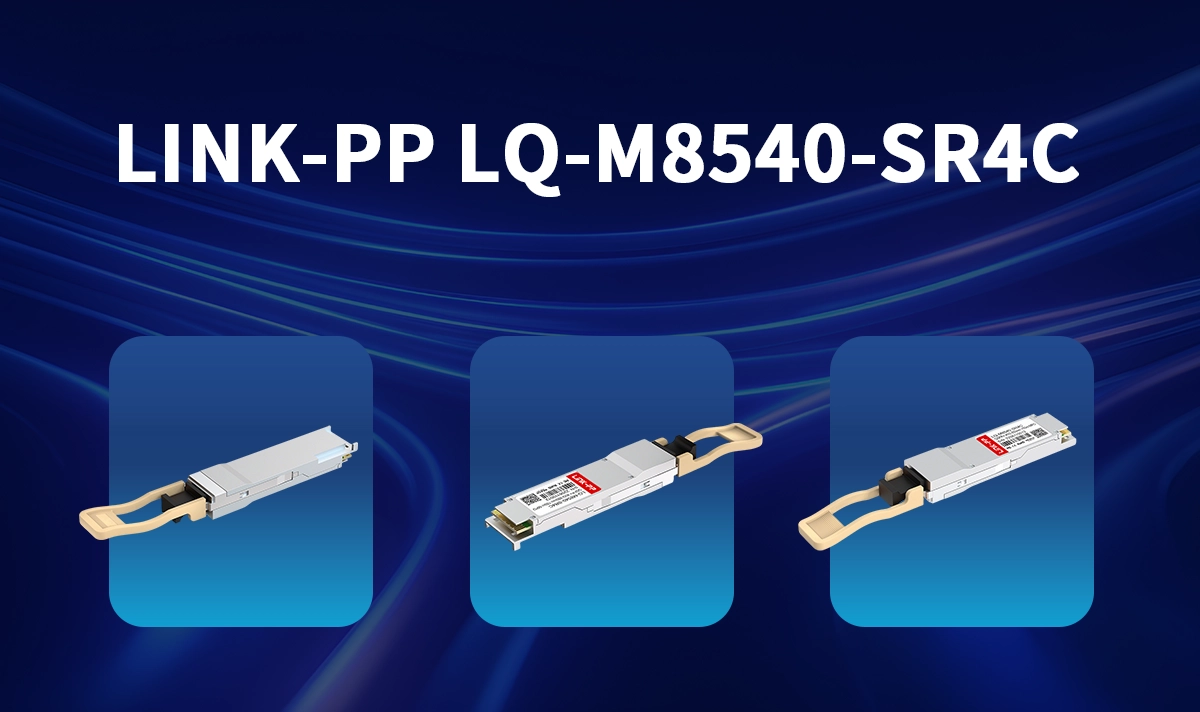
When selecting transceivers, compatibility, reliability, and performance are non-negotiable. This is where LINK-PP excels. Our optical transceivers are engineered to meet or exceed OEM standards, ensuring flawless performance in your branded equipment.
Key Advantages of LINK-PP 40G SR4 Modules:
100% MSA-Compliant: Guarantees interoperability with major switch brands (Cisco, Juniper, Arista, etc.).
Rigorous Testing: Every module, including our popular LINK-PP LQ-M8540-SR4C model, undergoes extensive testing to ensure optimal performance and low taux d'erreur binaire (BER).
Cost-Effective: Save up to 80% compared to OEM pricing without sacrificing quality or functionality.
Lifetime Warranty: We stand behind our products with robust customer support and a comprehensive warranty.
For those looking for a high-quality 40G QSFP SR4 compatible solution that won’t break the bank, LINK-PP provides the perfect balance of performance and value. Whether you need a standard 40gbe sr4 module or are exploring 40G optical transceiver options for a new deployment, we have you covered.
➤ Conclusion: Is QSFP+ 40G SR4 Right for You?
The QSFP+ 40G SR4 transceiver reste un pilier de la conception moderne des centres de données. Sa conception efficace en optique parallèle, sa capacité de démultiplexage (breakout) et son rapport coût-efficacité en font un choix extrêmement judicieux pour les applications 40G à courte portée.
Lorsque vous planifiez votre infrastructure réseau, choisir un fournisseur fiable pour vos transceivers optiques is critical. LINK-PP s’engage à fournir des solutions hautes performances, compatibles et abordables qui maintiennent votre flux de données.
Prêt à accélérer considérablement votre réseau avec une connectivité 40G fiable ? 🔗
Parcourez dès aujourd’hui notre vaste sélection de modules certifiés LINK-PP QSFP+ 40G SR4 Notre équipe d’experts est à votre disposition pour vous aider à trouver le transceiver exactement compatible avec vos besoins.
👉 Achetez dès maintenant le module LINK-PP LQ-M8540-SR4C et économisez ! 👈
Vous avez une question spécifique concernant la compatibilité ? Contactez notre équipe d’assistance pour une expérience d’achat fluide
➤ FAQ
Quelle est la distance maximale prise en charge par les modules QSFP+ 40G SR4 ?
Les modules QSFP+ 40G SR4 atteignent jusqu’à 100 mètres avec une fibre OM3. Ils peuvent atteindre jusqu’à 150 mètres avec une fibre OM4. Ces modules conviennent idéalement aux liaisons courtes au sein des centres de données.
Quels équipements prennent en charge les transceivers QSFP+ 40G SR4 ?
Vous pouvez utiliser les transceivers QSFP+ 40G SR4 dans de nouveaux commutateurs, routeurs et serveurs. L’équipement doit disposer d’un port QSFP+. Vérifiez toujours la liste de compatibilité de votre équipement avant tout achat.
Quel type de câble est requis pour les modules QSFP+ 40G SR4 ?
Vous devez utiliser des câbles en fibre multimode dotés de connecteurs MPO. Ces câbles permettent une transmission rapide des données et garantissent un fonctionnement optimal de votre module.
Que révèle la surveillance numérique des diagnostics (DDM) ?
La DDM fournit des informations en temps réel sur votre module : température, tension, puissance du signal et nombre d’erreurs. Cela vous permet de détecter rapidement les problèmes et de maintenir le bon fonctionnement de votre réseau.



