

Microsoft Azure is one of the world’s most trusted and expansive cloud platforms, providing businesses with a wide range of scalable solutions for computing, storage, networking, security, and more. With over 200 services, Azure continues to dominate the cloud landscape in 2025. This blog explores the core architecture and services of Microsoft Azure, its networking capabilities, and how optical transceivers support the platform’s robust cloud infrastructure.
As the demand for cloud computing grows, understanding the inner workings of Azure and the key components that make it fast, reliable, and scalable is crucial for IT professionals, network engineers, and cloud architects.
➡️ What Is Microsoft Azure?
Microsoft Azure is a comprehensive cloud computing platform offering a wide array of services such as virtual machines, storage, databases, AI/ML tools, networking, and much more. Azure allows businesses to run their applications and store their data in a secure, scalable, and highly available environment without needing to maintain physical infrastructure.
Key benefits of Azure include:
On-demand scalability for businesses of all sizes
Global availability with data centers in multiple regions
Enterprise-grade security and compliance
Flexible hybrid cloud solutions that integrate on-premises with cloud resources

➡️ Core Azure Cloud Services and Architecture
Azure offers a comprehensive set of services that allow businesses to build, deploy, and manage applications. Here’s a breakdown of the most important components of Azure’s cloud architecture:
1. Azure Regions and Availability Zones
Azure operates through a series of global Regions (e.g., East US, West Europe) and Availability Zones within those regions to provide high redundancy, fault tolerance, and disaster recovery. The cloud platform ensures that applications can be distributed across multiple zones, guaranteeing 99.99% uptime.
2. Azure Virtual Machines and Compute Services
Azure’s virtual machines (VMs) provide scalable, on-demand computing power. With Azure, businesses can run Windows, Linux, and custom OS instances in the cloud.
Azure Compute: Offers services like Azure Functions, Azure Kubernetes Service (AKS), and Azure Virtual Machines to run scalable workloads.
3. Azure Storage Solutions
Azure provides multiple storage options:
Blob Storage: For storing large amounts of unstructured data
File Storage: For network file shares
Azure Disk Storage: Persistent, high-performance storage for VMs
4. Azure Networking and Optical Transceivers
Azure uses a high-speed global network backbone that connects regions with low-latency links, ensuring fast, secure, and reliable connectivity between services. These connections are made possible with optical transceivers such as:
SFP+ 10G modules for data center access
SFP28 25G modules for high-performance server connections
QSFP+ 40G and QSFP28 100G modules for intra-region and inter-region networking
By using advanced optical technologies, Azure delivers seamless connectivity and scalability that is crucial for cloud-hosted applications.
Explore high-performance optical modules for Azure data centers: LINK-PP Optical Transceivers
➡️ Azure Hybrid Cloud and Integration with On-Premise Infrastructure
One of Azure’s standout features is its hybrid cloud capabilities, which allow businesses to integrate on-premise infrastructure with Azure services. Azure’s Azure Arc and Azure Stack offerings enable seamless integration between private data centers and Azure cloud environments, providing businesses with flexibility and control.
For hybrid environments, Azure relies on high-performance optical transceivers to connect on-premises hardware with Azure’s cloud infrastructure, ensuring fast and secure communication.
➡️ The Role of Optical Transceivers in Azure Data Centers
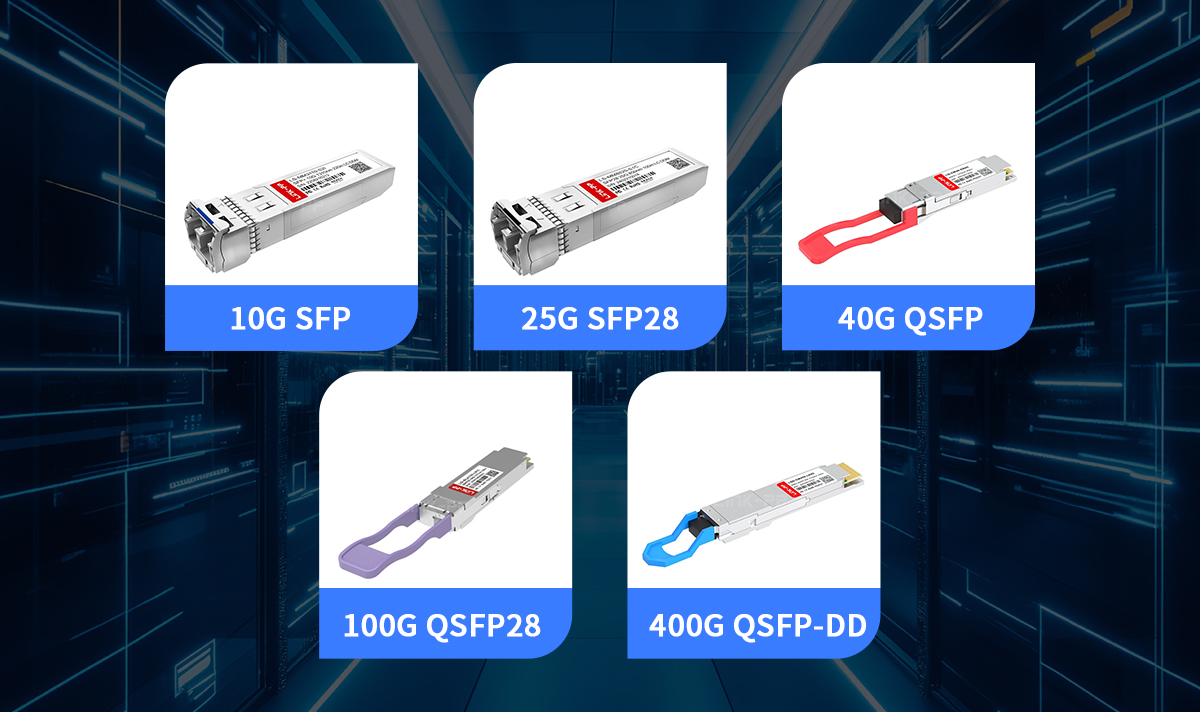
Azure data centers are equipped with state-of-the-art optical transceivers to ensure that network traffic flows smoothly between servers, storage devices, and the cloud. These modules are critical for high-speed data transfer in and out of the data center. Key types of optical modules used in Azure data center networks include:
▷ 10G and 25G Optical Transceivers
10G SFP+ and 25G SFP28 modules are commonly used in Azure’s data center network architecture for server-to-switch and switch-to-switch connections.
▷ 40G and 100G Optical Modules
For larger-scale workloads, QSFP+ 40G and QSFP28 100G modules provide the necessary bandwidth for fast intra-region data transfer and server-to-server communication.
▷ High-Density 400G Optical Transceivers
As Azure’s cloud platform evolves, 400G optical transceivers are becoming the standard for backbone network connections, offering exceptional data transfer speeds over long distances.
▷ Why Choose LINK-PP Optical Transceivers for Azure Networking?
At LINK-PP, we offer a range of optical transceivers compatible with Azure-style cloud networking, ideal for high-performance data center environments. Our modules are designed to deliver exceptional reliability, performance, and cost-efficiency, making them a perfect fit for businesses utilizing Azure’s cloud services.
SFP+ 10G, SFP28 25G, QSFP+ 40G, QSFP28 100G modules
AOC / DAC cables for low-latency interconnects
Compliant with leading switch brands like Cisco, Arista, Mellanox
➡️ Conclusion
Microsoft Azure continues to lead the cloud industry in 2025, offering scalable, secure, and flexible services to businesses worldwide. By leveraging high-performance optical transceivers, Azure data centers ensure fast, reliable, and scalable connectivity for applications across the globe. Businesses looking to build their own cloud infrastructure or integrate with Azure can rely on LINK-PP’s range of optical modules for high-speed, low-latency communication.