

In the era of cloud computing, big data, and ubiquitous connectivity, the seamless flow of information between data centers is not just an advantage—it’s a necessity. Data Center Interconnection (DCI) forms the critical backbone that enables cloud services, disaster recovery, and global workload mobility. Yet, managing this complex, high-bandwidth fabric with traditional networking approaches is increasingly untenable. Enter Software-Defined Networking (SDN), a paradigm shift that is fundamentally transforming how we architect, manage, and optimize DCI.
✅ Key Takeaways
SDN lets you control your network with software. This makes it easier to handle data center connections.
SDN helps you automate jobs and make changes fast. This cuts down on delays and boosts how well things work in data center interconnection.
SDN gives you one place to control all your data center links. This makes things simpler and means you do less manual work.
SDN makes security better by letting you set and change rules for moving data. This helps keep your data safe as it goes between data centers.
Setting up SDN can be hard. Training and starting with small projects can help you solve problems and get the most from SDN.
✅ The DCI Challenge: Beyond Physical Pipes
Traditional DCI relied on rigid, hardware-centric networks. Configuring circuits across multiple devices was manual, slow, and prone to error. Scaling bandwidth often meant over-provisioning "just in case," leading to inefficient capital expenditure (CapEx). More critically, the network lacked the intelligence to dynamically adapt to application needs or failures.
This is where SDN DCI solutions shine. By decoupling the network control plane (the brain) from the data forwarding plane (the muscle), SDN introduces unprecedented network automation, agility, and centralized intelligence to the DCI layer.
Traditional vs. SDN-Enabled DCI: A Quick Comparison
Feature | Traditional DCI | SDN-Enabled DCI |
|---|---|---|
Control & Management | Distributed, device-by-device | Centralized, software-based controller |
Provisioning Time | Days to weeks | Minutes to hours |
Resource Efficiency | Often over-provisioned, static | Dynamic optimization, "bandwidth on demand" |
Traffic Engineering | Limited, based on static protocols (e.g., BGP) | Intelligent, application-aware path computation |
Operational Complexity | High (CLI-driven) | Reduced (API-driven, intent-based) |
Innovation & Integration | Slow, vendor-locked | Fast, programmable via open APIs |
✅ Key Applications of SDN in DCI
1. Automated Provisioning and Orchestration
SDN controllers, through open APIs (like RESTful Northbound APIs), integrate directly with cloud orchestration platforms (e.g., OpenStack, Kubernetes). When an application requires a new inter-data center network link, the workflow can automatically request and provision the exact bandwidth and connectivity, slashing service delivery time from weeks to minutes. This automation is a cornerstone of intent-based networking for cloud.
2. Advanced Traffic Engineering and Load Balancing
SDN provides a global view of the entire DCI fabric. Instead of relying on shortest-path protocols alone, the controller can compute optimal paths based on real-time latency, jitter, available bandwidth, and cost. It can steer massive east-west data center traffic for big data analytics or VM migration along the most efficient route, avoiding congestion and improving application performance—a key benefit of SDN for traffic optimization.
3. Enhanced Security and Segmentation
SDN enables the creation of seamless, macro-scale segmentation policies across geographically dispersed data centers. Security groups and micro-segmentation rules defined in one location can be consistently applied throughout the interconnected fabric via the central controller, simplifying compliance and threat containment for secure data center interconnect.
4. Improved Resilience and Disaster Recovery
With its centralized intelligence, an SDN controller can detect a link or device failure in milliseconds and automatically recalculate and reroute traffic through alternative paths. This capability makes disaster recovery solutions more robust and reliable, ensuring critical services maintain connectivity.
5. Multi-Cloud and Hybrid Cloud Connectivity
As enterprises adopt a blend of private and public clouds, SDN provides a unified abstraction layer. It can manage and orchestrate connections not just between private data centers but also to major public cloud providers, creating a cohesive hybrid cloud network infrastructure.
✅ The Unsung Hero: High-Speed Optical Modules in an SDN DCI
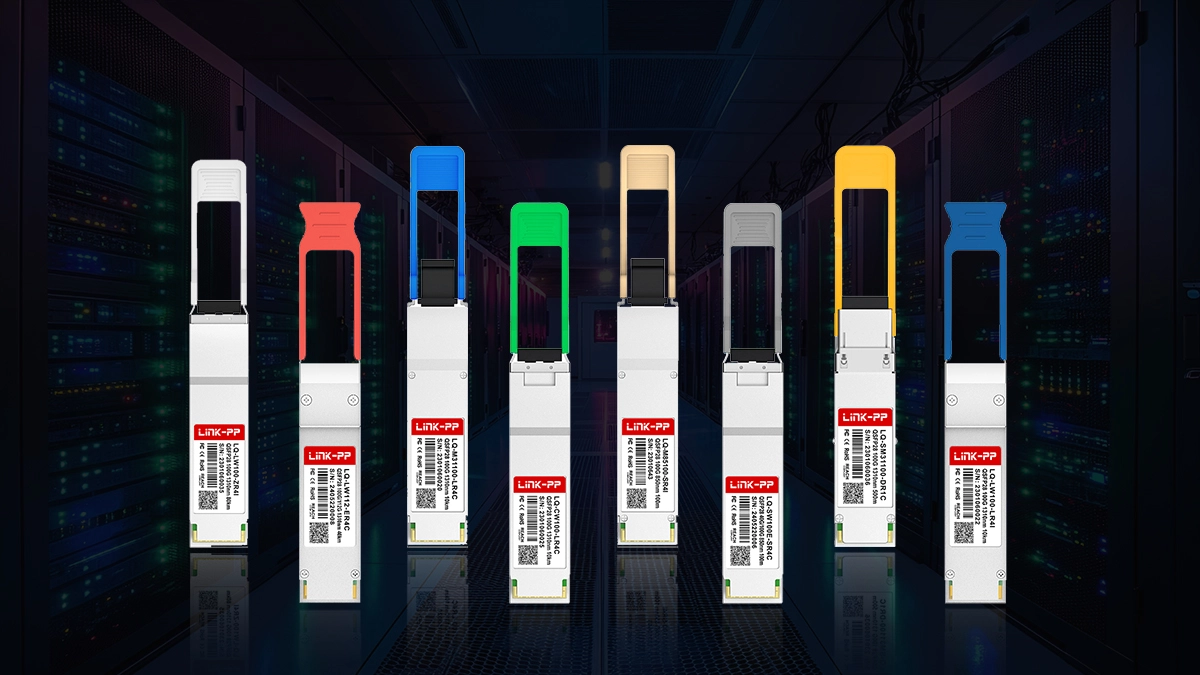
While SDN provides the intelligence, the physical layer—especially high-speed optical transceivers—provides the foundational capacity. The synergy between programmable networks and advanced optics is undeniable.
Modern data center optical modules, such as 400G and emerging 800G coherent optics, are the workhorses that carry the massive data flows across DCI links. But in an SDN architecture, they become more than just dumb pipes. Network programmability allows the controller to be aware of optical performance metrics (like signal power, BER). This enables proactive health monitoring and capacity planning.
For instance, a LINK-PP 400G QSFP-DD DR4 optical module is engineered for high-density, cost-effective data center interconnect solutions over distances up to 500m. In an SDN-managed spine-leaf DCI topology, the network controller, aware of the capabilities of these optics, can optimally assign workloads and balance traffic to utilize the high-bandwidth, low-latency paths they provide efficiently. Choosing reliable, high-performance optics like those from LINK-PP ensures that the SDN's intelligent routing decisions are executed on a robust and capable physical layer, maximizing ROI.
✅ The Future of SDN in DCI: Toward Full Autonomy
The evolution continues with the integration of artificial intelligence and machine learning (AI/ML). AI-driven SDN controllers can move from reactive optimization to predictive analytics, forecasting traffic patterns and potential bottlenecks before they impact services. This marks the journey toward a truly self-driving, self-optimizing DCI network.
✅ Conclusion
Software-Defined Networking is no longer a futuristic concept for Data Center Interconnection; it is the operational engine of the modern digital business. It transforms static, costly backbones into dynamic, efficient, and intelligent platforms that directly respond to application demands. By embracing SDN architecture for scalable networks, organizations can achieve the agility, resilience, and cost-effectiveness required to thrive in a data-centric world. Partnering with providers of robust hardware components, such as LINK-PP's industry-leading optical solutions, ensures this intelligent software layer is built upon a foundation of exceptional physical performance.
✅ FAQ
What is SDN in simple terms?
You use SDN, or Software-Defined Networking, to control your network with software. SDN lets you manage how data moves without touching each device. You get more control and can make changes faster.
How does SDN help data centers connect?
You use SDN to link data centers quickly. SDN lets you set up connections, move data, and change routes with software. You do not need to change hardware. This makes your network flexible and easy to manage.
Is SDN secure for data center interconnection?
You can make SDN secure by setting strong rules and watching your network. SDN lets you spot threats fast and change security settings from one place. You keep your data safe as it moves between data centers.
Do I need special skills to use SDN?
You need to learn new skills to use SDN well. Training helps you understand how SDN works. You can start with simple projects and build your knowledge over time.
Can SDN work with cloud services?
You can use SDN to connect your data centers to cloud services. SDN lets you move data between clouds and your sites easily. You get more options for using cloud computing in your business.