
















In the relentless pursuit of greater bandwidth and faster data transmission, fiber optic technology stands as the undisputed champion. But within this domain, two powerful multiplexing techniques battle for supremacy: Spatial Division Multiplexing (SDM) 및 파장 분할 다중화 (WDM).
Choosing the right technology is critical for network architects, data center managers, and ISPs. It impacts cost, scalability, and future-proofing. So, which one is right for your project? This guide will demystify SDM vs WDM, comparing their core principles, applications, and helping you make an informed decision.
♻️ Understanding the Core Concepts
1. What is Wavelength Division Multiplexing (WDM)?
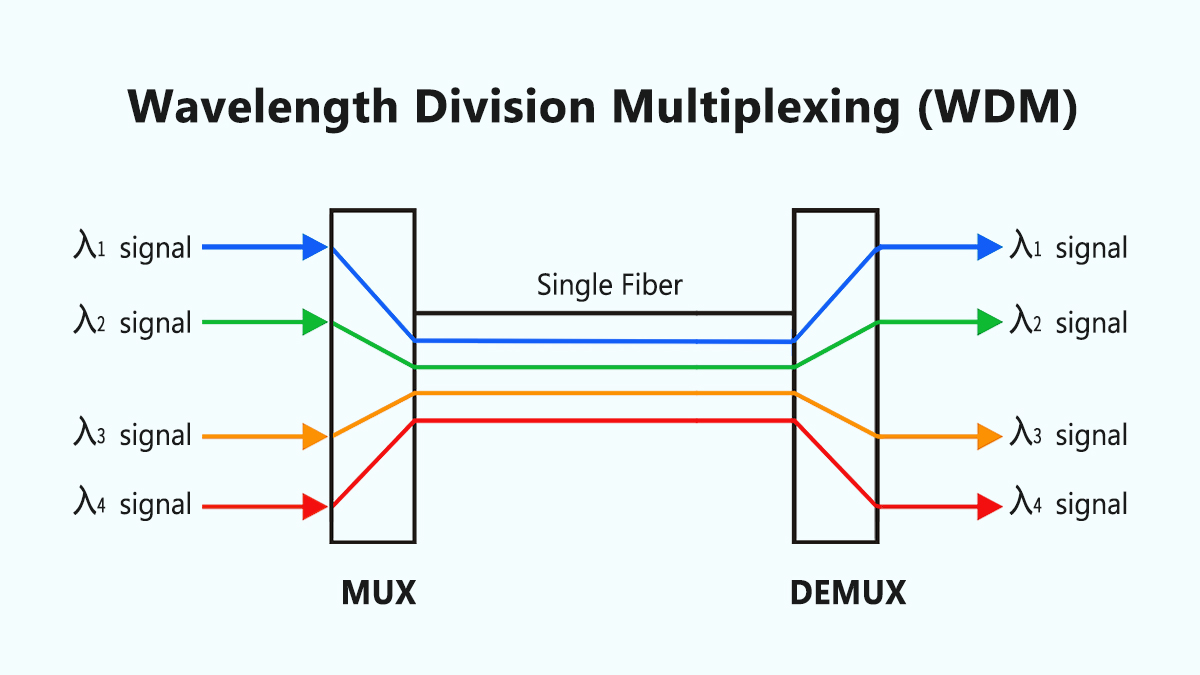
WDM 기술
increases fiber capacity by transmitting multiple light signals simultaneously on a single strand of fiber. It does this by using different wavelengths (or colors) of laser light. Each wavelength creates an independent channel, allowing data streams to travel in parallel without interference.
Think of it as a multi-lane highway on a single road, where each car (data stream) is a different color and stays in its designated lane.
CWDM (Coarse WDM): Uses wider wavelength spacing. It’s a cost-effective solution for shorter distances, often seen in metro and access networks.
DWDM (Dense WDM): Packs wavelengths much closer together. It’s designed for long-haul, high-capacity transmission over thousands of kilometers, forming the backbone of the internet.
2. What is Spatial Division Multiplexing (SDM)?
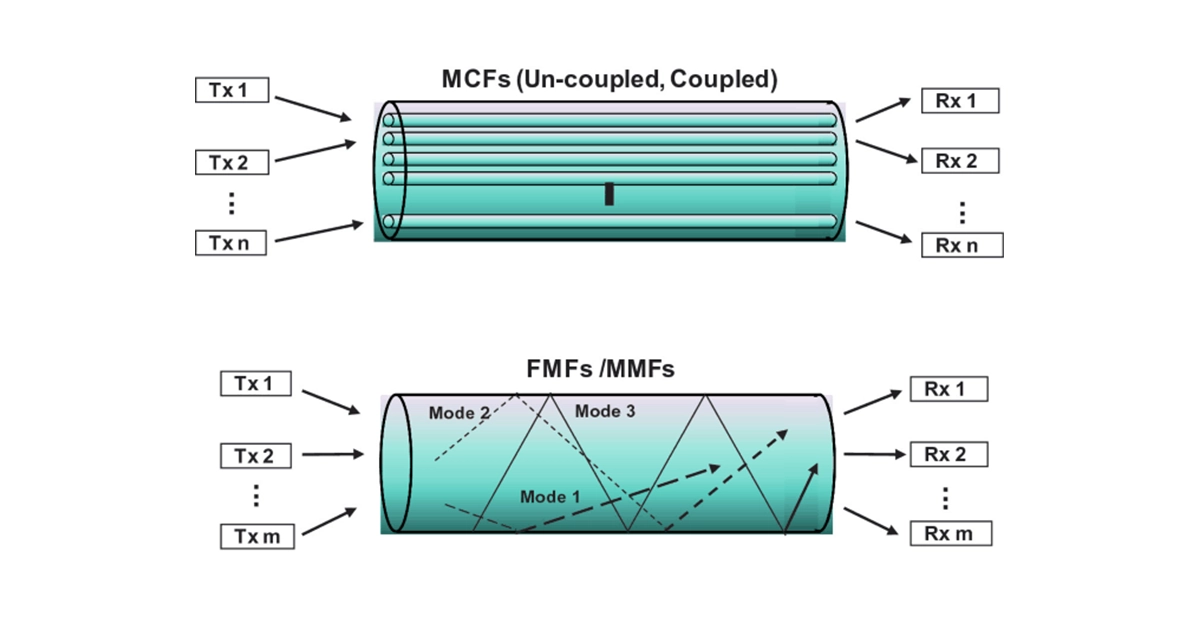
SDM takes a more straightforward approach. Instead of squeezing more signals into one fiber, it uses multiple parallel optical fibers within a single cable. Each fiber carries a separate data stream. It’s the fundamental principle behind multi-fiber cables like MPO/MTP trunk cables.
A simpler analogy: if WDM is a multi-lane highway, SDM is building multiple parallel highways.
Modern advancements like Multi-Core Fiber (MCF), where a single strand of glass contains several independent cores, are also part of the SDM family, pushing the boundaries of density.
♻️ Head-to-Head: SDM vs WDM Comparison Table
기능 | Spatial Division Multiplexing (SDM) | 파장 분할 다중화(WDM) |
|---|---|---|
Core Principle | Uses multiple, separate physical paths (fibers). | Uses multiple wavelengths on a single physical fiber. |
확장성 | Adding capacity requires laying more fiber. Can be costly and physically limiting. | Highly scalable by adding more wavelengths (colors) to existing fiber. |
비용 | Lower initial cost per port, but higher infrastructure cost for new fiber ducts. | Higher initial cost for transceivers (esp. DWDM), but maximizes ROI on existing fiber. |
복잡성(Complexity) | Simpler conceptually and electronically. No complex wavelength management. | More complex, requiring precision lasers, filters, and multiplexers/demultiplexers. |
적절한 사용 사례 | Short-reach, high-density connections (e.g., data center racks, campus networks). | Long-haul transmission, maximizing capacity of scarce/expensive fiber routes. |
Technology Example | LINK-PP QSFP28-100G-SR4 Parallel Fiber Transceiver | LINK-PP QSFP28-100G-CWDM4 WDM Transceiver |
♻️ How to Choose: SDM or WDM?
The choice isn’t about which technology is “better,” but which is more appropriate for your specific application.
Choose SDM (Parallel Fiber) if:
You are interconnecting equipment within a 데이터 센터 (e.g., spine-leaf architecture).
Physical distance is short (within a building or campus).
You have existing conduit space and can easily deploy multi-fiber cabling.
Your priority is simplicity and lower transceiver cost.
Choose WDM (especially DWDM) if:
You need to transport massive amounts of data over long distances (between cities or data centers).
Your existing fiber infrastructure is limited or extremely expensive to expand (e.g., under the ocean).
You need to provide multiple dedicated services or wavelengths to different clients over a single fiber.
♻️ The Power of Combination: Leveraging LINK-PP Solutions
Often, the most powerful networks use a hybrid approach. For instance, a 데이터 센터 might use SDM 하나의 10Base-T 채널과 MPO cables for high-speed intra-connections. Then, for connecting to a remote data center, it would use WDM technology to maximize the capacity of the long-haul fiber link.
This is where choosing a reliable partner for your 고성능 응용 분야를 위한 광 송수신 모듈 is crucial. LINK-PP provides a comprehensive portfolio of high-performance, compatible solutions for both paradigms.
For your SDM and parallel fiber needs, consider the QSFP-DD 400G-SR8, a workhorse for next-gen 400G data center links.
For your WDM requirements, LQ-SW100-SR4C LINK-PP 10G DWDM 전송기 offers a flexible and efficient solution for maximizing your long-haul fiber investment.
♻️ Conclusion and Next Steps
Both SDM and WDM are indispensable technologies in the modern optical network landscape. SDM offers a simple, powerful solution for high-density, short-reach applications. WDM provides an elegant, highly scalable method for conquering long distances and maximizing the value of every single strand of fiber.
Ready to design or upgrade your network infrastructure? The right 광 트랜스시버 are key to performance and reliability.
🎯 Still unsure which multiplexing technology is optimal for your network topology? Let our experts guide you. Explore the full range of certified, high-performance LINK-PP optical transceivers and discover the perfect solution for your bandwidth needs. [Browse Our Products]
♻️ FAQ
What is the main difference between SDM and WDM?
You use SDM to send data through many physical paths. You use WDM to send data using different light wavelengths in one fiber. SDM adds more fibers or cores. WDM adds more colors of light.
Which technology is better for upgrading existing networks?
You get faster upgrades with WDM. You use your current fiber and add more wavelengths. SDM needs new cables or fibers, so it works best for new builds.
Can you combine SDM and WDM for higher capacity?
You can mix SDM and WDM. You send many wavelengths through each fiber or core. This gives you the highest data rates for backbone and submarine networks.
Where should you use SDM instead of WDM?
You pick SDM for backbone networks, submarine cables, or large data centers. SDM gives you more capacity by adding physical paths. WDM works better for metro and access networks.
Does SDM or WDM save more energy?
You save more energy with SDM in large networks. Each path works alone, so power use stays low. WDM uses more power as you add channels to one fiber.



