
In today's hyper-connected world, data centers are the engines of the digital economy. From streaming services and cloud computing to AI and IoT, the demand for faster, more reliable, and scalable data transfer is insatiable. Traditional three-tier network architectures are often buckling under this pressure, leading to bottlenecks and latency issues.
Enter Spine-Leaf Architecture—a paradigm shift in network design that is perfectly suited for the high-speed, low-latency demands of modern optical networks. This post will demystify what spine-leaf architecture is, why it's a game-changer for data center networking, and how key components, including advanced optical transceivers from innovators like LINK-PP, make it all possible.
📜 Key Takeaways
Spine-leaf architecture has two layers. These are spine switches and leaf switches. This design lets data move fast. It also makes the network easy to grow.
Optical circuit switches make spine-leaf architecture better. They use light to move data. This gives faster speeds and less waiting time. It helps the network work better.
This architecture can grow bigger. You can add more switches easily. You do not need to change the whole network. This keeps the network fast and efficient as your data center gets bigger.
📜 What is Spine-Leaf Architecture? A Simple Analogy
Imagine a busy corporate office. In a traditional "hierarchical" setup (like a three-tier network), every department has to communicate through a central manager, who then talks to the CEO. This creates a single point of congestion.
Now, imagine a flat, agile organization where every department head (Leaf) has a direct, equal-path connection to every executive (Spine). Communication is faster, more efficient, and there's no single bottleneck. This is the core idea behind spine-leaf architecture.
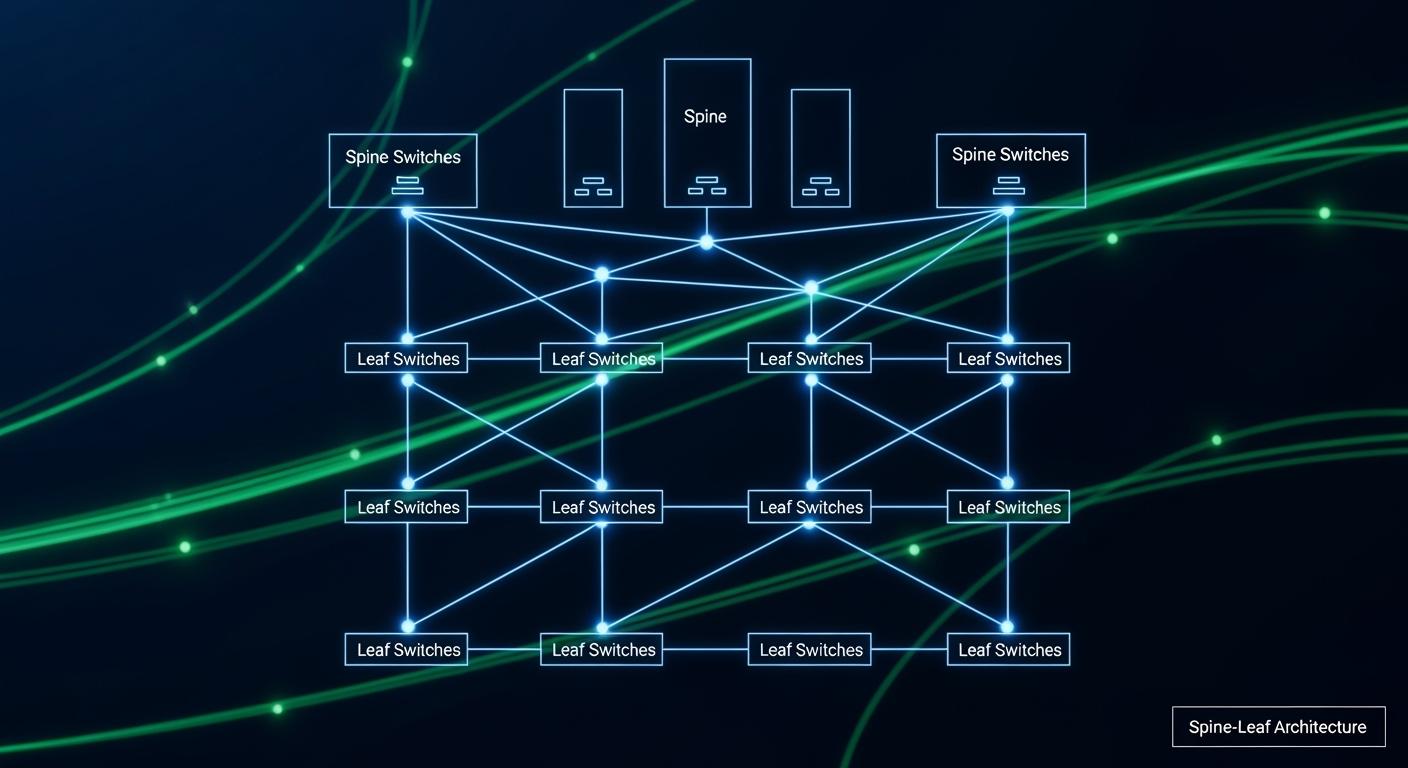
Formally, Spine-Leaf Architecture is a data center network topology that consists of two main layers:
Leaf Switches (The Access Layer): These switches form the network's edge, where servers, storage, and other end devices physically connect. Every leaf switch is responsible for ingressing and egressing traffic.
Spine Switches (The Core Layer): These switches form the network's backbone. Their sole purpose is to interconnect all leaf switches.
The critical rule is that every leaf switch is connected to every spine switch. This creates a dense mesh of interconnected pathways, eliminating oversubscription and ensuring predictable, low-latency performance.

📜 Spine-Leaf vs. Traditional Three-Tier Architecture
To fully appreciate the advantages of spine-leaf, it's helpful to compare it directly with the legacy three-tier model.
Feature | Traditional Three-Tier Architecture | Spine-Leaf Architecture |
|---|---|---|
Topology | Hierarchical (Access, Aggregation, Core) | Flat, non-blocking fabric |
Latency | Variable and often higher due to multiple hops | Predictable and consistently low |
Scalability | "Scale-up" - Limited; requires larger chassis | "Scale-out" - Seamless; add more spine or leaf switches |
Path Efficiency | Often uses Spanning Tree Protocol (STP), which blocks redundant paths | Uses all available paths (e.g., with ECMP) for optimal East-West Traffic flow |
Fault Tolerance | Single points of failure at aggregation/core layers | Highly resilient; the failure of a single spine or link has minimal impact |
Best For | North-South traffic (client-to-server) | Modern data centers with heavy East-West traffic (server-to-server) |
This comparison highlights why spine-leaf is the de facto standard for cloud data center design and high-performance computing environments.
📜 Why Spine-Leaf is Ideal for Optical Networks
The synergy between spine-leaf architecture and optical networking is a match made in heaven. Optical networks, which use light to transmit data over fiber optic cables, provide the raw speed and bandwidth required to make the spine-leaf model sing.
Here’s why they work so well together:
Massive Bandwidth: The spine-leaf model requires every leaf to connect to every spine. In a large data center, this means a massive number of interconnects. High-speed optical fiber is the only medium that can cost-effectively provide the required 10G, 40G, 100G, and now 400G/800G links without becoming a cabling nightmare.
Low Latency: Optical signals travel at the speed of light. When combined with the minimal hop count of a spine-leaf fabric (a maximum of two hops between any two servers), you achieve the lowest possible latency, which is critical for financial trading, real-time analytics, and AI workloads.
Long-Reach Capability: Optical connections can span much greater distances than copper, allowing for more flexible data center layouts and even enabling distributed spine-leaf fabrics across different buildings or campuses.
For network architects, implementing a scalable data center fabric with optical spine-leaf topology is a strategic move to future-proof their infrastructure.
📜 The Role of Optical Transceivers in a Spine-Leaf Fabric
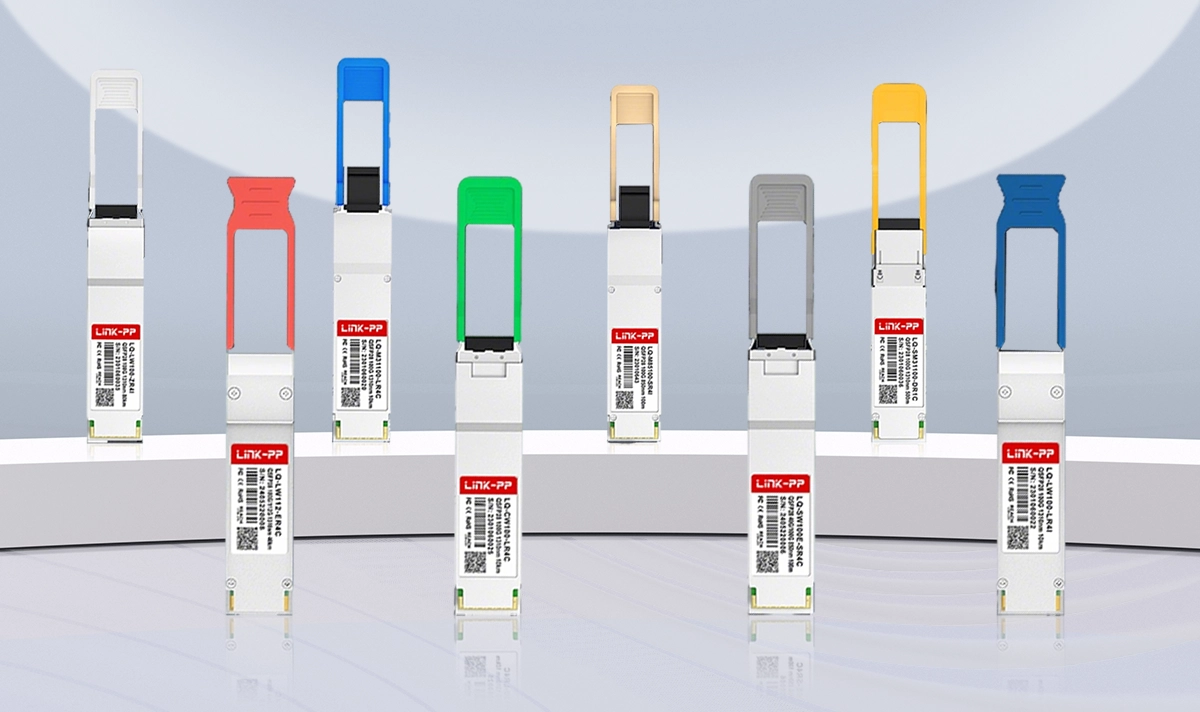
An optical network is only as good as its components. While the spine and leaf switches are the brains of the operation, optical transceivers are the vital eyes and mouths—converting electrical signals from the switch into light pulses for the fiber, and vice-versa.
In a spine-leaf architecture, the demand for high-density, reliable, and power-efficient transceivers is immense. Each connection from a leaf to a spine requires a transceiver at each end.
Key transceiver considerations for spine-leaf include:
Form Factor: High-density form factors like QSFP28, QSFP-DD, and OSFP are essential to fit the maximum number of ports on a leaf or spine switch.
Speed and Reach: Transceivers must match the link speed (e.g., 100G, 400G) and cover the required distance, from short-reach within a rack (SR4) to long-reach across a campus (LR4/ER4).
Power Consumption: With hundreds or thousands of transceivers in a single data center, lower power consumption translates to significant operational cost savings and improved thermal management.
Choosing the Right Transceiver for Your Deployment
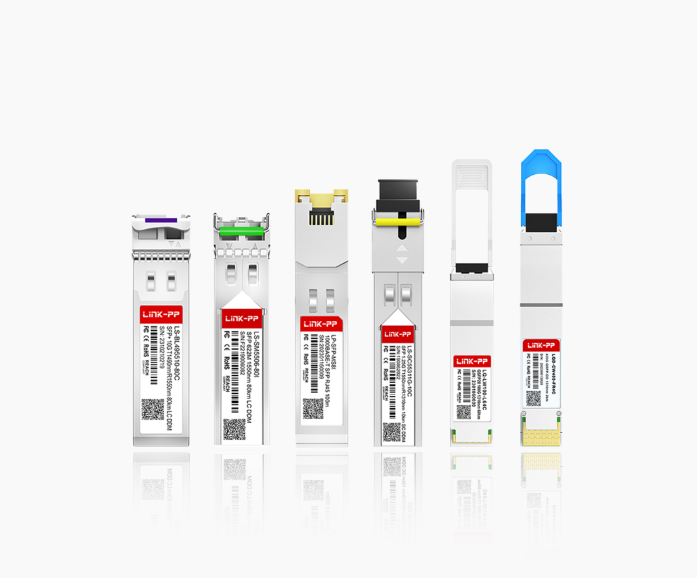
This is where partnering with a reliable manufacturer becomes critical. For instance, LINK-PP offers a range of high-performance, compliant optical transceivers engineered for demanding spine-leaf environments. A popular choice for 100G spine-leaf interconnects is the LINK-PP 100G QSFP28 LR4 transceiver.
This specific model is ideal for:
Connecting leaf and spine switches over single-mode fiber (SMF).
Achieving link distances of up to 10km, perfect for most data center and campus deployments.
Ensuring full interoperability with major networking hardware vendors.
Integrating quality components like the LINK-PP 100G QSFP28 ensures your spine-leaf fabric operates at peak efficiency, with minimal packet loss and maximum uptime. When planning your data center interconnect strategy, the choice of optical modules is a decision that directly impacts performance and total cost of ownership.
📜 Key Benefits and Challenges of Adopting Spine-Leaf
✅ Key Benefits:
Predictable Low Latency: Any communication requires a maximum of two hops (Leaf -> Spine -> Leaf), making performance consistent and reliable.
High Scalability: Need more capacity? Simply "scale-out" by adding another spine switch to the fabric. This is a cornerstone of efficient data center operations.
Enhanced Resilience: The multiple equal-cost paths provide built-in redundancy. The failure of a single link or spine switch is automatically routed around.
Optimized for East-West Traffic: Perfect for modern applications where servers communicate with each other more than with the outside world.
⚠️ Potential Challenges:
Increased Port Count: The "every-leaf-to-every-spine" requirement consumes a large number of switch ports, which can increase initial hardware costs.
Physical Cabling: Managing the large number of fiber optic cables requires careful planning and organization (often using structured cabling and fiber patch panels).
Design Complexity: While the concept is simple, designing and implementing an efficient IP fabric using protocols like BGP-EVPN can be more complex than traditional setups.
📜 Conclusion: Building the Future-Proof Data Center
Spine-leaf architecture is more than just a trend; it is the foundational blueprint for the modern, agile, and high-performance data center. By providing a scalable, low-latency fabric that perfectly complements the high-bandwidth capabilities of optical networks, it directly addresses the challenges of our data-driven era.
Successfully deploying this architecture hinges on a holistic approach—thoughtful design, robust switching hardware, and high-quality optical components. For organizations looking to build a resilient and future-proof network infrastructure, investing in a spine-leaf topology with reliable partners and components, such as LINK-PP's comprehensive range of optical transceivers, is a strategic imperative.
📜 FAQ
What makes spine-leaf architecture a future-proof data center design?
You can make your network better over time. Spine-leaf architecture lets you add new switches and devices. Your network stays fast and works well as you grow.
How does spine-leaf architecture improve data center connectivity?
Each leaf switch connects to every spine switch. This gives direct paths for data to travel. You do not get slowdowns, so your data center stays quick.
Do you need special infrastructure for spine-leaf architecture?
You need enough cables and ports for all connections. You must plan your setup to link leaf and spine switches. This helps your network work without problems.