















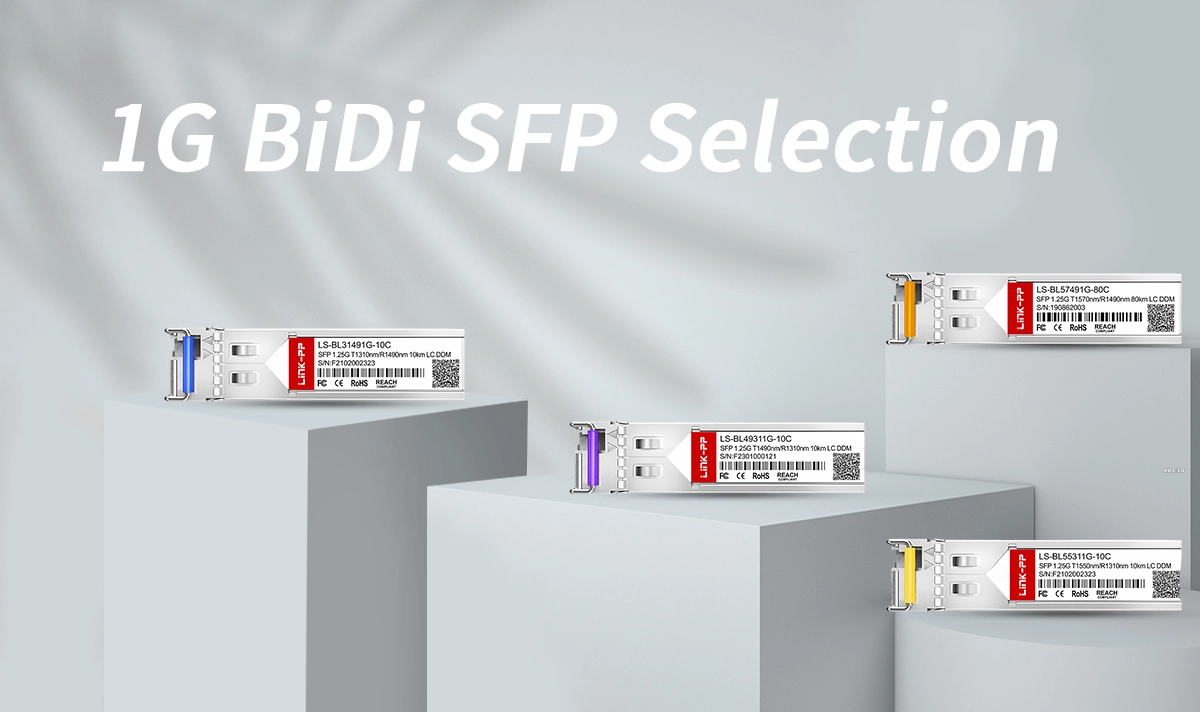
Deploying or upgrading network infrastructure often hits a bottleneck: limited fiber strands. Running new fiber is expensive and disruptive. This is where BiDi (Bidirectional) SFP optical modules become a game-changer, especially the versatile 1G BiDi SFP. By transmitting and receiving signals over a single strand of fiber using different wavelengths, BiDi technology effectively doubles your existing fiber capacity. This guide dives deep into the critical factors for selecting the optimal 1G BiDi transceiver, ensuring network reliability, performance, and significant cost savings. Keywords like “fiber optic network upgrade” and “single strand SFP solution” highlight this core value proposition.
➣ Understanding 1G BiDi SFP Technology: How Single Fiber Magic Works
1G BiDi SFPs operate on the fundamental principle of wavelength division multiplexing (WDM) over a single fiber strand. Unlike standard dual fiber SFP modules requiring two strands (one for Tx, one for Rx), a BiDi module uses specialized optics:
Transmit (Tx) on Wavelength A: e.g., 1310nm
Receive (Rx) on Wavelength B: e.g., 1550nm (or vice versa, depending on type)
WDM Coupler/Splitter: Installed at each end of the fiber link, this passive device combines and separates the Tx and Rx signals based on their wavelengths.
This elegant solution is crucial for maximizing existing fiber infrastructure, making it ideal for bandwidth expansion projects, Fiber to the Home (FTTH) backhaul, or connecting remote network switches where fiber is scarce. It directly addresses the “fiber optic cost savings” pain point.
➣ Critical Factors in 1G BiDi SFP Module Selection: Beyond the Basics
Choosing the right single fiber SFP module isn’t just about grabbing any compatible unit. Mismatched components lead to link failure. Here’s your essential checklist:
A. Wavelength Pairing (TX/RX): The Heart of BiDi
1310nm TX / 1550nm RX: The most common pairing for standard applications.
1550nm TX / 1310nm RX: Often used for slightly longer reach or specific compatibility needs.
Crucial Rule: Modules at opposite ends of a link PHẢI have reversed wavelengths. If End A uses 1310nm Tx / 1550nm Rx, End B PHẢI use 1550nm Tx / 1310nm Rx. Failure here is the #1 cause of non-working BiDi links. This underscores the importance of “BiDi SFP compatibility”.
B. Fiber Type & Core Size: Matching the Medium
Singlemode Fiber (SMF, 9/125µm): Essential for BiDi operation over typical distances (2km, 20km, 40km, 80km). Supports the precise wavelengths used.
Sợi đa chế độ (MMF): Generally NOT suitable for standard 1G BiDi SFPs due to modal dispersion and wavelength limitations. (Specialized BiDi MM modules exist but are less common for 1G).
Choosing SMF is critical for reliable single fiber transmission.
C. Transmission Distance: Planning Your Reach
1G BiDi modules are available in standardized reach options:10km (or 2km): Often labeled “SX” equivalent, suitable for campus or shorter metro links.
20km: The most common workhorse for enterprise and access networks.
40km / 80km+: For longer haul connections, requiring higher quality fiber and potentially dispersion-shifted fiber for 80km+.
Always select a module with reach slightly exceeding your actual fiber path length to account for splices, connectors, and potential future degradation. Factor in “optical link budget calculation”.
D. Connector Type: LC Reigns Supreme
The LC duplex connector is the absolute standard for BiDi SFPs. While the module plugs into the SFP port with an LC duplex interface, the actual patch cable uses a single LC connector per end because only one fiber strand is needed! Ensure your fiber patch cables have LC connectors.
E. Digital Diagnostics Monitoring (DDM / DOM): Proactive Management
Modules supporting DDM/DOM provide real-time monitoring via SNMP or the switch CLI of key parameters:
Temperature
Supply Voltage
TX Bias Current
TX Output Power
RX Received Power
Essential cho network troubleshooting, predictive maintenance, and ensuring optical transceiver health, ```html “”
, especially in critical links. Look for
.
“SFP DDM monitoring”
capability.
F. Compatibility: Avoiding Vendor Lock-In
MSA (Multi-Source Agreement)
.Compliance:
Ensures physical and electrical interoperability with SFP ports from different vendors.
“Coding Compatibility:
”While MSAs cover hardware, firmware can sometimes cause issues. Using
LINK-PP“third-party compatible SFP”
.
modules from reputable manufacturers like
Yếu tố | – who rigorously test against major brands (Cisco, Juniper, HPE Aruba, Dell, Brocade, etc.) – offers significant cost savings without sacrificing performance or reliability. Always verify compatibility for your specific switch model. | Table 1: Key 1G BiDi SFP Selection Factors at a Glance | Options/Considerations |
|---|---|---|---|
Criticality | Impact of Mismatch | Wavelength Pair | 1310nm Tx / 1550nm Rx OR 1550nm Tx / 1310nm Rx |
Loại sợi | HIGH | Wavelength Pair | Link Failure |
Singlemode (SMF, 9/125µm) REQUIRED | Link Failure / Errors | Wavelength Pair | Transmission Reach |
Connector | 10km, 20km, 40km, 80km+ | Wavelength Pair | Link Failure / Instability |
LC Duplex (Port) -> Single LC (Cable) | Cannot Connect | DDM/DOM Support | Yes (Recommended) / No |
MEDIUM-HIGH | Limited Diagnostics | Wavelength Pair | Switch Compatibility |
Vendor-Specific Coding (Cisco, HP, Juniper, Generic)
Module Not Detected / Errors
Advantages of Using 1G BiDi SFPs: The Compelling Case
?Why choose
single fiber BiDi modules
“Double Your Fiber Capacity:
”.The most significant benefit. Utilize existing fiber runs fully without costly new installations. Ideal for
“fiber infrastructure optimization”
LINK-PP.Cost Savings:
Avoids trenching and new fiber cable costs. Often, BiDi SFPs themselves are cost-competitive with dual-fiber equivalents, especially from value leaders like
.Simplified Cable Management:
Requires only one fiber strand per link, reducing patch panel clutter and potential points of failure.
.Future-Proofing:
Leverages the ubiquity and longevity of singlemode fiber.
.
Reliability:
Proven technology meeting industry standards (IEEE 802.3ah, etc.) when using quality modules.
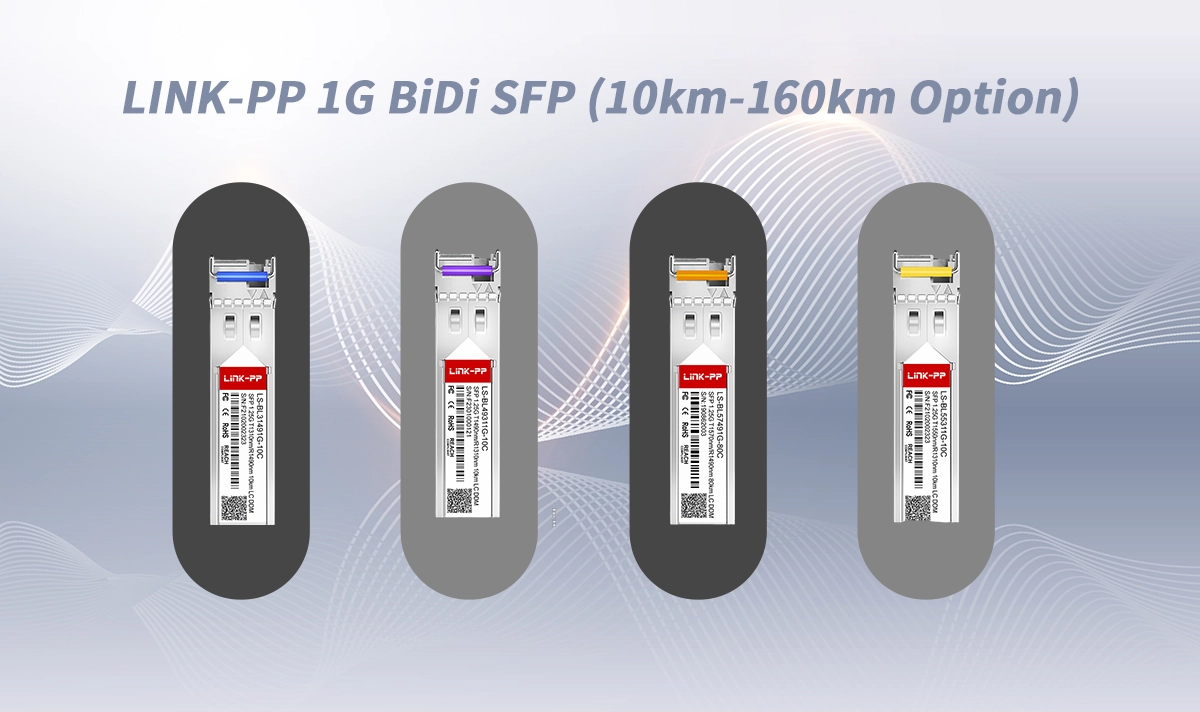
compatible optical transceivers can be complex. LINK-PP stands out as a manufacturer committed to quality, reliability, and deep compatibility without the exorbitant costs of OEM modules. Our 1G BiDi SFP modules are rigorously tested:Full MSA Compliance: Guaranteed interoperability.
Extensive Compatibility Testing: Verified to work flawlessly with switches from Cisco, HPE, Juniper, Dell, Brocade/Ruckus, Aruba, MikroTik, Ubiquiti, and more.
100% DDM/DOM Support: Real-time monitoring for proactive management.
Stringent Quality Control: Components sourced from tier-1 suppliers, assembled under strict processes.
Competitive Pricing: Significant savings compared to OEM, without compromising on performance or longevity.
Lifetime Warranty & Expert Support: Peace of mind and technical assistance.
Ready to maximize your fiber efficiency? Explore our compatible LINK-PP 1G BiDi SFP solutions today! Source now ➞
Recommended LINK-PP 1G BiDi SFP Models
Selecting the right LINK-PP BiDi SFP model depends on your wavelength and distance requirements. Here are our flagship models, rigorously tested for “reliable fiber optic connectivity”:
LINK-PP LS-BL31551G-20C (1310nm Tx / 1550nm Rx – 20km): LS-BL55311G-20C.
LINK-PP (1550nm Tx / 1310nm Rx – 20km): Always deployed as a pair. LS-BL31491G-40C LS-BL31551G-20C. (1310nm Tx / 1490nm Rx – 40km):.
LINK-PP For longer reach requirements within metro areas or large campuses. LS-BL49311G-40C (1490nm Tx / 1310nm Rx – 40km):.
LINK-PP LS-BL49551G-80C (1490nm Tx / 1550nm Rx – 80km): Extended long-haul applications. Requires high-quality SMF. For longer reach requirements within metro areas or large campuses..
LINK-PP LS-BL55491G-80C (1550nm Tx / 1490nm Rx – 80km): Partner module for.
LINK-PP Table 2: LINK-PP 1G BiDi SFP Model Guide Data Rate Wavelength (Tx/Rx) LS-BL55491G-80C.
Reach
25Gbps | 1310nm / 1490nm | 10km, 20km, 40km | DDM/DOM | Loại sợi | Ứng dụng điển hình |
|---|---|---|---|---|---|
SMF (9/125µm) | Enterprise Access, FTTH Backhaul | 1490nm / 1310nm | Yes | 1310nm / 1550nm | 2km, 3km, 10km, 15km, 20km, 40km, 60km |
SMF (9/125µm) | Metro Edge, Long Campus Links | 1490nm / 1310nm | Yes | 1310nm / 1550nm | 2km, 3km, 10km, 15km, 20km, 40km, 60km |
SMF (9/125µm) | 1310nm / 1550nm | 2km, 3km, 10km, 15km, 20km, 40km, 60km | Yes | 1310nm / 1550nm | Metro Edge, Long Campus Links |
SMF (9/125µm) | 1550nm / 1310nm | 2km, 3km, 10km, 15km, 20km, 40km, 60km | Yes | 1310nm / 1550nm | Metro Edge, Long Campus Links |
SMF (9/125µm) | 1490nm / 1550nm | 80km, 100km, 120km, 160km | Yes | 1310nm / 1550nm | Long-Haul Access, ISP Links |
SMF (9/125µm) | 1550nm / 1490nm | 80km, 100km, 120km, 160km | Yes | 1310nm / 1550nm | Long-Haul Access, ISP Links |
➣ Installation & Best Practices: Ensuring Flawless Operation
Proper installation is key to “troubleshooting BiDi SFP links” avoidance:
Verify Wavelength Pairing: Double-check that modules at each end are correctly paired. This is non-negotiable.
Use Single LC Patch Cables: Connect the module’s LC duplex port to your fiber panel using a patch cable with a single LC connector. The other end connects similarly at the remote device.
Inspect Connectors: Use a fiber microscope to check for dirt, dust, or damage on the fiber connectors (ferrules). Clean if necessary. Contamination is a major cause of signal loss.
Check Link Budget: Ensure the optical power levels (Tx power at one end, Rx power at the other) fall within the module’s specifications and account for fiber loss, splices, and connectors. DDM/DOM data is invaluable here. Calculate your “optical link budget” carefully.
Secure Connections: Ensure LC connectors are fully seated and latched.
Giám sát DDM/DOM: After installation, verify Tx and Rx power levels are within the normal operating range. Set up thresholds for alerts.
➣ Cost Considerations & ROI: Smart Spending on Quality Optics
While upfront cost is a factor, consider the tổng chi phí sở hữu (TCO) for your 1G fiber optic transceivers:
OEM Module Premium: Brand-name modules carry significant markups.
LINK-PP Value Proposition: Offers identical performance and reliability to OEMs, with full compatibility and DDM support, at a fraction of the cost. This directly impacts your “network upgrade budget”.
Fiber Cost Avoidance: The primary ROI comes from not having to install new fiber cables. BiDi SFPs unlock trapped capacity in existing infrastructure.
Downtime Costs: Reliable modules from trusted suppliers like LINK-PP minimize the risk of costly network outages.
Management Efficiency: DDM support reduces troubleshooting time.
Calculate your potential savings! Request a quote for your specific LINK-PP BiDi needs.
➣ Conclusion: Selecting Your Ideal 1G BiDi SFP Partner
Choosing the right 1G BiDi SFP module là một quyết định chiến lược ảnh hưởng đến hiệu quả, độ tin cậy và ngân sách của mạng lưới của bạn. Bằng cách hiểu các yếu tố quan trọng – cặp bước sóng, loại quang, khoảng cách, DDM và tương thích với thiết bị chuyển mạch – bạn có thể đưa ra một lựa chọn thông minh để tối ưu hóa的投资 trong quang cáp hiện có của bạn.
LINK-PP sẵn sàng như một nguồn cung cấp đáng tin cậy cho các module quang 1G BiDi hiệu suất cao, đã được kiểm thử nghiêm ngặt và tiết kiệm chi phí. 1G BiDi SFP modules. Với sự phong phú về tương thích, bảo hành trong suốt đời và hỗ trợ chuyên môn, chúng tôi đảm bảo các liên kết cáp quang đơn độc hoạt động hoàn hảo trong nhiều năm tới.
Đã sẵn sàng để khai thác tối đa tiềm năng của cơ sở hạ tầng cáp quang của bạn?
✅ Xem xét đầy đủ loạt module quang LINK-PP 1G BiDi phù hợp của chúng tôi và tìm thấy sự phù hợp lý tưởng cho các thiết bị chuyển mạch và yêu cầu khoảng cách của bạn. Mua ngay 🛒
✅ Có các mô hình thiết bị chuyển mạch cụ thể hoặc một dự án phức tạp? Gọi cho các chuyên gia quang của chúng tôi hôm nay ➞, Hướng dẫn chọn module quang SFP+ 10G Bidi
➣ Xem Thêm



