
















➤ What Is DDMI?
Definition
DDMI stands for Digital Diagnostic Monitoring Interface. It is a standardized interface—under the SFF-8472 agreement—that allows devices to read real-time health information directly from optical transceivers like SFP, SFP+, and QSFP modules.
Interface Mechanics
Using the I²C two-wire bus, DDMI communicates with the module’s microcontroller, which digitizes internal analog signals to present diagnostic data. The information is stored in specialized memory areas defined by SFF-8472 and accessible via specific I²C addresses (A2h for diagnostics).
➤ Why DDMI Matters
Proactive Fault Detection
With internal status metrics available at all times, network managers can identify early signs of failure—like overheating or signal drop—before they impact operations.Standardized Compatibility
Modules conforming to SFF-8472, such as LINK-PP’s DDM-enabled optical modules, ensure consistent diagnostics across varied platforms.Faster Troubleshooting
Accessing real-time DDMI data via CLI, SNMP, or NMS helps pinpoint faults quickly and replace problem modules without downtime.
➤ Key Parameters Monitored via DDMI
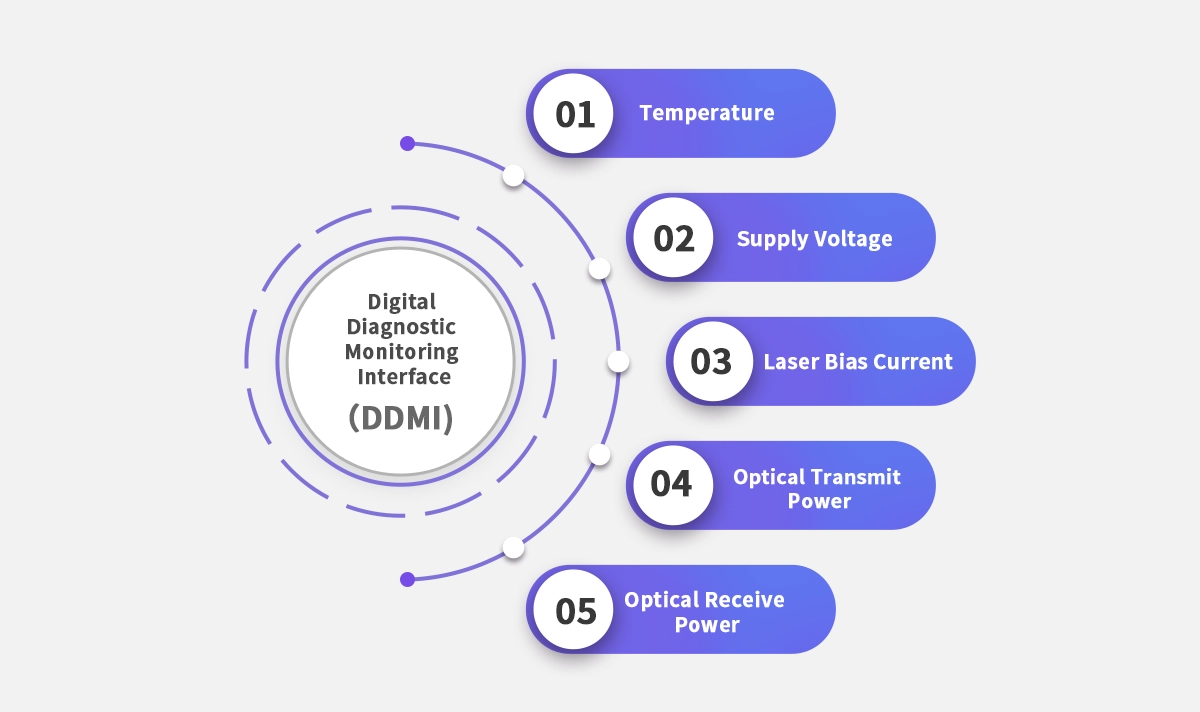
DDMI provides real-time measurements of several vital parameters:
Temperature – Tracks module operating temperature, crucial for avoiding heat-related failures.
Supply Voltage – Ensures the optical module receives stable power; deviations may indicate electrical issues.
Laser Bias Current – Monitors the current driving the laser diode, indicating aging or pending failure.
Transmit (TX) Optical Power – Checks that the output signal is within the optimal range for good link quality.
Receive (RX) Optical Power – Monitors incoming signal strength; helps detect fiber or alignment issues.
These real-time metrics allow proactive maintenance and consistency in network performance.
➤ How to Access DDMI Data
CLI Interfaces: Many switches and routers allow commands (e.g., “show interface transceiver”) to display DDMI readings.
SNMP/NMS-Integration: DDMI-Werte können für Trendanalysen oder Alarmkonfigurationen abgefragt und protokolliert werden.
Herstellersoftware: Einige Transceiver-Hersteller bieten Software-Tools, die Echtzeitdiagnosen anzeigen.
➤ DDMI in der Praxis: LINK-PPs LS-MM8532-S1C Modul
Ein herausragendes Beispiel für DDMI-Fähigkeiten im Portfolio von LINK-PP ist das LS-MM8532-S1C — ein 32 Gb/s (SFP28) 850 nm Transceiver mit 100 m Reichweite über MMF und vollständiger DDMI-Unterstützung. Es integriert einen VCSEL-Sender, einen PIN-Photodioden mit TIA und eine MCU, um Echtzeitdiagnosen in realen Anwendungen zu ermöglichen.
Dieses Modul zeigt, dass auch bei hohen Geschwindigkeiten (32 Gb/s) durch standardisierte Schnittstellen eine zuverlässige Diagnosemöglichkeit erreichbar ist—was es ideal für Rechenzentren und moderne Netzwerkeinrichtungen macht.
➤ Vorteile von DDMI-fähigen Modulen
Frühwarnsystem: Trends wie steigende Temperaturen oder fallende TX-Leistung können Wartungsmaßnahmen ankündigen.
Standardisierung: Konsistenter Zugriff auf Module—auch von verschiedenen Herstellern—vereinfacht das Asset-Management.
Reduzierte Ausfallzeiten: Defekte Module werden schnell identifiziert und ersetzt, was die Netzwerkresilienz erhöht.
Scalability: Von kleinen Aufbauten bis hin zu großen Netzwerken skaliert zentrale DDMI-Überwachung nahtlos.



