

In the high-stakes world of data centers and high-performance networks, selecting the right 100G optical transceiver is a critical decision that impacts performance, scalability, and total cost of ownership. The landscape is dominated by three key QSFP28 form factor contenders: 100G LR4, CWDM4, and PSM4. Understanding their core differences is essential for network architects and engineers.
This guide will dissect these three prevalent 100G optical standards, helping you make an informed choice for your specific infrastructure needs, whether for data center interconnect (DCI), spine-leaf architecture, or high-capacity enterprise backbones.
➤ Key Takeaways
Choose 100G LR4 for long-distance connections up to 10km. It is ideal for linking data centers across campuses or cities.
Select 100G CWDM4 for medium-range links up to 2km. It balances cost and performance, making it suitable for connections within large buildings.
Opt for 100G PSM4 for short links up to 500 meters. It is budget-friendly and perfect for connecting devices within the same rack or row.
Consider your distance, budget, cabling type, and application needs when selecting a transceiver. This ensures you choose the best fit for your network.
Use the decision guide in the blog to simplify your choice. It helps you match your network requirements to the right 100G transceiver.
➤ Chapter 1: The Core Technologies Explained
1. 100G LR4 (Long Reach 4)
100G LR4 transceiver is defined by the IEEE 802.3ba standard. It uses Wavelength Division Multiplexing (WDM) to combine four wavelengths (around 1310nm) onto a single strand of standard single-mode fiber (SMF), achieving reaches up to 10km. It’s a mature, highly interoperable solution often seen in campus networks and longer-reach DCI applications.
2. 100G CWDM4 (Coarse Wavelength Division Multiplexing 4)
The CWDM4 MSA (Multi-Source Agreement) specification also employs WDM technology but uses four CWDM wavelengths in the 1271-1331nm range. Its primary target is 2km reach over duplex (two-fiber) single-mode fiber. CWDM4 optics have become the de facto standard for cost-effective, intermediate-reach connections within and between data centers, offering a compelling balance of performance and price.
3. 100G PSM4 (Parallel Single-Mode 4)
Defined by the PSM4 MSA, this technology takes a different approach. It uses parallel optics, transmitting and receiving over four lanes (fibers) in each direction across an 8-fiber single-mode ribbon cable or an MTP/MPO connector. Designed specifically for 500m to 2 km reaches, PSM4 modules are favored for high-density, structured cabling environments like intra-data center links.
➤ Chapter 2: Head-to-Head Comparison
The table below summarizes the key technical and operational distinctions:
Feature | 100G LR4 Transceiver (IEEE) | 100G CWDM4 Transceiver (MSA) | 100G PSM4 Transceiver (MSA) |
|---|---|---|---|
Reach | Up to 10km | Up to 2km | Up to 2km (typically 500m) |
Wavelength | 4 LAN WDM (~1310nm) | 4 CWDM (1271-1331nm) | 4x Single Wavelength (e.g., 1310nm) |
Fiber Type | Duplex Single-Mode Fiber (SMF) | Duplex Single-Mode Fiber (SMF) | 8-fiber SMF Ribbon (MTP/MPO) |
Fiber Count | 2 Fibers (Tx/Rx) | 2 Fibers (Tx/Rx) | 8 Fibers (4 Tx, 4 Rx) |
Key Advantage | Standardized, Long Reach | Cost-effective for 2km, Duplex Fiber | Lower module cost, consistent power |
Primary Use Case | Campus/Enterprise, Long DCI | Data Center Interconnect (≤2km) | Intra-DC, Pre-terminated Ribbon Links |
Relative Cost | Higher | Moderate | Lower (Module), Higher (Cabling) |
➤ Chapter 3: Making the Right Choice for Your Application
Your choice hinges on distance, fiber infrastructure, and budget.
Choose 100G LR4 when you require a proven, standardized solution for reaches up to 10km and are connecting across campuses or between more distant facilities. It’s ideal for long-haul data center interconnects where duplex fiber is already deployed.
Choose 100G CWDM4 for the majority of 2km data center interconnect scenarios. It provides the best balance, using simple duplex LC fiber, offering strong vendor interoperability, and being more affordable than LR4 for this distance. It's a top choice for cost-effective high-speed networking.
Choose 100G PSM4 when operating in a high-density data center with a structured, parallel fiber plant (MTP/MPO trunks). It shines for top-of-rack (ToR) to spine or intra-cluster connections under 500m, where the lower transceiver cost can offset the initial cabling investment.
➤ Chapter 4: Spotlight on Optical Transceiver Modules
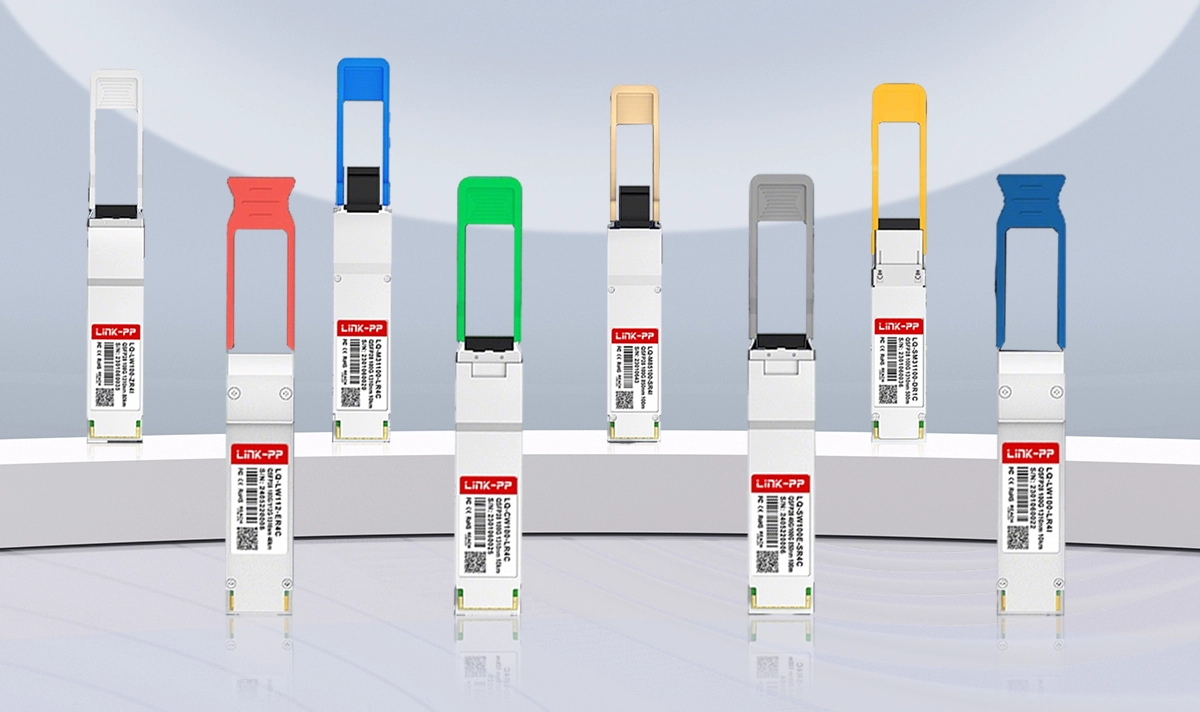
At the heart of any 100G link is the QSFP28 optical transceiver module. These hot-pluggable modules are not mere commodities; their quality, performance consistency, and compatibility are paramount for network reliability. When sourcing modules, consider factors like power consumption, temperature range (commercial vs. industrial), and digital diagnostics monitoring (DDM/DOM) capabilities.
For engineers seeking reliable, high-performance solutions, LINK-PP offers a comprehensive portfolio of 100G QSFP28 transceivers designed to meet rigorous demands. A prime example is the LINK-PP QSFP28-100G-CWDM4 module, which fully complies with the CWDM4 MSA, ensuring seamless interoperability for 2km links while providing robust monitoring features for network visibility. Similarly, for parallel optics applications, the LINK-PP QSFP28-100G-PSM4 delivers stable performance for data center backbone connections, making it a smart choice for scalable data center infrastructure.
Pro Tip: Always verify module compatibility with your specific switch or router brand. Reputable manufacturers like LINK-PP ensure broad compatibility and provide technical support, which is crucial for minimizing deployment risk and optimizing network performance tuning.
➤ Conclusion
There is no one-size-fits-all answer in the 100G LR4 vs CWDM4 vs PSM4 debate.
LR4 remains the go-to for longer-reach standard-based connectivity.
CWDM4 has won the market for 2km DCI due to its cost and duplex fiber efficiency.
PSM4 is the specialist for high-density, short-reach parallel fiber environments.
Your decision should be driven by a clear assessment of distance requirements, existing fiber plant, total infrastructure cost, and future scalability needs. By aligning the technology to the application, you can build a faster, more efficient, and cost-optimized network ready for tomorrow's challenges.
Looking for expert advice on your 100G deployment? Explore the technical specifications and compatibility guides for high-quality solutions like those from LINK-PP to ensure your optical foundation is robust and reliable.
➤ FAQ
What is the main difference between LR4, CWDM4, and PSM4 in data centers?
LR4 works for long-distance connections in data centers. CWDM4 is good for medium distances. PSM4 is best for short links. Each type helps you set up a flexible data center for different needs.
Can I use PSM4 for inter-data center connections?
You should not use PSM4 for connecting data centers. PSM4 only supports short distances. LR4 or CWDM4 are better for links between data centers because they work over longer distances.
Why do data centers often choose CWDM4 for data center applications?
Many data centers pick CWDM4 because it saves money and covers medium distances. CWDM4 modules work up to 2 km, which fits most data center needs. You also use less energy and cabling is easier.
How do I select the right transceiver for data center interconnections?
Check your link distance, cabling, and budget before you choose. LR4 is best for long links in data centers. CWDM4 is good for medium links. PSM4 is best for short links. Match your choice to what your data center needs.
Is LR4 the best choice for long-distance data center interconnect?
Yes, LR4 is the best for long-distance connections between data centers. LR4 modules work up to 10 km. This makes them great for connecting data centers in different cities or across a campus.
Tip: Always look at your network needs before picking a transceiver for your data center.