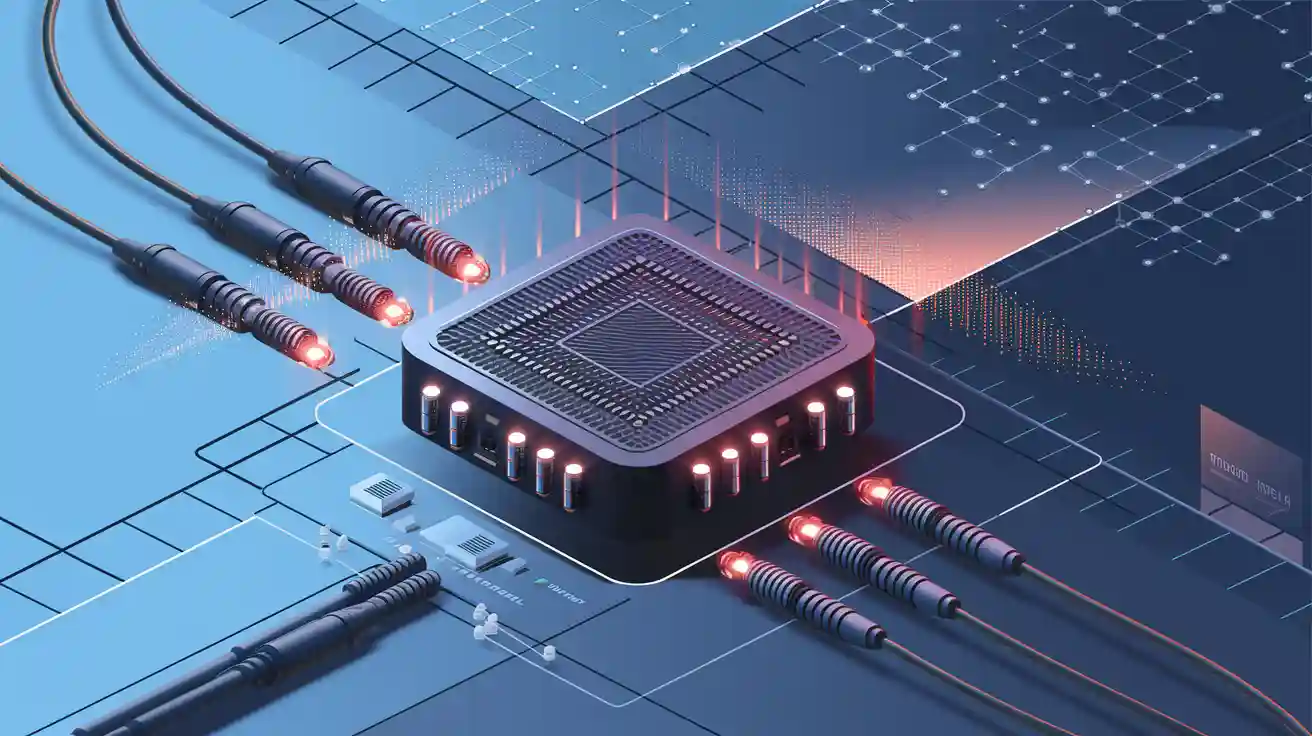

A Middle-of-Rack (MoR) switch is a data center access-layer switch installed in the middle section of a server rack, positioned strategically to provide balanced cabling distances for all servers. The MoR architecture offers a compromise between the simplicity of Top-of-Rack (ToR) and the centralized management of End-of-Row (EoR), making it suitable for medium and enterprise-sized data centers.
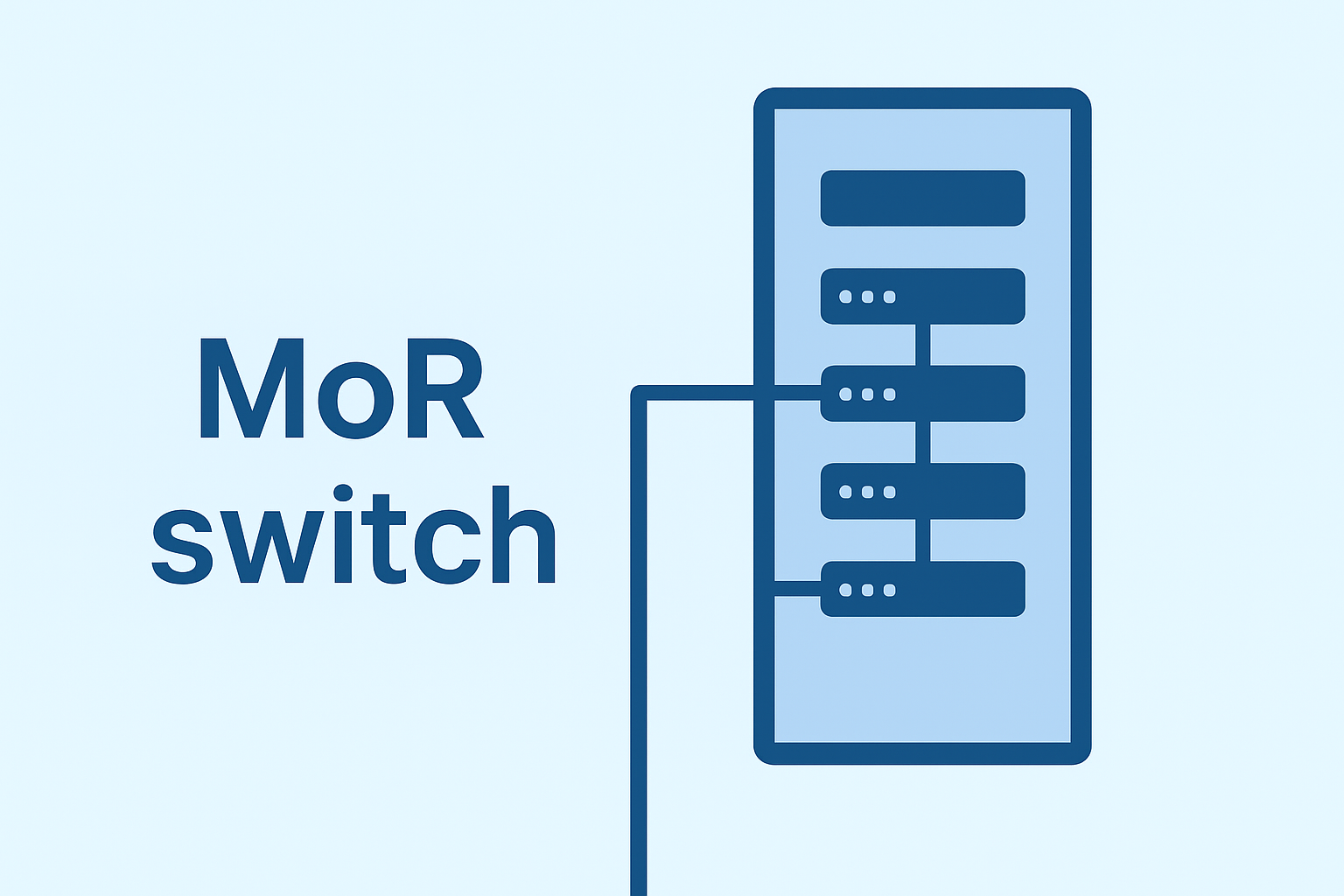
▶ What Is a MoR Switch?
A MoR switch (Middle-of-Rack switch) is an Ethernet switch placed around the center U positions of a server cabinet. Its purpose is to aggregate traffic from all servers in that rack and uplink to aggregation or spine switches. By placing the switch in the middle of the rack, cable lengths become more uniform, improving aesthetics and reducing stress on connectors.
MoR is commonly deployed with 10G, 25G, or 50G downlinks and 40G/100G/200G uplinks, depending on workload and data center generation.
▶ How Middle-of-Rack (MoR) Architecture Works
Balanced Cabling for Large or Mixed-Height Racks
Unlike the ToR model—where the switch sits at the very top—MoR reduces extreme cable length variations. This is especially valuable in:
High-density racks (42U / 48U)
Mixed server heights (1U, 2U, 4U)
Environments requiring neat, symmetric cable management
Simplified Maintenance and Airflow
MoR switches can be placed in thermally favorable rack zones, minimizing the impact on airflow patterns. Technicians can also access the switch more easily from the front or rear of the rack.
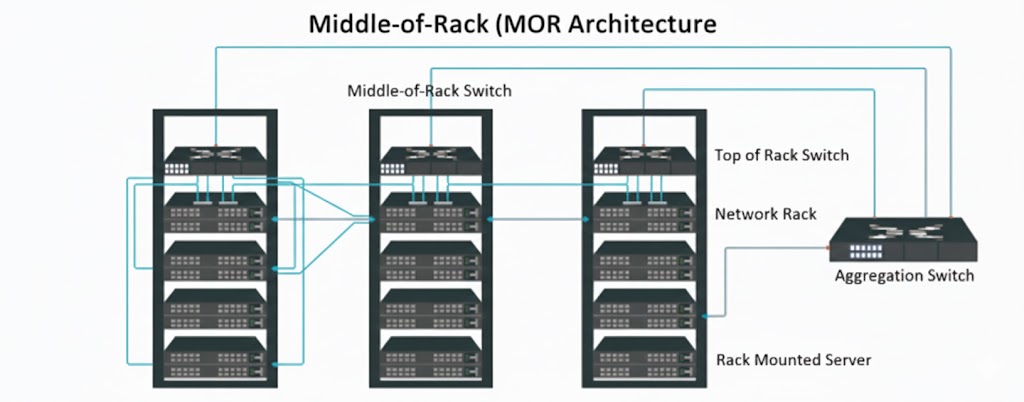
▶ MoR vs ToR vs EoR: Key Differences
Category | MoR | EoR | |
|---|---|---|---|
Switch Location | Middle of rack | Top of rack | End of aisle |
Cabling | Uniform | Short | Long |
Pros | Balanced layout; good airflow; neat | Easy cable routing; modular | Centralized management; fewer switches |
Cons | More cables than ToR; distributed switches | More switches required; cost increases | Heavy cabling; more complex routing |
When to Choose MoR Over ToR or EoR
Choose MoR when:
You have tall server cabinets and want symmetrical cable lengths
You require cleaner cable management
ToR switches are difficult to position due to power/airflow constraints
You want fewer cables per server than EoR but fewer switches than ToR
Choose ToR when you want the simplest cabling and maximum modularity.
Choose EoR when you need centralized switch management and minimal device count.
▶ Optical Transceivers Used in MoR Switches
MoR switches typically support the same transceiver types as ToR switches, depending on port speed. The most common module types include:
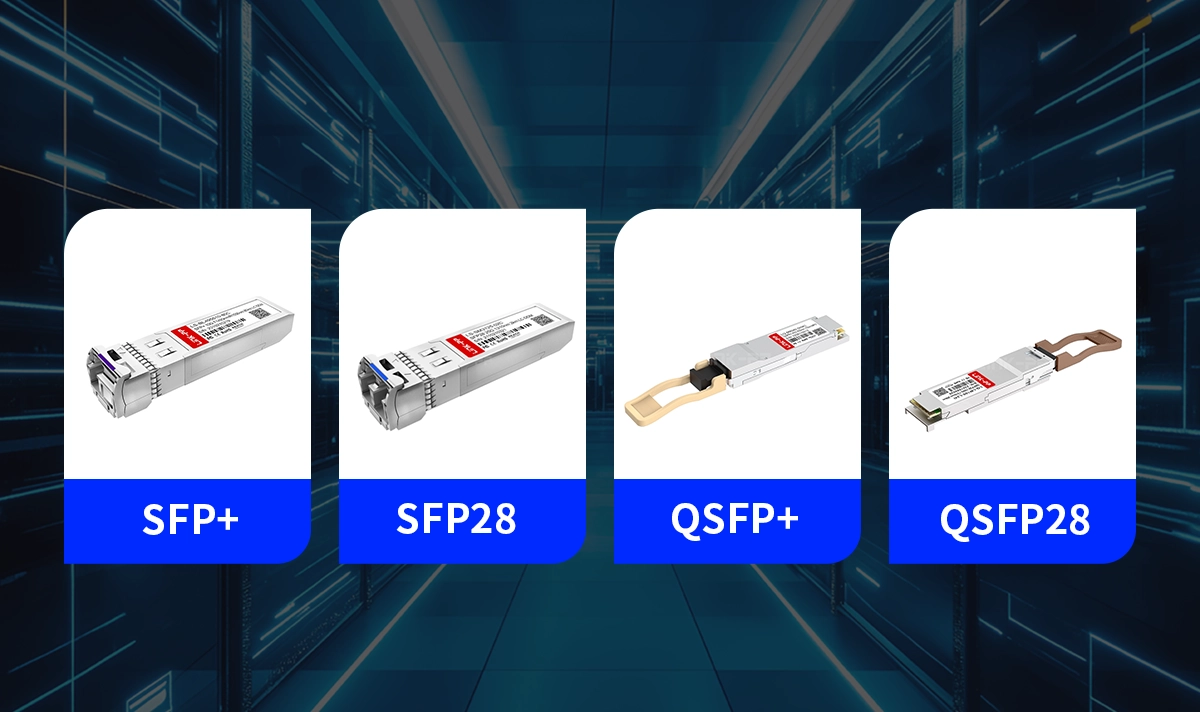
Downlink Modules (Server-to-MoR)
Used for server NIC connections:
These modules connect directly to server network cards using short-range fiber or DAC/AOC cables.
Uplink Modules (MoR-to-aggregation)
Used for uplink to leaf/spine switches:
QSFP+ 40GBASE-SR4/LR4
QSFP28 100GBASE-SR4/LR4/CWDM4
QSFP-DD 200G / 400G modules in upgraded environments
For enterprises and medium data centers, 40G and 100G uplinks are the most common.
H3: LINK-PP Compatible Modules for MoR Deployments
LINK-PP offers a full range of SFP/SFP+/SFP28/QSFP+ optical transceivers compatible with major switch vendors.
Practical note: Ensure module and switch vendor compatibility (or use proven OEM-compatible modules) and verify port backward compatibility—SFP28 ports accept SFP+ modules for slower speeds, which eases migration.
▶ Advantages of MoR Switching Architecture
1. Consistent Cabling Lengths
Reduces tension and bending on fiber/copper cables.
2. Balanced Rack Layout
Ensures a clean, organized environment, ideal for enterprise data centers.
3. Easier Troubleshooting
Technicians can access the switch without climbing or removing upper equipment.
4. Suitable for Mixed Workloads
Supports racks containing compute, storage, and GPU servers of varying heights.
▶ Disadvantages of MoR Architecture
1. More Switches Than EoR
Still requires one switch per rack (like ToR), though located differently.
2. Potentially Higher Cost Compared to EoR
EoR offers the lowest switch count overall.
3. Cabling More Complex Than ToR
Although balanced, MoR still has more total cable runs than ToR.
▶ Best Practices for Deploying MoR Switches
Use Uniform Cable Lengths
Standardize lengths to maintain rack cleanliness.
Place Switches in Thermal Neutral Zones
Usually mid-rack positions around 20–25U.
Choose Transceivers Based on Distance
Under 30 m: DAC/AOC
1–100 m: SR modules
500 m – 10 km: LR/CWDM modules
Validate Vendor Compatibility
Use compatible modules like LINK-PP transceivers for consistent performance.
▶ FAQ
● What is an MoR (Middle-of-Rack) architecture?
MoR refers to a data center network design where the switch is placed in the middle of the rack. This layout shortens cable runs for both upper and lower server positions, improves cable organization, and balances airflow within the rack.
● How is MoR different from ToR and EoR?
ToR (Top-of-Rack): Switch installed at the top of the rack; simplest cabling, most widely used.
MoR (Middle-of-Rack): Switch installed mid-rack; ideal for racks with servers mounted on both upper and lower sections.
EoR (End-of-Row): Switches placed at the end of a row; offers centralized management but requires longer cable runs.
MoR provides a balance between ToR’s simplicity and EoR’s centralized aggregation.
● What optical transceivers are commonly used in MoR deployments?
MoR is typically used for short-distance intra-rack connections. Common optics and cables include:
Short-reach optical transceivers and cables:
SFP28 25G SR (MMF) — ideal for 1–100 m cabling
QSFP28 100G SR4 (MMF) — popular for 100G uplinks
AOC (Active Optical Cable) — flexible, cost-effective for multi-meter links
DAC (Direct Attach Copper) — lowest-cost option for 1–3 m
ACC (Active Copper Cable) — extended-distance alternative to DAC
For rack-to-rack uplinks (MoR ↔ Aggregation):
QSFP28 100G LR4
QSFP56 200G / QSFP-DD 400G modules
QSFP+ 40G SR4/LR4
● Which types of data centers benefit from MoR?
High-density server environments
Colocation facilities with strict cable-management standards
Data centers with dual-sided patch panels
Cloud or telco environments prioritizing airflow balance and symmetrical cabling
▶ Conclusion
The Middle-of-Rack (MoR) switching architecture is a versatile and efficient choice for enterprise and medium-scale data centers. It offers balanced cabling, improved airflow, and easier maintenance while supporting modern high-speed optical transceivers for scalable network growth. With the right switch placement strategy and properly selected optical modules—such as SFP+, SFP28, and QSFP + modules from LINK-PP—MoR can deliver reliable, high-performance connectivity for diverse workloads.