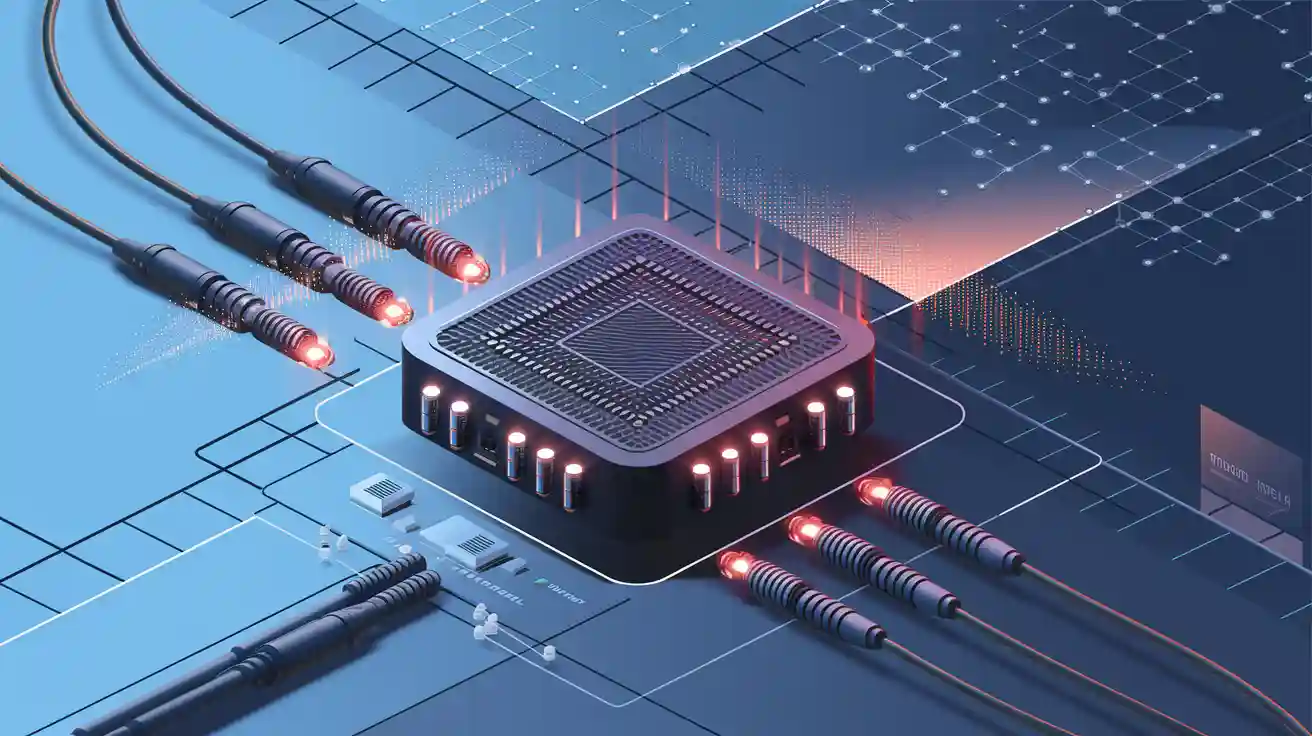


In the high-speed world of modern telecommunications and data centers, light is the undisputed king of data transmission. But just like any sophisticated highway system, managing the flow of this light is critical. This is where the often-unsung hero of optical networking comes into play: the wavelength converter.
This guide will demystify wavelength converters, explaining their function, core technologies, and why they are indispensable for building scalable and efficient networks. We'll also explore their direct connection to the optical transceivers in your network equipment.
➤ Key Takeaways
Wavelength converters help change light quickly. They switch things like wavelength, frequency, and photon energy. This makes technology work better and faster.
New features let converters work in real time. They also connect smartly with other devices. This helps them be more accurate and work together easily.
These converters give fast results and make fewer mistakes. They are trusted in labs and for daily use.
People use them in telecommunications and data centers. They help control signals and move data quickly and safely.
In the future, AI will help make converters smarter. They will also get smaller and do more things.
➤ What is a Wavelength Converter? Simply Put
Imagine you speak only English, and you need to send a message to someone who only understands French. You'd need a translator. A wavelength converter performs a similar role in an optical network.
A wavelength converter is a device that transforms an incoming optical signal from one wavelength to another without converting it back to an electrical signal (all-optical) or with minimal electrical intervention (opto-electronic).
In technical terms, it changes the color of the light carrying the data. This is crucial because Dense Wavelength Division Multiplexing (DWDM) technology allows multiple colors (wavelengths) of light to travel simultaneously over a single optical fiber, dramatically increasing its capacity.
➤ Why Do We Need to Convert Wavelengths? The Key Drivers
You might wonder, why not just use the same wavelength everywhere? The reasons are rooted in network efficiency, management, and cost. Here are the primary applications:
🚀 Eliminating Wavelength Blocking: In complex DWDM networks, the same wavelength cannot be reused on the same path until it has been "stopped." A converter allows a signal to be shifted to an available wavelength, preventing traffic jams and maximizing fiber utilization.
🔄 Network Interoperability & Upgrades: Different parts of a network or equipment from different vendors may operate on standard but incompatible wavelengths (e.g., 1310nm for client-side and 1550nm for line-side). A converter seamlessly bridges this gap, facilitating smooth wavelength conversion in optical networks.
💰 Cost-Effective Network Expansion: Instead of deploying new fiber, which is incredibly expensive, network operators can use converters to add more channels to their existing fiber plant. This is a cornerstone of scalable fiber optic network design.
📈 Signal Regeneration: Some advanced wavelength converters also clean up and amplify the optical signal, extending its reach over longer distances without degradation.
The table below summarizes the core benefits:
Benefit | Description | Impact |
|---|---|---|
Enhanced Capacity | Enables efficient use of DWDM by freeing up and reusing wavelengths. | Higher ROI on existing fiber infrastructure. |
Improved Flexibility | Allows interconnection between different network layers and equipment. | Simplified network design and vendor agnosticism. |
Extended Reach | Can incorporate signal re-shaping and amplification. | Reduces the need for additional line equipment. |
➤ How Does a Wavelength Converter Work? A Look at the Technologies
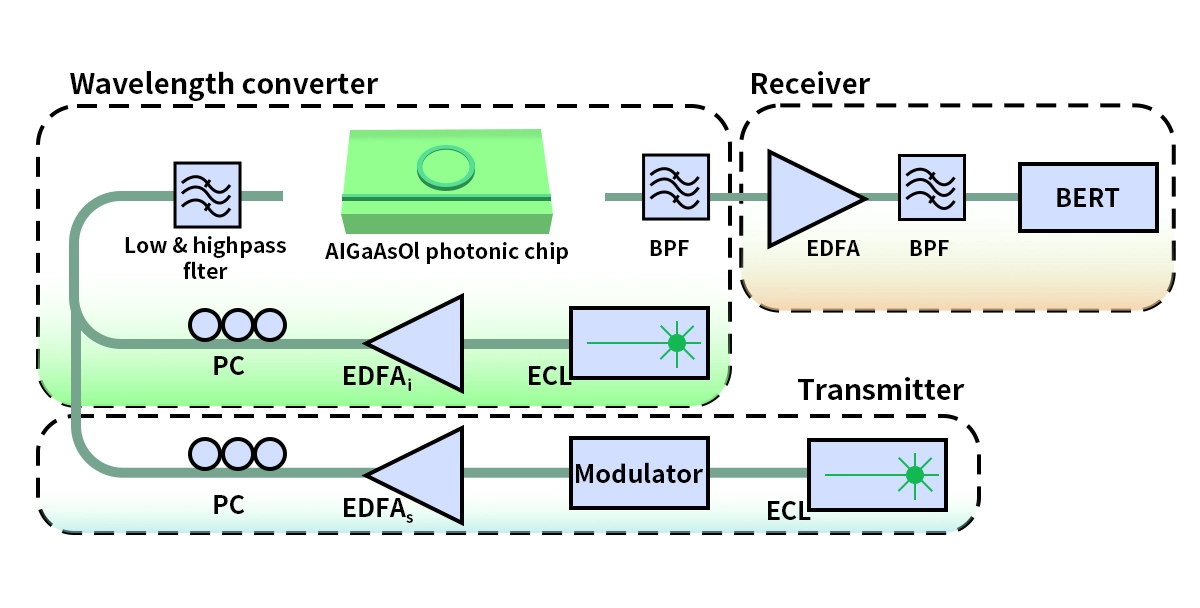
There are two primary methods for converting wavelengths, each with its own advantages.
1. O-E-O (Optical-Electrical-Optical) Conversion
This is the most common and mature technology. The process is straightforward:
O: The incoming optical signal is received.
E: The signal is converted into an electrical signal.
O: A new laser at the target wavelength is modulated by this electrical signal, creating a "clean", new optical signal.
Advantage: This method is highly reliable, protocol-transparent, and often includes 3R regeneration (Re-amplify, Reshape, Retime). For businesses seeking robust performance, a high-performance OEO wavelength converter is a dependable choice.
2. All-Optical Conversion
This more advanced technique keeps the signal in the optical domain throughout the process. It uses non-linear effects in materials like semiconductor optical amplifiers (SOAs) or optical fiber to directly transfer the data pattern from the input wavelength to a new output wavelength.
Advantage: Potentially lower power consumption and higher speeds, as it avoids electrical bottlenecks.
Disadvantage: More complex and can be less stable than O-E-O methods.
➤ The Heart of the Matter: Wavelength Converting Optical Modules
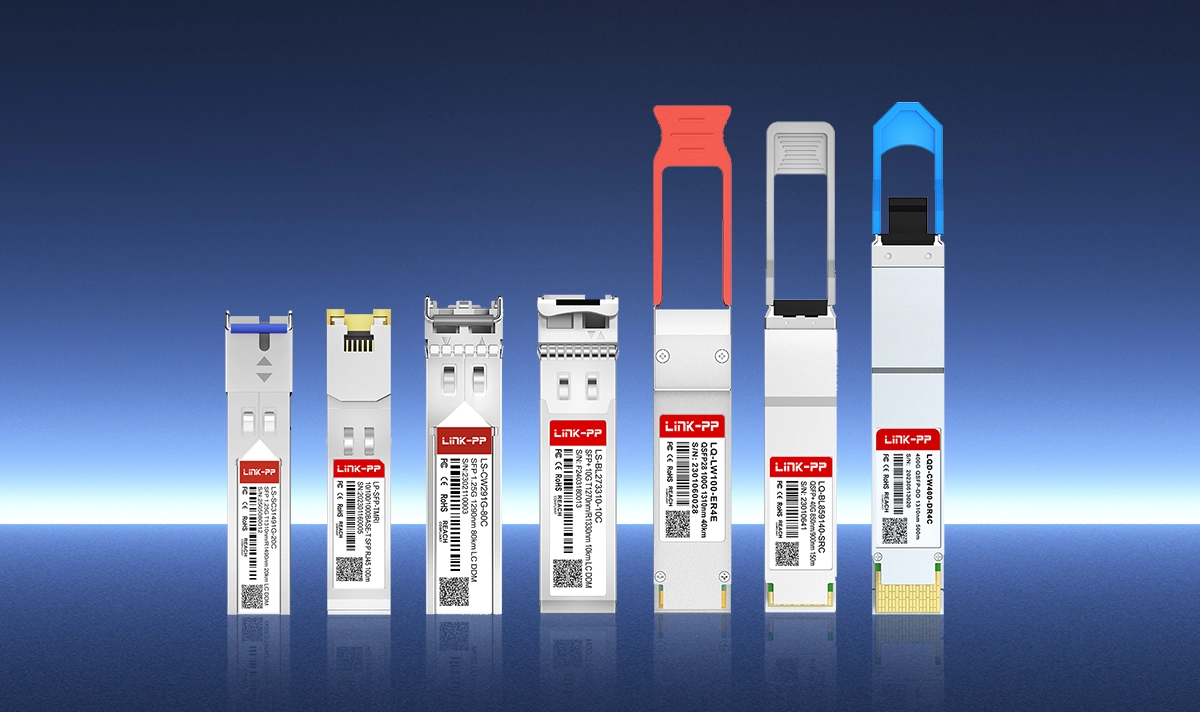
For many network engineers, the most tangible encounter with this technology is through optical transceivers. Modern pluggable modules are not just simple transmitter/receivers; many are now integrated wavelength conversion devices.
These advanced transceivers, such as DWDM SFP+ or QSFP28 modules, often have a fixed or tunable wavelength on their line side. They take a client-side signal (e.g., a standard 1310nm or 850nm signal from a switch) and directly convert it to a specific ITU-grid DWDM wavelength (e.g., 1550.12nm) for long-haul transmission. This integration simplifies the network architecture by eliminating the need for a separate, standalone converter box.
✅ Spotlight on LINK-PP Innovation
When looking for reliability in this integrated approach, LINK-PP's transceivers are engineered for precision and performance. A prime example is the LINK-PP QSFP-100G-LR4 module.
This module is a perfect illustration of wavelength conversion at work. It internally multiplexes four lanes of 25G data, each on a ~1310nm wavelength, and converts them for transmission as a single signal using four wavelengths around 1300nm over a single fiber for distances up to 10km. For more demanding DWDM applications, their 200G CFP2-DCO coherent module performs sophisticated signal processing and wavelength conversion, enabling transmission over hundreds of kilometers on a specific DWDM channel. Choosing a LINK-PP transceiver ensures your network benefits from seamless integration and carrier-grade quality.
➤ Conclusion: The Invisible Engine of Modern Connectivity
Wavelength converters are far more than a niche technical component. They are the invisible engine that provides the flexibility, scalability, and efficiency our global digital infrastructure relies on. By intelligently managing the spectrum of light, they prevent network congestion, enable seamless upgrades, and unlock the full potential of every strand of fiber.
As data rates continue to soar towards 800G and beyond, the role of sophisticated wavelength conversion, whether in standalone devices or within advanced optical modules from industry leaders like LINK-PP, will only become more central to building the fast, reliable, and agile networks of the future.
➤ FAQ
What does a wavelength converter do?
A wavelength converter changes light to a different wavelength. You can use it to find frequency, photon energy, or wavenumber. This helps you learn about light and control it in many devices.
What devices use wavelength converters?
You see wavelength converters in fiber optic networks and data centers. They are also in lasers and smart sensors. These devices help send data, measure light, and make technology better at home, school, or work.
What makes a wavelength converter different?
A 2025 wavelength converter gives you answers faster and with better accuracy. You can connect it to computers and other tools. New features let you measure more things about light.
What problems can a wavelength converter solve?
A wavelength converter helps fix signal mix-ups in networks. It helps measure light for science and makes devices work better. You can use it to make your technology faster and more reliable.