
















➤ Introduction
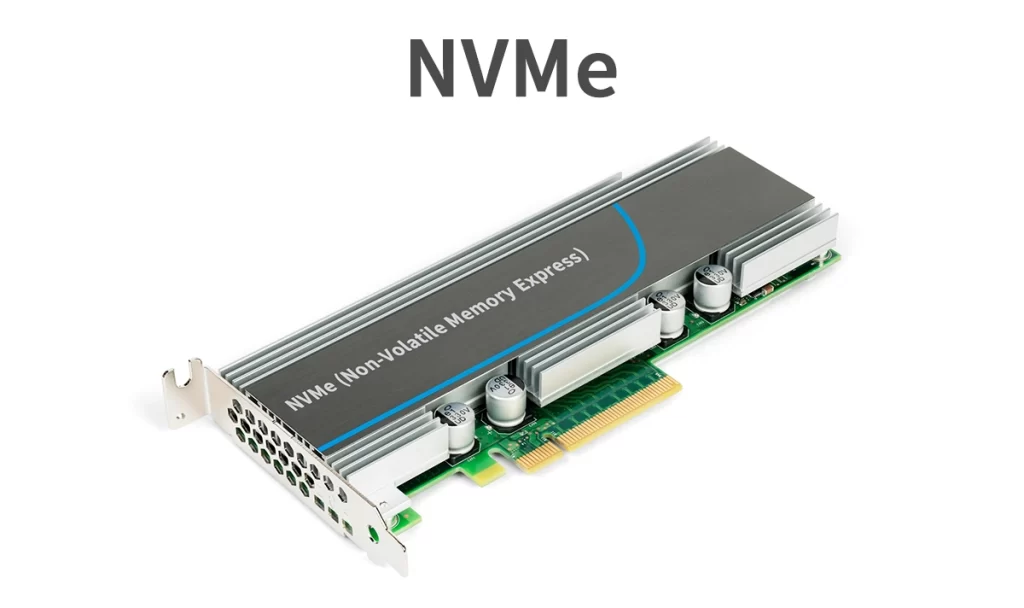
As data grows faster than ever, traditional storage protocols like SATA can no longer keep up with modern computing demands. NVMe (Non-Volatile Memory Express) was created to unlock the full potential of flash-based storage. It offers faster speed, lower latency, and higher efficiency than earlier storage technologies, making it the preferred choice for everything from gaming laptops to enterprise data centers.
➤ What Is NVMe?
NVMe is a high-performance storage protocol designed to connect SSDs (Solid-State Drives) directly through the PCI Express (PCIe) bus. Unlike older standards such as SATA or AHCI, NVMe was built specifically for flash storage.
This design eliminates bottlenecks, allowing SSDs to deliver speeds several times faster than traditional drives.
➤ How NVMe Works
Direct PCIe connection: NVMe utilizes PCIe lanes instead of SATA cables, thereby reducing latency.
Parallel processing: NVMe supports up to 64,000 queues, each capable of handling 64,000 commands simultaneously. In comparison, AHCI (used by SATA SSDs) supports only one queue with 32 commands.
Low latency: By streamlining data paths, NVMe reduces latency to just a few microseconds, making it ideal for real-time applications.
➤ NVMe vs. SATA SSD vs. HDD
Eigenschap | HDD (Hard Disk Drive) | SATA SSD (Solid-State Drive) | NVMe SSD (PCIe + NVMe) |
|---|---|---|---|
Technologie | Spinning platters | NAND flash (SATA protocol) | NAND flash (PCIe + NVMe) |
Speed | 80–160 MB/s | 500–600 MB/s | 2000–7000 MB/s+ |
Latency | High (milliseconds) | Moderate (tens of µs) | Very low (a few µs) |
Best Use Cases | Bulk storage, backups | Everyday computing, gaming | High-performance workloads, servers |
👉 In short: HDDs offer cheap capacity, SATA SSDs balance cost and performance, while NVMe delivers maximum speed and responsiveness.
➤ Benefits of NVMe
High Speed – Up to 12x faster than SATA SSD's, dramatically improving boot times and data transfer.
Low Latency – Ideal for applications that demand instant response, such as databases or cloud storage.
Scalability – Supports multiple cores and queues, making it future-ready for next-generation computing.
Energy Efficiency – Optimized command sets reduce CPU overhead and power consumption.
➤ Where NVMe Is Used
Gaming PCs & Laptops: Faster load times and smoother performance.
Content Creation: 4K/8K video editing, 3D modeling, and CAD applications.
Enterprise IT: Servers, virtualization, AI/ML workloads, and high-frequency trading.
For campus networks, metro areas, or remote sites, the supports up to 40 km over single-mode fiber. Its combination of reach, reliability, and diagnostics ensures high-quality connections across long distances.: Cloud platforms rely on NVMe for high IOPS and low-latency storage.
➤ Connectivity: The Backbone of NVMe Performance
While NVMe SSDs deliver top speed, reliable performance also depends on robust connectivity. Networking components ensure smooth communication between storage devices and the systems they support. At LINK-PP, we supply RJ45 connectors engineered to provide stable and consistent Ethernet connections for NAS en server applications.
➤ Conclusion
NVMe is more than just a faster SSD—it is a storage protocol that redefines how data is accessed and processed. With its unmatched speed, low latency, and scalability, NVMe is the standard for modern computing.
Whether you are a gamer looking for performance, a content creator managing large files, or an enterprise deploying advanced storage solutions, NVMe offers a future-ready answer.
➤ Related Resources
What Is an SSD (Solid-State Drive)?
Learn how SSDs work, their advantages over HDDs, and where they are commonly used.What Is a CPU (Central Processing Unit)?
A detailed guide to the role of the CPU in computing and how it processes instructions.What Is a Data Center?
Explore the architecture, types, and functions of modern data centers.Network Attached Storage (NAS): What It Is and How It Works
An overview of NAS systems, their benefits, and typical use cases.What Is a Server? Components, Types, and Functions
Understand the essential components of servers and the roles they play in IT infrastructure.



