

An SFP duplex LC connector is a fiber optic interface used in many small form-factor pluggable (SFP) optical transceivers to enable full-duplex optical communication. The connector integrates two LC (Lucent Connector) interfaces in a single compact housing, allowing one fiber to transmit optical signals (TX) and the other to receive them (RX). This dual-fiber design supports simultaneous bidirectional data transmission, which is the standard operating mode for most Ethernet and telecom optical links.
Duplex LC connectors are widely adopted in SFP, SFP+, and SFP28 optical modules because they offer several important advantages: compact size for high-density port layouts, precise fiber alignment through a 1.25 mm ceramic ferrule, and compatibility with both single-mode fiber (SMF) and multimode fiber (MMF) systems. As modern networks continue to increase port density in data centers and switching equipment, the LC form factor has become the dominant optical interface for many transceiver types, including 1G, 10G, and 25G Ethernet optics.
Understanding how SFP duplex LC connectors work is important for network engineers, system integrators, and infrastructure designers. Correct fiber polarity, proper connector handling, and a clear understanding of TX/RX signal paths all play a role in maintaining stable optical links. A solid grasp of these fundamentals helps ensure reliable deployment of optical transceivers in environments such as data centers, telecom transport networks, and enterprise backbone infrastructure.
By reading this article, you will learn:
• What an SFP duplex LC connector is and how it is structured
• How duplex LC connectors function inside optical transceivers
• The key differences between simplex and duplex fiber connectors
• Why most SFP optical modules use LC duplex interfaces
• Common deployment scenarios in data centers, telecom networks, and enterprise infrastructure
▶️ What Does Duplex LC Mean in Fiber Optics
In fiber optic networking, the term Duplex LC describes a connector configuration that combines the LC connector form factor with a dual-fiber communication architecture. It is one of the most widely used interfaces for optical transceivers because it supports reliable full-duplex data transmission, which is required for most Ethernet and telecom links.

To understand the meaning of Duplex LC, it is useful to examine the two components of the term separately: LC and duplex.
LC: Lucent Connector
LC stands for Lucent Connector, a small form factor fiber optic connector originally developed by Lucent Technologies and now standardized in many optical networking systems.
The LC connector is characterized by:
A 1.25 mm ceramic ferrule, which precisely aligns the fiber core
A compact footprint, roughly half the size of older SC connectors
A push-pull latch mechanism for secure insertion and easy removal
High reliability in high-density networking environments
Because of its compact size, the LC connector allows equipment manufacturers to place more optical ports on switches, routers, and servers. This density advantage is a key reason why LC connectors are widely used in SFP, SFP+, and SFP28 optical modules.
Duplex: Two Fibers Working as a Pair
In fiber optics, duplex refers to a configuration where two separate optical fibers are used together to support bidirectional communication.
In a duplex fiber link:
One fiber carries the transmit (TX) signal
The other fiber carries the receive (RX) signal
This arrangement enables simultaneous two-way communication, commonly called full-duplex transmission. Full-duplex operation is essential for Ethernet networking because devices must be able to send and receive data at the same time without collisions.
Two LC Connectors Joined Together
A duplex LC connector consists of two LC connectors joined together with a duplex clip, forming a single paired interface. Each connector terminates one optical fiber within a duplex patch cable.
In typical SFP transceiver connections:
The TX port of one device connects to the RX port of the opposite device
The RX port connects to the opposite TX port
This cross-connection ensures that transmitted optical signals from one device are correctly received by the other.
Because this architecture is simple, standardized, and highly reliable, duplex LC connectors have become the default optical interface for most 1G, 10G, and 25G Ethernet SFP transceivers used in modern fiber networks.
▶️ Structure of a Duplex LC Connector
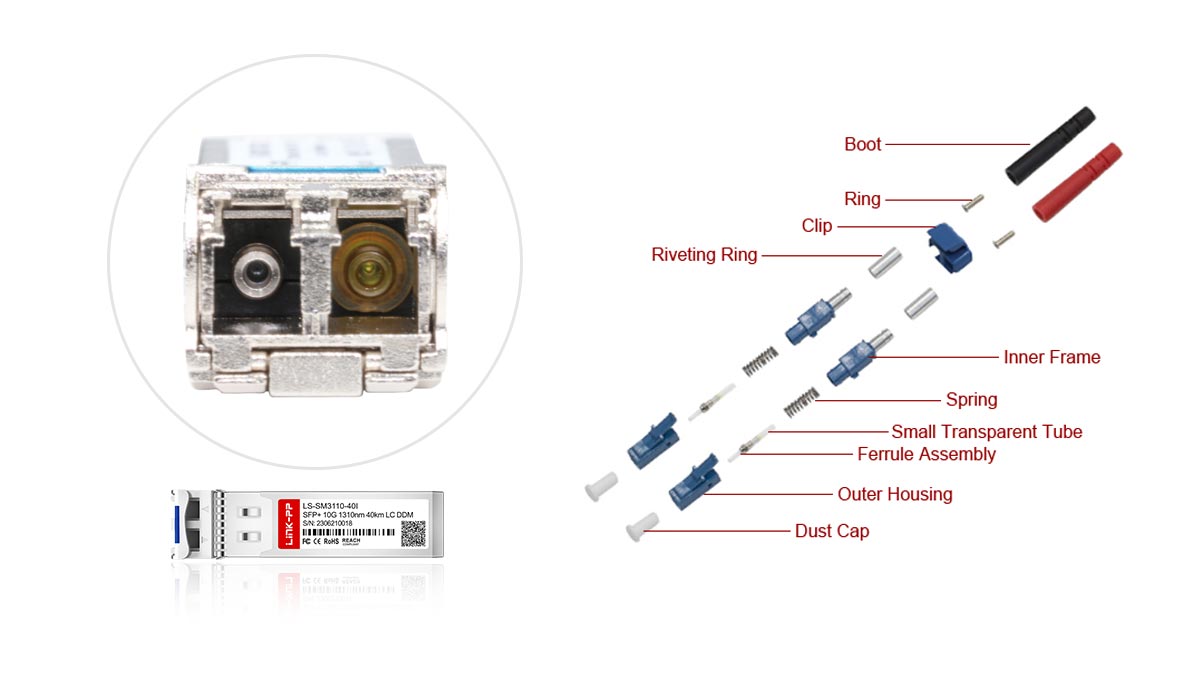
A duplex LC connector is constructed by combining two LC simplex connectors into a single paired interface using a duplex clip. This design allows two optical fibers to operate together—one for transmitting data and the other for receiving—while maintaining the compact footprint required in high-density networking equipment such as switches, routers, and optical transceivers.
The LC connector format is widely used in SFP, SFP+, and other small form-factor optical modules, where precise fiber alignment and reliable mechanical connection are critical for maintaining stable optical signal transmission.
Key Components of a Duplex LC Connector
A typical duplex LC connector assembly includes several important mechanical and optical elements:
• 1.25 mm Ceramic Ferrules
Each LC connector contains a precision 1.25 mm ceramic ferrule that holds and aligns the optical fiber. The ferrule ensures accurate positioning of the fiber core so that light can efficiently pass between two mated connectors with minimal insertion loss.
• Fiber Alignment Sleeve
Inside the adapter or transceiver receptacle, an alignment sleeve guides the two ferrules into precise alignment. This component helps maintain low optical loss and consistent signal coupling between the connected fibers.
• Plastic Housing with Latch Mechanism
The connector body is typically made from durable plastic and includes a push-pull latch mechanism. This latch securely locks the connector into the port while still allowing quick insertion and removal during installation or maintenance.
• Duplex Clip
A duplex clip holds two LC connectors together side-by-side, forming a duplex pair. This clip maintains proper spacing and orientation between the transmit and receive fibers, ensuring consistent polarity when used with duplex fiber patch cables.
Why This Structure Matters
The compact mechanical design of the duplex LC connector provides several advantages for optical networking:
High port density in switches and data center equipment
Reliable fiber alignment for stable optical performance
Easy installation and removal through the latch mechanism
Standardized compatibility with most SFP-based optical transceivers
Because of these structural characteristics, duplex LC connectors have become one of the most widely deployed fiber interfaces in modern Ethernet and telecom networks.
▶️ How Duplex LC Connectors Work in Optical Transceivers
In optical networking, duplex LC connectors enable full-duplex communication between devices by providing separate optical paths for transmitting and receiving data. Most 1G SFP, 10G SFP+, and 25G SFP28 Modules are designed with a duplex LC interface to support this two-fiber communication architecture.

Inside an optical transceiver, the duplex LC connector links the module to a duplex fiber patch cable, which contains two optical fibers. Each fiber performs a dedicated function:
TX Fiber → Transmits the optical signal from the transceiver to the remote device
RX Fiber → Receives the optical signal coming from the remote device
This separation of transmit and receive channels allows both devices to send and receive data simultaneously, enabling true full-duplex Ethernet communication.
Signal Path Between Two Optical Devices
When two devices—such as switches or routers—are connected using duplex LC fiber, the optical paths must be correctly crossed to establish communication. The transmit port of one device must connect to the receive port of the other.
The signal flow follows this pattern:
Device A (TX)  →  Device B (RX)
Device B (TX)  →  Device A (RX)
This cross-connection ensures that optical signals generated by one transceiver are delivered to the receiver of the opposite transceiver. In most deployments, duplex fiber patch cables are manufactured with the proper polarity so that this connection works automatically when both connectors are inserted.
Optical Transmission Inside the Transceiver
Within the SFP or SFP+ module itself, the optical signal conversion process occurs in two directions:
Electrical to Optical (Transmit Path)
Network data enters the transceiver as an electrical signal. A laser diode (such as a VCSEL for multimode optics or a DFB laser for single-mode optics) converts the electrical signal into modulated light, which is then launched into the TX fiber through the LC ferrule.
Optical to Electrical (Receive Path)
Incoming light from the remote device travels through the RX fiber into the transceiver, where a photodiode detects the optical signal and converts it back into an electrical signal for the network device.
Why Duplex LC Is Ideal for SFP Transceivers
The duplex LC interface is widely used in optical transceivers because it provides:
Compact connector size, enabling high port density on switches and routers
Reliable fiber alignment, ensuring stable optical coupling
Standardized compatibility with Ethernet fiber patch cables
Support for both single-mode and multimode optical modules
For these reasons, duplex LC connectors have become the standard interface for most 1G, 10G, and 25G SFP-based optical transceivers used in modern fiber networks.
▶️ Duplex LC vs. Simplex Fiber Connectors
In fiber optic connectivity, LC connectors can be configured as either duplex or simplex, depending on how many fibers are used for signal transmission. Understanding the difference between these two configurations is important when selecting optical transceivers and fiber patch cables for a network deployment.
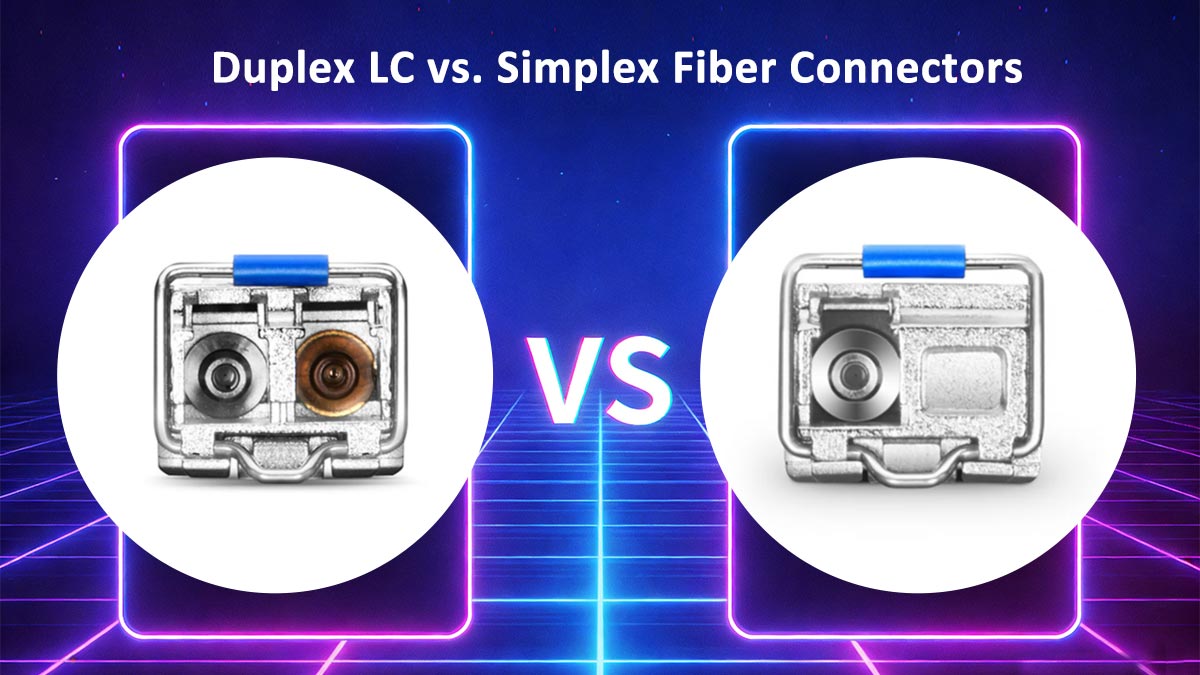
A duplex LC connector uses two fibers to support separate transmit and receive paths, which is the standard architecture for most Ethernet optical links. In contrast, a simplex LC connector uses a single fiber and relies on wavelength multiplexing technology to handle bidirectional communication.
Key Differences Between LC Duplex and LC Simplex
Feature | LC Duplex | LC Simplex |
|---|---|---|
Fiber Count | 2 fibers | 1 fiber |
TX / RX Channels | Separate transmit and receive fibers | Shared fiber using different wavelengths |
Typical Modules | Standard SFP / SFP+ / SFP28 | BiDi (Bidirectional) SFP modules |
Common Applications | Ethernet and data center networking | WDM or fiber-limited environments |
How Duplex and Simplex Communication Differ
In a duplex LC configuration, two optical fibers are used:
One fiber carries the transmit (TX) signal
The other fiber carries the receive (RX) signal
This design provides a straightforward and highly reliable full-duplex communication path, which is why it is widely used in Ethernet standards such as 1000BASE-SX, 10GBASE-SR, and 10GBASE-LR.
A simplex LC configuration, on the other hand, uses only one fiber. To enable bidirectional communication over that single fiber, BiDi optical transceivers transmit and receive signals at different wavelengths. For example, one side may transmit at 1310 nm and receive at 1550 nm, while the opposite side uses the reverse wavelengths.
When to Use Each Connector Type
Duplex LC connectors are typically used in environments where fiber availability is not a constraint and where maximum compatibility with standard Ethernet optics is required. This includes:
Data center interconnects
Enterprise backbone networks
Switch-to-switch fiber links
Simplex LC connectors are more commonly used when fiber resources are limited, such as in long-distance access networks or existing fiber infrastructure where installing additional fibers is difficult or expensive.
For most modern optical networking equipment, particularly SFP and SFP+ transceivers used in Ethernet networks, the duplex LC connector remains the most common and standardized interface.
▶️ LC vs. SC vs. MPO Connectors
Fiber optic networks use several connector types, each designed for different performance requirements, port densities, and transmission architectures. Among them, LC, SC, and MPO (or MTP) connectors are the most commonly encountered in modern networking equipment and fiber infrastructure.
Understanding the differences between these connector types helps network engineers choose the right interface for specific applications such as SFP transceivers, high-density data center cabling, or legacy telecom systems.
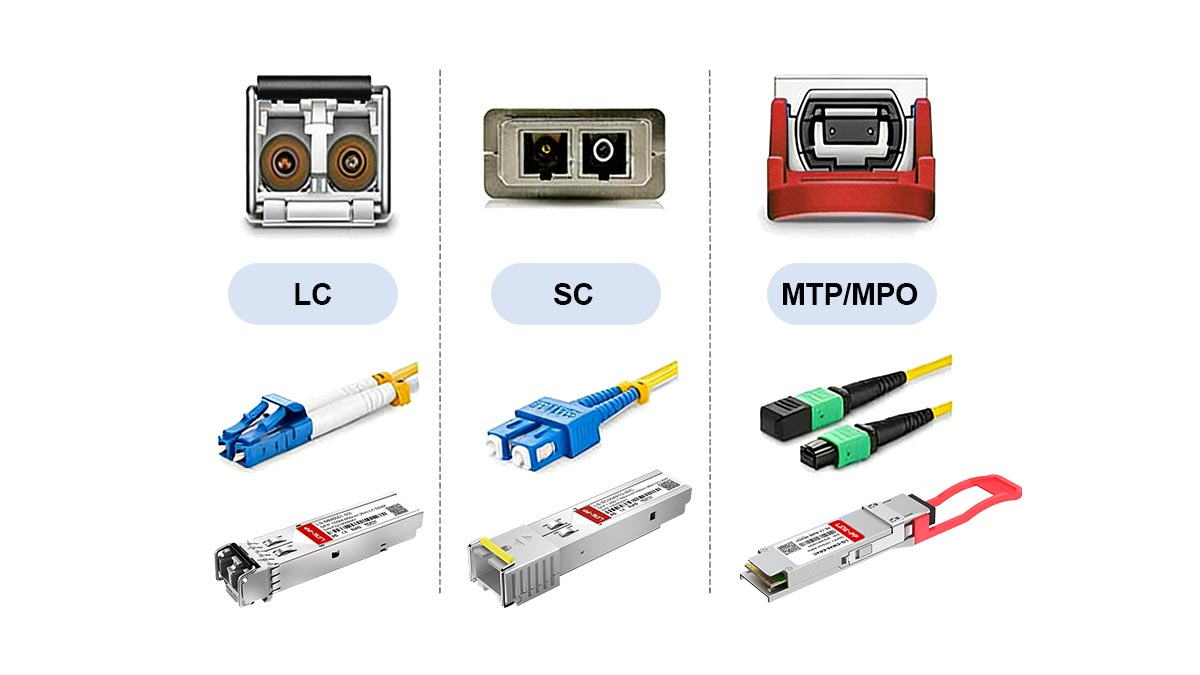
Comparison of Common Fiber Connector Types
Connector | Fiber Count | Typical Use |
|---|---|---|
LC | 2 (Duplex) | SFP / SFP+ / SFP28 optical transceivers |
SC | 1 or 2 | Legacy telecom and enterprise fiber systems |
MPO / MTP | 8 / 12 / 24 (or more) | High-speed parallel optics such as 40G and 100G |
LC Connectors
The LC connector is a small form-factor connector that uses a 1.25 mm ferrule and a push-pull latch mechanism. Its compact size allows network devices to support a high density of optical ports, which is essential for modern switches and routers.
Because of these advantages, LC connectors are widely used with SFP-based optical modules, including:
1G SFP (1000BASE-SX / LX)
10G SFP+ (10GBASE-SR / LR / ER)
25G SFP28 transceivers
Most of these modules use duplex LC interfaces to support separate transmit and receive fibers.
SC Connectors
The SC connector (Subscriber Connector or Square Connector) is an older but still widely deployed fiber interface. It uses a 2.5 mm ferrule, which makes it larger than LC connectors.
SC connectors are commonly found in:
Legacy telecom equipment
Passive optical network (PON) infrastructure
Older enterprise fiber installations
Although SC connectors provide reliable performance, their larger size makes them less suitable for high-density switch ports, which has contributed to the widespread transition to LC connectors in modern equipment.
MPO / MTP Connectors
MPO (Multi-Fiber Push-On) connectors are designed for parallel fiber transmission, where multiple fibers are bundled in a single connector. MPO connectors typically support 8, 12, 24, or more fibers within one interface.
These connectors are commonly used in high-speed data center environments that require parallel optical transmission, including:
40G Ethernet (40GBASE-SR4)
100G Ethernet (100GBASE-SR4 / SR10)
High-density fiber trunk cabling
MTP is a high-performance MPO variant that improves mechanical alignment and optical performance.
Why LC Connectors Are the Most Common for SFP Transceivers
Among these connector types, LC connectors provide an optimal balance of size, performance, and compatibility. Their compact design allows equipment manufacturers to maximize port density while maintaining reliable optical alignment and low insertion loss.
As a result, duplex LC connectors have become the standard interface for most SFP and SFP+ optical transceivers used in modern Ethernet networks.
▶️ Fiber Types Used with SFP Duplex LC Connectors
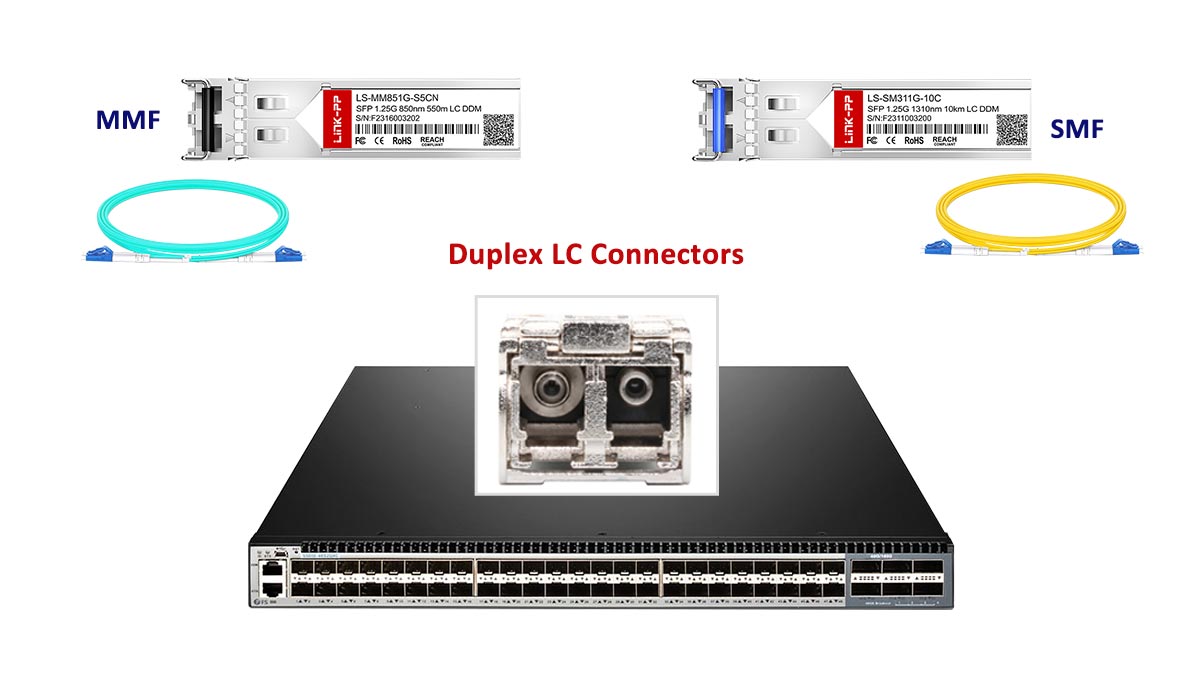
Duplex LC connectors are compatible with both multimode fiber (MMF) and single-mode fiber (SMF) systems. The choice of fiber type depends primarily on the required transmission distance, network architecture, and the optical transceiver standard being used.
In Ethernet optical networks, many SFP, SFP+, and SFP28 transceivers use duplex LC interfaces regardless of whether the module is designed for multimode or single-mode fiber. The connector format remains the same, while the optical components and wavelengths inside the transceiver determine the supported fiber type and transmission distance.
Multimode Fiber (MMF)
Multimode fiber is typically used for short-to-medium distance communication within buildings, campuses, and data centers. It has a larger core diameter (commonly 50 µm or 62.5 µm), which allows multiple light propagation paths, making it suitable for high-bandwidth connections over relatively short distances.
Multimode optical transceivers usually operate at a wavelength of 850 nm and often use VCSEL (Vertical-Cavity Surface-Emitting Laser) technology.
Common Ethernet optical modules that use duplex LC connectors with multimode fiber include:
Optical Standard | Typical Maximum Distance | Fiber Type |
|---|---|---|
1000BASE-SX | Up to 550 m (OM2) | Multimode fiber |
10GBASE-SR | Up to 300 m (OM3) / 400 m (OM4) | Multimode fiber |
Up to 70 m (OM3) / 100 m (OM4) | Multimode fiber |
Because of its cost efficiency and high bandwidth performance over short distances, multimode fiber is widely used in data center switch-to-switch links and server connectivity.
Single-Mode Fiber (SMF)
Single-mode fiber is designed for longer-distance optical transmission. It has a much smaller core diameter, typically around 9 µm, allowing light to propagate in a single optical path. This reduces modal dispersion and enables reliable communication over significantly longer distances.
Single-mode transceivers usually operate at 1310 nm or 1550 nm wavelengths and commonly use DFB (Distributed Feedback) lasers for stable long-distance transmission.
Common Ethernet optical modules that use duplex LC connectors with single-mode fiber include:
Optical Standard | Typical Maximum Distance | Fiber Type |
|---|---|---|
Up to 10 km | Single-mode fiber | |
10GBASE-LR | Up to 10 km | Single-mode fiber |
Up to 40 km | Single-mode fiber |
Single-mode fiber is commonly deployed in telecommunication networks, metro networks, and long-distance enterprise backbone connections where extended reach and stable signal transmission are required.
Why Duplex LC Works with Both Fiber Types
The duplex LC connector itself is fiber-type agnostic, meaning it can terminate either multimode or single-mode fibers as long as the correct patch cable and transceiver are used. This flexibility is one of the reasons duplex LC connectors have become the dominant interface for SFP-based optical networking across different transmission standards and network environments.
▶️ Common Applications of Duplex LC Connectors
Because of their compact size, reliable optical alignment, and compatibility with many Ethernet standards, duplex LC connectors are widely deployed across multiple types of fiber optic networks. They are commonly used with SFP, SFP+, and SFP28 optical transceivers, making them a standard interface for both short-reach and long-reach optical communication.

Below are some of the most common environments where duplex LC connectors are used.
Data Centers
In modern data centers, network equipment requires high port density and reliable high-speed optical connectivity. The small footprint of LC connectors allows switches and servers to support a large number of optical ports within limited rack space.
Typical data center applications include:
Switch-to-switch links within aggregation or spine-leaf architectures
Server connectivity using fiber uplinks for high-bandwidth workloads
Short-reach links using multimode optics such as 10GBASE-SR or 25GBASE-SR
These deployments commonly use duplex LC multimode patch cables to connect optical transceivers between switches and servers.
Telecom Networks
Duplex LC connectors are also widely used in telecommunication transport networks, especially where SFP-based optical modules are deployed.
Typical telecom applications include:
Metro network links connecting aggregation and access equipment
Longer-distance optical connections using single-mode fiber
DWDM systems, where duplex LC connectors connect transceivers to passive wavelength multiplexing equipment
In these environments, duplex LC connectors provide a reliable interface for optical modules operating at wavelengths such as 1310 nm or 1550 nm.
Enterprise Networks
Many enterprise campus networks rely on fiber backbone connections between buildings or between distribution and core switching layers. Duplex LC connectors are commonly used in these environments because they support widely deployed Ethernet standards while maintaining compatibility with standard fiber patch panels.
Common enterprise applications include:
Campus backbone connections between buildings
Core switching infrastructure within enterprise networks
Fiber uplinks connecting access switches to aggregation or core switches
In these scenarios, duplex LC connectors typically terminate single-mode or multimode fiber patch cables connected to SFP optical transceivers in network switches.
Across data centers, telecom networks, and enterprise environments, the duplex LC interface continues to play a critical role in enabling reliable and standardized optical connectivity for modern fiber networks.
▶️ FAQs About SFP Duplex LC Connectors
1. What is a duplex LC connector?
A duplex LC connector is a fiber optic connector configuration that combines two LC connectors in a single paired interface. Each connector terminates one optical fiber, allowing separate paths for transmitting and receiving optical signals.
In most optical networking systems:
One fiber carries the transmit (TX) signal
The other fiber carries the receive (RX) signal
This two-fiber architecture enables full-duplex communication, which is the standard operating mode for Ethernet-based optical links used in switches, routers, and servers.
2. Why do most SFP transceivers use duplex LC connectors?
Most SFP, SFP+, and SFP28 optical transceivers use duplex LC connectors because they provide an effective balance of compact size, reliable optical alignment, and standardized compatibility with fiber patch cables.
Key reasons include:
High port density – LC connectors are smaller than older connector types such as SC, allowing more optical ports on networking equipment
Reliable optical coupling – the 1.25 mm ferrule provides precise fiber alignment for stable signal transmission
Standardized Ethernet architecture – most Ethernet optical standards are designed around separate TX and RX fibers
Because of these advantages, the duplex LC interface has become the default connector type for many 1G, 10G, and 25G optical transceivers used in modern networks.
3. Can a duplex LC connector work with single-mode fiber?
Yes. Duplex LC connectors are compatible with both single-mode fiber (SMF) and multimode fiber (MMF).
The connector itself simply provides the mechanical interface for fiber termination. The fiber type and optical wavelength are determined by the optical module and patch cable used.
For example:
Single-mode applications: 1000BASE-LX, 10GBASE-LR, 10GBASE-ER
Multimode applications: 1000BASE-SX, 10GBASE-SR, 25GBASE-SR
As long as the fiber patch cable and optical transceiver match the required standard, duplex LC connectors can be used in either environment.
4. What is the difference between LC duplex and simplex?
The primary difference between LC duplex and LC simplex connectors is the number of fibers used for communication.
Connector Type | Fiber Count | Communication Method |
|---|---|---|
LC Duplex | 2 fibers | Separate TX and RX channels |
LC Simplex | 1 fiber | Bidirectional transmission on a single fiber |
Duplex LC connectors use two fibers, allowing simultaneous transmission and reception. This design is used in most Ethernet optical modules.
Simplex LC connectors typically appear in BiDi optical transceivers, which use different wavelengths to send and receive signals over a single fiber.
5. Can one fiber replace a duplex LC connector?
In some cases, yes—but only with specialized optical modules.
Standard optical transceivers require two fibers and therefore use duplex LC connectors. However, BiDi (bidirectional) optical transceivers are designed to operate over a single fiber.
These modules use wavelength division multiplexing (WDM) technology, where:
One wavelength is used for transmission
A different wavelength is used for reception
For example, one module may transmit at 1310 nm and receive at 1550 nm, while the opposite module uses the reverse wavelengths.
While single-fiber solutions can reduce fiber usage, duplex LC connections remain the most common and widely supported configuration in Ethernet optical networking.
▶️ Conclusion: Understanding the Role of Duplex LC Connectors in Optical Networks
Duplex LC connectors have become the standard optical interface for many modern transceivers because they combine compact size, precise fiber alignment, and reliable support for full-duplex communication. By using two fibers—one dedicated to transmitting optical signals and the other for receiving—duplex LC connectors provide a simple and highly stable architecture for Ethernet and telecom optical links.
Their small form factor and 1.25 mm ferrule design allow high port density on switches, routers, and servers while maintaining accurate fiber alignment and low insertion loss. These characteristics make duplex LC connectors especially suitable for SFP, SFP+, and SFP28 optical transceivers, which are widely used in both short-reach multimode and long-reach single-mode fiber networks.
Across modern networking environments—including data centers, telecom transport networks, and enterprise campus infrastructure—duplex LC connectors play a critical role in enabling reliable fiber connectivity. Their compatibility with standard fiber patch cables and Ethernet optical standards ensures straightforward deployment and long-term interoperability across different network platforms.
As optical networks continue to scale in bandwidth and port density, the duplex LC connector remains one of the most widely adopted and dependable interfaces for fiber optic communication.

Explore high-performance SFP optical transceivers with duplex LC interfaces designed for reliable and scalable fiber networking at the LINK-PP Official Store, and discover solutions optimized for modern data center and telecom applications.