

10GbE SFP+ modules remain one of the most widely deployed optical interfaces in enterprise networks, data centers, and carrier access environments. Despite the rapid adoption of 25G, 100G, and higher-speed technologies, 10-gigabit Ethernet continues to offer an optimal balance of cost, performance, and infrastructure reuse—making it a long-lifecycle investment for many organizations.
From a procurement perspective, selecting the right 10GbE SFP+ module involves more than choosing reach distance or connector type. Buyers must evaluate multi-vendor compatibility, pricing tiers across OEM and third-party options, lead time and stocking strategy, warranty and RMA policies, and long-term operational reliability. Incorrect selection can lead to interoperability issues, unexpected thermal constraints, or higher total cost of ownership.
From an engineering and deployment standpoint, decisions must also account for fiber type (MMF vs. SMF), optical budget margins, DOM/DDM monitoring capability, and switch platform support. Even mechanically compatible modules may require validated EEPROM coding or firmware alignment to ensure stable link establishment and accurate diagnostics.
This procurement-and-deployment guide consolidates both purchasing and technical decision criteria into a single reference. By the end of this article, network engineers, sourcing managers, and IT asset planners will be able to:
Identify the most suitable 10G SFP+ module type for a given distance and fiber plant
Compare pricing and cost drivers across SR, LR, ER, and copper options
Validate compatibility with major switch vendors before bulk purchase
Reduce deployment risk through proper specification verification and testing
Plan inventory and supplier strategy for predictable lead time and lifecycle support
Whether upgrading existing 1G infrastructure, expanding a 10G access layer, or optimizing spare-parts sourcing, this guide is designed to support accurate technical selection and low-risk procurement at scale.
♦️What Is 10GbE SFP+?
A 10GbE SFP+ module is a hot-pluggable optical or copper transceiver used to enable 10-Gigabit Ethernet (10GbE) connectivity between switches, routers, servers, and storage systems. It converts electrical signals from the host device into optical or copper transmission signals and is widely adopted due to its high port density, interoperability standards, and scalable deployment cost.
Compared with legacy 10G form factors (XENPAK/XFP), SFP+ delivers equivalent throughput in a smaller footprint, allowing more ports per switch and reducing total infrastructure cost per gigabit.
From a procurement perspective, buyers evaluate SFP+ modules based on compatibility, supported Ethernet standard, transmission distance, vendor coding, and lifecycle availability—because these factors directly influence network upgrade cost, spare strategy, and long-term maintenance risk.
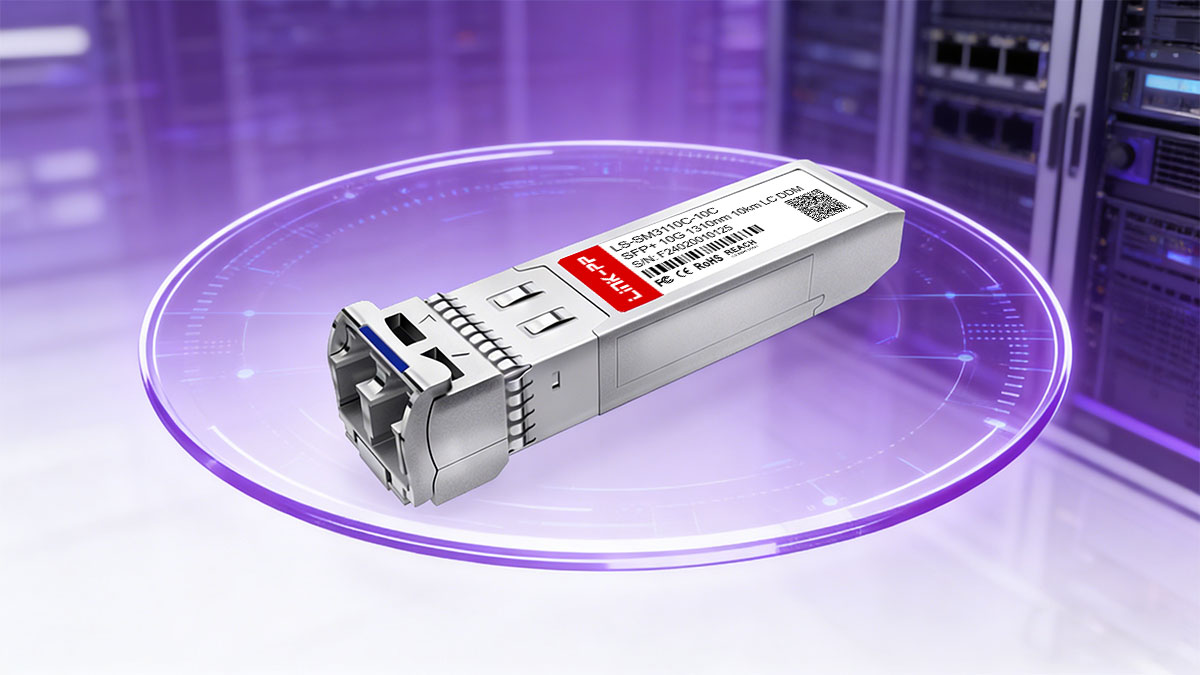
10G SFP+ Form Factor and Standards
The SFP+ ecosystem is governed by widely adopted Multi-Source Agreements (MSAs) and related standards that ensure multi-vendor interoperability.
SFF-8431 / SFF-8472
SFF-8431 defines the electrical interface and module characteristics for SFP+ transceivers, including signal integrity and high-speed serial interface requirements.
SFF-8472 specifies the Digital Diagnostic Monitoring (DDM/DOM) interface, enabling real-time reporting of optical power, temperature, voltage, and laser bias current for operational visibility.
These specifications allow network operators to deploy third-party compatible optics while maintaining predictable performance across equipment vendors.
Hot-Swappable Design
SFP+ modules are designed for live insertion and removal without powering down the host system, simplifying maintenance and enabling rapid replacement during failures or capacity expansion. Hot-swap capability reduces service downtime and lowers operational risk during field upgrades.
Common SFP+ Types Available on the Market
The 10GbE SFP+ category includes multiple physical-layer variants optimized for different fiber types, distances, and cabling environments.
10GBASE-SR (Short Range)
Typically operates over multimode fiber (MMF).
Supports distances up to ~300 m on OM3 (longer on higher-grade MMF).
Most commonly used inside data centers for top-of-rack switching and short interconnects.
10GBASE-LR (Long Range)
Uses single-mode fiber (SMF) at ~1310 nm wavelength.
Standard reach up to 10 km.
Frequently deployed for campus backbones and metro access links.
10GBASE-ER (Extended Range)
Operates on SMF at ~1550 nm.
Supports distances up to 40 km under IEEE specifications.
Suitable for long-haul enterprise inter-building or telecom aggregation scenarios.
10GBASE-T (Copper SFP+)
Uses RJ-45 interface and twisted-pair copper cabling (Cat6A/7).
Provides backward compatibility with lower Ethernet speeds through auto-negotiation.
Often selected where structured copper cabling already exists and fiber deployment cost must be minimized.
10GbE SFP+ Module Types — Full Comparison Matrix
Type | IEEE / MSA Standard | Medium | Typical Wavelength | Max Reach (Typical) | Connector | Power Consumption (Typical) | Cost Level |
|---|---|---|---|---|---|---|---|
10GBASE-SR | IEEE 802.3ae | MMF (OM3/OM4) | 850 nm | 300 m (OM3), 400 m (OM4) | LC Duplex | ~0.8–1.0 W | ★ Low |
10GBASE-LR | IEEE 802.3ae | SMF | 1310 nm | 10 km | LC Duplex | ~1.0–1.3 W | ★★ Medium |
10GBASE-ER | IEEE 802.3ae | SMF | 1550 nm | 40 km | LC Duplex | ~1.5–2.0 W | ★★★ High |
10GBASE-ZR | Industry MSA | SMF | 1550 nm | 80 km | LC Duplex | ~2.5–3.5 W | ★★★★ Very High |
10G SFP+ DAC (Passive) | SFF-8431 | Twinax Copper | Electrical | 1–7 m | SFP+ Direct Attach | <0.5 W | ★ Very Low |
10G SFP+ DAC (Active) | SFF-8431 | Twinax Copper | Electrical | Up to 10–15 m | SFP+ Direct Attach | ~1.0 W | ★★ Medium |
10G SFP+ AOC | SFF-8431 | Multimode Fiber | 850 nm | Up to 30–100 m | SFP+ Fixed Cable | ~1.0–1.5 W | ★★ Medium |
10GBASE-T (SFP+) | IEEE 802.3an | Cat6A / Cat7 Copper | Electrical | 30 m (10G) | RJ-45 | ~2.5–3.0 W | ★★ Medium |
Typical Enterprise and Data Center Applications of 10GbE SFP+
SFP+ 10GbE modules remain a foundational connectivity option across enterprise and service-provider networks:
Top-of-Rack (ToR) to aggregation switching in modern data centers.
Server NIC uplinks supporting virtualization and high-throughput workloads.
Campus backbone links between distribution and core layers.
Storage networking, including iSCSI and Fibre Channel over Ethernet (FCoE) environments.
Their combination of standardized interfaces, compact form factor, and broad ecosystem support has made SFP+ the long-standing mainstream for 10-Gigabit deployments, particularly where upgrading to 25G or higher is not yet economically justified.
♦️ Types of 10GbE SFP+ Modules and Typical Reach
Understanding reach, fiber type, and cabling constraints is central to accurate 10GbE SFP+ selection. While many modules share the same SFP+ form factor, their optical characteristics, supported distances, and infrastructure requirements differ significantly. This section breaks down the main 10GbE SFP+ variants buyers encounter in the market and maps each to realistic deployment scenarios.
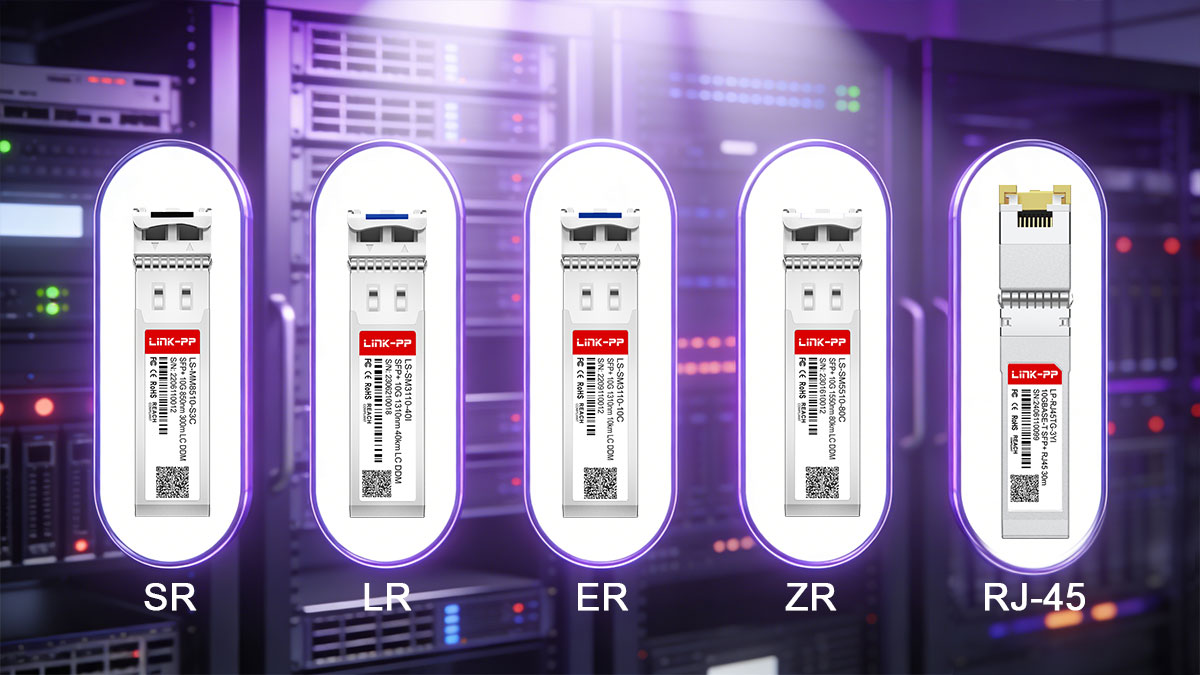
1. Multimode Fiber Modules (10GBASE-SR)
SFP+ SR modules are designed for short-reach transmission over multimode fiber (MMF) and are the most cost-effective optical option for in-rack and row-to-row connections.
Key characteristics
Wavelength: ~850 nm
Fiber type: OM3 / OM4 / OM5 MMF
Typical reach:
OM3: up to 300 m
OM4: up to 400 m
Connector: LC duplex
Procurement notes
Lowest cost among optical SFP+ modules
High availability and short lead times
Ideal when existing MMF infrastructure is in place
Not suitable for campus or inter-building links due to distance limits
SR modules dominate data center access and aggregation layers, where link distances are predictable and well within MMF limits.
2. Single-Mode Fiber Modules (LR / ER / ZR)
Single-mode SFP+ modules are selected when reach requirements exceed MMF limits or when links must span buildings, campuses, or metro networks.
Module Type | Wavelength | Fiber Type | Standard / Typical Reach | Typical Use Cases |
|---|---|---|---|---|
10GBASE-LR | ~1310 nm | Single-mode fiber (SMF) | Up to 10 km | Campus backbones; data center interconnect (DCI) within metro areas |
10GBASE-ER | ~1550 nm | SMF | Up to 40 km | Long-distance enterprise links; telecom aggregation and access networks |
10GBASE-ZR (non-IEEE, commonly available) | ~1550 nm | SMF | 60–80 km (vendor-dependent) | — |
Notes
LR is the most commonly sourced SMF module due to cost-to-reach balance
ER and ZR modules have higher unit cost and stricter optical power budgets
Long-reach optics require careful link-budget validation and, in some cases, optical attenuation
3. 10GbE Copper Options (DAC and RJ-45)
Not all 10GbE SFP+ deployments require optical fiber. Copper-based alternatives are widely used in short-distance, cost-sensitive environments.
SFP+ Direct Attach Copper (DAC)
Passive or active copper twinax cable
Typical reach:
Passive: 1–7 m
Active: up to 10–15 m
Advantages
Lowest power consumption
No optical components
Very low latency and cost per link
Limitations
Fixed cable length
Not suitable beyond rack-level connections
10GBASE-T SFP+ (RJ-45)
Uses Cat6A / Cat7 twisted-pair copper
Reach: up to 30 m (practical limit)
Notes:
Higher power consumption than optical or DAC options
Useful when reusing existing copper cabling
Thermal impact must be validated on dense switch platforms
4. Reach and Fiber Compatibility Comparison Table
Module Type | Medium | Wavelength | Typical Reach | Common Use Case |
|---|---|---|---|---|
10GBASE-SR | MMF (OM3/OM4) | 850 nm | 300–400 m | Data center short-reach links |
10GBASE-LR | SMF | 1310 nm | 10 km | Campus / metro links |
10GBASE-ER | SMF | 1550 nm | 40 km | Long-distance enterprise / telecom |
10GBASE-ZR* | SMF | 1550 nm | 60–80 km | Extended metro / DCI |
SFP+ DAC | Copper twinax | N/A | 1–15 m | In-rack connections |
10GBASE-T | Twisted pair | N/A | ≤30 m | Copper-based access |
*ZR reach varies by vendor and is not standardized by IEEE.
Selecting the correct 10GbE SFP+ module is less about maximum advertised distance and more about matching fiber type, link length, power budget, and platform constraints. Over-specifying reach increases cost unnecessarily, while under-specifying can lead to unstable links and costly redeployment.
♦️ 10GbE SFP+ Module Pricing: What Determines Cost?
Understanding how 10GbE SFP+ pricing is structured is critical for procurement teams evaluating multiple vendors or planning volume deployments. The price of a 10G SFP+ Transceiver varies significantly depending on optical technology, transmission distance, vendor branding, and qualification requirements.
Typical Market Price Ranges by SFP+ Type
In the global market, price variance between OEM-branded and compatible optics can be substantial:
SFP+ SR (MMF)
Third-party compatible modules can be available at relatively low cost in volume markets, sometimes around tens of US dollars per unit.
Branded OEM modules may be quoted around ~US$100–300+ depending on vendor and support agreements.
SFP+ LR (SMF, 10 km)
Compatible optics often range from lower hundreds of dollars depending on supplier and coding.
Branded long-reach modules can be quoted significantly higher—sometimes many hundreds or even over a thousand dollars in enterprise procurement contexts.
SFP+ ER / long-distance optics
Higher-power lasers and tighter optical tolerances typically result in higher pricing than SR/LR categories.
OEM vs Compatible Modules
OEM optics usually include full vendor support and certification.
Third-party “compatible” optics are widely used in production networks to reduce CapEx, provided interoperability validation is completed.
Procurement insight: Price differences between identical specifications are often driven more by branding, warranty, and qualification policies than by fundamental hardware differences.
Optical Module Cost Drivers
Several technical and commercial factors directly influence module pricing:
Optical Components
Laser type (VCSEL vs. DFB vs. EML)
Receive sensitivity and link budget requirements
Longer-reach optics require higher-performance components.
DDM / DOM Support
Modules supporting digital diagnostics (per SFF-8472) may carry slightly higher cost due to monitoring circuitry and calibration.
Brand Coding and Qualification
EEPROM vendor coding, interoperability testing, and certification programs add engineering and validation overhead.
Vendor lock-in policies can significantly increase OEM pricing in some ecosystems.
Production Scale
High-volume data center optics (e.g., SR) benefit from economies of scale.
Lower-volume specialty optics (e.g., ER/ZR) remain more expensive.
Total Cost of Ownership (TCO) Considerations of SFP+ Optics
Purchase price alone does not reflect the true lifecycle cost of deploying 10GbE SFP+ optics.
Power Consumption
Optical SFP+ SR/LR modules typically consume around ~0.8–1.5 W, while 10GBASE-T SFP+ copper modules can exceed 2–3 W, increasing chassis thermal load and operating expense.
Fiber Infrastructure Reuse
Selecting LR optics may allow reuse of existing single-mode fiber, avoiding new cabling costs.
For short-reach links, DAC cables may provide significantly lower cost per link.
Failure Replacement and Support Risk
OEM modules may reduce vendor support disputes.
Compatible optics reduce upfront CapEx but require qualification testing to avoid operational risk.
Operational Stability
In large-scale deployments, standardized vendor sourcing and documented compatibility matrices reduce troubleshooting time and spare inventory complexity.
The most cost-effective 10GbE SFP+ choice balances initial module price, power consumption, fiber reuse, vendor support policy, and long-term operational reliability—not just the lowest unit cost.
♦️ SFP+ Compatibility with Major Switch Vendors
For many organizations, switch compatibility is the single most important criterion when sourcing 10GbE SFP+ modules. Even when modules comply with the same MSA standards, vendors may implement platform-level validation mechanisms that affect link initialization, diagnostics reporting, or long-term stability.
Ensuring that a 10GbE SFP+ is verified for the target switch model—before bulk purchase—reduces the risk of port errors, unsupported optics warnings, or operational downtime.
♦Cisco, Arista, Juniper, HPE Compatibility
Most enterprise and data center switches from major vendors support industry-standard SFP+ transceivers, including:
However, each vendor maintains its own qualification list and may enforce validation through EEPROM identification data. In practice:
OEM modules are guaranteed to be recognized and supported within the vendor’s ecosystem.
Qualified third-party “compatible” modules—coded to match the target vendor—are widely deployed in production networks.
Some platforms generate warning messages or disable DOM features if the module identification does not match expected parameters.
Procurement teams should confirm:
Exact switch model compatibility
Supported optics list (SOL) or hardware compatibility matrix
Firmware version dependencies
This verification is particularly important in mixed environments where different switch families coexist.
♦ EEPROM Coding and Qualification Process
SFP+ modules contain EEPROM memory that stores identification and capability information defined by SFF-8472. This includes:
Vendor name and part number
Supported data rates
Optical characteristics
Diagnostic capability
Third-party suppliers often provide vendor-specific coding so the module presents itself as compatible with a target platform (e.g., Cisco-compatible or Arista-compatible).
A typical qualification workflow includes:
Coding the module to match the target vendor profile
Functional link testing in the intended switch platform
DOM/DDM validation to confirm monitoring accuracy
Interoperability testing with peer optics
This process ensures that the module is not only mechanically recognized but also operates reliably across temperature and traffic conditions.
♦ Risks of Unverified Third-Party Modules
Using optics that have not been validated for the specific platform introduces measurable operational risk:
Link initialization failures or intermittent connectivity
“Unsupported transceiver” alarms
Inaccurate DOM/DDM readings
Reduced vendor support during troubleshooting
Potential firmware-level restrictions on certain switch models
While many third-party optics perform reliably, the risk profile increases when modules are sourced without compatibility testing or traceable quality control.
♦ Best Practices for Multi-Vendor Networks
Organizations operating heterogeneous networks can reduce interoperability risk by applying structured sourcing and validation practices:
Maintain a documented approved optics list aligned with each switch model
Standardize on suppliers that provide multi-vendor coding options
Validate new optics batches through lab testing before production rollout
Record firmware versions and compatibility notes
Use DOM/DDM monitoring to verify optical power margins after deployment
Takeaway:
Compatibility is not only a mechanical fit—it is a combination of EEPROM identification, platform firmware support, and validated interoperability. Establishing a repeatable qualification process before large-volume purchases significantly reduces lifecycle operational risk and support escalation.
♦️ SFP+ 10G Supplier Selection Criteria: MOQ, Lead Time, and Warranty
After determining the correct 10GbE SFP+ specification and compatibility profile, supplier selection becomes the next critical decision point. Differences in minimum order quantity (MOQ), delivery timelines, warranty coverage, and quality assurance processes can significantly impact deployment schedules and long-term operational risk.
For procurement teams managing multi-site rollouts or maintaining spare inventory, selecting a supplier with predictable logistics and traceable quality controls is often as important as module pricing.
Typical 10GbE SFP+ MOQ and Volume Pricing Models
The global optics market supports a wide range of purchasing volumes:
Low MOQ suppliers may allow small trial quantities for validation or lab testing.
Volume pricing tiers typically apply at increasing quantity brackets (e.g., 10+, 50+, 100+ units).
Large-scale deployments often negotiate framework agreements that lock pricing across multiple shipments.
Common procurement practices
Initial engineering validation order (sample batch)
Pilot deployment at limited scale
Volume purchase aligned with project rollout phases
Standardized optics such as SFP 10G SR usually have the most flexible MOQ due to high production volume, while specialty optics (e.g., ER/ZR) may require higher minimum quantities or longer quotation cycles.
SFP+ Module Lead Time Expectations (Stock vs. Custom Coding)
Lead time varies depending on whether fiber modules are:
Stocked Standard Inventory
Often available for immediate shipment or within a few business days
Typically pre-coded for common vendors
Custom-Coded or Project-Specific Builds
May require additional programming and validation
Lead times commonly extend from several days to multiple weeks depending on order size
Factors influencing supplier lead time
Current inventory levels
Vendor-specific EEPROM coding requirements
Production batch scheduling
Global logistics and shipping method
For projects with strict deployment windows, procurement teams should confirm:
Real-time stock availability
Guaranteed shipment dates
Ability to support staged delivery across multiple sites
SFP+ 10GbE Warranty, RMA, and Quality Assurance
Warranty terms directly influence lifecycle cost and operational continuity.
Typical industry practices
Standard warranty periods ranging from 1 to 5 years
Advance replacement options for critical infrastructure
Defined RMA turnaround time and failure analysis reporting
Quality assurance expectations for professional deployments include:
Optical performance testing (Tx/Rx power, sensitivity)
Burn-in or environmental screening
DOM/DDM calibration verification
Traceable serial number and batch records
Suppliers that provide clear RMA procedures and documented test reports reduce downtime risk and simplify asset tracking.
Evaluating 10GbE Module's Supplier Credibility
Before committing to volume purchases, buyers should verify that the supplier demonstrates consistent technical and manufacturing capability.
Compliance and Certification
Conformance to IEEE Ethernet standards
RoHS / REACH environmental compliance
Quality management systems (e.g., ISO 9001)
Manufacturing Capability
In-house optical assembly and programming capacity
Stable component sourcing
Ability to scale production during demand spikes
Testing Process
100% functional testing across supported platforms
Interoperability validation with major switch vendors
Documented acceptance criteria for optical performance
Tips:
A reliable 10GbE SFP+ supplier is defined not only by competitive pricing, but by predictable lead time, transparent warranty coverage, validated compatibility, and repeatable manufacturing quality. Establishing long-term relationships with qualified vendors reduces sourcing risk and supports consistent network performance across future expansion cycles.
♦️ Deployment Scenarios and Recommended SFP+ Module Types
Selecting the correct 10G SFP+ optical module depends heavily on transmission distance, fiber infrastructure, and network architecture. Matching the module specification to the deployment scenario ensures optimal link stability, minimizes total cost, and avoids unnecessary power consumption or optical budget limitations.
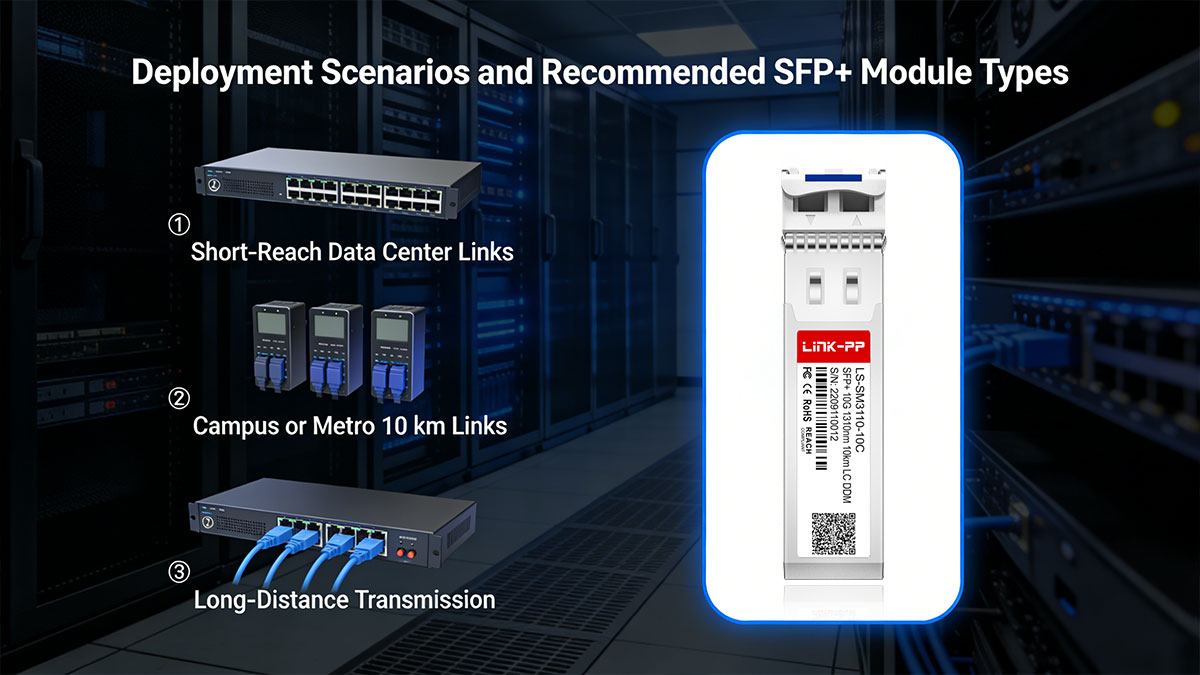
① Short-Reach Data Center Links
For intra-rack or inter-rack connections within a data center environment, 10GBASE-SR modules are typically the most cost-effective and widely deployed option.
Typical Characteristics
Wavelength: 850 nm
Fiber Type: Multimode Fiber (OM3 / OM4)
Reach:
OM3: Up to 300 m
OM4: Up to 400 m
Advantages
Lowest cost among 10G optical modules
Minimal power consumption
High availability across all major vendors
Ideal for high-density switch-to-switch or switch-to-server links
Recommended Use Cases
Top-of-Rack (ToR) switching
Spine-leaf interconnects within the same row
Short cross-connects inside data halls
When multimode infrastructure is already deployed, SR modules provide the best balance between performance and capital efficiency.
② Campus or Metro 10 km Links
For medium-distance connections between buildings or across campus environments, 10GBASE-LR modules are generally recommended.
Typical Characteristics
Wavelength: 1310 nm
Fiber Type: Single-Mode Fiber (SMF 9/125 µm)
Reach: Up to 10 km
Advantages
Stable transmission over longer distances
Widely supported by enterprise and telecom switches
Compatible with existing single-mode fiber infrastructure
Recommended Use Cases
Inter-building backbone connections
Enterprise campus aggregation layers
Access-to-core uplinks
LR modules represent the most common deployment type in enterprise networks because they provide sufficient distance coverage without the higher cost associated with extended-reach optics.
③ Long-Distance Transmission
For extended-reach applications beyond standard campus distances, 10GBASE-ER or 10GBASE-ZR modules may be required depending on the link budget.
Typical Characteristics
ER:
Wavelength: 1550 nm
Reach: Up to 40 km
ZR (vendor-specific):
Reach: Up to 80 km or greater (depending on optical conditions)
Advantages
Supports metro aggregation and regional transport
Enables long-haul connectivity without intermediate regeneration
Design Considerations
Higher optical transmit power
Increased module cost and power consumption
Potential need for dispersion management or attenuation
Recommended Use Cases
Metropolitan network interconnects
Data center interconnect (DCI) across cities
Telecom aggregation nodes
For links exceeding 10 km, engineers should always validate the optical power budget, fiber attenuation, and connector loss to ensure sufficient margin for reliable operation.
♦️ How to Select the Right 10GbE SFP+ Modules
Selecting the appropriate 10GbE SFP+ module requires balancing technical requirements, existing infrastructure, and vendor compatibility. The following checklist provides a structured decision path that procurement teams and network engineers can use to minimize deployment risk and avoid costly re-purchases.
▶ 10GbE SFP+ Procurement Decision Flow
Use the sequence below as a practical selection workflow:
1. Determine Transmission Distance
0–400 m: Consider 10GBASE-SR over multimode fiber.
Up to 10 km: Use 10GBASE-LR over single-mode fiber.
10–40 km or more: Evaluate 10GBASE-ER or extended-reach optics.
Distance is the primary constraint because it directly determines wavelength, optical power budget, and supported fiber types.
2. Confirm Available Fiber Infrastructure
Multimode Fiber (OM3 / OM4): Best suited for SR modules.
Single-Mode Fiber (9/125 µm): Required for LR, ER, and long-reach deployments.
Verify connector type (typically LC duplex).
Check existing attenuation levels and patch panel quality.
Reusing existing fiber infrastructure can significantly reduce total deployment cost.
3. Verify Switch and Platform Compatibility
Confirm the module is supported by the target switch vendor (Cisco, Arista, Juniper, HPE, etc.).
Ensure correct EEPROM coding or vendor qualification.
Check firmware compatibility lists or interoperability matrices.
Compatibility validation helps avoid port shutdowns, warning alarms, or unsupported transceiver messages.
4. Evaluate Monitoring and Operational Requirements
Confirm DOM/DDM (Digital Optical Monitoring) support for visibility into:
Tx/Rx optical power
Temperature
Voltage
Laser bias current
Review power consumption limits per port.
Assess thermal impact in high-density switch environments.
5. Assess Commercial Factors
Lead time (stock vs custom coding)
Warranty and RMA policies
Vendor reliability and production capacity
These factors influence long-term operational cost and service continuity.
▶ Recommended 10GbE SFP+ Modules by Deployment Scenario
Deployment Scenario | Environment | Typical Distance | Recommended Module | Reasoning |
|---|---|---|---|---|
Data Center Deployment | High-density switching within the same facility | <300 m | 10GBASE-SR | Lowest cost per link; minimal power consumption; ideal for short multimode infrastructure |
Enterprise Campus Network | Building-to-building backbone | 1–10 km | 10GBASE-LR | Compatible with standard single-mode fiber; provides stable medium-range transmission; widely supported across enterprise switches |
Telecom or Metro Aggregation | Long-distance backbone or regional interconnect | 10–40 km or more | 10GBASE-ER or Extended-Reach Optics | Higher optical power output; designed for extended reach over SMF; supports carrier-grade transmission scenarios |
♦️ 10GbE SFP+ Module FAQs
This FAQ section is structured to provide concise, technically accurate answers designed for featured snippets, AI citation, and procurement-stage decision support.
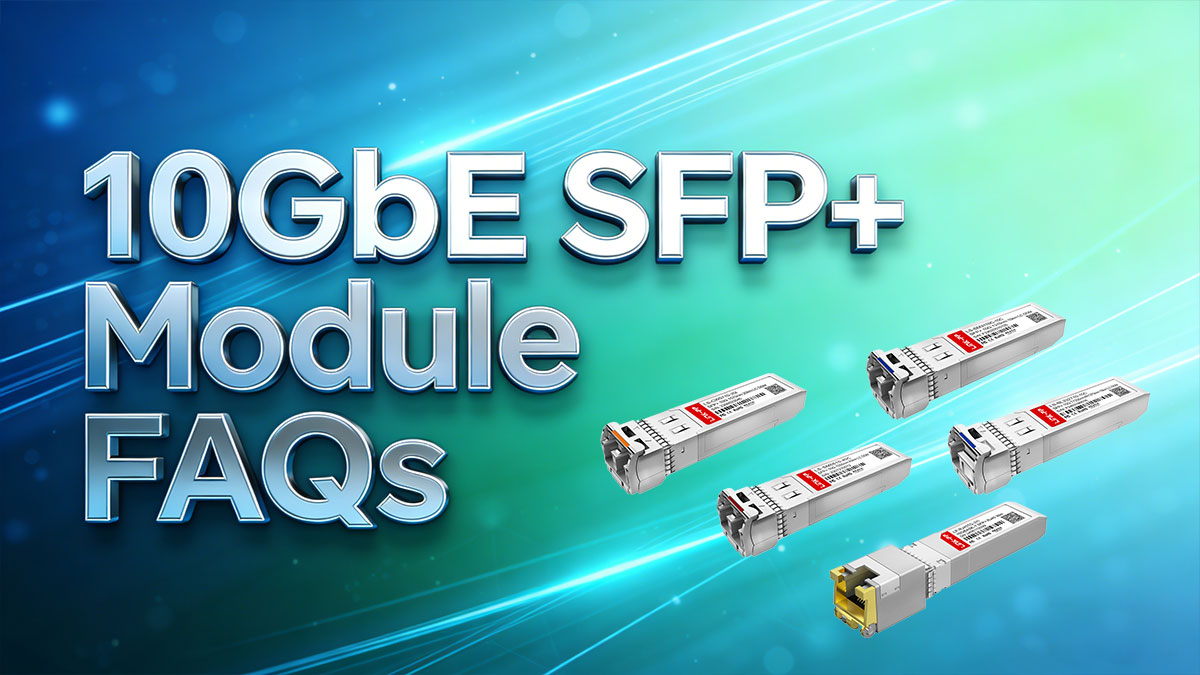
1. What is a 10GbE SFP+ module?
A 10GbE SFP+ module is a hot-swappable transceiver that enables 10 Gigabit Ethernet (10GbE) connectivity between network switches, routers, and servers. It converts electrical signals from the host device into optical or copper transmission media and is defined by the SFP+ form factor standards (SFF-8431).
2. What are the most common types of 10G SFP+ modules?
The most widely deployed types include:
10GBASE-SR — Short-reach multimode fiber (typically up to 300–400 m)
10GBASE-LR — Long-reach single-mode fiber (up to 10 km)
10GBASE-ER — Extended reach (up to 40 km)
10GBASE-T SFP+ — Copper RJ-45 interface over Cat6A or better cabling
DAC (Direct Attach Copper) — Passive or active twinax cable for short connections
Each type is optimized for a specific distance, fiber infrastructure, and cost profile.
3. How far can a 10GbE SFP+ module transmit data?
Transmission distance depends on the optical specification:
SR: Typically 26–300 m (OM1–OM3) and up to ~400 m (OM4)
LR: Up to 10 km over single-mode fiber (SMF)
ER: Up to 40 km over SMF
DAC: Typically 1–7 m (passive) or up to ~10 m (active)
10GBASE-T: Up to 30 m at 10G over Cat6A (longer at lower speeds)
Actual reach depends on fiber quality, connector loss, and total link attenuation.
4. Are third-party (compatible) 10G SFP+ modules reliable?
Yes—qualified compatible modules can be reliable when they are:
EEPROM-coded for the target switch vendor
Tested for interoperability
Manufactured under controlled quality processes
However, unverified modules may trigger compatibility warnings, port shutdowns, or unstable links.
5. What determines the price of a 10G SFP+ module?
Key cost factors include:
Optical components (laser type and wavelength)
Transmission distance (SR vs LR vs ER)
Brand vs compatible coding
Digital diagnostics (DDM/DOM) support
Production volume and supplier positioning
Longer-reach optics and branded OEM modules typically command higher prices.
6. Can SFP+ modules be used interchangeably between different switch vendors?
Interchangeability depends on compatibility coding:
Many switches enforce vendor identification through EEPROM data.
Modules coded for Cisco, Arista, Juniper, or HPE are usually required for full functionality.
Multi-vendor environments often standardize on compatible modules with validated coding profiles.
7. Do all 10GbE SFP+ modules support Digital Optical Monitoring (DOM/DDM)?
Most modern optical SFP+ modules support DOM/DDM as defined by SFF-8472, allowing real-time monitoring of:
Transmit optical power
Receive optical power
Module temperature
Supply voltage
Laser bias current
Some very low-cost or legacy modules may have limited monitoring capabilities.
8. How much power does a typical 10G SFP+ module consume?
Typical power consumption varies by type:
SR / LR optics: ~0.8–1.5 W
ER optics: ~1.5–2.5 W
DAC passive: <0.5 W
10GBASE-T SFP+: Often 2–3 W or higher
Higher power modules can impact switch thermal budgets in high-density deployments.
9. How do I choose between SR, LR, and ER modules?
Selection should be based primarily on:
Required transmission distance
Available fiber type (MMF vs SMF)
Power budget and link margin
Total cost of ownership
As a general rule:
SR for short intra-data-center links
LR for campus or building interconnect
ER for long-distance backbone or metro applications
10. Is 10GbE SFP+ still widely used despite higher-speed interfaces?
Yes. Despite the adoption of 25G, 100G, and beyond, 10GbE SFP+ remains widely deployed due to:
Large installed base of switches and servers
Cost-effective upgrades from 1G
Sufficient bandwidth for many enterprise and edge workloads
As a result, 10G SFP+ modules continue to represent a significant portion of global transceiver shipments in enterprise and campus networks.
♦️ Final 10GbE SFP+ Selection Guidance and RFQ Support
Final 10GbE SFP+ Module Selection Logic
Selecting the right 10GbE SFP+ module ultimately comes down to a clear, engineering-driven decision path:
start with transmission distance → confirm fiber or copper infrastructure → verify switch compatibility → evaluate total cost of ownership (TCO).
For short intra-rack or row connections, DAC or 10GBASE-SR offers the lowest cost and power draw. For building or campus links, 10GBASE-LR over single-mode fiber remains the most balanced and widely deployed option. 10GBASE-ER should be reserved for long-distance scenarios where link margin—not module price—is the dominant constraint. Throughout the process, compatibility validation and supplier quality matter as much as raw specifications.
SFP+ Moudules Procurement Tips
Before placing an order or issuing an RFQ, experienced network procurement teams typically ensure that:
The module is explicitly coded and tested for the target switch platform
Optical reach aligns with real link budgets, not just datasheet maximums
Power consumption fits the port-level and chassis thermal envelope
The supplier offers clear warranty terms, RMA processes, and batch consistency
Lead time and MOQ support both pilot deployment and future scale-out
These steps significantly reduce operational risk and avoid costly post-deployment replacements.
To continue your evaluation or move toward deployment, explore the following next steps:
Browse 10GbE SFP+ Product Listings — compare SR, LR, ER, and DAC options by reach, power, and compatibility
Review Vendor-Specific Compatibility Guides — Cisco, Arista, Juniper, HPE, and multi-vendor environments
Download Technical SFP+ Datasheet — optical budgets, DOM/DDM parameters, and compliance details
10G SFP+ RFQ & Bulk Inquiry
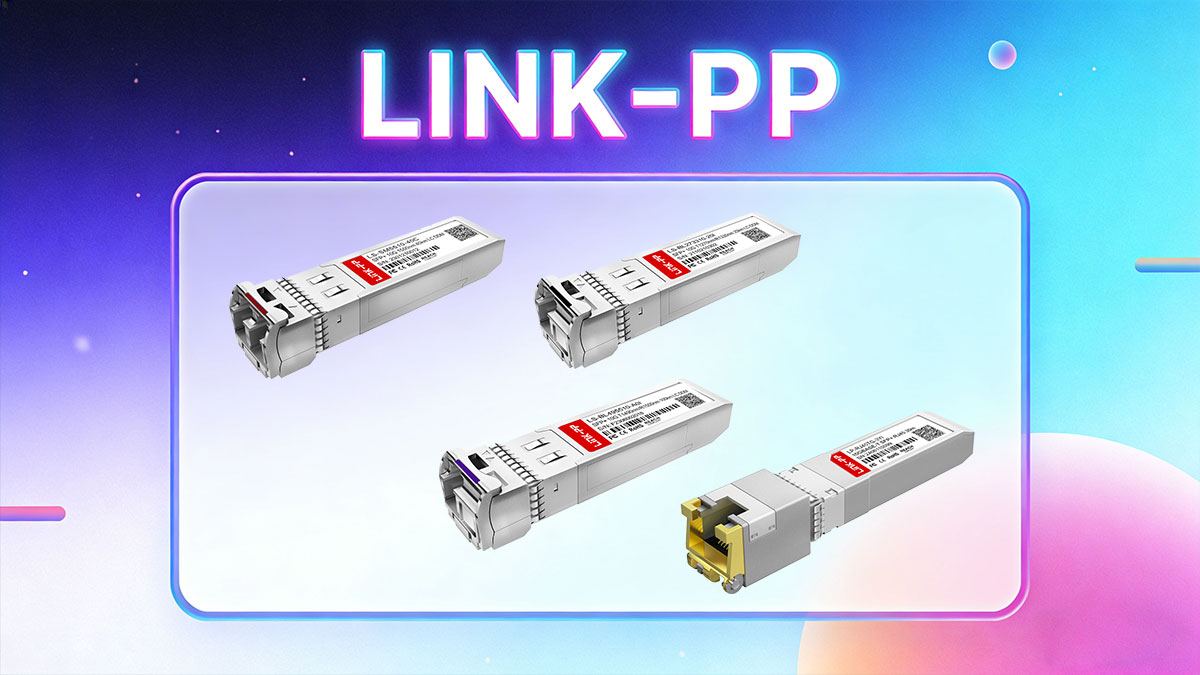
If you are planning a bulk purchase, multi-site rollout, or long-term supply agreement, LINK-PP supports:
Vendor-coded and interoperability-tested 10GbE SFP+ modules
Flexible MOQ and volume pricing
Stable lead times for both standard and custom-coded optics
Warranty-backed products with structured RMA support
👉 Request a Quote (RFQ) or visit LINK-PP Official Store to receive pricing, compatibility confirmation, and deployment recommendations tailored to your network architecture.