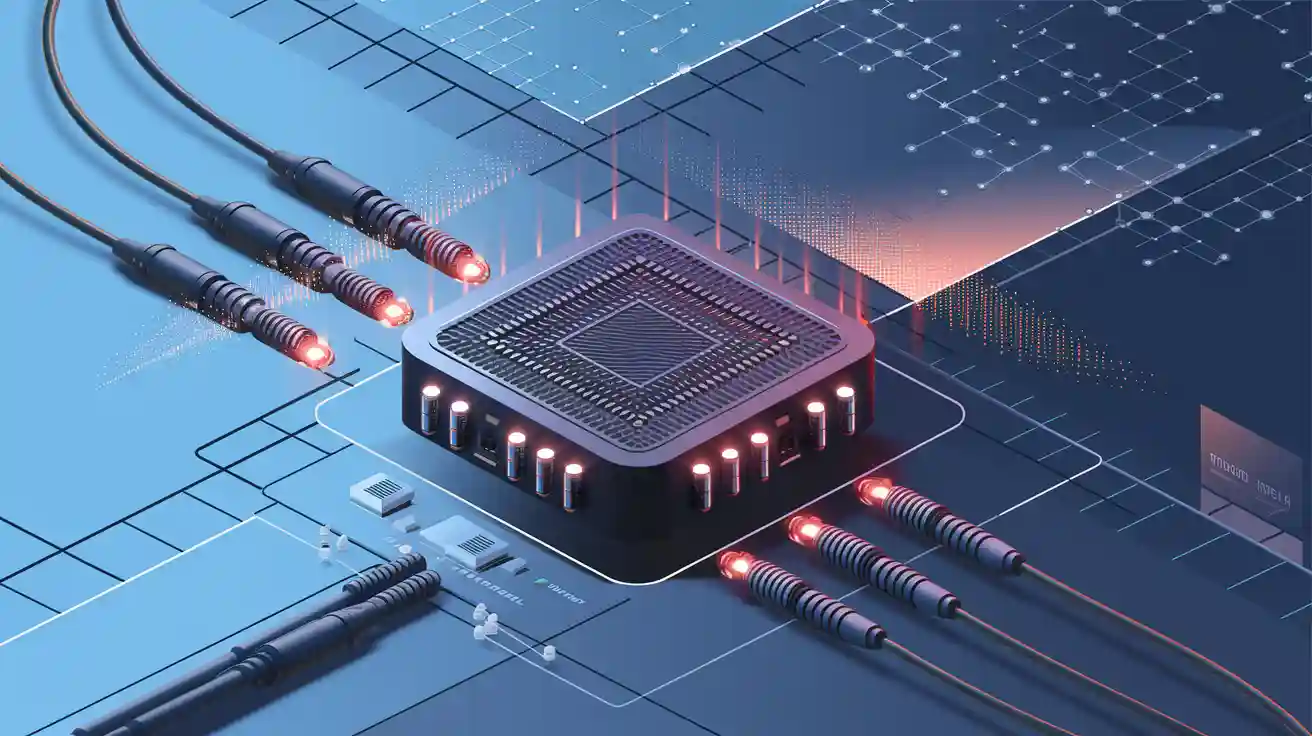

In today's data-driven world, efficient communication systems are the backbone of everything from streaming videos to cloud computing. At the heart of these systems lie two critical components: the multiplexer (MUX) and demultiplexer (DEMUX). These devices play a pivotal role in optimizing bandwidth, reducing costs, and enhancing network performance. Whether you're a network engineer, IT professional, or simply curious about how data travels, this guide will demystify MUX and DEMUX, exploring their functions, types, and real-world applications. We'll also dive into the role of optical transceivers, including solutions from industry leaders like LINK-PP, to show how these technologies integrate seamlessly. By the end, you'll grasp why MUX and DEMUX are essential for modern networks and how they support high-speed data transmission.
📑 Key Takeaways
Multiplexers put many signals together into one. This helps save space and lowers costs when sending data.
Demultiplexers take one signal and split it into many outputs. This makes sure each device gets the right data.
Using MUX and DEMUX together helps manage data well. It also means fewer wires are needed in a network.
These devices are very important in things we use every day. Phones, computers, and TVs use them to make talking and sharing faster and better.
Learning about MUX and DEMUX helps you get ready for new technology. You will be ready for things like smart cities and 5G networks.
📑 What Are MUX and DEMUX?
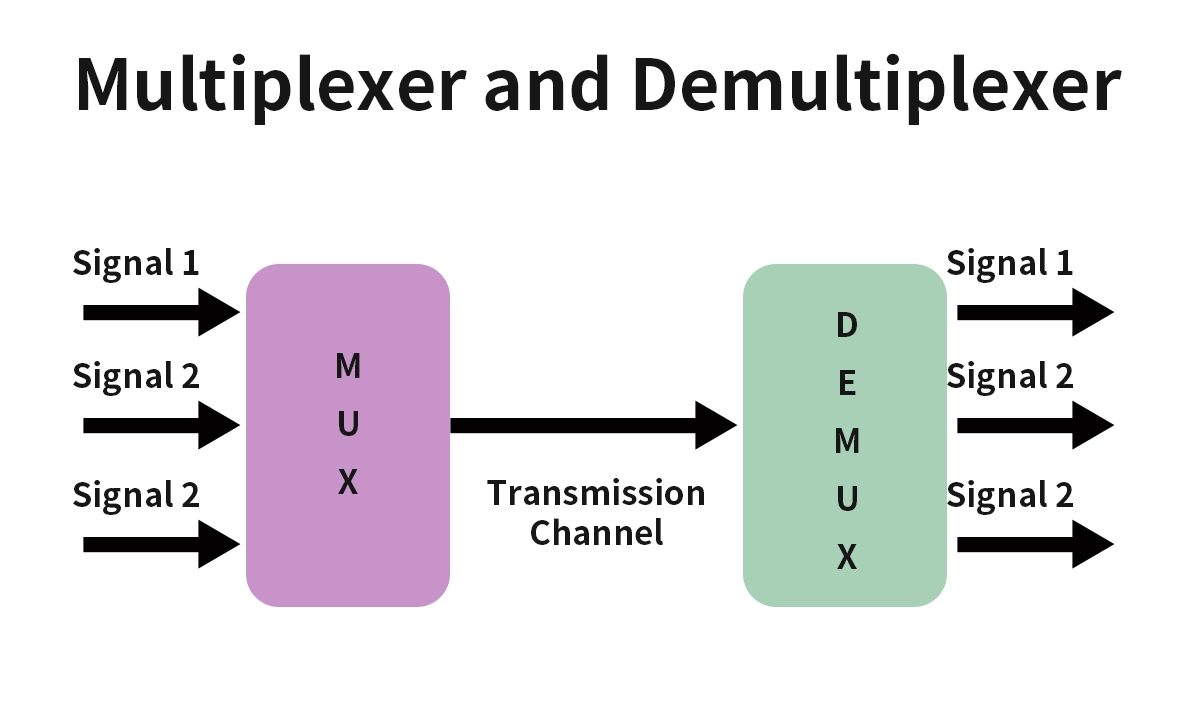
A multiplexer (MUX) is a device that combines multiple input signals into a single output line, allowing efficient use of transmission media like cables or fiber optics. Think of it as a traffic merger on a highway, where several lanes converge into one without collisions. Conversely, a demultiplexer (DEMUX) performs the reverse operation: it separates a combined signal back into its original components at the receiving end. This dynamic duo ensures that networks handle large volumes of data without bottlenecks, making them indispensable in telecommunications, broadcasting, and internet infrastructure.
• How MUX Works: MUX selects inputs based on control signals (e.g., time slots or frequencies) and merges them. For example, in time-division multiplexing (TDM), it allocates specific time intervals to each input.
• How DEMUX Works: DEMUX uses similar control logic to route the single input to multiple outputs, effectively "unpacking" the data.
This process not only saves physical resources but also boosts scalability, a key factor in "optimizing network bandwidth with MUX and DEMUX".
📑 Types of MUX and DEMUX: A Comparative Overview
MUX and DEMUX come in various forms, each suited to different applications. Below is a table summarizing the common types, their descriptions, and typical use cases. This comparison highlights why choosing the right type matters for performance and cost-efficiency.
Type | Description | Common Applications |
|---|---|---|
Divides the signal into time slots, assigning each input a specific interval. | Telephone networks, digital audio broadcasting | |
Splits the bandwidth into frequency bands, with each input occupying a unique range. | Radio and TV broadcasting, cable internet | |
Uses different wavelengths of light to combine signals, ideal for fiber optics. | Data centers, long-haul telecommunications | |
Encodes signals with unique codes, allowing simultaneous transmission. | Wireless communications, 4G/5G networks |
Among these, WDM is particularly relevant for "high-speed fiber optic networks," as it enables massive data capacity over single fibers. For instance, dense WDM (DWDM) can handle dozens of wavelengths, making it a go-to for "MUX and DEMUX in data center optimization."
📑 Applications of MUX and DEMUX in Modern Networks
MUX and DEMUX technologies are everywhere, from everyday internet use to specialized industrial systems. Here are some key applications:
• Telecommunications: In phone networks, TDM allows multiple calls to share a single line, reducing infrastructure costs. DEMUX then routes calls to the correct recipients. This is crucial for "improving telecommunication efficiency with multiplexing" .
• Broadcasting: TV and radio stations use FDM to transmit multiple channels over the airwaves, enabling viewers to access diverse content seamlessly.
• Data Centers: With the rise of cloud computing, WDM-based MUX/DEMUX systems help manage enormous data flows, supporting "scalable data center solutions" – a trending topic in IT forums.
• Internet of Things (IoT): In smart cities, MUX aggregates sensor data, while DEMUX distributes commands, enhancing "IoT network performance with MUX DEMUX integration."
These applications underscore why understanding MUX and DEMUX is vital for anyone involved in "network infrastructure planning." Moreover, as data demands grow, innovations in these areas continue to evolve, driven by companies like LINK-PP, which offer cutting-edge components for reliable performance.
📑 The Role of Optical Modules in MUX and DEMUX Systems
Optical modules are critical in fiber optic networks, acting as transceivers that convert electrical signals to light and vice versa. They often incorporate MUX and DEMUX functionalities, especially in WDM systems, to maximize bandwidth and minimize latency. This section explores how optical modules enhance MUX/DEMUX operations and highlights LINK-PP's contributions.
In WDM networks, optical modules use built-in MUX to combine multiple data streams into different wavelengths of light, transmitting them over a single fiber. At the other end, a DEMUX-equipped module separates these wavelengths for processing. This not only reduces cable clutter but also supports high-speed data rates, making it ideal for "high-performance optical networking solutions." For businesses seeking reliability, LINK-PP offers advanced optical modules that integrate seamlessly with MUX/DEMUX setups. One standout model is the LINK-PP 10G DWDM series, which features integrated DWDM capabilities for dense wavelength division multiplexing. This series supports up to 40 channels, ensuring efficient bandwidth utilization in data-intensive environments like cloud storage or video streaming services. By incorporating the LINK-PP 10G DWDM series, networks can achieve lower power consumption and higher scalability, addressing common pain points in "optimizing fiber optic systems with MUX DEMUX technology."
Beyond hardware, LINK-PP emphasizes compatibility with industry standards, ensuring their modules work smoothly in diverse setups. This makes them a top choice for "reliable MUX DEMUX optical modules" – As networks advance toward 5G and beyond, the synergy between optical modules and MUX/DEMUX will only grow, reinforcing the need for innovative products like those from LINK-PP.
📑 Conclusion
MUX and DEMUX are unsung heroes in the realm of data communication, enabling efficient, cost-effective, and scalable networks. From basic TDM in telephony to advanced WDM in fiber optics, these technologies adapt to evolving demands, supported by robust components like optical modules. Brands such as LINK-PP play a key role by delivering solutions like the 10G DWDM series, which streamline MUX/DEMUX integration for superior performance. As you explore network upgrades, remember that mastering MUX and DEMUX can unlock new levels of efficiency. Stay tuned for future trends, such as software-defined networking (SDN), where MUX and DEMUX will continue to shine.
For more insights, check out our resources on "MUX and DEMUX best practices" and consider LINK-PP products for your next project. Together, we can build faster, smarter networks for tomorrow.
📑 FAQ
What is the main purpose of a multiplexer (mux)?
A multiplexer lets you send many signals through one wire. You save space and money. You can control which signal goes out by using select lines.
How does a demultiplexer (demux) help in communication?
A demultiplexer takes one signal and sends it to the right device. You use it to make sure each device gets the correct data. This keeps your network organized.
Can you use mux and demux together?
Yes! You often use a multiplexer at the start to combine signals. At the end, you use a demultiplexer to split them. This helps you move data quickly and easily.
Where do you see mux and demux in real life?
You find them in phones, TVs, and computers. Data centers and factories also use them. These devices help you send and receive information every day.