

SFP+ (Small Form-factor Pluggable Plus) modules are the most widely deployed transceiver form factor for 10 Gigabit Ethernet (10GbE) networks. However, the term “SFP+ types” often causes confusion, as it refers not to a single specification, but to a family of optical and copper-based modules designed for different media, distances, and deployment scenarios.
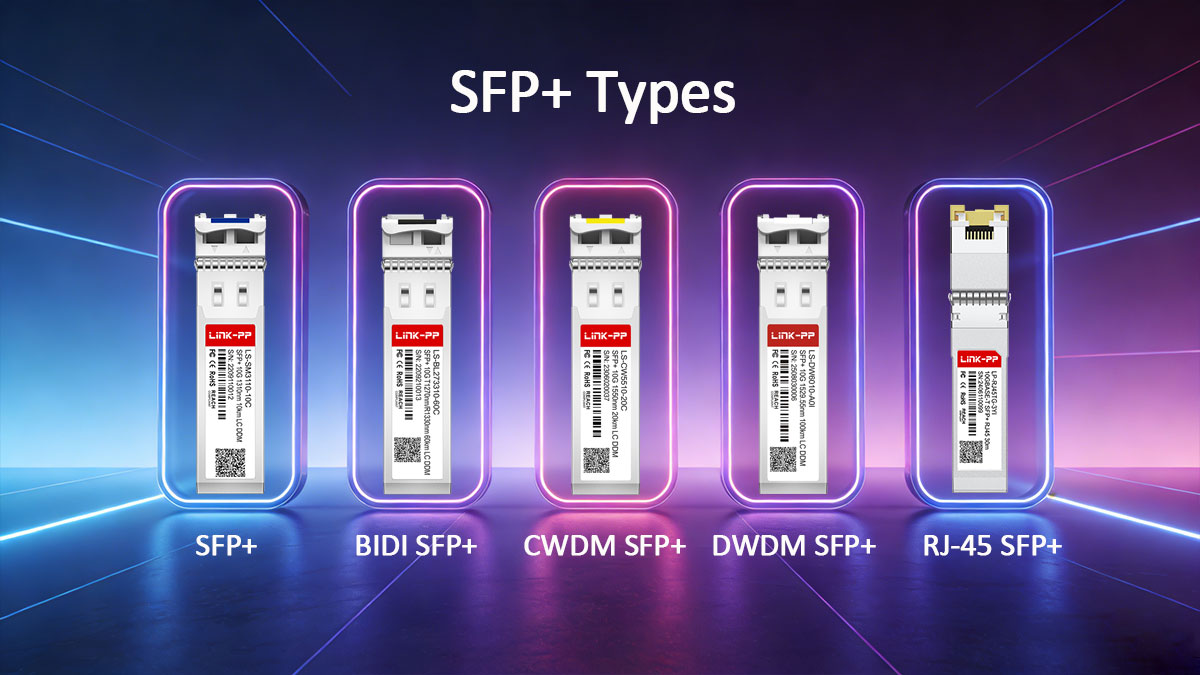
At a high level, SFP+ modules can be grouped into three primary categories:
optical SFP+ modules, copper SFP+ modules, and direct attach cable (DAC/AOC) solutions. Each type follows distinct IEEE standards, electrical interfaces, and physical layer constraints, which directly impact transmission reach, power consumption, latency, and compatibility with switches and NICs.
Understanding the differences between optical, copper, and direct attach SFP+ types is essential during the network design and module selection phase. Choosing the wrong type may lead to unnecessary power draw, limited reach, interoperability issues, or higher total cost of ownership (TCO), even when all modules are labeled as “10G SFP+”.
This guide provides a technical, vendor-neutral overview of SFP+ types, explaining how each category works, where it is typically deployed, and how they compare in real-world 10GbE applications. By the end of this article, readers will be able to clearly distinguish between the major SFP+ types and identify the most appropriate option for their specific network environment.
✳️ What Are SFP+ Modules?
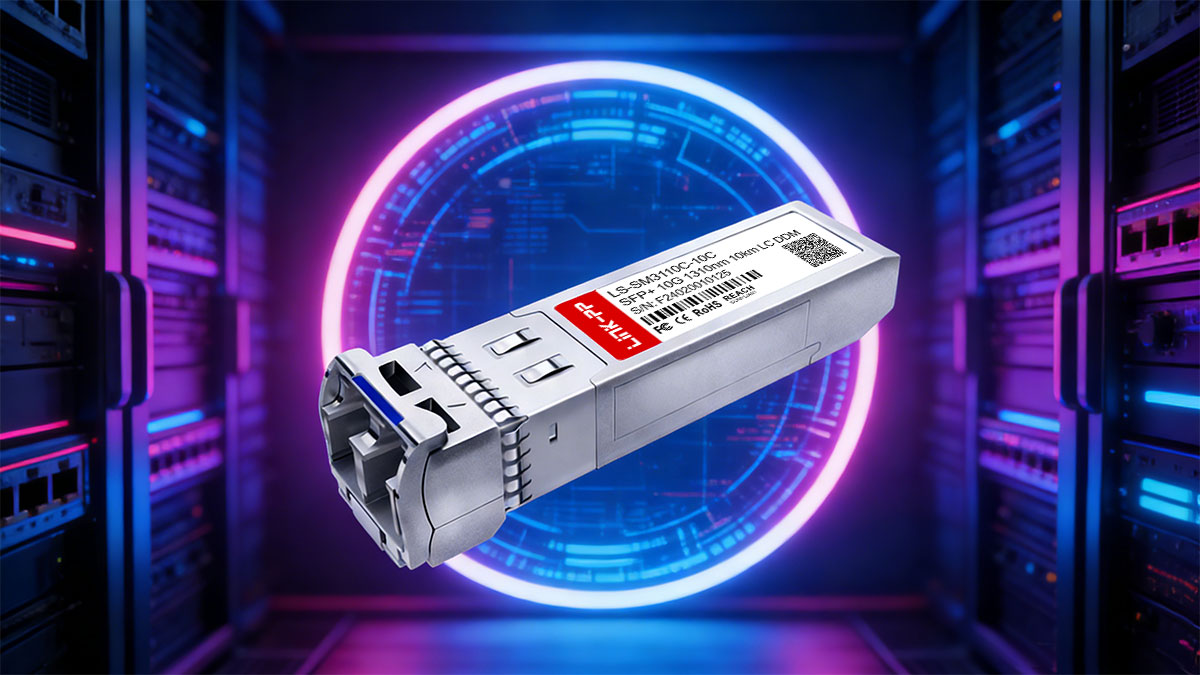
An SFP+ (Small Form-factor Pluggable Plus) module is a hot-swappable 10-gigabit Ethernet or fiber-channel transceiver that converts electrical signals from a network switch or server into optical or copper signals, enabling flexible 10GbE connectivity across short-reach, campus, and metro-scale links using standardized SFP+ form factors.
Why SFP+ Still Matters in 2026
Massive installed base
SFP+ remains widely deployed in enterprise switches, legacy data centers, and access networks, ensuring long-term demand and compatibility requirements.Cost-efficient 10GbE connectivity
Compared with higher-speed optics (25G/100G), SFP+ offers a lower cost per port for workloads that do not require bandwidth upgrades.Broad media flexibility
Supports multimode fiber, single-mode fiber, DAC, AOC, and copper (10GBASE-T), covering most real-world cabling scenarios.Mature standards and interoperability
Backed by IEEE 802.3ae and SFP+ MSA specifications, with predictable performance and stable multi-vendor ecosystems.Ideal for specific use cases
Still preferred for management networks, storage backends, campus backbones, and cost-sensitive edge deployments.
✳️ SFP+ Types at a Glance
SFP+ Type | Medium | IEEE / MSA Standard | Typical Wavelength | Fiber / Cable Type | Max Distance | Typical Power Consumption | Primary Deployment Scenario |
|---|---|---|---|---|---|---|---|
10GBASE-SR | Optical | IEEE 802.3ae | 850 nm | Multimode Fiber (OM3/OM4) | 300–400 m | Low (~0.8–1 W) | Data center intra-rack / short inter-rack links |
10GBASE-LR | Optical | IEEE 802.3ae | 1310 nm | Single-Mode Fiber (SMF) | Up to 10 km | ~1 W | Campus backbone, building-to-building |
10GBASE-ER | Optical | IEEE 802.3ae | 1550 nm | Single-Mode Fiber (SMF) | Up to 40 km | Higher (~1.5–2 W) | Metro and carrier aggregation |
BiDi SFP+ | Optical | MSA (Non-IEEE specific) | Tx/Rx paired wavelengths (e.g., 1270/1330 nm) | Single Fiber SMF | Up to 10–40 km | ~1–1.5 W | Fiber-limited deployments, access networks |
CWDM SFP+ | Optical | CWDM MSA | 1270–1610 nm (20 nm spacing) | Single-Mode Fiber | Typically 10–40 km | ~1–1.5 W | Metro aggregation, fiber capacity expansion |
DWDM SFP+ | Optical | DWDM MSA | ITU-T DWDM grid | Single-Mode Fiber | 40–80 km+ (depends on link design) | Higher (~2–2.5 W) | Long-haul, high-density transport networks |
Passive DAC | Copper (Twinax) | SFP+ MSA | N/A | Twinax Copper Cable | Up to ~7 m | Very Low (<0.5 W) | Top-of-Rack server-to-switch connections |
Active DAC | Copper (Twinax) | SFP+ MSA | N/A | Twinax Copper Cable | Up to ~10–15 m | Low (~0.5–1 W) | Inter-rack short links with better signal integrity |
10GBASE-T SFP+ | Copper (RJ-45) | IEEE 802.3an | Electrical signaling | Cat6A / Cat7 | Up to 30 m @10G (100 m @1G) | Highest (~2–3 W) | Legacy copper infrastructure integration |
Classification of SFP+ Types
SFP+ modules are commonly classified based on transmission medium, reach, wavelength, and electrical interface architecture. This structured categorization helps network designers quickly identify the most suitable module for data center, enterprise, or telecom deployments while ensuring interoperability with IEEE Ethernet standards.
By Transmission Medium
The primary and most widely used classification divides SFP+ types into three categories:
Optical Fiber SFP+ Transceivers
These modules convert electrical signals into optical signals for transmission over fiber. Optical SFP+ variants are typically selected when longer reach, EMI immunity, or higher link stability is required.
Common subtypes include:
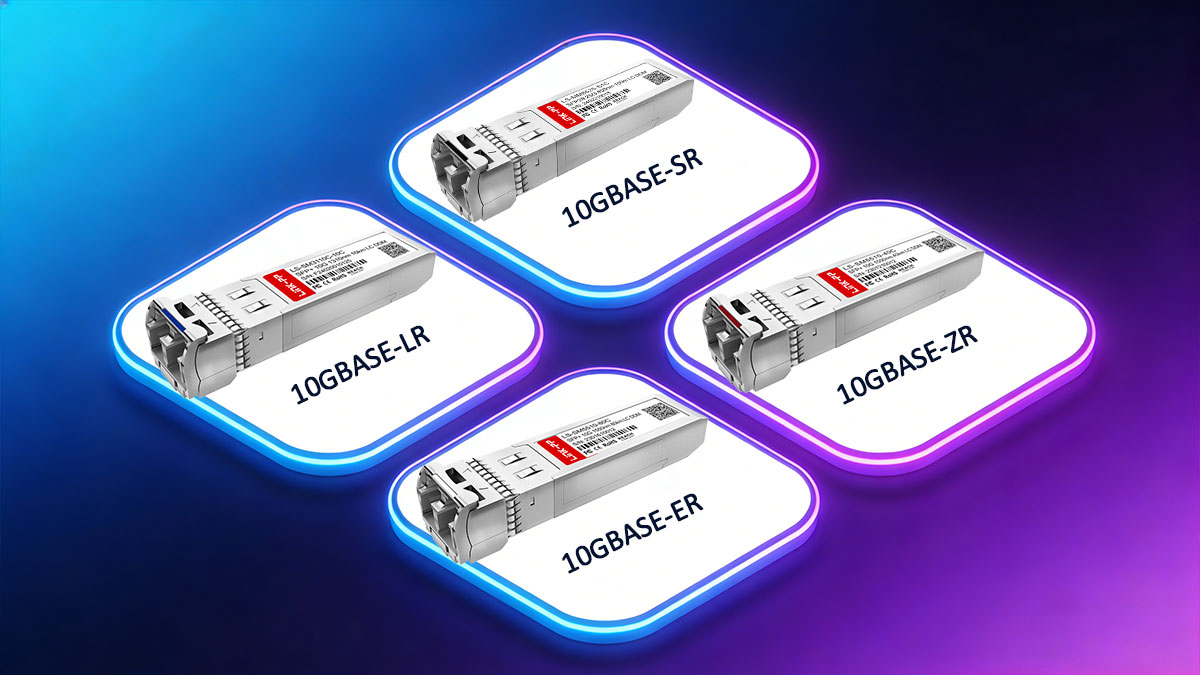
10GBASE-SR (Short Reach) — Uses 850 nm wavelength over multimode fiber (MMF), typically supporting distances up to 300–400 m depending on fiber grade.
10GBASE-LR (Long Reach) — Operates at 1310 nm over single-mode fiber (SMF), supporting distances up to 10 km.
10GBASE-ER (Extended Reach) — Uses 1550 nm optics, enabling transmission distances up to 40 km.
SFP+ BiDi (Bidirectional) — Transmits and receives on different wavelengths over a single fiber strand, reducing fiber infrastructure requirements.
CWDM SFP+ / DWDM SFP+ — Designed for wavelength-division multiplexing applications to increase fiber capacity in metro and long-haul networks.
Direct Attach Copper (DAC) Cables
DAC SFP+ assemblies integrate twinax copper cabling with fixed SFP+ connectors on both ends. These are commonly used for short-distance, low-latency, and cost-efficient connections inside racks or between adjacent racks.
Typical characteristics:
Passive DAC: up to ~7 m reach, no signal amplification
Active DAC: extended reach (up to ~10–15 m), includes signal conditioning electronics
Lowest power consumption among SFP+ interconnect options
10GBASE-T Copper SFP+ Modules
These SFP+ modules use RJ-45 interfaces and transmit 10 Gbps Ethernet over twisted-pair cabling.
Key deployment traits:
Supports Cat6A / Cat7 cabling
Typical maximum reach up to 30 m at 10 Gbps (longer at lower speeds)
Enables backward compatibility with existing copper infrastructure
Higher power consumption compared to optical or DAC solutions
By Transmission Distance (Reach-Based Classification)
SFP+ modules are also grouped according to supported link distance:
Short Reach (SR, DAC) — Data center intra-rack and inter-rack connectivity
Intermediate Reach (LR) — Campus or building-to-building links
Extended Reach (ER / ZR / DWDM) — Metro, aggregation, or carrier networks
This reach-based classification aligns module selection with network topology and budget considerations.
By Wavelength and Optical Technology
For fiber-based SFP+ optics, wavelength selection determines fiber compatibility and network design:
850 nm — Multimode data center applications
1310 nm — Standard single-mode enterprise and access links
1550 nm — Long-distance and carrier transport
CWDM/DWDM Grid — Multi-channel optical transport and bandwidth scaling
By Electrical Interface Architecture
From a hardware integration perspective, SFP+ types may also be categorized by signal handling:
Linear optics — Minimal onboard DSP, lower latency
Retimed optics — Includes clock and data recovery for improved signal integrity
Active copper (AEC) — Copper interconnects with integrated signal conditioning
Understanding these classification dimensions—medium, reach, wavelength, and electrical architecture—allows engineers and buyers to match SFP+ types precisely to bandwidth targets, cabling infrastructure, power budgets, and long-term scalability requirements.
Quick Decision Guidance
Choose 10G SR for the lowest cost and power consumption when distances are within a data hall and multimode fiber is already deployed.
Choose 10G LR for reliable 1–10 km links over standard single-mode fiber across campus or metro sites.
Choose 10G ER or 10G ZR when distances exceed 10 km and higher optical budget is required.
Choose DAC for the most economical ultra-short connections between adjacent racks or within the same cabinet.
Choose AOC when you need plug-and-play fiber links with consistent performance in dense environments.
Choose 10GBASE-T when preserving existing structured copper cabling is more cost-effective than deploying fiber.
✳️ Optical SFP+ Types
10GBASE-SR (Short-Range)
Key Specifications
Wavelength: ~850 nm (VCSEL-based)
Fiber Type: Multimode fiber (MMF), typically OM3 or OM4
Typical Reach:
Up to 300 m on OM3
Up to 400 m on OM4 (longer distances may be possible on OM5 under certain conditions)
Typical Deployments & Cost Profile
10GBASE-SR is the most widely deployed 10GbE optical interface inside data centers. It is commonly used for:
Top-of-Rack (ToR) to aggregation switch links
Leaf–spine architectures
Short intra-row or intra-pod connections
Because SR modules use short-wavelength VCSEL lasers and multimode fiber infrastructure, they generally offer the lowest cost per optical link and relatively low power consumption, making them the default choice for high-port-density environments.
Quick Procurement Note
Before ordering SR modules, verify the installed MMF grade (OM2 vs OM3/OM4). Using older OM2 fiber may significantly reduce achievable distance and could require link budget validation or migration to higher-grade MMF.
10GBASE-LR (Long-Range)
Key Specifications
Wavelength: ~1310 nm
Fiber Type: Single-mode fiber (SMF, typically OS2)
Standard Reach: Up to 10 km
Deployment Characteristics
10GBASE-LR is commonly selected for:
Building-to-building campus backbones
Data center interconnect (DCI) within metro distances
Enterprise aggregation layers
LR optics provide a balanced combination of reach, stability, and moderate cost, and they are supported across virtually all enterprise switch platforms.
Procurement / Compatibility Note
When sourcing LR modules, confirm:
Vendor compatibility coding (e.g., Cisco, Arista, Juniper, HPE)
Optical budget alignment with installed fiber plant (connector count, splice loss)
LR modules typically represent one of the highest global purchasing volumes due to their flexibility across multiple deployment scenarios.
10GBASE-ER (Extended-Range)
Key Specifications
Wavelength: ~1550 nm
Fiber Type: Single-mode fiber (SMF)
Standard Reach: Up to 40 km (per IEEE 802.3ae optical specifications)
Typical Reach & Deployment
ER optics are designed for longer enterprise or carrier access links where distances exceed LR capabilities. Typical use cases include:
Long-distance inter-building connections
Metro aggregation
Telecom access or regional interconnect
When to Choose ER
Select ER modules when:
Link distance approaches or exceeds 10 km
Additional optical power budget is required
Carrier-grade transmission stability is necessary
Because ER optics use higher-power transmitters and more complex optical components, they generally carry a higher acquisition cost and may require attention to receive-side overload conditions in very short links.
10GBASE-ZR (Vendor / Non-IEEE Extended Reach)
Standards Status and Specifications
IEEE Status: Not formally standardized by IEEE 802.3
Wavelength: Typically ~1550 nm
Fiber Type: Single-mode fiber (SMF)
Typical Reach: Approximately 60–80 km, depending on vendor implementation and link conditions
Deployment Considerations
ZR modules are widely available from many optical vendors and are commonly used for extended metro or regional connectivity without deploying separate transport equipment.
Caveats
Optical budgets and performance characteristics vary significantly between manufacturers
Interoperability across different vendors may not be guaranteed
Some switch platforms enforce stricter qualification requirements for non-standard optics
For procurement, verify both platform compatibility and link engineering margins before selecting ZR for production networks.
10GBASE-LRM (Legacy Multimode Support)
Key Specifications
Wavelength: ~1310 nm
Fiber Type: Legacy multimode fiber (including older installed MMF such as OM1/OM2)
Typical Reach: Up to 220 m depending on fiber quality and mode conditioning
Relevance and Use Cases
10GBASE-LRM was designed to extend 10GbE operation over existing multimode infrastructure where SR could not meet distance requirements and fiber replacement was not immediately feasible.
Current Market Context
Today, LRM is considered a legacy or niche option:
Often used only in environments with older cabling plants
May require mode conditioning patch cables for stable performance
Increasingly replaced by either SR on upgraded MMF or LR over single-mode fiber for new deployments
From a sourcing perspective, confirm availability and platform support, as some modern switch ecosystems have reduced validation focus on LRM optics.
✳️ Copper & Direct Attach SFP+ Types
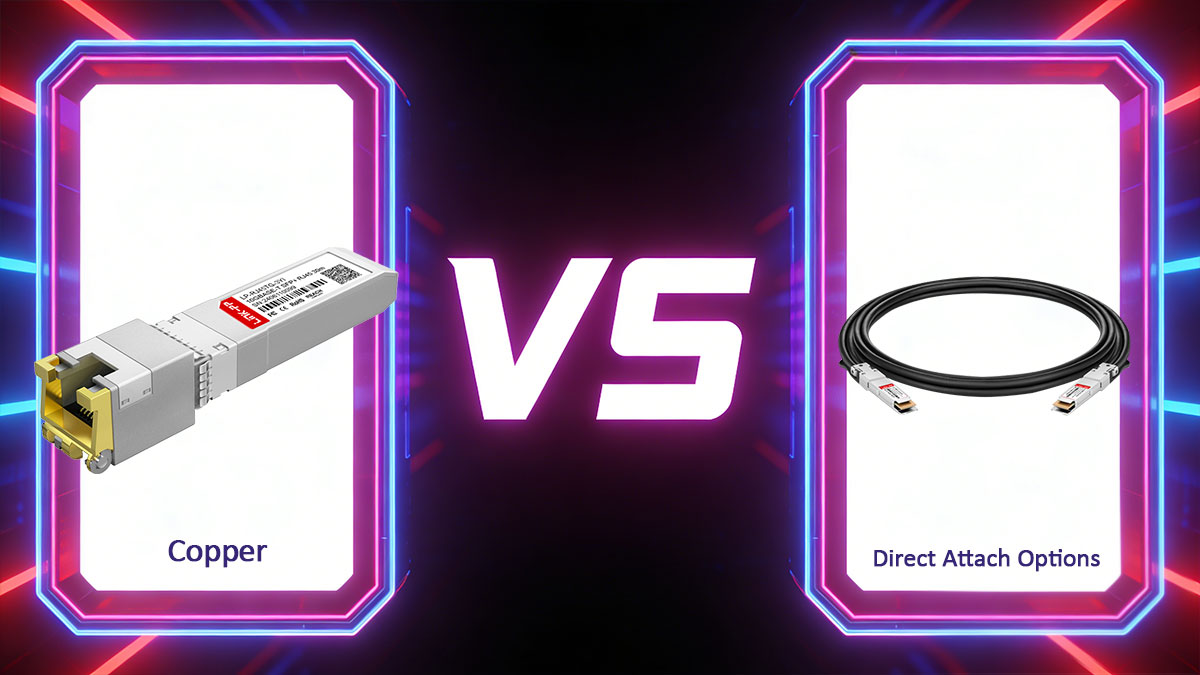
SFP+ DAC (Passive / Active Twinax)
Overview
SFP+ Direct Attach Copper (DAC) cables integrate fixed SFP+ connectors with twinax copper cabling, providing a cost-effective, low-latency interconnect for short-reach 10GbE links.
Typical Lengths
Passive DAC: Commonly 0.5 m to 3 m (in some implementations up to ~5 m depending on signal quality)
Active DAC: Typically 3 m to 10 m, using integrated signal conditioning to extend reach
Latency and Power Tradeoffs
Passive DAC
Lowest latency (no active electronics)
Very low power consumption
Lowest cost per port
Best suited for rack-level connections (e.g., server ↔ ToR switch)
Active DAC
Slightly higher power draw due to embedded electronics
Extends usable distance beyond passive limits
Still lower latency and cost compared with optical solutions
Deployment Notes
DAC is widely used in high-density data center environments where structured fiber is unnecessary and cable management distances remain short.
AOC (Active Optical Cable)
Overview
Active Optical Cables (AOCs) integrate optical transceivers and multimode fiber into a factory-terminated cable assembly. They function like a “plug-and-play” optical link without requiring separate transceiver modules and patch cords.
When AOC Is Preferred Over DAC
Distances typically 10 m to 100 m or more (model-dependent)
Environments where copper DAC distance is insufficient
Cable routing paths requiring lighter weight and improved EMI immunity
Higher port density rows or cross-rack connections
Operational and Manageability Notes
Fixed cable length—cannot be re-terminated in the field
Generally lower power consumption than RJ-45 copper solutions
Simplifies installation but reduces flexibility compared with discrete optics + patch cords
Vendor compatibility coding is still required for switch interoperability
AOCs are frequently chosen when the link exceeds DAC distance but cost sensitivity remains higher than for discrete SR optics.
10GBASE-T (RJ-45 SFP+)
Overview
10GBASE-T SFP+ modules provide 10GbE connectivity over standard twisted-pair copper cabling using an RJ-45 interface, enabling reuse of existing structured cabling infrastructure.
Cable Classes and Reach
Cat6A or Cat7: Up to 100 meters at 10Gbps
Cat6: Often supports shorter 10G distances (commonly up to ~30–55 m depending on installation quality)
Power and Thermal Considerations
Typically higher power consumption than optical SR or DAC solutions
Increased thermal output can impact switch port density and airflow design
Some switches limit the number of simultaneously installed 10GBASE-T SFP+ modules due to power budgets
Deployment Guidance
10GBASE-T SFP+ is commonly selected when:
Existing copper infrastructure must be reused to avoid fiber installation costs
Backward compatibility with 1G/100M auto-negotiation is required
Link distances approach standard structured cabling lengths within enterprise environments
For new high-density data center designs, planners often prefer SR optics or DAC to reduce energy consumption and heat load.
✳️ How to Choose the Right SFP+ Type
Selecting the correct SFP+ variant requires aligning physical infrastructure, link budget, and switch compatibility before considering cost. The following checklist reflects the typical engineering and procurement workflow used in enterprise and data center deployments.
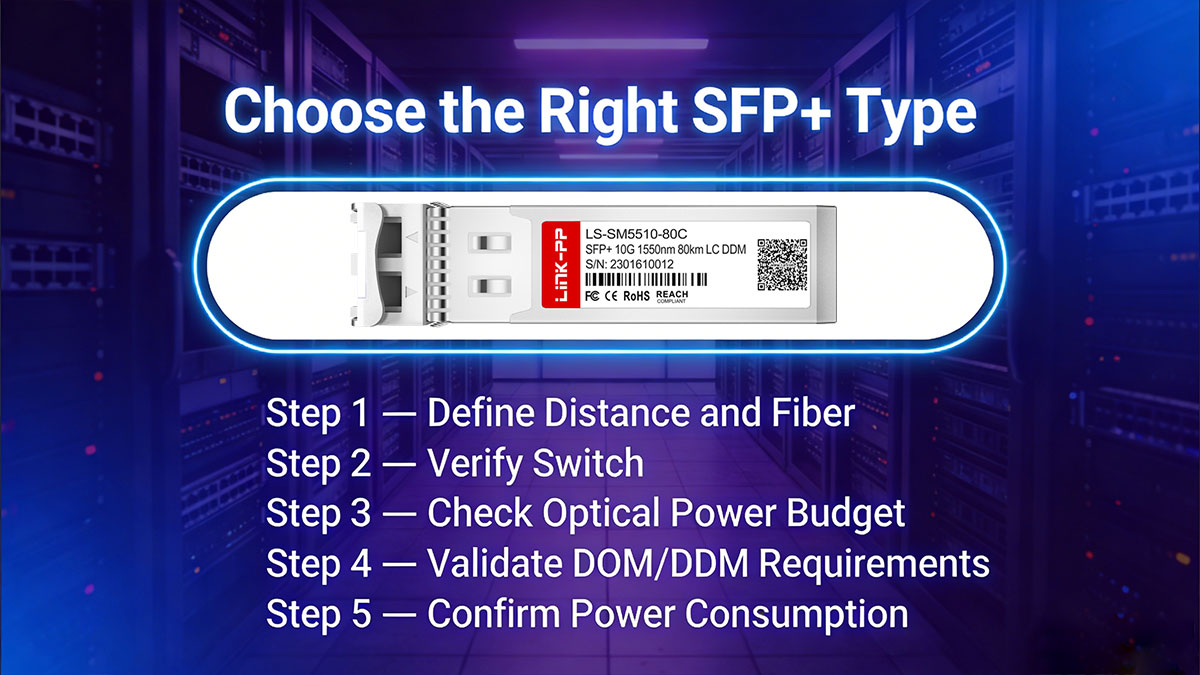
Step 1 — Define Distance and Fiber/Copper Infrastructure
Start by confirming the actual link length and the existing cabling type.
≤ 3–5 m (same rack): Consider Passive DAC for the lowest cost and power.
5–100 m (same row or adjacent racks): Active DAC or AOC may be appropriate.
Up to ~300–400 m over MMF (OM3/OM4): Choose 10GBASE-SR.
1–10 km over SMF: Use 10GBASE-LR.
10–40 km or longer over SMF: Evaluate 10GBASE-ER or extended-reach optics.
Also verify:
Fiber grade (OM2 / OM3 / OM4 / OS2)
Connector type (LC duplex vs RJ-45)
Whether existing structured cabling must be reused
Step 2 — Verify Switch/Vendor Compatibility and EEPROM Coding
Check the switch vendor’s interoperability requirements:
Confirm supported optics list (e.g., Cisco, Arista, Juniper, HPE).
Ensure the module is properly EEPROM-coded for the target platform.
For multi-vendor networks, consider modules tested across multiple OEM environments.
Validate whether the switch enforces vendor lock or allows third-party optics.
Early compatibility verification prevents link bring-up failures and avoids unnecessary RMA cycles.
Step 3 — Check Optical Power Budget and Reserve Margin
For fiber links, confirm that the transmit (Tx) power, receiver sensitivity, and total link loss provide adequate margin.
Basic workflow:
Calculate total channel loss:
Fiber attenuation (dB/km × distance)
Connector and splice losses
Compare with module optical specifications.
Maintain engineering margin (commonly ≥2–3 dB for stable operation).
Insufficient margin can cause intermittent errors even if the link initially comes up.
Step 4 — Validate DOM/DDM Requirements and Monitoring
Determine whether Digital Optical Monitoring (DOM/DDM) is required for operations:
Real-time visibility into:
Tx/Rx optical power
Module temperature
Supply voltage
Laser bias current
Useful for:
Preventive maintenance
SLA monitoring
Remote troubleshooting
Ensure both the module and the switch OS support DOM reporting via SFF-8472.
Step 5 — Confirm Power Consumption and Chassis Thermal Budget
Power draw varies significantly by media type:
Lowest: Passive DAC
Moderate: SR optics / AOC
Higher: LR / ER optics
Highest: 10GBASE-T (RJ-45 SFP+)
Before large deployments:
Verify per-port power limits on the switch.
Confirm airflow direction and thermal headroom.
Check whether the platform restricts the number of high-power modules.
Ignoring thermal constraints can lead to port shutdowns or reduced system reliability.
SFP+ Types Selection Decision Quick Flow
1. What is the required distance?
≤ 3–5 m → Passive DAC
5–10 m → Active DAC
10–100 m → AOC or SR
≤ 300–400 m over MMF → 10GBASE-SR
1–10 km over SMF → 10GBASE-LR
10 km → ER or extended-reach
2. Does existing cabling need to be reused?
Existing Cat6A/Cat7 → Consider 10GBASE-T
Existing MMF → Prefer SR
Existing SMF → LR / ER family
3. Is the switch vendor restrictive?
If yes → Use certified or correctly coded compatible optics.
4. Is operational monitoring required?
If yes → Select modules with DOM/DDM support.
5. Are power and thermal budgets tight?
Favor DAC or SR over higher-power copper or long-reach optics.
This structured approach ensures the selected SFP+ type meets technical requirements while minimizing deployment risk and long-term operating cost.
✳️ Practical SFP+ 10G Modules Deployment Examples
Real-world deployments illustrate which SFP+ variants are best suited for specific environments, distances, and operational constraints. These examples help procurement and network engineers make informed decisions based on both technical and cost factors.
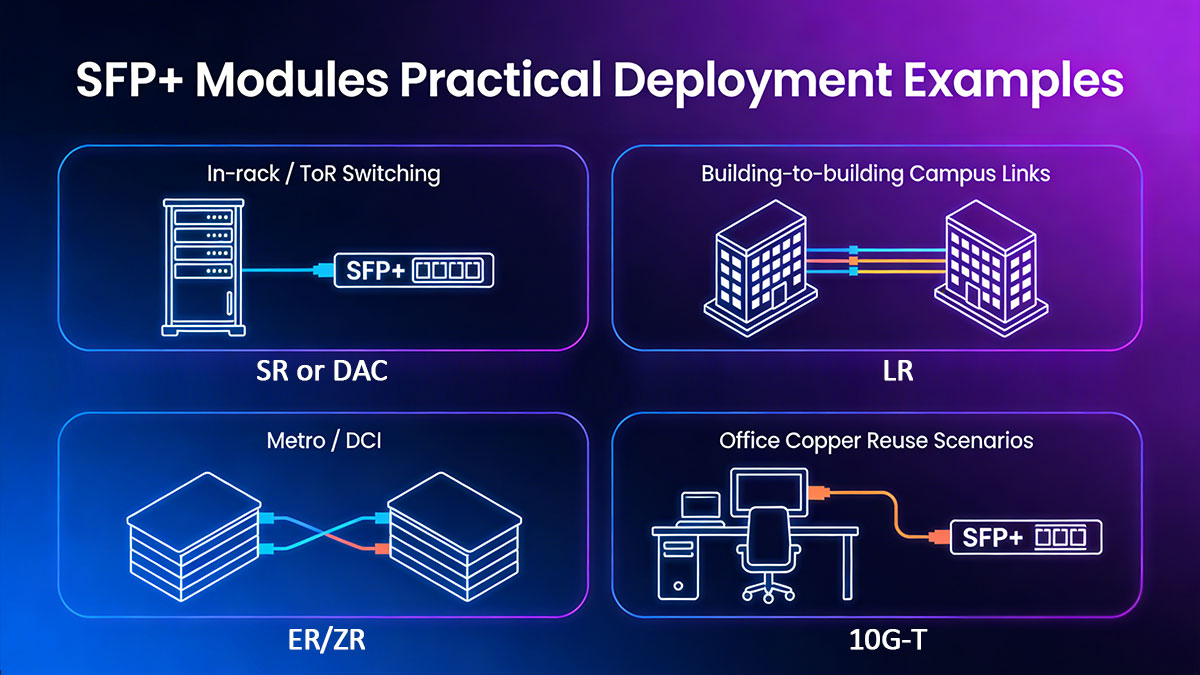
● In-rack / ToR Switching (SR or DAC)
Environment: High-density, short-distance links within the same rack or adjacent racks.
Recommended Modules:
SFP-10G-SR for fiber-based ToR connections
Passive DAC for direct copper connections under 5 meters
Reasoning:
Lowest cost per link
Minimal power consumption
Plug-and-play deployment without complex link budget calculations
Ideal for modern hyper-scale or enterprise racks with multimode fiber already deployed
● Building-to-building Campus Links (LR)
Environment: Inter-building connections within a campus, up to 10 km.
Recommended Module: SFP-10G-LR (single-mode fiber)
Reasoning:
Provides stable medium-range transmission
Compatible with standard single-mode fiber (OS1/OS2)
Widely supported across Cisco, Arista, Juniper, and other enterprise switches
Ensures low error rates for backbone traffic
Deployment Notes:
Check fiber connector types (LC duplex)
Validate optical power budget and reserve margin
● Metro / DCI (ER/ZR and Amplification/Dispersion Notes)
Environment: Regional backbone, metro interconnect, or data center interconnect (DCI) applications over 10–80 km.
Recommended Modules: 10GBASE-ER or 10GBASE-ZR
Reasoning:
Higher optical power output for extended reach
Designed for long-haul SMF transmission
Can support carrier-grade aggregation and inter-datacenter links
Deployment Notes:
Monitor optical link budget carefully; include connector/splice losses
Consider optional optical amplification or dispersion compensation for ZR-class distances
Validate vendor compatibility for non-IEEE ZR modules
● When to Choose 10G-T (Office Copper Reuse Scenarios)
Environment: Existing structured copper cabling in office or enterprise LANs.
Recommended Module: 10GBASE-T SFP+ RJ-45
Reasoning:
Enables reuse of Cat6A/Cat7 cabling without fiber deployment
Supports backward compatibility with 1G/100M through auto-negotiation
Easy to install in office environments where fiber infrastructure is absent
Deployment Notes:
Monitor power consumption, as 10G-T modules draw more than optical SFP+ or DAC
Ensure adequate chassis airflow and thermal management for multiple ports
✳️ Common SFP+ Interoperability & Procurement Concerns with SFP+ Modules
Ensuring smooth deployment of SFP+ modules requires attention to vendor coding, warranty coverage, and pre-deployment testing. Addressing these concerns upfront reduces downtime, prevents compatibility issues, and safeguards procurement investments.
1. Vendor Coding & “Unsupported Transceiver” Messages
Key Points:
Many switches (Cisco, Arista, Juniper, HPE) enforce vendor EEPROM coding to recognize modules.
Using unverified third-party SFP+ modules may trigger “unsupported transceiver” warnings.
Even if modules work physically, firmware or lane mapping mismatches can cause intermittent errors.
Recommendations:
Always verify EEPROM ID, vendor OUI, and supported module type before purchase.
Use modules certified or tested for your specific switch model when possible.
For mixed-vendor networks, maintain a vendor-approved compatibility list.
2. Warranty, RMA, and Supplier Validation
Key Points:
Check warranty period and RMA procedures—some suppliers offer advanced replacement options.
Ensure the supplier adheres to ISO or other manufacturing standards for quality.
MOQ, lead time, and batch traceability are critical for bulk or recurring purchases.
Recommendations:
Confirm return policies for defective modules before procurement.
Evaluate supplier credibility based on prior shipments, certifications, and support responsiveness.
Consider supplier redundancy to avoid downtime if a vendor cannot meet urgent demand.
3. Lab Testing Checklist Before Mass Deployment
Purpose: Detect compatibility and performance issues before network-wide rollout.
Checklist:
Plug modules into representative switches to confirm link negotiation.
Verify DOM/DDM readings: optical power, temperature, supply voltage, and laser bias.
Test latency and error rates under expected traffic loads.
Confirm interoperability with DAC, AOC, or fiber cabling in use.
Check firmware versions and lane alignment for multi-vendor deployments.
Outcome:
Early detection of module mismatches or defective units.
Reduced operational risk and simplified troubleshooting post-deployment.
Ensures procurement decisions align with network reliability and total cost of ownership (TCO).
This section equips network engineers and procurement managers with the knowledge to avoid common SFP+ pitfalls, ensuring compatibility, quality, and predictable operational performance.
✳️ Quick SFP+ Types Reference Tables
To simplify procurement and deployment decisions, the following tables provide compact, copy-ready SFP+ specifications and a quick purchasing checklist suitable for product pages or internal references.
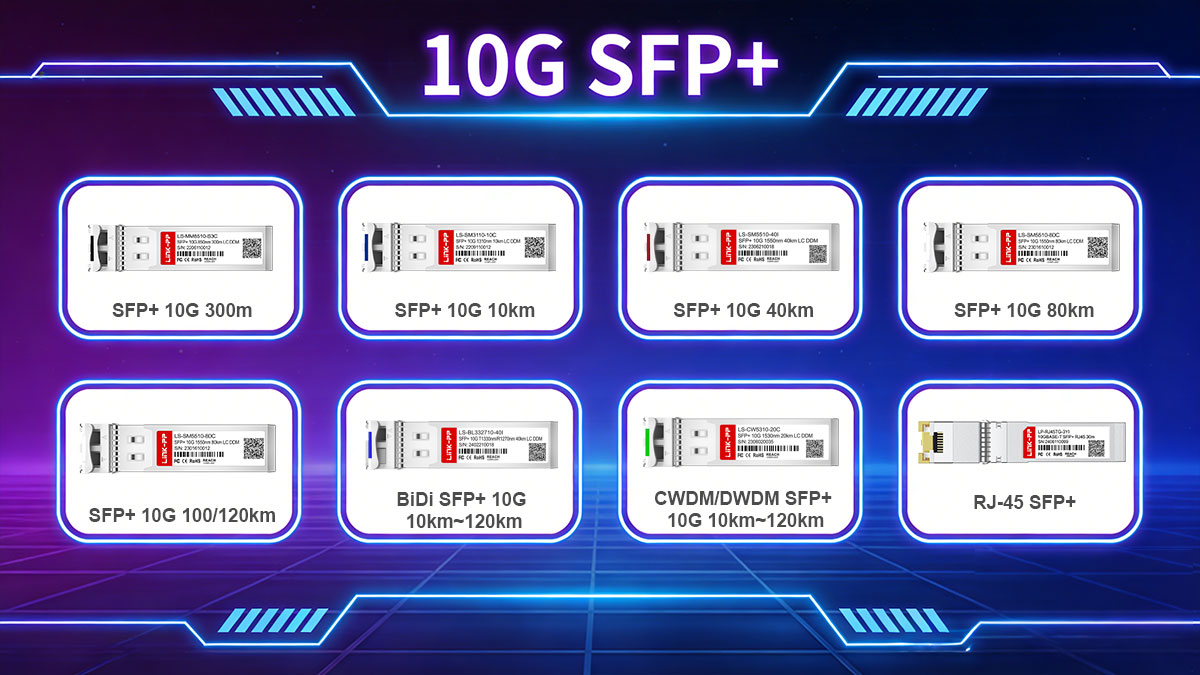
Compact Spec Table of All Types of 10G SFP+
Type | Wavelength | Fiber Type | Typical Reach | Connector | Typical Use |
|---|---|---|---|---|---|
10GBASE-SR | 850 nm | MMF (OM3/OM4) | up to 300 m | LC | In-rack / ToR switching |
10GBASE-LR | 1310 nm | SMF | up to 10 km | LC | Campus / building-to-building |
10GBASE-ER | 1550 nm | SMF | up to 40 km | LC | Metro / enterprise backbone |
10GBASE-ZR | 1550 nm | SMF | 60–80 km (vendor) | LC | Long-haul / DCI |
10GBASE-T | N/A | Copper Cat6A/7 | up to 100 m | RJ-45 | Office / copper reuse |
DAC (Passive) | N/A | Twinax Copper | 1–7 m | Direct | Short ToR / switch interconnect |
DAC (Active) | N/A | Twinax Copper | 7–15 m | Direct | Higher reach / low-latency |
AOC | N/A | Fiber (active) | 10–100 m+ | LC / MPO | Medium-range fiber interconnect |
Short-Cut Purchasing Checklist
Match module type to link distance (SR <300m, LR 10km, ER/ZR 40–80km).
Verify switch/vendor compatibility (EEPROM ID, certified modules).
Check fiber/cable type and connector (OM3/OM4 vs SMF, LC vs RJ-45).
Confirm power and thermal budgets for module and chassis.
Assess supplier support, warranty, and RMA procedures before bulk purchase.
✳️ SFP+ Types Conclusion and Further Reading
Choosing the right SFP+ type depends on distance, fiber or copper infrastructure, switch/vendor compatibility, and power/thermal constraints, balancing cost with performance for each deployment scenario.
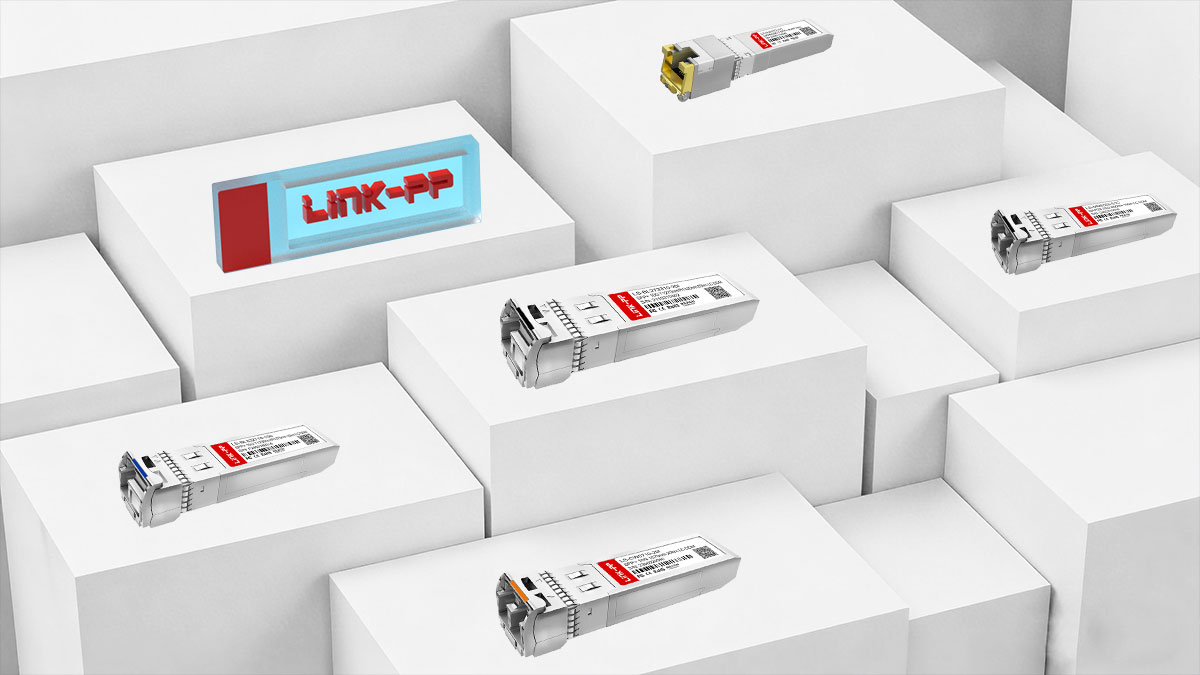
LINK-PP Resources and Technical References
Browse the LINK-PP 10GbE SFP+ Product Catalog
Check the Compatibility Matrix for Cisco, Arista, Juniper, and HPE
Download detailed Datasheets for SR, LR, ER, ZR, DAC, AOC, and 10G-T modules
Verify your network requirements, request bulk quotes, and explore the full product range at the LINK-PP Official Store to confidently plan and deploy your 10GbE SFP+ infrastructure.
See Also
Exploring Various Fiber Connector Types Used In Transceivers
Comparing SFP, SFP+, SFP28, QSFP+, And QSFP28 Transceivers
A Guide To Copper SFP Modules For Networking