

10Gbps Copper SFP—also known as a 10GBASE-T SFP+ module—is a practical solution for delivering 10 Gigabit Ethernet over standard RJ45 copper cabling. It allows network engineers and IT teams to upgrade to 10GbE speeds without replacing existing Cat6a or Cat7 infrastructure, making it especially attractive for cost-sensitive upgrades and hybrid network environments.
In today’s high-bandwidth applications—such as cloud computing, data centers, enterprise networks, and even advanced home labs—the demand for reliable 10Gbps connectivity continues to grow. While fiber optics and DAC cables are often considered the default for high-speed networking, copper SFP modules fill an important gap by enabling plug-and-play compatibility with traditional Ethernet (RJ45) systems.
However, choosing a 10G copper SFP is not always straightforward. Users frequently ask:
Can you really achieve 10Gbps over copper?
Is SFP+ faster than RJ45?
Which is better—fiber SFP or copper SFP?
These questions reflect a deeper concern: Is a copper SFP the right solution for your specific network scenario?
This guide provides a complete, practical breakdown of 10Gbps Copper SFP modules, including how they work, their real-world advantages and limitations, and how they compare to fiber SFP+ and DAC solutions. By the end, you’ll clearly understand when to use copper SFP—and when to choose an alternative for better performance, efficiency, or scalability.
✔️ What Is a 10Gbps Copper SFP and How Does It Work?
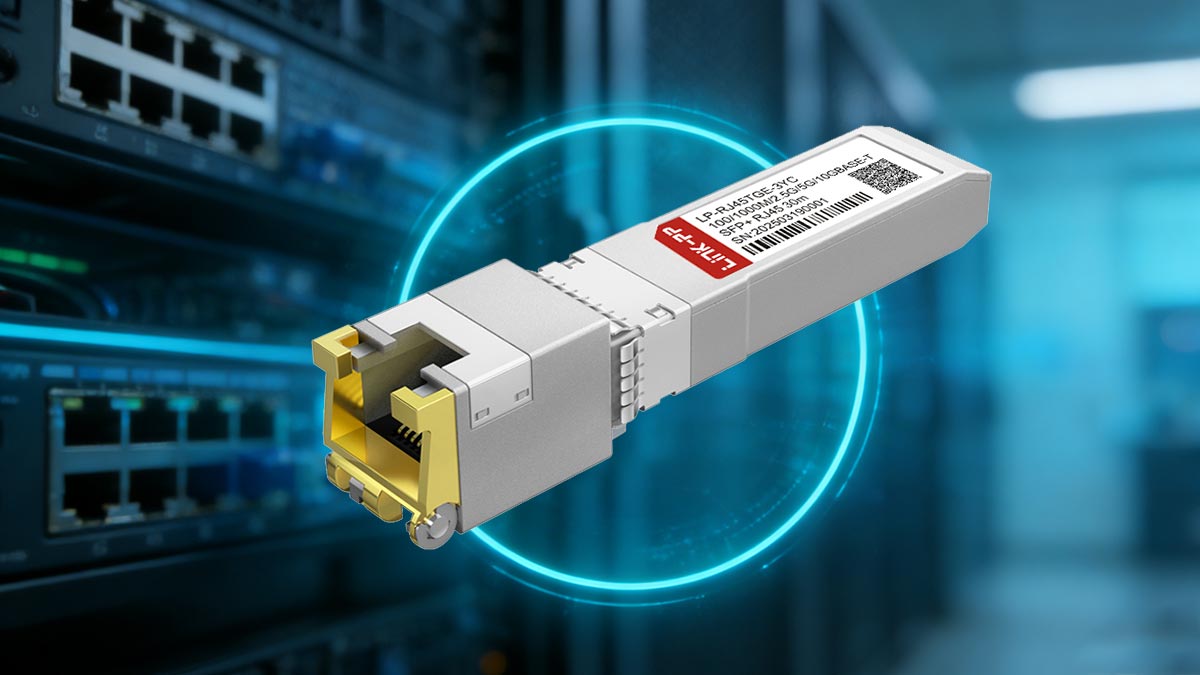
A 10Gbps Copper SFP refers to a 10GBASE-T SFP+ transceiver module that enables Ethernet transmission over standard twisted-pair copper cabling using an RJ45 interface. It is designed to plug into an SFP+ port on a switch, router, or server and convert the high-speed optical/electrical SFP+ interface into a familiar copper Ethernet connection.
Definition: 10GBASE-T SFP+
A 10GBASE-T SFP+ module is a hot-swappable transceiver that supports 10 Gigabit Ethernet over copper cabling standards, typically Cat6a or Cat7. Unlike traditional fiber SFP+ modules that use optical transmission, 10GBASE-T modules rely on electrical signaling over copper wires.
In simple terms, it acts as a bridge between SFP+ networking ports and RJ45-based Ethernet infrastructure, allowing legacy copper cabling to support modern 10Gbps speeds.
RJ45 Interface Explanation
At the front end of the module is an RJ45 port, which is the standard connector used in most Ethernet networks. This makes the 10Gbps Copper SFP highly practical in environments where:
Existing structured cabling is already terminated with RJ45
Devices such as switches, PCs, or servers only support Ethernet ports
Network upgrades must avoid the cost of fiber rewiring
The RJ45 interface allows direct connection using standard Ethernet patch cables, eliminating the need for optical patch cords or DAC twinax cables.
How It Converts SFP+ to Copper Ethernet
Inside the module, the 10Gbps Copper SFP contains a high-performance PHY (physical layer) chipset that performs protocol conversion:
SFP+ Side (Host Interface)
The switch or server sends high-speed serial data through the SFP+ cage.Signal Processing Inside the Module
The module’s PHY chip converts this SFP+ electrical signal into 10GBASE-T Ethernet encoding, handling tasks such as:Signal equalization
Error correction
Encoding/decoding (e.g., PAM-16 modulation used in 10GBASE-T)
RJ45 Copper Output
The processed signal is then transmitted over twisted-pair copper cabling through the RJ45 connector.
This conversion process enables seamless interoperability between SFP+ networking hardware and traditional Ethernet infrastructure, while maintaining 10Gbps data rates under supported conditions.
Basic 10Gbps Copper SFP Working Principle
At a fundamental level, a 10Gbps Copper SFP works as a media conversion bridge inside a compact pluggable module:
It receives high-speed data from the SFP+ host interface
It processes and adapts the signal for copper transmission
It outputs Ethernet data through RJ45 using 10GBASE-T standards
This architecture allows a single SFP+ port to support multiple media types—fiber, DAC, or copper—depending on the installed module.
However, because copper transmission requires more complex signal processing than optical or DAC solutions, it typically results in higher power consumption and heat generation, which is an important consideration for dense network deployments.
✔️ Can You Run 10GbE Over Copper (RJ45)?
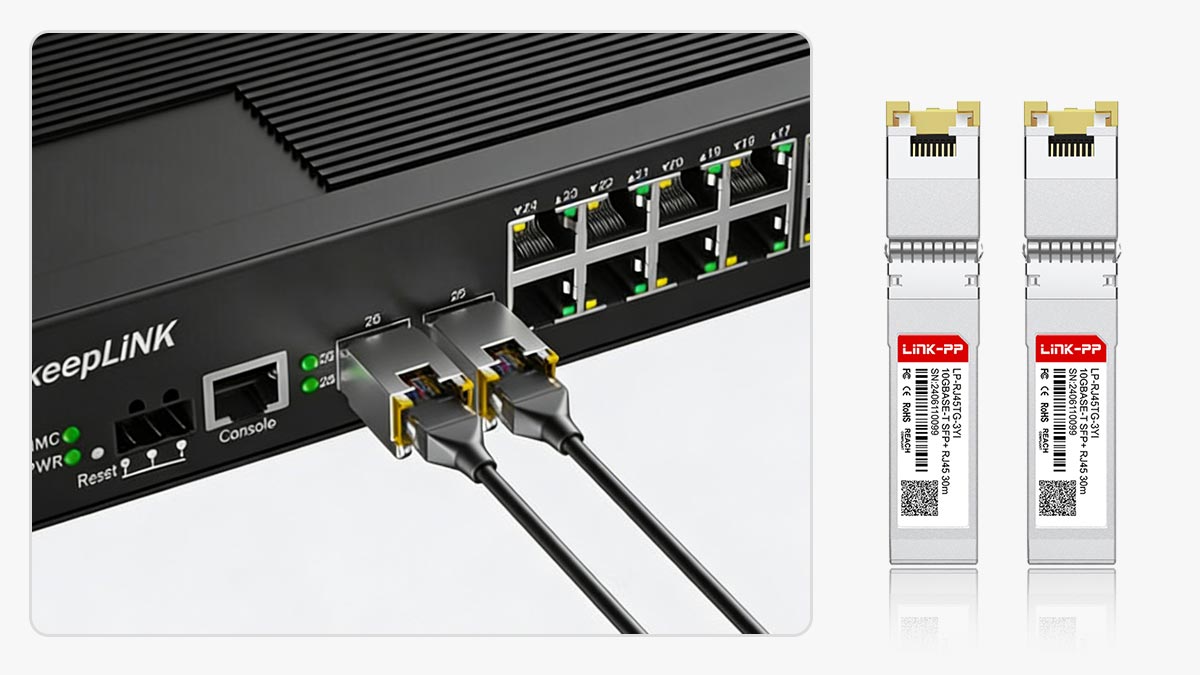
Yes — you can run 10 Gigabit Ethernet (10GbE) over copper using RJ45, and this is exactly what the 10GBASE-T standard was designed for. A 10Gbps Copper SFP (10GBASE-T SFP+ module) enables this by converting the SFP+ interface into a copper-based Ethernet link, allowing standard twisted-pair cabling to carry 10Gbps data.
However, while it is fully supported, achieving stable 10GbE over copper depends heavily on cabling quality, distance, and hardware compatibility.
Supported Cable Types for 10GbE Over Copper
To reliably achieve 10Gbps speeds, the following cabling standards are typically required:
Cat6a (recommended standard) → up to ~100 meters under ideal conditions
Cat7 (shielded environments) → stable performance in interference-heavy setups
Cat6 (limited use case) → usually only up to ~30 meters for stable 10Gbps
Below Cat6 → generally not recommended for 10GbE
Among these, Cat6a is the industry baseline for consistent 10GbE performance over RJ45 copper links.
Distance Limitations in Real Deployments
Although standards may advertise up to 100 meters, real-world performance with 10Gbps Copper SFP modules often varies due to:
Cable quality and installation environment
Switch PHY and module thermal design
Power and signal stability constraints
In practice, many network engineers observe that 10GbE over copper is most stable at shorter distances (30–80 meters), especially when using SFP+ copper transceivers inside dense switch environments.
Why 10GbE Over Copper Is Possible
Copper-based 10GbE works through a technology called 10GBASE-T signaling, which uses advanced encoding methods (such as PAM-based modulation) to transmit high-speed data over twisted-pair copper wires.
Unlike fiber optics (which transmit light) or DAC cables (which use direct electrical twinax connections), 10GBASE-T must:
Compensate for signal degradation over copper
Perform real-time noise cancellation
Equalize signal distortion across long cable runs
This is why 10Gbps Copper SFP modules include built-in PHY chipsets, which handle complex signal processing inside the transceiver.
Key Reality Check
Even though 10GbE over copper is widely supported, it comes with trade-offs:
Higher power consumption compared to fiber or DAC
Increased heat generation inside switches
Potential compatibility differences across vendors
Greater sensitivity to cable quality and installation practices
Because of these factors, copper-based 10GbE is often chosen for convenience and compatibility, rather than maximum efficiency.
You can absolutely run 10GbE over copper (RJ45) using a 10Gbps Copper SFP module. It is a proven, standards-based solution—but it works best when:
You use Cat6a or higher-quality cabling
You keep cable runs relatively short
Your switch supports 10GBASE-T SFP+ modules
You accept higher power and heat compared to fiber alternatives
✔️ 10Gbps Copper SFP vs. Fiber SFP vs. DAC: Which Is Better?
When evaluating 10Gbps network connectivity, most engineers compare three common options: Copper SFP (10GBASE-T SFP+), Fiber SFP+, and DAC (Direct Attach Copper). Although all three can deliver 10Gbps throughput, they differ significantly in cost, power consumption, distance, and deployment flexibility.
There is no single “best” option—the right choice depends on your network environment and design goals.
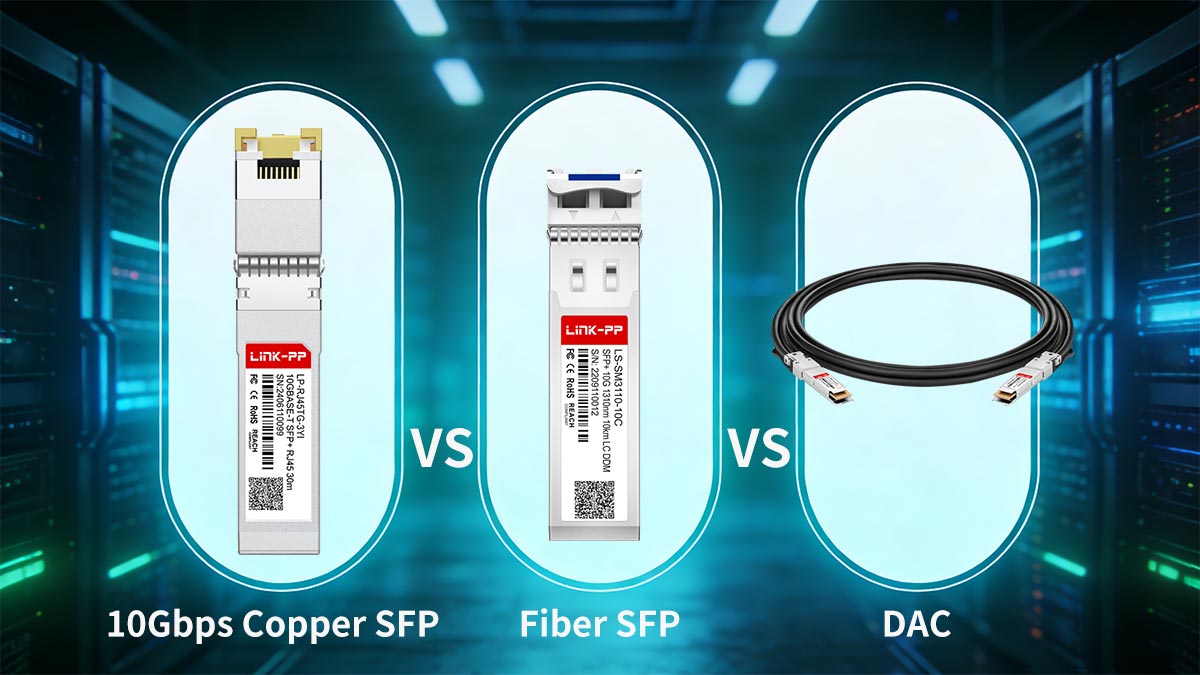
Overview Comparison
Solution | Medium | Typical Use Case | Key Strength |
|---|---|---|---|
10Gbps Copper SFP (10GBASE-T) | RJ45 Copper | Legacy cabling, mixed environments | Maximum compatibility |
Fiber SFP+ | Optical fiber | Data centers, long-distance links | Best performance & scalability |
DAC (Direct Attach Copper) | Twinax copper cable | Short rack-to-rack connections | Lowest cost & power |
1. 10Gbps Copper SFP (10GBASE-T SFP+)
A 10Gbps Copper SFP converts SFP+ ports into RJ45 Ethernet interfaces, allowing 10GbE transmission over standard copper cabling.
Strengths:
Works with existing Cat6a/Cat7 infrastructure
Simple plug-and-play RJ45 connectivity
Ideal for environments transitioning from 1GbE to 10GbE
Flexible for mixed-device networks
Limitations:
Higher power consumption (PHY processing required)
More heat generation inside switches
Usually higher latency compared to DAC/fiber
Performance depends heavily on cable quality
👉 Best for: Upgrades where rewiring is not possible
2. Fiber SFP+ (Optical Solution)
Fiber SFP+ modules use optical transceivers and fiber cables (single-mode or multi-mode) to transmit data using light signals.
Strengths:
Lowest latency and power consumption
Excellent for long-distance transmission (10m to 10km+)
Highly stable in high-density environments
Minimal electromagnetic interference (EMI immunity)
Limitations:
Higher initial cost (transceivers + fiber cabling)
Requires fiber patching and installation skills
Less flexible for RJ45-based legacy systems
👉 Best for: Data centers, enterprise backbone, long-distance uplinks
3. DAC (Direct Attach Copper)
DAC cables are pre-terminated twinax copper cables with SFP+ connectors built in on both ends.
Strengths:
Lowest cost solution for short distances
Very low latency and power consumption
Plug-and-play inside racks
Extremely stable for switch-to-server links
Limitations:
Limited reach (typically 1–7 meters)
Not suitable for cross-room or long-distance connections
Requires SFP+ compatibility on both ends
👉 Best for: Rack-level connections and short intra-rack links
Key Performance Differences
① Power & Heat
Copper SFP → highest power usage due to PHY processing
Fiber SFP+ → lowest power and heat
DAC → extremely efficient, minimal heat
② Distance
Fiber SFP+ → longest reach (up to kilometers)
Copper SFP → short-to-medium (typically up to 30–80m practical use)
DAC → very short (≤7m)
③ Latency
Lowest: DAC
Low: Fiber
Higher: Copper SFP (due to signal conversion overhead)
④ Cost Consideration
DAC: Lowest overall cost
Fiber: Moderate (depends on optics type)
Copper SFP: Often highest per-port cost (module + power cost over time)
Final Verdict: Which Is Better?
The answer depends entirely on your use case:
Choose 10Gbps Copper SFP if you need RJ45 compatibility and reuse existing copper infrastructure
Choose Fiber SFP+ if you need performance, scalability, and long-distance stability
Choose DAC if you need the cheapest and most efficient short-range connection
✔️ Advantages and Disadvantages of 10G Copper SFP Modules
A 10G Copper SFP is widely used as a practical bridge between modern 10GbE networking and traditional RJ45 copper infrastructure. However, while it offers strong deployment flexibility, it also introduces several technical trade-offs that are important for real-world network design decisions.
Below is a clear breakdown of the key advantages and disadvantages based on deployment behavior, engineering constraints, and common industry feedback.
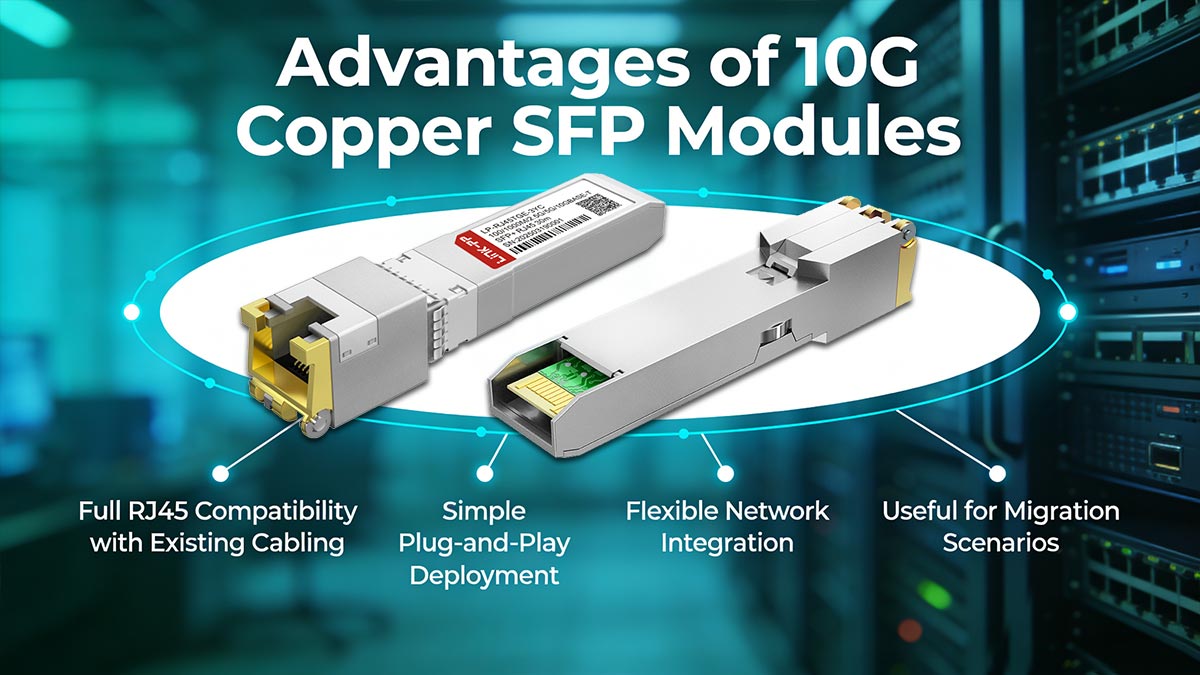
Advantages of 10G Copper SFP Modules
1. Full RJ45 Compatibility with Existing Cabling
One of the biggest advantages is the ability to reuse existing structured cabling.
Works with Cat6a and Cat7 Ethernet cables
Eliminates the need for fiber rewiring
Ideal for upgrading legacy 1GbE environments to 10GbE
👉 This makes it highly attractive for cost-sensitive network upgrades.
2. Simple Plug-and-Play Deployment
A 10G Copper SFP behaves like a standard SFP+ module:
Hot-swappable design
No special optical patching required
Direct RJ45 connection on the front end
👉 This reduces installation complexity, especially in mixed environments.
3. Flexible Network Integration
Copper SFP modules allow seamless integration between:
SFP+ switches
RJ45-based servers and devices
Hybrid network architectures
👉 This is particularly useful in environments where not all endpoints support fiber or DAC.
4. Useful for Migration Scenarios
Many organizations use copper SFPs as a transition technology:
Upgrade from 1GbE to 10GbE without changing cabling
Gradual migration toward fiber infrastructure
Temporary bridging solution during network expansion
Disadvantages of 10G Copper SFP Modules
1. Higher Power Consumption
One of the most significant drawbacks is energy usage.
Requires PHY chip inside the module
Consumes significantly more power than fiber or DAC
Adds thermal load to the switch
👉 This is why many high-density switches limit or discourage copper SFP usage.
2. Heat Generation Issues
Because of the complex signal processing involved in 10GBASE-T encoding, copper SFP modules generate more heat.
Can increase internal switch temperature
May require active airflow or improved cooling
In dense deployments, heat becomes a limiting factor
3. Limited Real-World Distance Stability
Although standards may support up to 100 meters (Cat6a), real-world performance often varies:
Best stability typically within 30–80 meters
Performance depends heavily on cable quality and EMI conditions
Degradation can occur in poor installations
4. Compatibility Limitations Across Devices
Not all SFP+ ports fully support 10GBASE-T modules.
Some switches reject copper SFP modules entirely
Vendor-specific restrictions may apply
Firmware or hardware limitations can affect compatibility
👉 This is one of the most frequently reported issues in real deployments.
5. Higher Cost Compared to Alternatives
In many cases, copper SFPs are more expensive than expected:
Higher module cost vs DAC
Increased operational cost due to power usage
Additional cooling considerations in large deployments
Balanced Summary (Engineering Perspective)
A 10G Copper SFP is best understood as a convenience-driven solution rather than a performance-optimized one.
It excels when:
You need RJ45 connectivity
You are upgrading existing copper networks
You want to avoid fiber deployment costs
It struggles when:
Power efficiency is critical
High-density switching environments are used
Long-term scalability is required
✔️ When Should You Use a 10Gbps Copper SFP? (Real Use Cases & Deployment Scenarios)
A 10Gbps Copper SFP (10GBASE-T SFP+) is not a universal replacement for fiber or DAC—it is a scenario-driven networking solution. Its value becomes clear only when specific infrastructure, distance, or compatibility constraints make RJ45-based 10GbE the most practical option.
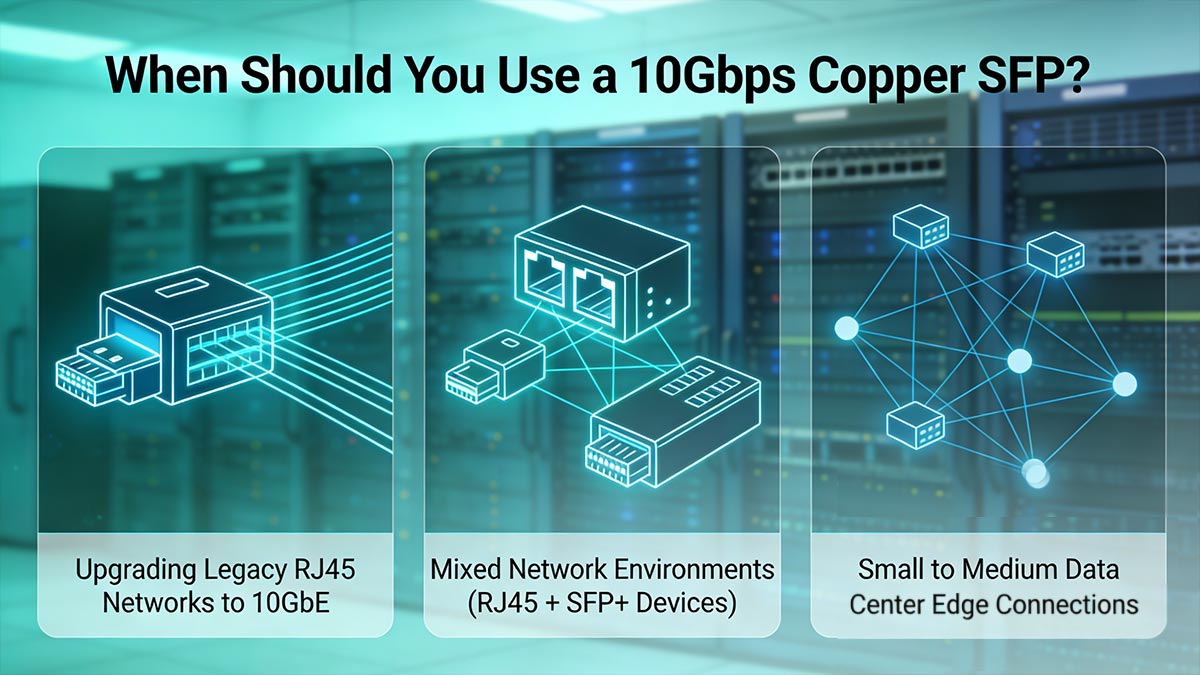
Below are the most common real-world deployment scenarios where a 10Gbps Copper SFP makes sense.
◆ Upgrading Legacy RJ45 Networks to 10GbE
One of the most common use cases is incremental network upgrading.
Many enterprise and SMB environments already have:
Cat6 or Cat6a structured cabling
RJ45 wall ports and patch panels
Copper-based switches or endpoints
Instead of replacing the entire cabling system with fiber, a 10Gbps Copper SFP allows organizations to:
Upgrade from 1GbE → 10GbE
Reuse existing copper infrastructure
Avoid costly rewiring projects
👉 This makes it ideal for budget-conscious infrastructure modernization.
◆ Mixed Network Environments (RJ45 + SFP+ Devices)
In many real networks, not all devices support the same interface type.
For example:
Core switches use SFP+ ports
Servers or endpoints only support RJ45 Ethernet
Network storage devices may be copper-based
A 10Gbps Copper SFP enables seamless interoperability:
SFP+ switch port → RJ45 device
No additional media converters required
Simplified network design
👉 This is especially useful in heterogeneous IT environments.
◆ Small to Medium Data Center Edge Connections
While fiber dominates large-scale data centers, copper SFP modules can still be used at the edge:
Top-of-rack (ToR) to legacy servers
Short-distance interconnects within racks or adjacent racks
Temporary links during infrastructure migration
However, due to heat and power constraints, copper SFPs are typically avoided in high-density core switching layers.
◆ Home Labs and SMB High-Speed Upgrades
A growing use case comes from:
Home lab enthusiasts
Developers
Small office environments
In these cases, users often want:
Affordable 10GbE upgrade
Minimal infrastructure changes
Easy plug-and-play setup
Copper SFP modules allow:
Direct connection to consumer-grade RJ45 devices
Simple integration with existing Ethernet switches
Fast deployment without fiber tools or expertise
👉 This is one of the strongest “practical convenience” use cases.
◆ Short-Distance High-Speed Links (30–80m Range)
Copper SFP is best suited for short-range high-speed connections, such as:
Office floor-to-floor connections
Equipment room to nearby workstation
Short rack-to-rack links (when DAC is not suitable)
With proper Cat6a/Cat7 cabling, stable 10Gbps performance can typically be achieved within this range.
◆ Temporary or Transitional Network Deployments
In fast-changing network environments, copper SFP modules are often used as a temporary bridge solution:
During staged migration from copper to fiber
While waiting for fiber installation
For testing and validation environments
For temporary lab setups
👉 This flexibility makes them valuable in project-based deployments.
When You Should NOT Use Copper SFP
To maintain performance and efficiency, avoid 10G copper SFP in:
High-density switch environments (heat issues)
Long-distance backbone links
Power-sensitive infrastructure designs
Fiber-optimized data centers
In these cases, fiber SFP+ or DAC is typically the better choice.
A 10Gbps Copper SFP is best viewed as a flexibility-first networking tool. It is not designed to outperform fiber or DAC, but to enable 10GbE connectivity in environments where RJ45 infrastructure already exists or cannot easily be replaced.
✔️ Is SFP+ Faster Than RJ45? (Common Misconceptions Explained)
A common question in 10GbE networking is whether SFP+ is faster than RJ45. The short answer is: no—SFP+ is not inherently faster than RJ45. Both can deliver the same 10Gbps speed, but they differ in how that speed is achieved, the underlying medium, and the efficiency of data transmission.
Understanding this distinction is critical when evaluating a 10Gbps Copper SFP (10GBASE-T SFP+) versus fiber or DAC-based SFP+ solutions.
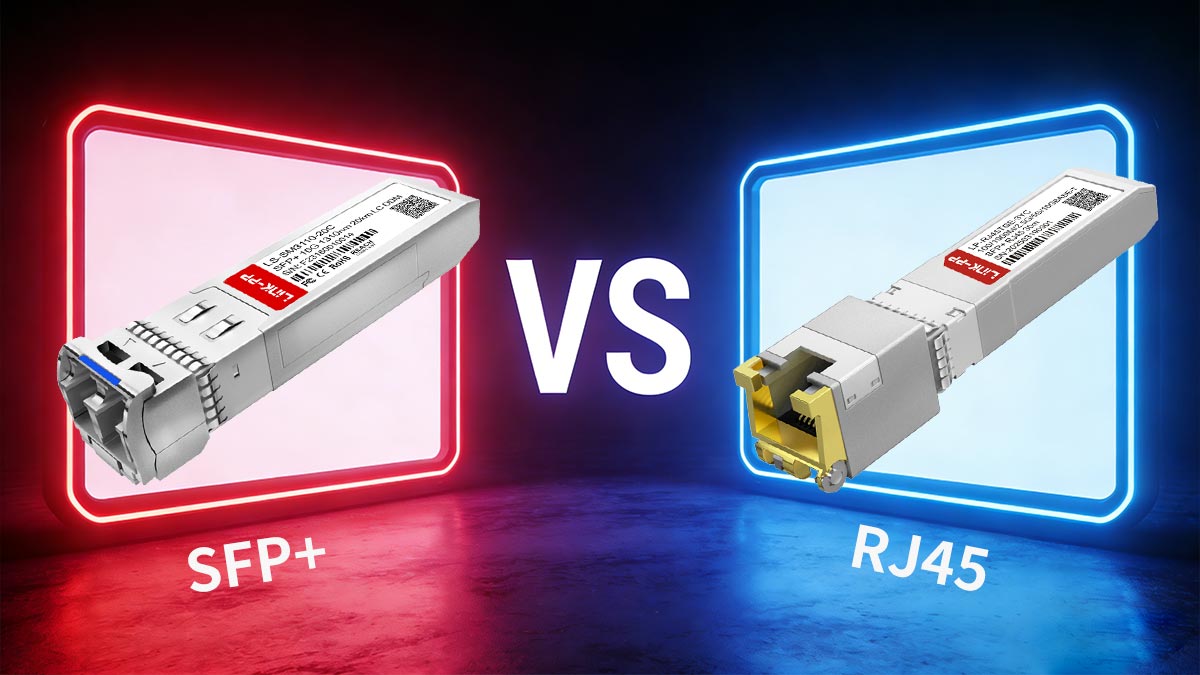
SFP+ vs. RJ45: The Core Difference
The confusion comes from comparing two different concepts:
SFP+ → a port and transceiver form factor (used with fiber, DAC, or copper modules)
RJ45 → a copper Ethernet connector type
This means SFP+ and RJ45 are not direct speed competitors. Instead, they represent different physical interfaces used to carry Ethernet signals.
Both can support:
1GbE
2.5GbE / 5GbE (depending on hardware)
10GbE (10Gbps)
👉 So at the protocol level, they can deliver the same bandwidth.
Why SFP+ Is Often Perceived as “Faster”
Although speed is the same, SFP+ solutions are often considered superior due to performance efficiency, not raw throughput.
1. Lower Latency (Fiber and DAC SFP+)
Fiber and DAC SFP+ modules typically:
Bypass heavy signal processing
Avoid complex encoding layers
Provide more direct data transmission paths
👉 Result: lower latency compared to 10GBASE-T copper RJ45 systems
2. Simpler Signal Processing vs. 10GBASE-T
A key difference lies in how data is transmitted:
RJ45 (10GBASE-T / Copper SFP)
Requires advanced PHY processing
Uses complex signal encoding (e.g., PAM-based modulation)
Performs real-time error correction and equalization
Fiber / DAC SFP+
More direct transmission path
Less signal processing overhead
👉 This is why copper SFP modules often consume more power and generate more heat.
3. Power and Thermal Efficiency
Even though speed is equal, efficiency is not:
SFP+ fiber/DAC: low power, low heat
RJ45 copper SFP+: higher power, more heat
👉 This is one of the biggest reasons data centers prefer fiber or DAC over copper.
So Why Use RJ45 at All?
If SFP+ fiber is more efficient, why do copper SFP modules exist?
Because RJ45 still offers practical advantages:
Uses existing Cat6a/Cat7 infrastructure
Works with a wide range of legacy devices
No need for fiber termination tools or DAC constraints
Easier migration path from 1GbE networks
👉 In other words, RJ45 prioritizes compatibility and convenience over efficiency.
Key Misconception: “SFP+ is Faster”
Let’s correct the most common misunderstanding:
❌ SFP+ is faster than RJ45
✅ Both can deliver 10Gbps, but SFP+ (fiber/DAC) is more efficient
Speed is determined by the Ethernet standard (10GbE), not the connector type.
Where 10Gbps Copper SFP Fits In
A 10GBASE-T SFP+ (Copper SFP) sits between the two worlds:
Same 10Gbps speed as fiber SFP+
Same RJ45 compatibility as Ethernet
But with higher overhead due to signal conversion
👉 It is best described as a compatibility-focused SFP+ variant, not a performance upgrade.
SFP+ is not faster than RJ45. Instead:
Both support the same 10Gbps Ethernet speed
Fiber and DAC SFP+ are more efficient and lower latency
RJ45 (via 10Gbps Copper SFP) is more flexible and backward-compatible
✔️ Key Buying Considerations for 10GBASE-T SFP+ Modules (Compatibility, Power, Heat, Distance)
Choosing the right 10GBASE-T SFP+ (10Gbps Copper SFP) module is not just about achieving 10GbE connectivity. In real-world deployments, factors such as compatibility, power consumption, thermal behavior, and cable distance directly determine whether the module will perform reliably in your network environment.
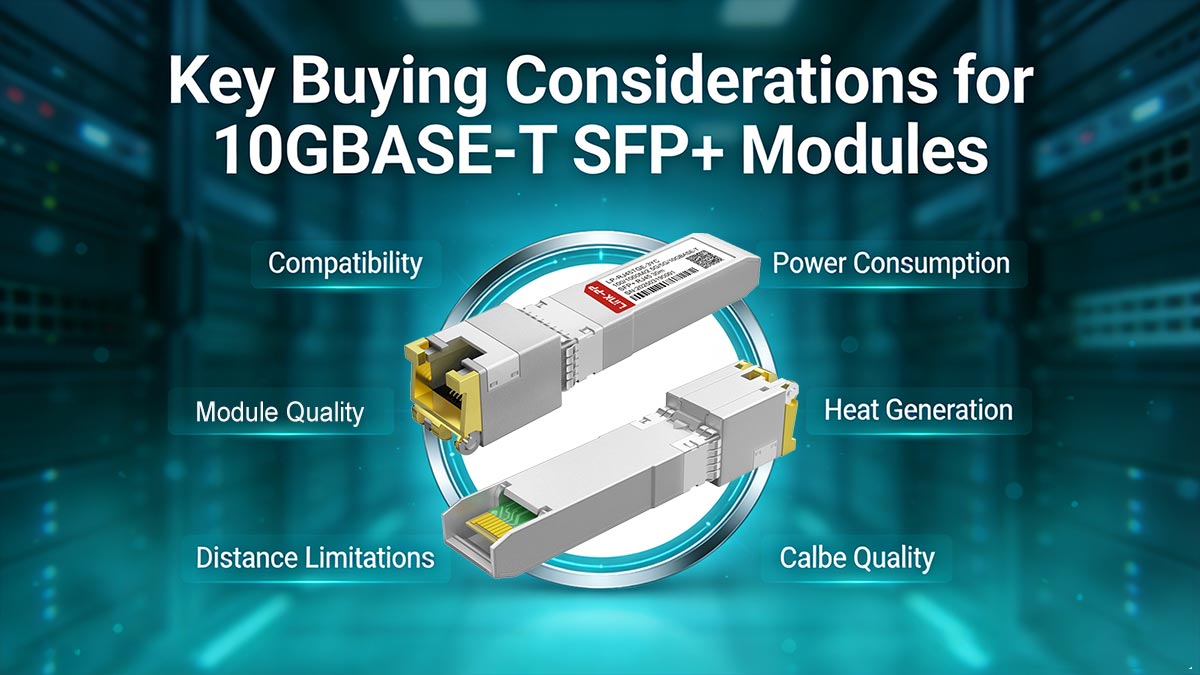
Below are the most important buying considerations you should evaluate before deployment.
▶ Compatibility: The Most Critical Factor
Not all SFP+ ports support 10GBASE-T copper modules, even if they physically accept SFP+ transceivers.
Key compatibility risks include:
Switches that support only fiber or DAC SFP+ modules
Vendor-locked firmware restrictions
Limited PHY support for 10GBASE-T signaling
Port-level power or thermal limitations
What to check before purchasing:
Whether the switch explicitly supports 10GBASE-T SFP+
Vendor compatibility lists (Cisco, Juniper, MikroTik, etc.)
Whether third-party modules are allowed or blocked
▶ Power Consumption: Hidden Operational Cost
Compared to fiber or DAC, a 10Gbps Copper SFP consumes significantly more power because it includes a full PHY chipset for signal conversion.
Typical characteristics:
Higher power draw per module
Increased overall switch power budget usage
Additional operational cost in large deployments
Why it matters:
In dense switch environments, power limits can restrict how many copper SFPs you can use
Some switches reduce port availability when thermal or power thresholds are reached
👉 Always verify the per-port power budget impact before scaling deployment.
▶ Heat Generation: The Biggest Physical Constraint
Heat is one of the most widely reported real-world challenges of 10GBASE-T SFP+ modules.
Why copper SFPs run hotter:
Complex signal processing (10GBASE-T PHY)
Continuous equalization and noise compensation
Higher electrical activity compared to fiber or DAC
Deployment impact:
Can increase internal switch temperature
May require stronger airflow or active cooling
Limits high-density port usage in confined chassis
👉 In many enterprise environments, thermal design is the deciding factor against copper SFP adoption.
▶ Distance Limitations and Cable Quality
Although the 10GBASE-T standard supports long distances, real-world performance depends heavily on installation quality.
Typical performance ranges:
Cat6a: up to ~100m (theoretical standard)
Cat6: ~30–55m (more limited stability)
Cat5e or below: not recommended for 10GbE
Real-world considerations:
Electromagnetic interference (EMI)
Cable shielding quality
Connector and termination quality
Environmental noise in industrial setups
👉 For most stable deployments, Cat6a is the minimum recommended standard.
▶ Latency and Performance Trade-offs
While all 10GbE solutions provide the same nominal bandwidth, copper SFPs introduce slightly higher latency due to:
PHY-layer signal conversion
Encoding/decoding overhead
Error correction processing
Comparison:
Fiber SFP+ → lowest latency
DAC → near-zero overhead
Copper SFP → higher latency (but still suitable for most enterprise workloads)
👉 For latency-sensitive applications (trading, HPC, storage clusters), copper SFP is usually not preferred.
▶ Vendor Ecosystem and Module Quality
Not all 10GBASE-T SFP+ modules perform equally.
Differences you may encounter:
OEM vs. third-party module compatibility
Variations in power efficiency
Thermal design quality differences
Firmware-level interoperability issues
👉 Choosing a reliable vendor with validated compatibility testing is essential for stable operation.
Before deploying a 10Gbps Copper SFP, always evaluate:
✔ Switch compatibility with 10GBASE-T SFP+
✔ Power budget per port and overall switch capacity
✔ Cooling and thermal design limitations
✔ Cable quality (prefer Cat6a or higher)
✔ Expected link distance and environment conditions
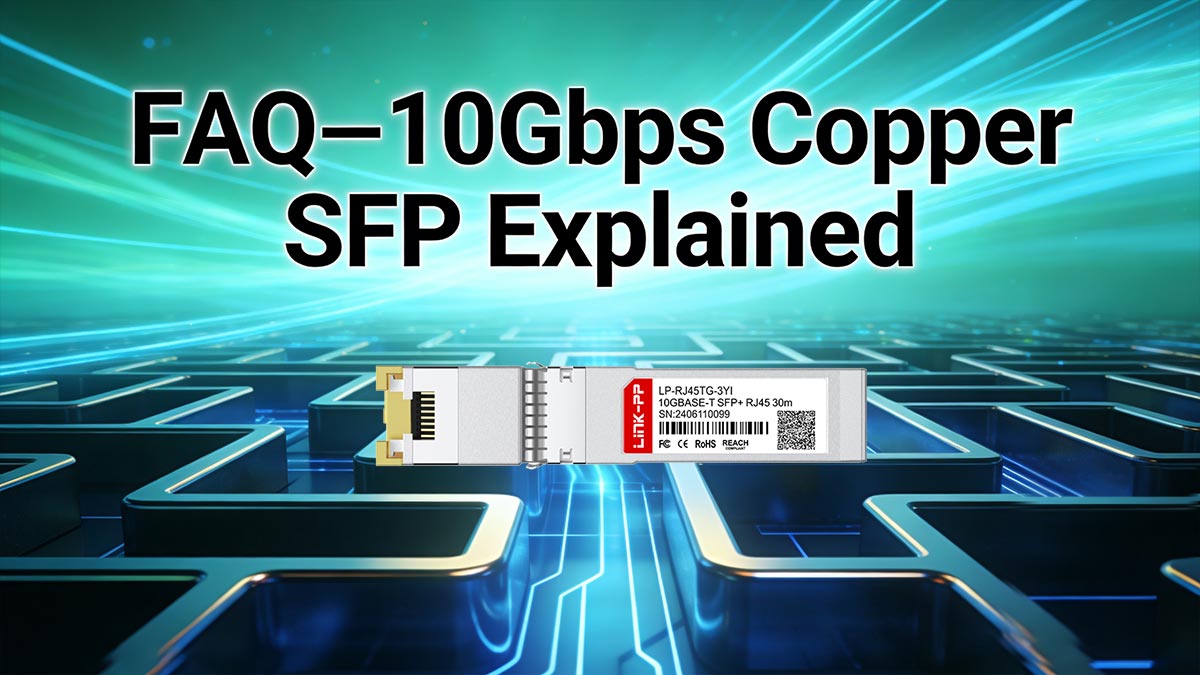
✔️ FAQ – 10Gbps Copper SFP Explained
1. What devices support 10Gbps Copper SFP modules?
10Gbps Copper SFP modules are supported only on SFP+ ports that explicitly allow 10GBASE-T operation. This typically includes select enterprise switches, routers, and network appliances from vendors such as Cisco, MikroTik, and Juniper.
However, support is not universal. Many SFP+ ports are designed primarily for fiber or DAC modules, so compatibility must always be verified in the device’s official transceiver support list.
2. Why do 10GBASE-T SFP+ modules run hot?
Heat generation is caused by the internal PHY chipset that converts SFP+ signals into 10GBASE-T copper Ethernet.
This process requires:
Continuous signal equalization
Noise cancellation and correction
High-frequency electrical processing
As a result, copper SFP modules consume more power and generate more heat than fiber or DAC alternatives.
3. Can copper SFP be mixed with fiber SFP in the same switch?
Yes. Most modern SFP+ switches support a mixed-media environment, allowing copper, fiber, and DAC modules to operate simultaneously.
However, this depends on:
Switch hardware design
Firmware support for multi-media SFP+ modules
Power and thermal constraints per port group
In practice, hybrid deployment is common in enterprise networks.
4. Is 10Gbps Copper SFP suitable for long-term infrastructure design?
Copper SFP is generally considered a flexibility and transition solution, not a long-term backbone strategy.
It is best suited for:
Temporary migration from 1GbE to 10GbE
Environments with existing RJ45 cabling
Short to medium-distance connections
For long-term scalability and efficiency, fiber SFP+ is usually preferred in modern network design.
5. Why is copper SFP less popular in data centers?
Data centers prioritize density, efficiency, and thermal control, which are areas where copper SFP modules are weaker.
Key reasons include:
Higher power consumption per port
Increased heat output in dense switch chassis
Lower efficiency compared to DAC or fiber
Limited port scaling in high-density environments
Because of this, copper SFP is typically used only at the edge of data center networks, not in core layers.
✔️ 10Gbps Copper SFP Decision Guide Final Conclusion
A 10Gbps Copper SFP (10GBASE-T SFP+ module) is best understood as a compatibility-first 10G networking solution rather than a pure performance upgrade. It is especially valuable in scenarios where network operators need to:
Maintain or reuse existing RJ45 copper cabling infrastructure
Upgrade from 1GbE to 10GbE without costly rewiring
Connect devices that are not fiber-ready or DAC-compatible
However, real-world deployment feedback and industry experience consistently highlight important trade-offs:
Higher power consumption compared to fiber SFP+ or DAC
Increased heat output, especially in high-density switch environments
Compatibility limitations depending on switch vendor and firmware support
Because of these factors, a 10Gbps Copper SFP is not typically the first choice for optimized data center design—but it remains extremely useful for edge networks, enterprise upgrades, and hybrid infrastructure transitions.
In most modern deployments, the decision is not just “Copper SFP vs. Fiber SFP,” but rather balancing cost, heat, compatibility, and long-term scalability. Understanding these trade-offs is what separates a basic installation from a truly optimized 10GbE architecture.
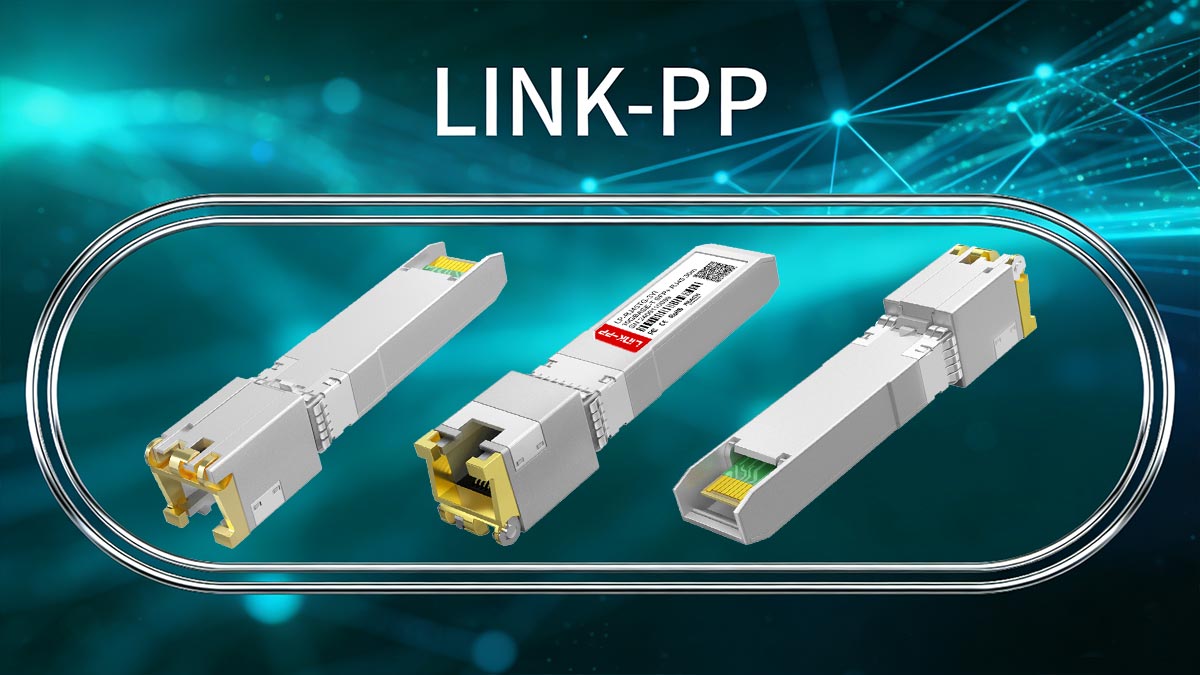
If you are planning to design or upgrade a 10GbE copper-based network, choosing the right interconnect components is critical for stability and performance.
👉 At LINK-PP Official Store, we provide a full range of high-quality 10GBASE-T compatible solutions to ensure stable, compliant, and scalable 10GbE copper network performance.
About the Author
This article is written by a network infrastructure content specialist with experience in high-speed Ethernet connectivity, optical transceivers, and enterprise networking hardware design. The content is developed based on industry deployment patterns, product-level engineering behavior, and real-world networking constraints observed in 10G/25G infrastructure environments.
The goal is to provide practical, decision-oriented technical guidance for engineers, IT buyers, and network architects evaluating 10GbE copper and fiber solutions.