

As global network traffic continues to surge—driven by cloud computing, 5G infrastructure, and AI workloads—high-speed optical interconnects have become the backbone of modern communication systems. Among the earliest solutions enabling 100G transmission, the CFP optical module remains a critical technology in many telecom and long-haul network deployments.
But in today’s landscape—where compact form factors like QSFP28 dominate data centers—many engineers and buyers are asking important questions:
What is a CFP optical module? Is it still relevant in 2026? And when should you choose it over newer alternatives?
This guide is designed to answer those questions with clarity and technical depth. Whether you are a network engineer evaluating infrastructure upgrades, a procurement specialist comparing optical transceivers, or a learner building foundational knowledge, understanding the role of CFP modules is essential for making informed decisions.
Originally introduced as the first standardized pluggable solution for 100 Gigabit Ethernet, CFP (C Form-factor Pluggable) modules were engineered to support high-bandwidth, long-distance transmission using multiple optical lanes. Their robust design made them ideal for carrier-grade networks, DWDM systems, and backbone infrastructure—where performance and reliability outweigh size constraints.
Even as newer form factors like QSFP28 and OSFP gain widespread adoption, CFP modules have not disappeared. In fact, they continue to serve specific use cases where long reach, optical stability, and interoperability are critical. This creates a unique decision-making scenario:
Should you still deploy CFP modules, or migrate to newer technologies?
What You’ll Learn in This Guide
By reading this article, you will:
Understand what a CFP optical module is and how it works
Learn the differences between CFP, CFP2, and CFP4
Compare CFP vs. QSFP28 in terms of size, power, and cost
Explore real-world 100G applications and deployment scenarios
Evaluate whether CFP is obsolete or still relevant in 2026
Get practical guidance on choosing the right optical module for your network
By the end, you’ll have a clear, expert-level understanding of CFP optical modules—and more importantly, the confidence to decide whether they are the right fit for your specific application.
📌 What Is a CFP Optical Module?
A CFP optical module is a high-speed pluggable transceiver used in fiber optic communication systems to enable 100 Gigabit Ethernet (100G) data transmission over optical fiber. It plays a fundamental role in converting electrical signals from networking equipment into optical signals—and vice versa—for long-distance, high-bandwidth communication.
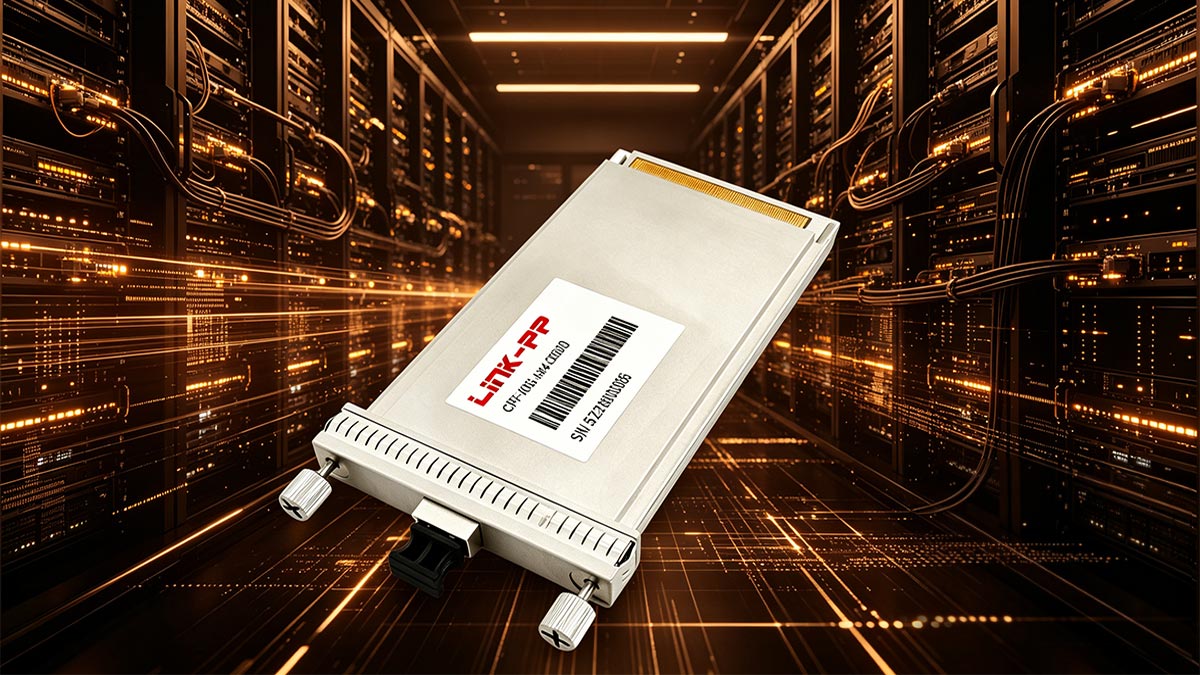
If you're new to fiber optics, think of a CFP transceiver like this:
It’s a translator that converts digital signals from your network device into light signals that can travel through fiber cables—and then converts them back again at the destination.
What Does CFP Stand For?
CFP stands for C Form-factor Pluggable:
“C” refers to centum (Latin for 100), representing 100G data rates
“Form-factor” defines its standardized physical size and interface
“Pluggable” means it is hot-swappable, allowing insertion or removal without powering down the system
In simple terms, CFP is one of the first standardized modules designed specifically for 100G networking.
How Does a CFP Optical Module Work?
At its core, a CFP module performs signal conversion between electrical and optical domains, often described as:
Electrical → Optical (E/O conversion) for transmission
Optical → Electrical (O/E conversion) for reception
Basic Working Process:
The network switch or router sends an electrical signal to the CFP module
The module converts it into an optical signal (light pulses)
The signal travels through fiber optic cables over long distances
At the receiving end, another CFP module converts it back into an electrical signal
This process ensures high-speed, low-loss data transmission, especially over tens to hundreds of kilometers.
Role in 100G Ethernet and Telecom Networks
CFP optical modules were originally developed to support early 100G Ethernet standards, making them essential in:
Telecom backbone networks
Long-haul and metro optical transport systems
DWDM (Dense Wavelength Division Multiplexing) environments
Carrier-grade infrastructure
Their larger size allows for:
More complex optical components
Higher power handling
Better support for long-distance transmission (e.g., 40km, 80km, or more)
This is why CFP modules are still widely used in high-performance telecom applications, even as smaller modules dominate data centers.
Key Takeaway
A CFP module is:
A 100G pluggable fiber transceiver
Designed for long-distance, high-capacity transmission
A foundational technology in telecom and optical transport networks
📌 CFP Optical Module Types Explained (CFP, CFP2, CFP4)
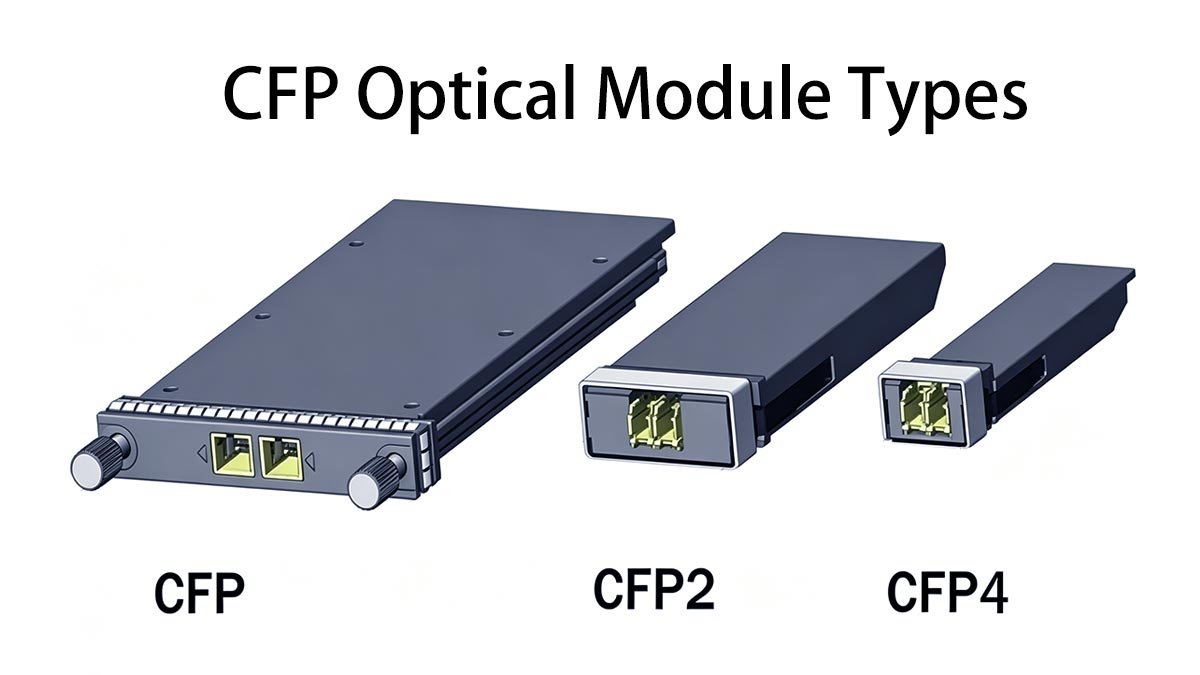
As network demands increased and hardware needed to become more compact and energy-efficient, the original CFP optical module evolved into smaller and more optimized versions: CFP2 and CFP4. These form factors were designed to maintain 100G performance while significantly improving port density, power efficiency, and system scalability.
Evolution of CFP Form Factors
The CFP family has gone through three major generations:
CFP (1st Generation)
The original 100G module, designed with 10×10G lanes, large size, and high power consumption. Built for early telecom and long-haul deployments.CFP2 (2nd Generation)
Roughly half the size of CFP, with improved electrical interfaces (moving toward 4×25G lanes). Offers better power efficiency and higher port density.CFP4 (3rd Generation)
About one-quarter the size of CFP, optimized for 4×25G architecture, enabling much higher density and lower power usage.
This evolution reflects a broader industry shift toward smaller, faster, and more energy-efficient optical modules.
Size, Power, and Performance Differences
The main differences between CFP, CFP2, and CFP4 lie in three areas:
1. Size (Form Factor)
CFP: Largest, bulky design
CFP2: ~50% smaller than CFP
CFP4: ~75% smaller than CFP
Smaller size = more ports per switch/router
2. Power Consumption
CFP: Typically 20–24W+
CFP2: Around 9–12W
CFP4: Around 6–8W
Lower power = less heat + better energy efficiency
3. Performance & Architecture
CFP: 10×10G lanes (older architecture)
CFP2 / CFP4: 4×25G lanes (more efficient design)
Newer architectures reduce complexity and improve signal integrity
Comparison Table: CFP vs. CFP2 vs. CFP4
Feature | CFP (1st Gen) | CFP2 (2nd Gen) | CFP4 (3rd Gen) |
|---|---|---|---|
Data Rate | 100G | 100G | 100G |
Size | Largest | ~50% smaller | ~25% of CFP size |
Electrical Lanes | 10 × 10G | 4 × 25G | 4 × 25G |
Power Consumption | High (20W+) | Medium (9–12W) | Low (6–8W) |
Port Density | Low | Medium | High |
Use Case | Telecom / Long-haul | Telecom / Metro | Higher-density systems |
Why CFP4 Improved Network Density
The biggest advantage of CFP4 is its ability to dramatically increase port density.
Here’s why:
Smaller modules allow more ports per line card
Lower power enables denser deployments without overheating
Simplified 4-lane architecture reduces hardware complexity
In practical terms: A system that supports 4 CFP ports could potentially support 16 CFP4 ports in the same space
What This Means for Modern Network Design
CFP → Best for legacy systems and long-haul telecom
CFP2 → Transitional solution with improved efficiency
CFP4 → Optimized for higher density and modern architectures
However, even CFP4 is increasingly competing with QSFP28, which offers similar performance in an even smaller footprint.
Key Takeaway
The evolution from CFP → CFP2 → CFP4 reflects the industry's push toward:
Higher density
Lower power consumption
More efficient data transmission
📌 Key Features and Technical Specifications of CFP Modules
To make the right decision when selecting a CFP optical module, it’s essential to understand its core technical specifications—including data rates, transmission types, wavelengths, and power characteristics. These factors directly impact network performance, distance capability, and system design.
Data Rates: 100G and Beyond
CFP modules were originally designed to support 100 Gigabit Ethernet (100G), making them one of the first standardized solutions for high-speed optical transmission.
Key points:
Standard data rate: 100Gbps
Early CFP architecture: 10 × 10G lanes
Later variants (CFP2/CFP4): 4 × 25G lanes
While CFP is primarily associated with 100G, some extended applications include:
OTN (Optical Transport Network) integration
Support for advanced modulation formats in telecom systems
However, for 200G/400G, newer form factors like QSFP-DD and OSFP are typically used instead of CFP.
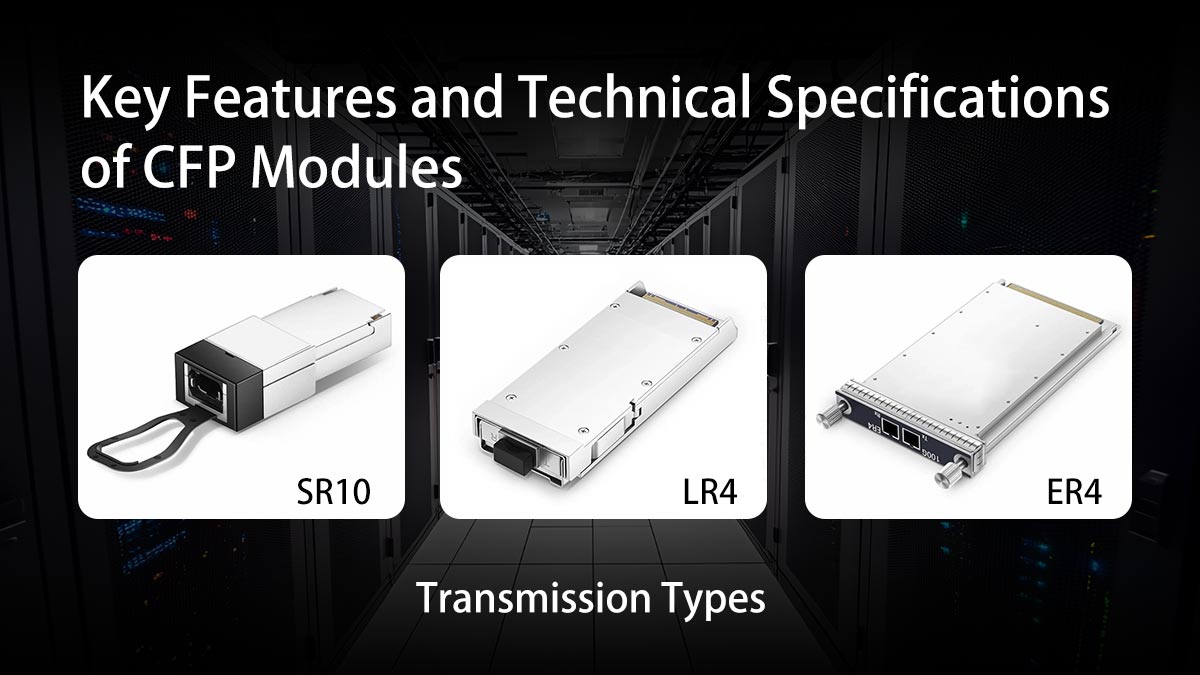
Transmission Types: SR10, LR4, ER4
CFP modules support multiple transmission standards, each optimized for different distances and fiber types:
1. SR10 (Short Range)
Distance: up to 100–150 meters
Fiber: Multimode fiber (MMF)
Application: Data center interconnects (legacy)
Uses 10 parallel lanes (10×10G)
2. LR4 (Long Range)
Distance: up to 10 km
Fiber: Single-mode fiber (SMF)
Uses 4 wavelengths (WDM technology)
One of the most common CFP deployments
3. ER4 (Extended Range)
Distance: up to 40 km
Fiber: Single-mode fiber (SMF)
Higher optical power and sensitivity
Ideal for telecom and metro networks
Wavelengths and Fiber Types
CFP modules rely on specific wavelengths and fiber types to achieve optimal transmission:
Multimode Fiber (MMF)
Used in SR10 modules
Typical wavelength: 850 nm
Lower cost, shorter distance
Single-Mode Fiber (SMF)
Used in LR4 / ER4 modules
Typical wavelengths:
1310 nm range (LAN-WDM) for LR4
1550 nm range for ER4
SMF enables long-distance, low-loss transmission
Power Consumption and Heat Considerations
One of the most critical aspects of CFP modules is their power usage and thermal output, especially compared to modern alternatives.
Typical Power Consumption:
CFP: 20–24W+
CFP2: 9–12W
CFP4: 6–8W
Why This Matters:
Heat Generation
Higher power = more heat
Requires robust cooling systems
System Design Impact
Limits port density
Affects rack layout and airflow
Operational Cost
Increased energy consumption over time
Engineering Insight
This is one of the main reasons why:
CFP is still used in long-haul telecom (where performance matters most)
But replaced in data centers (where density and efficiency matter more)
Key Takeaway
The technical strength of CFP modules lies in:
Reliable 100G performance
Flexible transmission options (SR10, LR4, ER4)
Strong support for long-distance optical communication
However, these advantages come with trade-offs: Higher power consumption and larger size
📌 CFP vs. QSFP28: Which Optical Module Should You Choose?
When designing or upgrading a 100G network, one of the most critical decisions is choosing between CFP optical modules and QSFP28 transceivers. While both support 100G data rates, they are built for very different use cases, architectures, and cost structures.
This section provides a clear, real-world comparison to help you decide.
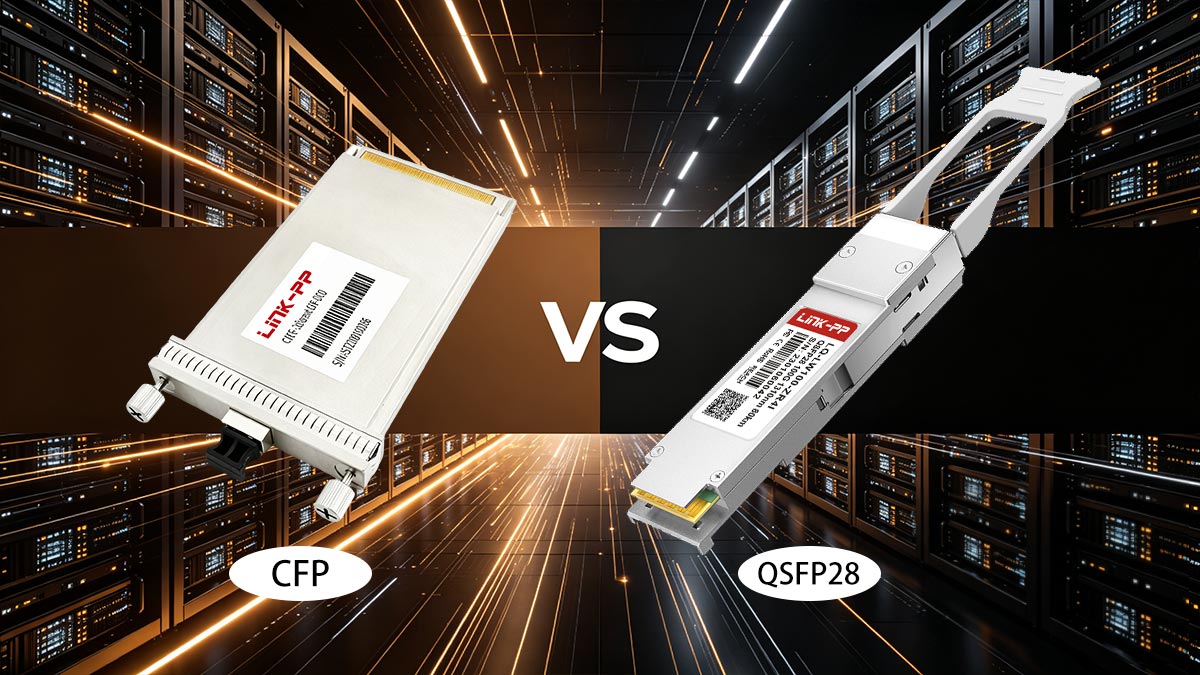
Size and Port Density Comparison
One of the most noticeable differences is physical size, which directly impacts how many ports you can deploy.
CFP
Large form factor (early-generation design)
Limited port density (typically 1–2 ports per line card)
QSFP28
Compact, modern design
High port density (up to 36+ ports per switch)
Because QSFP28 is significantly smaller, it allows much higher interface density, which is essential in modern data centers.
Engineering Insight: High-density environments (leaf-spine architectures, hyperscale data centers) almost always favor QSFP28.
Power Consumption Differences
Power efficiency is a major factor in operational cost and thermal design.
CFP
High power consumption: typically >20–24W
Generates more heat → requires stronger cooling systems
QSFP28
Low power consumption: around 3.5–5W
Easier thermal management
QSFP28 modules consume up to 80% less power, making them far more efficient for large-scale deployments.
Real Impact:
Lower electricity cost
Reduced cooling requirements
Higher rack efficiency
Cost Analysis (Critical for Decision Making)
Cost differences are driven by manufacturing scale, efficiency, and ecosystem maturity.
CFP
Higher cost (niche, legacy demand)
Higher operational cost (power + cooling)
QSFP28
Lower unit price (mass adoption)
Lower total cost of ownership (TCO)
Industry data shows QSFP28 benefits from economies of scale, making it more cost-effective overall.
Real User Insight (From Reddit Discussions)
From real-world engineer feedback:
“80KM optics are significantly cheaper as QSFP modules than CFP”
This highlights a key trend:
Even in long-distance scenarios, QSFP28 is often more cost-efficient
Users actively look for CFP-to-QSFP28 migration paths
Real-World Deployment Scenarios
The best choice depends on where and how the module is used:
Choose CFP When:
You are working with legacy telecom infrastructure
You need long-haul transmission (40km–80km+)
Your system is designed for DWDM or carrier networks
CFP remains strong in optical transport networks and backbone systems
Choose QSFP28 When:
You are building modern data centers
You need high port density and scalability
You want lower power consumption and cost
QSFP28 is now the mainstream choice for 100G deployments
Quick Comparison Summary
Feature | CFP | QSFP28 |
|---|---|---|
Size | Large | Compact |
Port Density | Low | Very High |
Power Consumption | High (>20W) | Low (~3–5W) |
Cost | Higher | Lower |
Best Use Case | Telecom / Long-haul | Data centers / Cloud |
Final Decision Insight
The real question is not “which is better,” but:
“What is your network designed for?”
If your priority is distance and telecom-grade performance → CFP is still relevant
If your priority is efficiency, scalability, and cost → QSFP28 is the clear winner
Key Takeaway
QSFP28 dominates modern 100G networks due to size, efficiency, and cost advantages
CFP remains essential in specialized long-distance and legacy telecom environments
📌 Common Applications of CFP Optical Modules
Despite the rise of more compact transceivers, CFP optical modules continue to play a vital role in specific high-performance network environments. Their robust design, high optical power, and long-distance capabilities make them especially valuable in telecom and carrier-grade deployments.
Let’s explore where CFP modules are still widely used today.
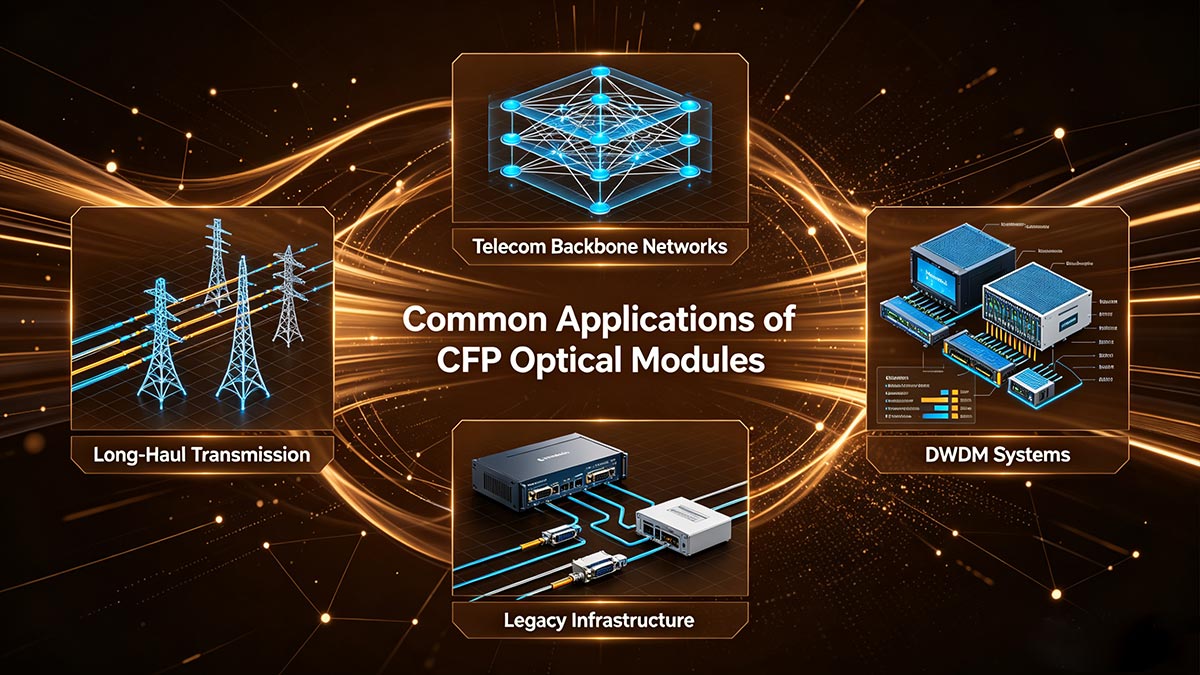
Long-Haul Transmission
One of the most important applications of CFP modules is long-haul optical communication, where data must travel over tens to hundreds of kilometers.
Why CFP is ideal:
Supports ER4 (40 km) and extended reach solutions (80 km+)
Higher optical output power and sensitivity
Stable performance over long distances
This makes CFP modules a preferred choice for:
Inter-city connections
Regional network links
Submarine and cross-country transmission (in some architectures)
Engineering Insight: Long-haul networks prioritize signal integrity and reach, where CFP’s larger size allows for more advanced optical components.
DWDM Systems (Dense Wavelength Division Multiplexing)
CFP modules are widely used in DWDM systems, which enable multiple optical signals to be transmitted simultaneously over a single fiber using different wavelengths.
Key advantages in DWDM:
Supports coherent optics and tunable wavelengths
Compatible with optical transport platforms
Enables high-capacity data transmission (multi-terabit systems)
CFP is often deployed in:
High-capacity backbone infrastructure
DWDM + CFP allows operators to maximize fiber utilization, a critical requirement in modern telecom networks.
Telecom Backbone Networks
CFP modules are a core component in carrier-grade backbone networks, where reliability and performance are critical.
Typical use cases:
Core routers and switches
Metro aggregation layers
ISP infrastructure
Why telecom still uses CFP:
Proven, mature technology
Strong interoperability across vendors
Designed for 24/7 high-load operation
In these environments, stability matters more than size, making CFP a reliable long-term solution.
Legacy Infrastructure
Many existing networks were originally built around CFP-based systems, and upgrading them is not always practical or cost-effective.
CFP remains relevant because:
Existing hardware supports CFP interfaces only
Migration to QSFP28 may require hardware replacement
CFP modules ensure backward compatibility
Common scenarios:
Gradual network upgrades
Hybrid deployments (CFP + QSFP28 coexistence)
Maintenance of older telecom systems
Real-world insight: Many operators choose to extend the life of CFP deployments rather than fully replace infrastructure.
What This Means for Network Designers
CFP optical modules are best suited for environments where:
Distance > density
Performance > power efficiency
Stability > compact size
Even in 2026, CFP modules remain highly relevant in:
Long-haul transmission networks
DWDM and optical transport systems
Telecom backbone infrastructure
Legacy network environments
While not ideal for modern data centers, CFP continues to deliver unique value in high-performance, long-distance applications.
📌 Advantages and Limitations of CFP Optical Modules
Understanding the strengths and trade-offs of a CFP optical module is essential for making the right deployment decision. While CFP remains powerful in certain scenarios, it also has clear limitations in modern network environments.
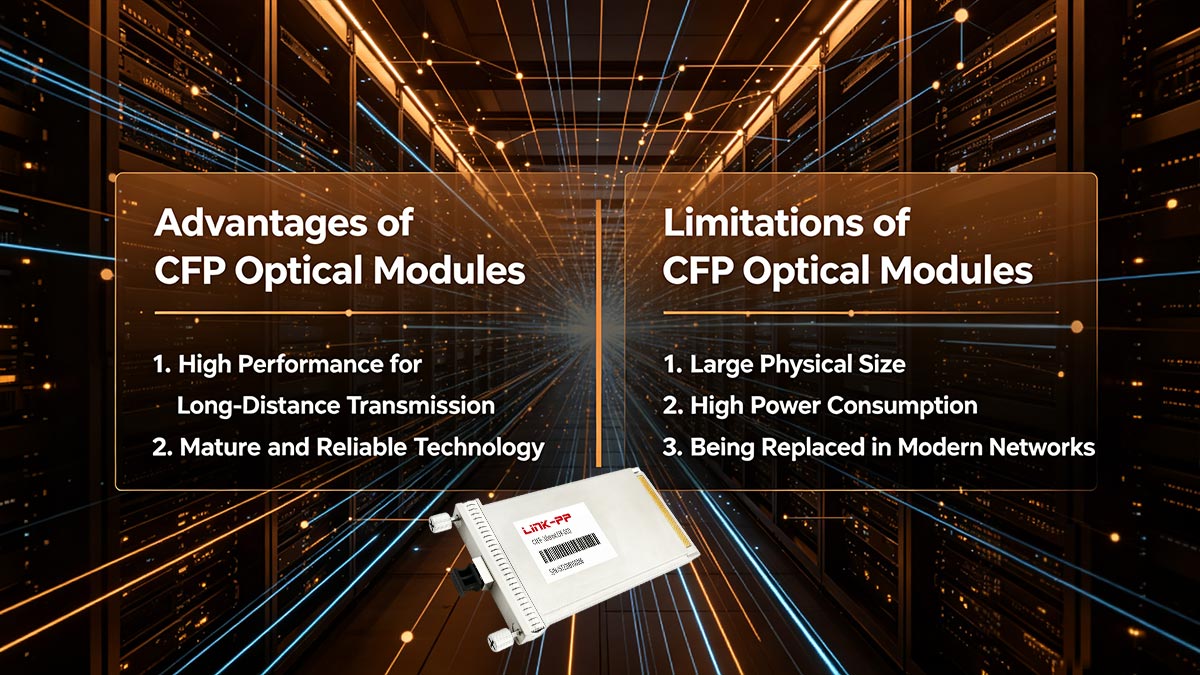
Advantages of CFP Optical Modules
1. High Performance for Long-Distance Transmission
CFP modules are specifically designed for long-haul and carrier-grade networks, where signal quality over distance is critical.
Supports ER4 (40 km) and extended reach (80 km+)
Higher optical power budget compared to smaller modules
Better tolerance for signal degradation over long fiber links
This makes CFP ideal for:
Telecom backbone networks
Metro and regional optical transport
DWDM systems requiring stable long-distance performance
Key Insight: When distance and signal integrity matter more than size, CFP remains a top choice.
2. Mature and Reliable Technology
CFP is one of the earliest standardized 100G optical modules, meaning it has been thoroughly tested and widely deployed.
Proven stability in 24/7 carrier environments
Strong interoperability across vendors
Established ecosystem with predictable performance
For network operators, this translates to:
Lower risk in mission-critical deployments
Easier integration with existing infrastructure
Real-world advantage: Telecom providers often prefer CFP because it is field-proven and highly reliable.
Limitations of CFP Optical Modules
1. Large Physical Size
One of the biggest drawbacks of CFP modules is their bulky form factor.
Much larger than QSFP28 and newer modules
Limits the number of ports per device
Reduces overall system density
Impact:
Not suitable for high-density environments like modern data centers
Increases hardware footprint
2. High Power Consumption
CFP modules consume significantly more power than newer alternatives.
Typical consumption: 20–24W or higher
Generates more heat
Requires stronger cooling systems
Consequences:
Higher operational costs
Thermal management challenges
Reduced energy efficiency
Compared to QSFP28 (~3–5W), CFP is far less efficient.
3. Being Replaced in Modern Networks
As technology evolves, CFP is gradually being replaced in many applications.
QSFP28 dominates data center and cloud deployments
Newer form factors (QSFP-DD, OSFP) support 400G+
Industry trend favors smaller, faster, and more efficient modules
Result:
CFP is now considered a legacy or niche solution in many scenarios
Balanced Perspective
Aspect | CFP Optical Module |
|---|---|
Long-distance performance | ⭐⭐⭐⭐⭐ |
Reliability | ⭐⭐⭐⭐⭐ |
Size efficiency | ⭐⭐ |
Power efficiency | ⭐⭐ |
Future scalability | ⭐⭐ |
Final Insight
CFP optical modules are not “outdated”—they are specialized.
They excel in long-distance, high-reliability environments, but fall short in high-density, energy-efficient modern networks.
Choose CFP when you need:
Long-distance transmission
Proven telecom-grade reliability
Avoid CFP when you need:
High port density
Low power consumption
Future-ready scalability
📌 How to Choose the Right CFP Optical Module
Selecting the right CFP optical module is not just about choosing a 100G transceiver—it’s about aligning technical specifications with your network architecture, distance requirements, and long-term cost strategy. This section provides a practical, engineer-focused framework to help you make the right decision.
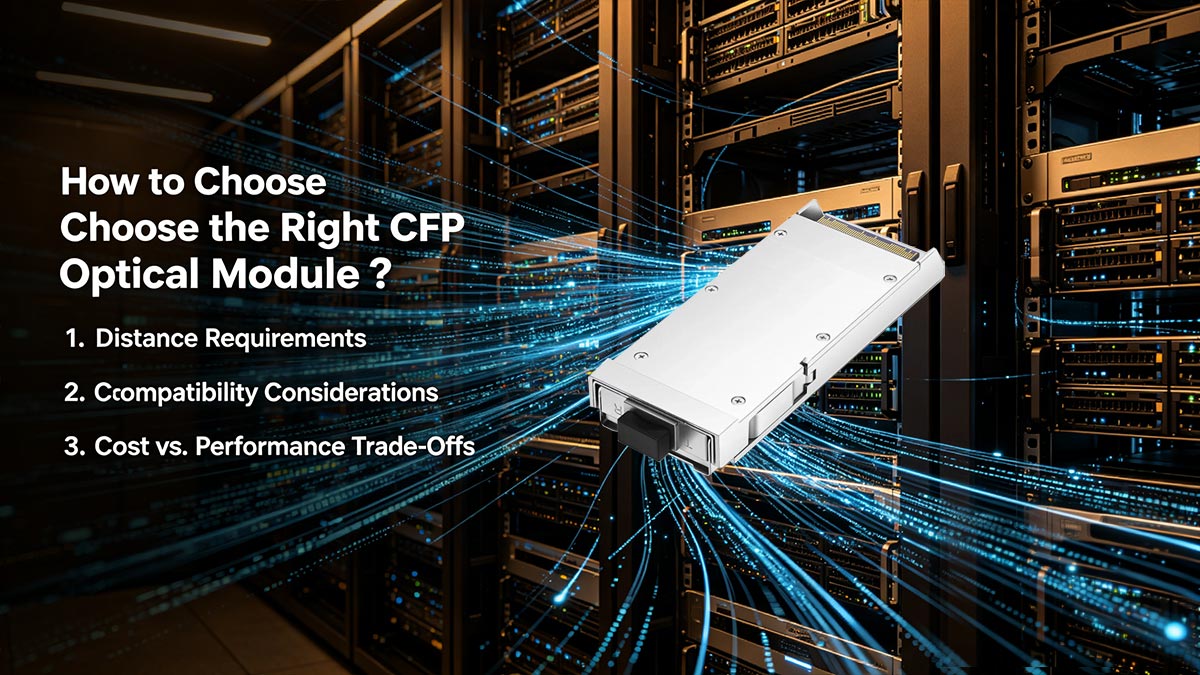
1. Distance Requirements (The First Decision Factor)
Transmission distance is the most critical parameter when choosing a CFP module.
Typical Options:
SR10 → up to 100–150 m (multimode fiber)
LR4 → up to 10 km (single-mode fiber)
ER4 → up to 40 km (single-mode fiber)
ZR / extended solutions → 80 km+ (in telecom scenarios)
How to decide:
Data center interconnect (short distance) → consider alternatives like QSFP28
Metro network (~10 km) → LR4 is usually sufficient
Long-haul / backbone → ER4 or higher
Pro Tip: Always include a link budget margin to account for fiber loss, connectors, and aging.
2. Compatibility Considerations
Compatibility is often overlooked—but it can make or break your deployment.
Key factors to check:
Hardware interface
Does your switch/router support CFP, CFP2, or CFP4?
Vendor compatibility
OEM vs. third-party modules (Cisco, Juniper, etc.)
Protocol support
Ethernet (100GBASE) vs. OTN (Optical Transport Network)
Interoperability
Can it work with existing modules on the other end?
In many legacy telecom systems, CFP may be the only supported option, making it the default choice.
Real-world insight: Engineers often prioritize plug-and-play reliability over theoretical performance gains.
3. Cost vs. Performance Trade-Offs
Choosing a CFP module involves balancing performance requirements against total cost of ownership (TCO).
Cost Factors:
Initial module price
Power consumption (long-term electricity cost)
Cooling and infrastructure requirements
Maintenance and replacement cycles
Performance Factors:
Transmission distance
Signal stability
Network reliability
Decision logic:
If your network requires long-distance + high stability → CFP justifies its higher cost
If your priority is cost efficiency + scalability → QSFP28 is often better
Key Insight: CFP is not the cheapest option—but it can be the most cost-effective for specific telecom use cases.
4. When CFP Is Still the Best Choice
Despite newer technologies, CFP remains the optimal solution in certain scenarios.
✅ Choose CFP if:
You are deploying in long-haul networks (40 km+)
Your system requires DWDM or OTN integration
You are maintaining or expanding legacy infrastructure
Your equipment only supports CFP interfaces
You prioritize reliability over density
❌ Avoid CFP if:
You need high port density (data centers)
Power efficiency is a top priority
You are building a future-proof 200G/400G network
Quick Decision Guide
Requirement | Recommended Choice |
|---|---|
Short-range, high density | QSFP28 |
Medium range (≤10 km) | QSFP28 / CFP LR4 |
Long-haul (40 km+) | CFP ER4 |
Legacy system compatibility | CFP |
Cost-sensitive scaling | QSFP28 |
Choosing the right CFP optical module comes down to one question:
Does your network prioritize distance and reliability, or density and efficiency?
If distance + stability → CFP is still the right choice
If efficiency + scalability → consider modern alternatives
📌 FAQs About CFP Modules
Q1: What is the difference between CFP and CFP2/CFP4 in real deployments?
The main difference lies in size, power efficiency, and system density:
CFP is larger and consumes more power, typically used in legacy or long-haul systems
CFP2 and CFP4 are smaller, more efficient, and allow higher port density
In real deployments, CFP2/CFP4 are preferred when upgrading systems without completely redesigning infrastructure.
Q2: Can CFP optical modules support DWDM and coherent optics?
Yes. CFP modules—especially advanced variants—can support:
DWDM (Dense Wavelength Division Multiplexing)
Coherent optical transmission (in telecom-grade applications)
This makes them suitable for:
High-capacity optical transport networks (OTN)
Long-distance, high-bandwidth transmission
Q3: Are CFP optical modules hot-swappable?
Yes, CFP modules are hot-swappable, meaning:
They can be inserted or removed without shutting down the system
This reduces downtime and simplifies maintenance
This feature is critical in carrier-grade networks where uptime is essential.
Q4: What connectors are used with CFP optical modules?
CFP modules typically use:
LC duplex connectors (for LR4, ER4)
MPO/MTP connectors (for SR10 parallel optics)
The connector type depends on the transmission standard and fiber configuration.
Q5: What is the typical lifespan of a CFP optical module?
A CFP optical module generally has a lifespan of:
5 to 10 years, depending on:
Operating temperature
Power conditions
Network environment
In telecom networks, CFP modules are often used long-term due to their proven reliability.
Q6:Can CFP modules be used in data centers today?
Technically yes, but in practice:
CFP is rarely used in modern data centers
QSFP28 and newer modules are preferred due to:
Smaller size
Lower power consumption
Higher port density
CFP is mainly limited to specialized or legacy deployments.
Q7: Do CFP optical modules require special cooling?
Yes. Due to higher power consumption:
CFP modules generate significant heat
Systems must include:
Adequate airflow design
Enhanced cooling mechanisms
This is one of the reasons CFP is less suitable for high-density environments.
Q8: Are CFP optical modules interoperable between vendors?
In many cases, yes—but with conditions:
Must follow MSA (Multi-Source Agreement) standards
Compatibility may depend on:
Firmware
Vendor restrictions (OEM locking)
It’s recommended to verify compatibility before deployment.
📌 Conclusion: Should You Still Use CFP Optical Modules?
As optical networking continues to evolve, the role of the CFP optical module is becoming more specialized—but it is far from irrelevant.
Clear Recommendation
You should still use CFP optical modules if your network prioritizes long-distance transmission, telecom-grade reliability, and compatibility with existing infrastructure.
However, for new deployments focused on scalability, energy efficiency, and high port density, modern form factors like QSFP28 or OSFP are typically the better choice.
Decision Summary
Choose CFP if:
You operate long-haul or DWDM networks (40 km+)
Your system relies on legacy telecom infrastructure
Stability and proven performance matter more than density
Choose newer modules (QSFP28 / OSFP) if:
You are building modern data centers
You need higher port density and lower power consumption
Future scalability (200G/400G+) is a priority
Transition Advice
For many network operators, the smartest approach is not immediate replacement—but gradual migration:
Continue using CFP in existing long-haul links
Introduce QSFP28 in new or upgraded segments
Plan for hybrid architectures during transition phases
👉 This reduces cost, minimizes risk, and ensures smooth network evolution.
Is CFP Optical Module Obsolete in 2026?
Market Trend Analysis
By 2026, the industry trend is clear:
CFP adoption is declining in new deployments
Smaller, more efficient modules (QSFP28, QSFP-DD, OSFP) dominate data center and hyperscale environments
Vendors are focusing R&D on higher-speed, lower-power form factors
However, “declining” does not mean “obsolete.”
Where CFP Is Still Relevant
CFP optical modules remain highly relevant in:
Telecom backbone networks
Long-haul optical transport (40 km–80 km+)
DWDM and OTN systems
Legacy infrastructure with CFP interfaces
In these scenarios, CFP continues to deliver stable, high-performance connectivity where newer modules may not yet fully replace it.
Migration to QSFP28 / OSFP
Modern networks are transitioning toward:
Key migration drivers:
Higher port density
Lower power consumption
Reduced cost per bit
Migration is not just a technology shift—it’s a cost-efficiency strategy.
Decision Framework: Keep or Replace?
Ask yourself these key questions:
Does my current system require CFP interfaces?
Are my transmission distances beyond QSFP28 capabilities?
Is power consumption or space a limiting factor?
Am I planning a next-generation network upgrade?
✔ Keep CFP if:
Your infrastructure depends on it
Your use case is long-distance telecom
Replacement cost outweighs benefits
🔄 Replace CFP if:
You need higher density and efficiency
You are upgrading to 200G/400G networks
Your hardware supports newer form factors
Final Thoughts
CFP optical modules are no longer the default choice—but they remain a critical technology in specific high-performance networking scenarios.
If you're evaluating whether to maintain, upgrade, or replace CFP modules, choosing a reliable supplier with proven compatibility and engineering support is essential.
👉 Explore high-quality optical transceivers and connectivity solutions at the LINK-PP Official Store to find the right fit for your network—whether you're maintaining legacy systems or building next-generation infrastructure.