

In modern Ethernet networks, choosing the right multimode fiber optic cable can significantly impact bandwidth, scalability, and long-term infrastructure costs. Two of the most widely deployed laser-optimized multimode fibers are OM3 and OM4, both designed to support high-speed data transmission using VCSEL-based optical modules. However, despite their similar core size and compatibility, these two fiber standards differ in modal bandwidth, maximum transmission distance, and performance in high-speed networks such as 40G and 100G Ethernet.
For network engineers, data center designers, and IT infrastructure planners, understanding the differences between fiber optic cable OM3 vs. OM4 is essential when building scalable networks. While OM3 has long been considered the standard for 10-gigabit multimode deployments, OM4 was introduced to support higher bandwidth applications and longer link distances, making it a preferred option in many modern data centers.
Another reason this comparison receives significant attention is the practical decision engineers face during upgrades. Many existing installations already use OM3 cabling, leading to common questions such as:
Can OM3 support 100G Ethernet?
Is OM3 compatible with OM4 fiber?
Is the extra cost of OM4 justified for future network expansion?
Real-world discussions from networking communities and infrastructure forums also highlight that the decision is rarely theoretical. Engineers often weigh factors such as link length, transceiver type, installation cost, and upgrade roadmap when deciding between OM3 and OM4.
In this guide, we will compare OM3 vs. OM4 fiber optic cables from both a technical and practical perspective, including:
The core specifications and bandwidth differences
Maximum transmission distance at 10G, 40G, and 100G speeds
Cost considerations and deployment scenarios
Compatibility and upgrade strategies
Insights from real network engineer discussions and field experiences
By the end of this article, you will have a clear understanding of when OM3 fiber is sufficient and when upgrading to OM4 fiber provides meaningful advantages for high-speed network infrastructure.
🎯 What Is OM3 Fiber? Definitions, Specs, and Real-World Uses
OM3 fiber is a type of laser-optimized multimode fiber (MMF) designed for high-speed data transmission in enterprise networks and data centers. It belongs to the ISO/IEC multimode fiber classification system and uses a 50/125 µm core/cladding structure, which enables it to transmit optical signals using vertical-cavity surface-emitting lasers (VCSELs) commonly found in modern optical transceivers.
Compared with older multimode fiber types such as OM1 and OM2, OM3 was specifically engineered to support 10 Gigabit Ethernet over longer distances while maintaining stable signal quality. Its improved effective modal bandwidth (EMB) of approximately 2000 MHz·km at 850 nm significantly reduces modal dispersion, which is the main limitation in multimode fiber transmission.
Because of this design, OM3 fiber became the industry standard for 10G short-reach optical links, especially in environments such as data centers, campus networks, and enterprise backbone connections.
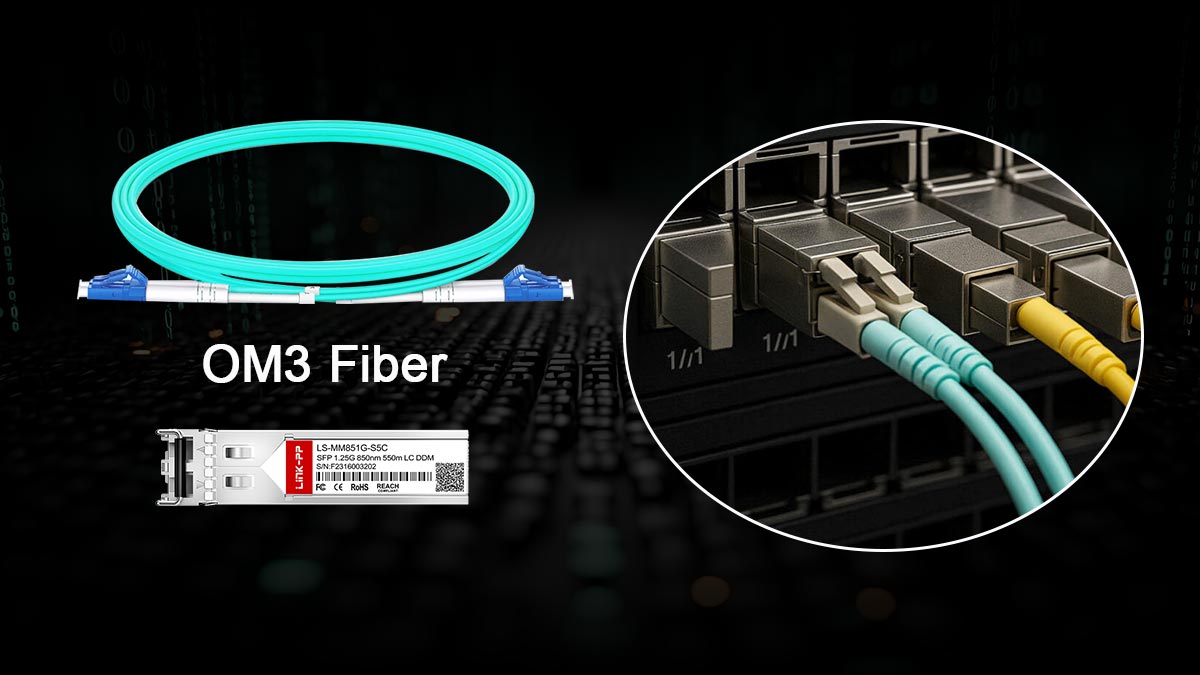
OM3 Technical Specs
The key technical characteristics of OM3 fiber help explain why it became widely adopted for high-speed networking deployments.
Specification | OM3 Multimode Fiber |
|---|---|
Fiber type | Laser-optimized multimode |
Core / cladding size | 50 / 125 µm |
Typical wavelength | 850 nm |
Effective modal bandwidth | ≈ 2000 MHz·km |
Attenuation (850 nm) | ≤ 3.5 dB/km |
Jacket color | Aqua |
10G Ethernet distance | Up to 300 m |
40G / 100G Ethernet distance | Up to 100 m |
The 2000 MHz·km modal bandwidth is one of the defining specifications of OM3. This value determines how much data can be transmitted through the fiber without excessive signal distortion caused by modal dispersion.
In practical terms, this bandwidth allows OM3 to support:
10GBASE-SR up to 300 meters
40GBASE-SR4 and 100GBASE-SR4 up to 100 meters
These capabilities make OM3 suitable for short-reach high-speed interconnects within buildings or data center rows.
OM3 Common Applications
Due to its balance of performance and cost, OM3 fiber has been widely deployed in many networking environments. Typical applications include:
1. Data Center Interconnects
OM3 is commonly used for Top-of-Rack (ToR) to aggregation switch connections where distances typically range from 10 to 100 meters.
2. Enterprise Backbone Networks
Many enterprise buildings use OM3 fiber for 10G backbone links between floors or network closets.
3. High-Speed Server Connectivity
Short-distance connections between servers, storage arrays, and switches often rely on OM3 paired with SFP+ or QSFP optical modules.
4. Campus Network Links
Campus environments frequently deploy OM3 for building-to-building links within moderate distances, especially when planning for future 10G upgrades.
In addition, OM3 is widely used with MPO/MTP trunk cables to support parallel optics used in 40G and 100G Ethernet deployments.
When OM3 Is the Best Value Choice
Although newer fiber standards exist, OM3 still remains a cost-effective solution for many network scenarios.
OM3 is often the best choice when:
Network speeds are primarily 10 Gigabit Ethernet
Link distances are under 300 meters
The infrastructure does not require immediate upgrades to high-density 100G networks
The project budget prioritizes lower cabling cost
In many existing networks, OM3 cabling infrastructure is already installed. In these cases, engineers often continue to use OM3 because it provides reliable performance for short-range high-speed connections without requiring a complete fiber upgrade.
However, when planning new data center deployments or expecting rapid growth in 40G, 100G, or higher-speed optical networks, many organizations consider OM4 fiber to provide additional performance headroom and longer transmission distances.
🎯 What Is OM4 Fiber? Technical Specs, EMB, and Data-Center Use Cases
OM4 fiber is an advanced laser-optimized multimode fiber (MMF) designed to support higher bandwidth and longer transmission distances than OM3. Like OM3, it uses a 50/125 µm core and cladding structure and is optimized for VCSEL-based optical transceivers operating around 850 nm.
The key improvement of OM4 lies in its higher effective modal bandwidth (EMB), which is specified at approximately 4700 MHz·km. This significantly reduces modal dispersion, allowing optical signals to maintain integrity over longer distances at higher data rates.
Because of this increased bandwidth, OM4 has become a preferred fiber type in modern data centers, especially where organizations deploy 40G and 100G Ethernet or expect future upgrades to higher-speed optical networks.
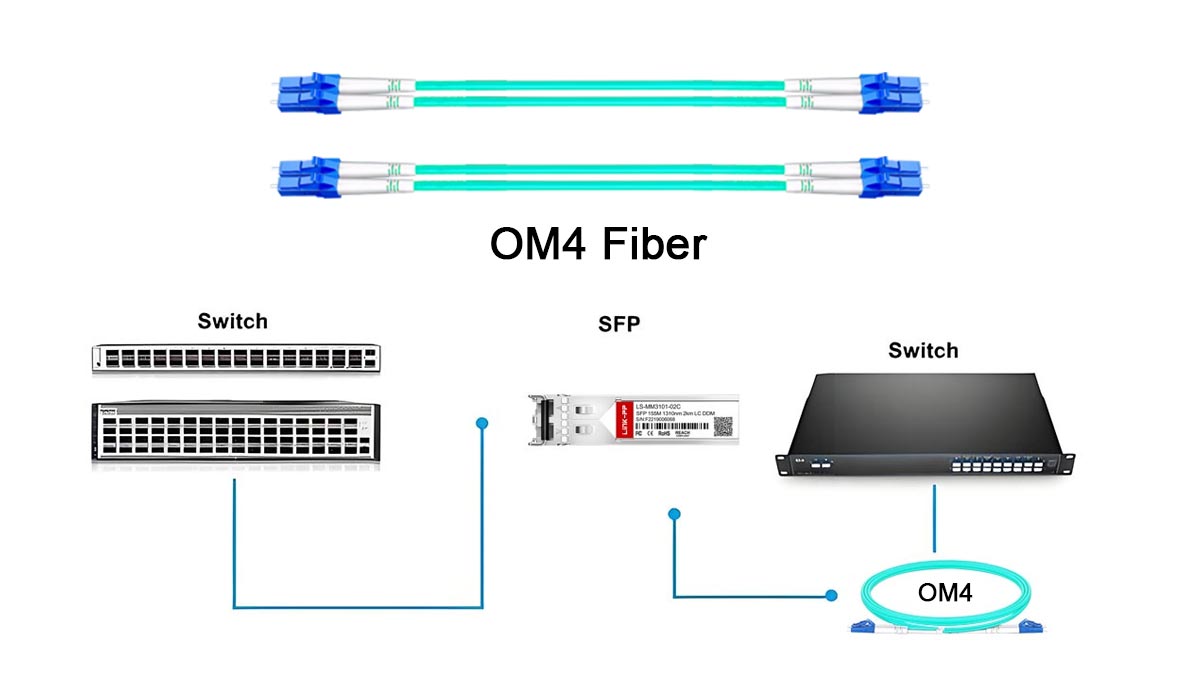
OM4 Technical Specs
The following table summarizes the main technical specifications that differentiate OM4 from earlier multimode fiber standards.
Specification | OM4 Multimode Fiber |
|---|---|
Fiber type | Laser-optimized multimode |
Core / cladding size | 50 / 125 µm |
Operating wavelength | 850 nm |
Effective modal bandwidth | ≈ 4700 MHz·km |
Attenuation (850 nm) | ≤ 3.0 dB/km |
Jacket color | Aqua or Erika Violet |
10G Ethernet distance | Up to 400–550 m |
40G / 100G Ethernet distance | Up to 150 m |
The 4700 MHz·km EMB specification gives OM4 nearly twice the modal bandwidth of OM3, which directly translates to longer reach and improved performance for parallel optics used in high-speed Ethernet standards.
OM4 in 40G and 100G Deployments
One of the primary reasons OM4 was developed was to support higher-speed optical networking standards such as 40GBASE-SR4 and 100GBASE-SR4.
In data center environments, these standards typically use parallel optics over MPO/MTP fiber connections, where multiple fiber strands transmit data simultaneously. OM4's higher modal bandwidth ensures that these signals experience less dispersion over longer links.
Typical deployment scenarios include:
Data Center Spine-Leaf Architectures
OM4 fiber is often used to connect leaf switches to spine switches, where higher bandwidth and scalability are required.
High-Density Cloud Infrastructure
Cloud providers and hyperscale data centers frequently deploy OM4 to support large volumes of east-west traffic between servers and storage systems.
High-Speed Aggregation Links
Network engineers may choose OM4 when planning 40G or 100G aggregation links that exceed the practical distance limits of OM3.
Because of its improved performance margin, OM4 also helps reduce the risk of link failures caused by dispersion and insertion loss, especially in complex cabling infrastructures with multiple connectors.
OM4 vs. OM5: A Quick Note
Although OM4 remains widely deployed in modern networks, some organizations evaluating new infrastructure also encounter OM5 multimode fiber.
OM5 was introduced to support short-wavelength division multiplexing (SWDM), which allows multiple wavelengths to travel through the same multimode fiber. This technology can enable higher capacity without increasing the number of fiber strands.
However, OM5 adoption is still relatively limited compared with OM4. Many networks continue to deploy OM4 because:
It is fully compatible with existing multimode infrastructure
It supports most current 40G and 100G optical transceivers
It offers strong performance without the higher cost associated with newer fiber types
For these reasons, OM4 remains a common choice for data centers planning high-speed optical networks while balancing performance, cost, and compatibility.
🎯 OM3 vs. OM4: Speed, Modal Bandwidth, and Maximum Transmission Distance
When comparing fiber optic cable OM3 vs. OM4, the most important technical differences relate to modal bandwidth, supported Ethernet speeds, and maximum transmission distance. Both fiber types are laser-optimized multimode fibers with a 50/125 µm core, but OM4 offers significantly higher bandwidth capacity, which enables longer link distances at high data rates.
The primary metric used to measure this capability is Effective Modal Bandwidth (EMB). EMB indicates how well a multimode fiber can transmit high-speed optical signals without excessive modal dispersion. Since OM4 has a much higher EMB than OM3, it can maintain signal integrity over longer distances, particularly in 40G and 100G Ethernet environments.
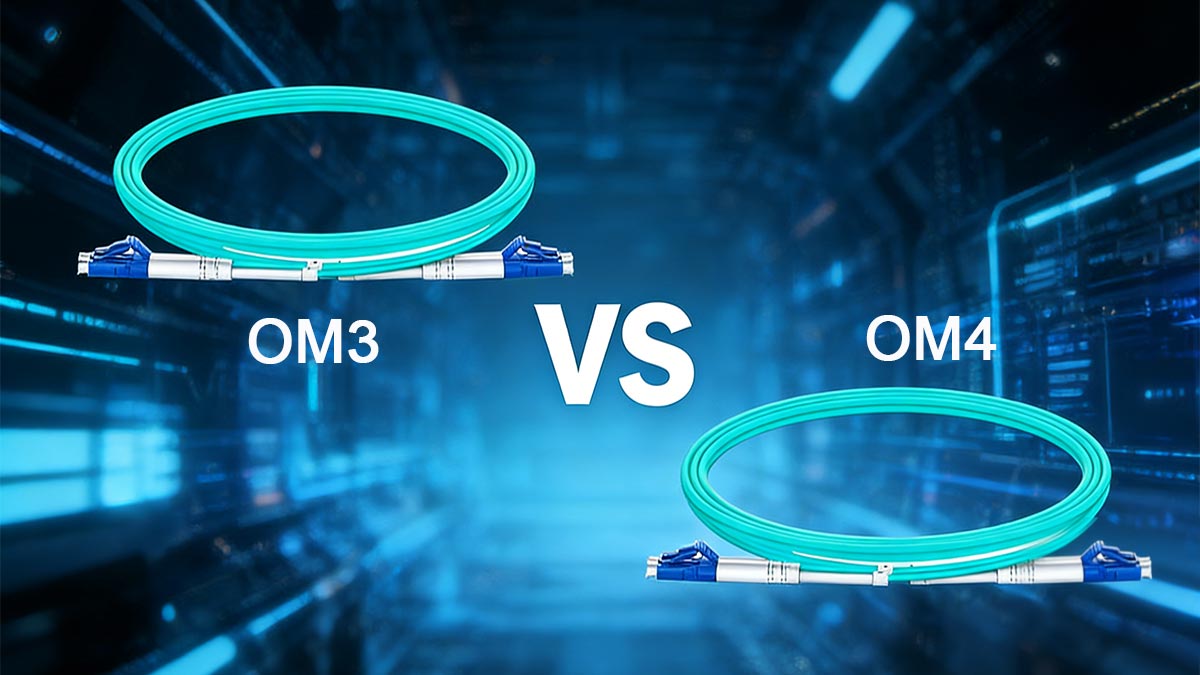
OM3 vs. OM4 Distance by Speed
The following table provides a clear comparison of the maximum recommended transmission distances for common Ethernet standards.
Ethernet Speed | OM3 Distance | OM4 Distance |
|---|---|---|
up to 1000 m | up to 1000 m | |
10GBASE-SR | up to 300 m | up to 400–550 m |
40GBASE-SR4 | up to 100 m | up to 150 m |
100GBASE-SR4 | up to 100 m | up to 150 m |
Several key insights emerge from this comparison:
At 1G speeds, both OM3 and OM4 provide similar maximum distances.
At 10G, OM4 extends the reach by roughly 100–250 meters compared with OM3.
At 40G and 100G, OM4 increases the link distance by about 50% over OM3.
This difference is particularly important in large data centers, where longer fiber runs between rows or switching layers may exceed the practical limits of OM3.
What EMB Means for Your Link Design
The performance difference between OM3 and OM4 largely comes down to effective modal bandwidth.
Fiber Type | Effective Modal Bandwidth (850 nm) |
|---|---|
OM3 | ≈ 2000 MHz·km |
OM4 | ≈ 4700 MHz·km |
Higher EMB means the fiber can carry more data over longer distances without signal distortion. In multimode fibers, optical signals travel along multiple paths (modes). If these modes arrive at different times, the signal becomes distorted — a phenomenon known as modal dispersion.
OM4 reduces this effect because its higher EMB allows signals from VCSEL lasers to stay synchronized over longer distances. As a result:
High-speed Ethernet links remain stable over longer runs
Network designers gain additional performance margin
Infrastructure upgrades become easier without replacing fiber
For this reason, many organizations deploying 40G or 100G networks choose OM4 fiber, even if their current link distances could technically be supported by OM3. The additional bandwidth headroom provides future scalability and greater tolerance for insertion loss in complex cabling systems.
In short, while OM3 remains suitable for short-reach 10G applications, OM4 offers a larger performance margin for modern high-speed data center networks.
🎯 OM3 vs. OM4 Compatibility and Mixing: Best Practices for Upgrades
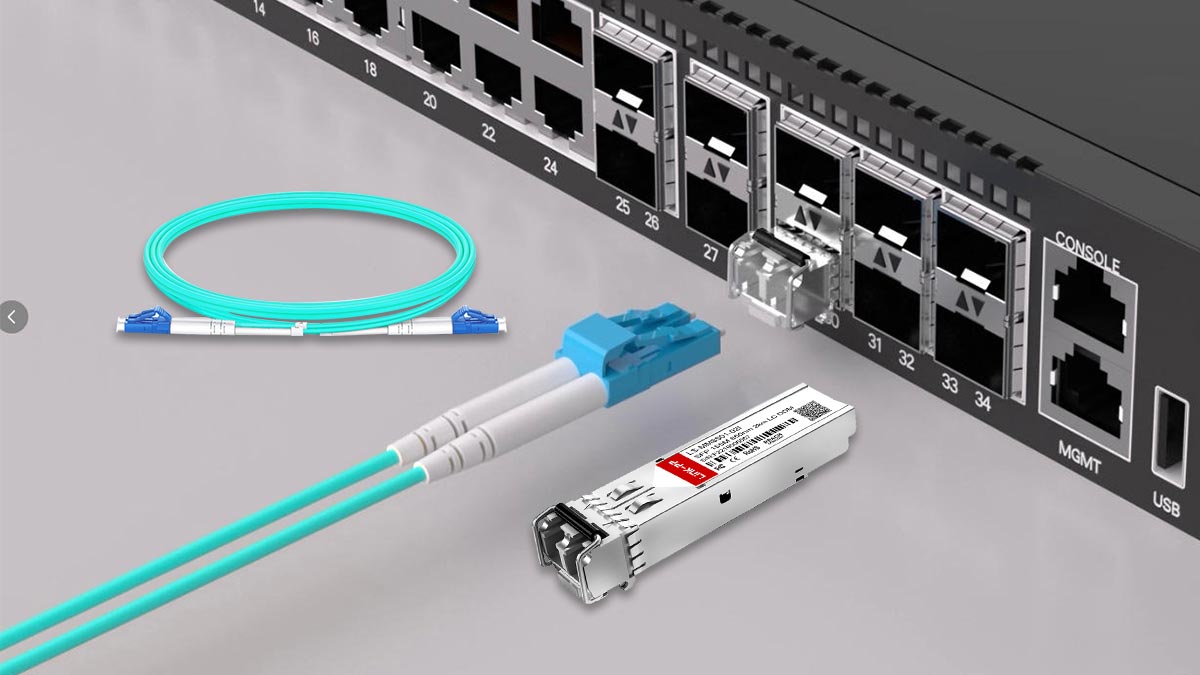
During network expansions or infrastructure upgrades, engineers often face a practical question: can OM3 and OM4 fiber be used together in the same link? The answer is yes—OM3 and OM4 are fully compatible because both use the same 50/125 µm multimode fiber structure and support identical connector types such as LC, SC, and MPO/MTP.
However, there is an important rule in fiber optic network design:
When different fiber grades are mixed in a single link, the overall performance is limited by the lowest-grade fiber.
This means that if OM4 fiber is connected to OM3 fiber, the link will typically operate within OM3 distance limits, particularly at higher speeds such as 40G-SR4 or 100G-SR4.
Understanding this principle helps network engineers plan incremental upgrades without introducing performance bottlenecks.
Mix-and-Match Scenarios
In real deployments, OM3 and OM4 are commonly mixed in several upgrade scenarios.
1. Extending Existing OM3 Infrastructure
Many legacy data centers installed OM3 fiber during the 10G Ethernet era. When additional racks or rows are added, engineers may deploy OM4 trunk cables to support future high-speed upgrades. Until the entire channel is upgraded, the link performance will still follow OM3 limits.
2. OM4 Patch Cords with OM3 Backbone Cabling
Another common case occurs when OM4 patch cables are connected to an OM3 backbone. This configuration works without compatibility issues, but again the maximum supported distance will follow OM3 specifications.
3. Gradual Migration to High-Speed Networks
Organizations planning to move toward 40G or 100G Ethernet sometimes upgrade trunk cabling to OM4 while keeping existing OM3 patch infrastructure. This approach allows phased migration without replacing the entire fiber system at once.
MPO/MTP Considerations
High-speed optical networks often use MPO/MTP connectors, particularly for 40G and 100G parallel optics. When mixing OM3 and OM4 fibers in MPO-based systems, several best practices are important:
Maintain consistent polarity schemes (Method A, B, or C) across the fiber channel
Avoid mixing different fiber types within the same trunk cable whenever possible
Verify that MPO trunk cables and breakout assemblies match the intended Ethernet standard
Ensure connectors are clean and properly inspected, since insertion loss can impact high-speed links
Because parallel optics distribute signals across multiple fibers, even small losses or mismatches can reduce overall link performance.
Field Testing and Verification Checklist
After installing or modifying mixed OM3/OM4 infrastructure, proper testing is essential to ensure the network operates reliably. Network engineers typically follow a verification process that includes:
1. Optical Loss Testing
Use optical power meters and light sources to measure insertion loss across the fiber link.
2. OTDR Testing
Optical Time Domain Reflectometer (OTDR) testing can identify:
Connector losses
Fiber bends
Splice issues
3. Certification Against Standards
Many installations are certified against TIA-568 or ISO/IEC structured cabling standards to confirm the link meets performance requirements.
4. Transceiver Compatibility Verification
Ensure optical modules (for example SFP+, QSFP+, or QSFP28) are compatible with the installed fiber type and expected transmission distance.
When properly tested and managed, mixed OM3 and OM4 fiber deployments can operate reliably, allowing organizations to upgrade network infrastructure gradually. However, for new installations or long-term data center designs, many engineers choose a single fiber type—often OM4—to simplify performance planning and ensure sufficient headroom for future high-speed Ethernet upgrades.
🎯 Cost Comparison & TCO: OM3 vs. OM4 Procurement Guidance
When evaluating fiber optic cable OM3 vs. OM4, the decision is rarely based on technical performance alone. In many projects, cost and long-term total cost of ownership (TCO) play a major role in determining which fiber type is deployed.
At first glance, OM3 fiber is generally less expensive per meter than OM4. However, the initial cable price represents only a small portion of the overall network investment. Factors such as installation labor, patch panels, optical modules, and future upgrade costs often have a much larger impact on the final project budget.
Because fiber infrastructure typically remains in place for 10–20 years, many organizations evaluate both short-term purchase cost and long-term scalability before choosing between OM3 and OM4.

Short-Term vs Long-Term Cost Model
In the short term, OM3 often appears more attractive from a purely budget perspective.
Typical cost considerations include:
Cost Factor | OM3 | OM4 |
|---|---|---|
Cable price per meter | Lower | Higher |
Patch cords | Slightly lower | Slightly higher |
Installation cost | Similar | Similar |
Connector types | Same | Same |
Transceiver compatibility | Same | Same |
Because both fiber types use identical connectors and termination methods, installation costs are usually nearly identical. The main difference lies in the fiber cable itself, where OM4 is typically priced higher due to tighter manufacturing tolerances and higher modal bandwidth specifications.
However, focusing only on the cable price can be misleading. In many data center environments, labor and downtime costs far exceed the price difference between OM3 and OM4 fiber.
For example:
Pulling fiber through cable trays
Installing patch panels
Performing fiber testing and certification
Scheduling maintenance windows
These operational costs mean that replacing fiber infrastructure later can become significantly more expensive than installing higher-performance fiber from the beginning.
ROI Example for 40G / 100G Upgrade
A simple upgrade scenario illustrates how OM4 can reduce long-term infrastructure costs.
Imagine a data center deploying 10G Ethernet using OM3 fiber with link distances close to the 300-meter limit. If the organization later upgrades to 40G or 100G Ethernet, OM3 will only support approximately 100 meters at those speeds. Any links longer than that would require new fiber installation.
In contrast, OM4 supports up to 150 meters for 40G and 100G Ethernet, providing additional headroom for many network topologies. This extra distance can prevent costly infrastructure replacement during upgrades.
From a TCO perspective, this means:
OM3: Lower initial cable cost, but potential future re-cabling expenses
OM4: Higher upfront investment, but better long-term scalability
Procurement Decision Matrix
The best fiber choice often depends on the type of network environment and future growth expectations.
Environment | Recommended Choice | Reason |
|---|---|---|
Homelab / small networks | OM3 | Short links and budget sensitivity |
Enterprise campus networks | OM3 or OM4 | Depends on future bandwidth plans |
Modern data centers | OM4 | Better support for 40G / 100G upgrades |
Hyperscale / cloud infrastructure | OM4 or OM5 | High bandwidth growth requirements |
For many organizations deploying new infrastructure today, OM4 is frequently selected because it provides greater flexibility for future high-speed Ethernet deployments while keeping compatibility with existing multimode optical modules.
Ultimately, the decision between OM3 and OM4 should balance budget constraints, expected link distances, and long-term network upgrade strategies rather than focusing solely on the initial cable price.
🎯 OM3 vs. OM4 vs. OM5: Future-Proofing and When to Choose OM5
As data center bandwidth continues to grow, many network designers are not only comparing OM3 vs. OM4, but also evaluating OM5 multimode fiber as a potential long-term solution. OM5 was introduced as the newest generation of wideband multimode fiber (WBMMF), designed to support short-wavelength division multiplexing (SWDM) technologies.
While OM3 and OM4 primarily operate with a single wavelength around 850 nm, OM5 enables multiple wavelengths between approximately 850 nm and 950 nm to be transmitted simultaneously through the same fiber. This capability allows higher total throughput without increasing the number of fiber strands.
However, the decision to deploy OM5 depends heavily on network architecture, transceiver availability, and cost considerations.
OM5 Explained
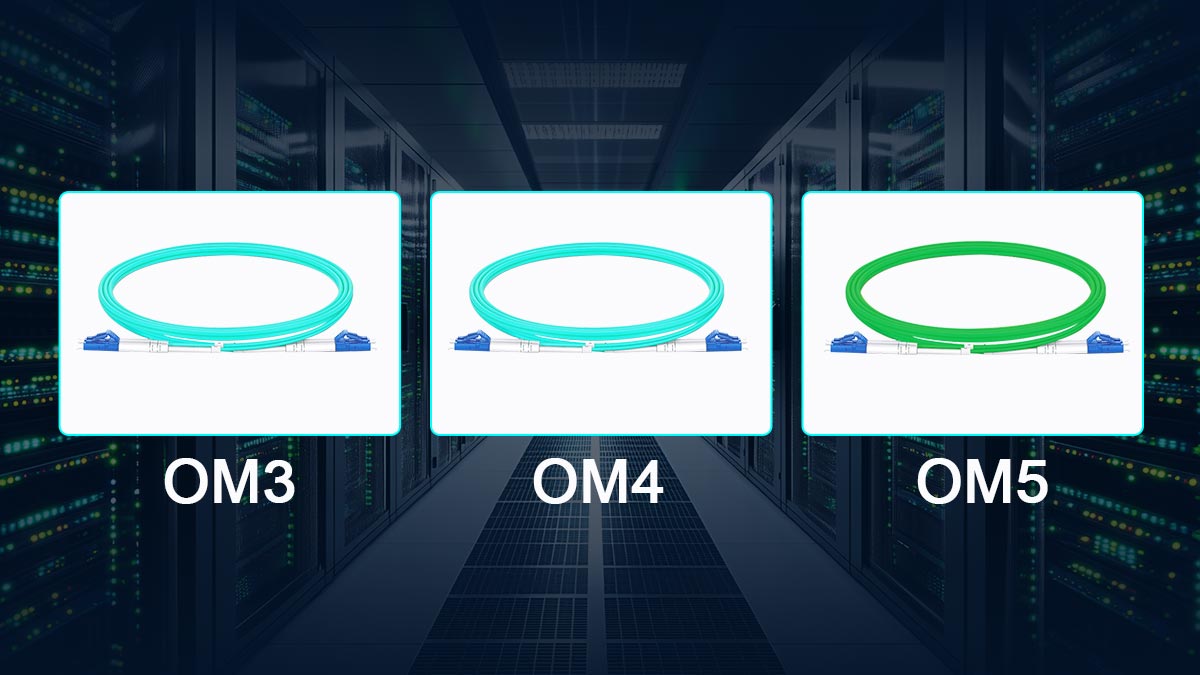
OM5 fiber maintains the same 50/125 µm core size used by OM3 and OM4, which means it remains fully backward compatible with existing multimode optical modules and connectors.
The key difference lies in its wideband modal bandwidth, which allows multiple wavelengths to travel through the fiber simultaneously. This feature supports SWDM transceivers, which combine several optical channels over a single pair of multimode fibers.
Key characteristics of OM5 include:
Specification | OM3 | OM4 | OM5 |
|---|---|---|---|
Core size | 50/125 µm | 50/125 µm | 50/125 µm |
Modal bandwidth | ~2000 MHz·km | ~4700 MHz·km | Wideband (850–953 nm) |
Jacket color | Aqua | Aqua / Violet | Lime Green |
SWDM support | No | Limited | Yes |
Typical 100G distance | ~100 m | ~150 m | Similar to OM4 (but multi-wavelength capable) |
The main advantage of OM5 is fiber efficiency. By transmitting multiple wavelengths simultaneously, networks can achieve higher capacity without requiring additional fiber pairs.
When OM5 Makes Sense
Despite its technical advantages, OM5 adoption remains relatively selective. In many cases, OM4 continues to meet the requirements of most enterprise and data center deployments.
OM5 typically becomes attractive in scenarios such as:
1. High-Density Data Centers
Hyperscale data centers with limited cable pathways may benefit from SWDM technology because it reduces the number of fiber strands required for high-capacity links.
2. Long-Term Infrastructure Planning
Organizations designing infrastructure intended to last 15–20 years may consider OM5 as part of a future-proofing strategy.
3. Bandwidth-Constrained Fiber Pathways
In environments where running additional fiber is difficult or expensive, multi-wavelength transmission can increase capacity without expanding the cable plant.
However, there are also reasons many networks continue to choose OM4:
OM4 supports most 40G and 100G Ethernet deployments
SWDM optical modules are less widely deployed and more expensive
OM4 infrastructure is already common in modern data centers
As a result, OM4 is often considered the practical balance between performance, cost, and ecosystem maturity, while OM5 serves specialized environments that specifically benefit from multi-wavelength multimode transmission.
For most organizations comparing fiber optic cable OM3 vs. OM4, the decision will remain between those two fiber types. OM5 becomes relevant primarily when advanced SWDM technologies or long-term bandwidth scaling strategies are part of the network design roadmap.
🎯 OM3 vs. OM4: Final Recommendations for Network Deployment
Choosing between OM3 and OM4 fiber optic cables depends on several key factors: link distance, target bandwidth, budget, and the network environment. Both fiber types are fully compatible and support high-speed data transmission, but OM4 provides higher effective modal bandwidth (EMB) and longer distances for 40G and 100G Ethernet, offering additional future-proofing for growing networks.
How to Choose OM3 and OM4: Decision Flow
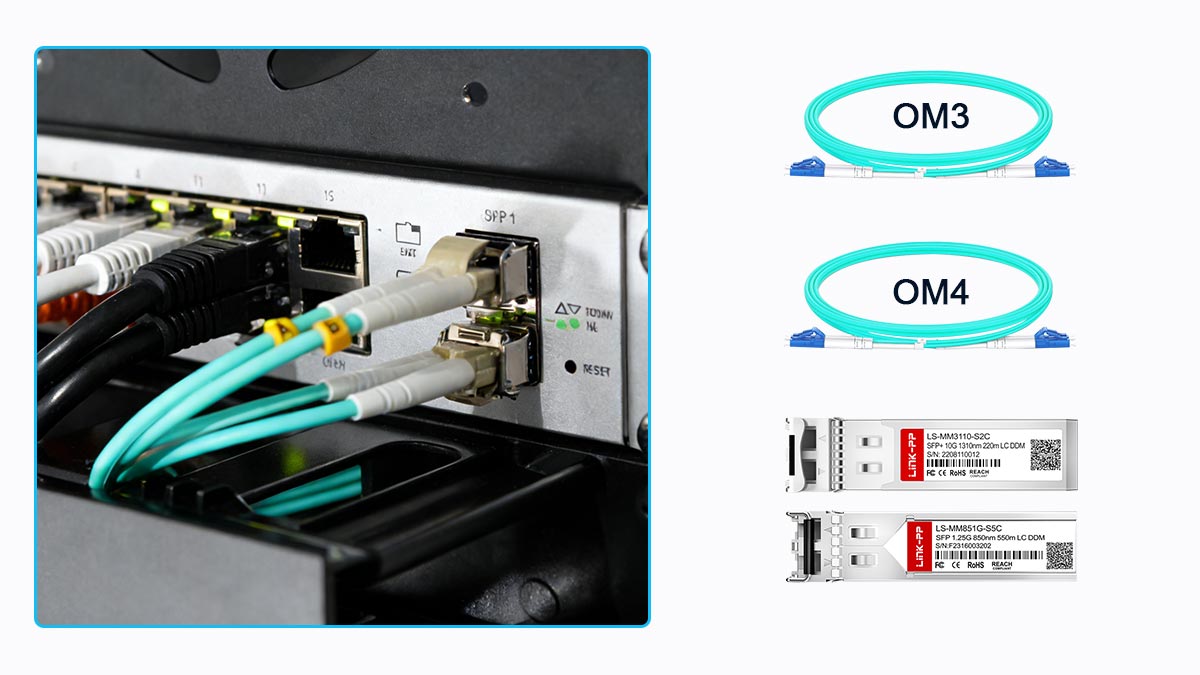
A practical decision framework helps determine the best fiber type for your deployment:
Distance:
Short links (<300 m for 10G): OM3 is sufficient
Longer links (>300 m for 10G or >100 m for 40G/100G): OM4 recommended
Target Bandwidth:
10G applications: OM3 is cost-effective
40G or 100G: OM4 provides required performance margin
Budget:
Tight budgets or small-scale networks: OM3
Enterprise or data center environments planning upgrades: OM4
Environment & Future-Proofing:
Homelabs or small offices: OM3
High-density data centers or cloud deployments: OM4 (or consider OM5 for SWDM scenarios)
Real Engineer Feedback about OM3 vs. OM4 deployments
Network engineers frequently discuss OM3 vs. OM4 deployments in forums and field reports:
Reddit threads reveal that mixing OM3 and OM4 is acceptable but link performance defaults to the lower-grade fiber. Engineers emphasize testing with OTDR and insertion loss meters before production.
Lab tests demonstrate that OM4 allows up to 150 m for 40G/100G links, while OM3 reaches 100 m, confirming specifications from vendors.
Field reports from enterprise and data center deployments show that OM4 simplifies upgrades and reduces the need for fiber replacement during network expansion.
Multimode Fiber Cable Resources
For network planning and procurement, check out:
OM3 OM4 Multimode Fiber SFP Module – LINK-PP Official Store
Additional resources:
Multimode Fibers Explained: OM1 OM2 OM3 OM4 OM5
Standards and authority references: ISO/IEC 11801, TIA-492AAAC, TIA-492AAAD
By following this framework, network designers can confidently select the right fiber type, optimize TCO, and ensure long-term reliability for both current and future high-speed network applications.