
The relentless demand for bandwidth, fueled by cloud computing, AI, and 5G networks, has pushed data center interconnects to unprecedented speeds. At the heart of this transformation lies IEEE 802.3bs, a crucial amendment to the overarching IEEE 802.3 Ethernet standard.
Ratified in December 2017, IEEE 802.3bs specifically defined the specifications for 200 Gigabit Ethernet (200GbE) and 400 Gigabit Ethernet (400GbE). This standard is not just an incremental speed bump; it represents a paradigm shift that enables the scalable, energy-efficient, and dense optical connectivity now essential for hyperscale environments.
This expert guide will provide a deep dive into the technical core of IEEE 802.3bs, exploring the underlying technologies and the critical role it plays in the evolution of 200G/400G optical transceivers.
▶ Understanding the Core Mandate of IEEE 802.3bs
The primary objective of the IEEE 802.3bs Task Force was to provide Physical Layer (PHY) specifications and Media Access Control (MAC) parameters capable of supporting data rates of 200 Gb/s and 400 Gb/s over optical fiber.
To achieve this massive leap in speed from the previous 100GbE standard (IEEE 802.3bm/cd), the standard introduced two fundamental changes:
The Shift to PAM4 Modulation
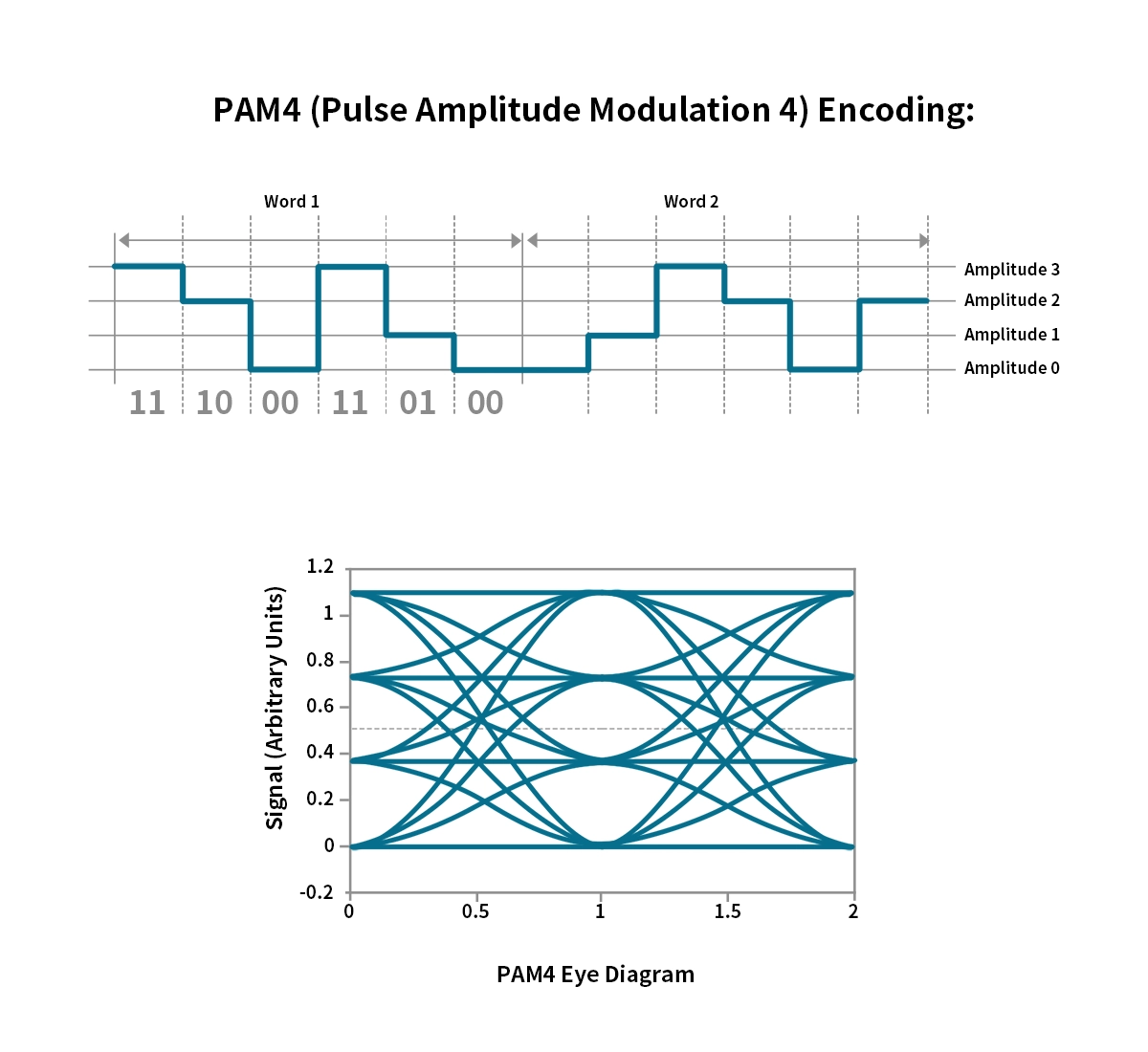
A key enabler of 400G Ethernet is the adoption of Pulse Amplitude Modulation 4-level (PAM4) signaling. Earlier Ethernet speeds, including 100G, predominantly relied on Non-Return-to-Zero (NRZ) encoding, which transmits 1 bit per symbol by using two distinct signal levels (high/low).
NRZ: 2 levels, 1 bit per symbol.
PAM4: 4 distinct signal levels, transmitting 2 bits per symbol (00, 01, 10, 11).
By doubling the information carried per symbol, PAM4 effectively doubles the bit rate for a given Baud rate (symbol rate). For example, a lane running at 26.56 Gbaud with NRZ delivers approximately 25 Gb/s, but with PAM4, it delivers 50 Gb/s. This efficiency is paramount for realizing 200G/400G Ethernet without requiring a linear, non-scalable increase in electrical bandwidth and power consumption.
Mandatory Forward Error Correction (FEC)
The trade-off for PAM4’s spectral efficiency is a reduced Signal-to-Noise Ratio (SNR) due to the smaller voltage separation between the four signal levels. To maintain the low Bit Error Rate (BER) required for reliable data center operation, IEEE 802.3bs made Reed-Solomon Forward Error Correction (RS-FEC) mandatory.
Function: RS-FEC adds redundant data to the transmitted signal, allowing the receiver to detect and correct a certain number of errors without retransmission.
Significance: FEC is a critical component that compensates for the inherent signal degradation of high-speed PAM4 signaling, ensuring the integrity and stability of 400GbE links.
▶ The Essential 200G and 400G PMD Specifications
IEEE 802.3bs defines several Physical Medium Dependent (PMD) specifications that dictate the cable type, distance, and optical technology for both 200G and 400G links. These standards form the basis for all compliant QSFP-DD and OSFP optical transceivers.
Standard | Rate | Fiber Type | Lanes / Wavelengths | Reach (Min) | Technology |
|---|---|---|---|---|---|
400GBASE-SR16 | 400G | MMF (OM4) | 16 fibers (8 Tx, 8 Rx) | 100m | Parallel Fiber |
400GBASE-DR4 | 400G | SMF | 4 fibers (4 Tx, 4 Rx) | 500m | Parallel Fiber (4×100G) |
400GBASE-FR8 | 400G | SMF | 8 wavelengths | 2km | CWDM / LWDM |
400GBASE-LR8 | 400G | SMF | 8 wavelengths | 10km | CWDM / LWDM |
200GBASE-DR4 | 200G | SMF | 4 fibers (4 Tx, 4 Rx) | 500m | Parallel Fiber (4×50G) |
200GBASE-FR4 | 200G | SMF | 4 wavelengths | 2km | CWDM / LWDM |
▶ The Pervasive Role of 400GBASE-DR4 and 400GBASE-LR8
In modern hyperscale data centers, the 400GBASE-DR4 and 400GBASE-LR8 specifications, both defined by IEEE 802.3bs, are paramount.
400GBASE-DR4: Utilizes four parallel single-mode fiber (SMF) pairs, with each fiber carrying 100 Gb/s using PAM4. This parallel optical approach offers a cost-effective solution for reaches up to 500m and is widely adopted for intra-data center spine-and-leaf architectures. Importantly, a 400GBASE-DR4 transceiver can often be broken out into four individual 100GBASE-DR links.
400GBASE-LR8: Leverages Wavelength Division Multiplexing (WDM) by transmitting 8 channels (wavelengths) of 50 Gb/s PAM4 over a single fiber pair, achieving 10 km reach. This is the gold standard for connecting geographically dispersed data centers and high-density aggregation points.
▶ The Business Impact: 200G/400G Optical Transceivers and the Future of Networking
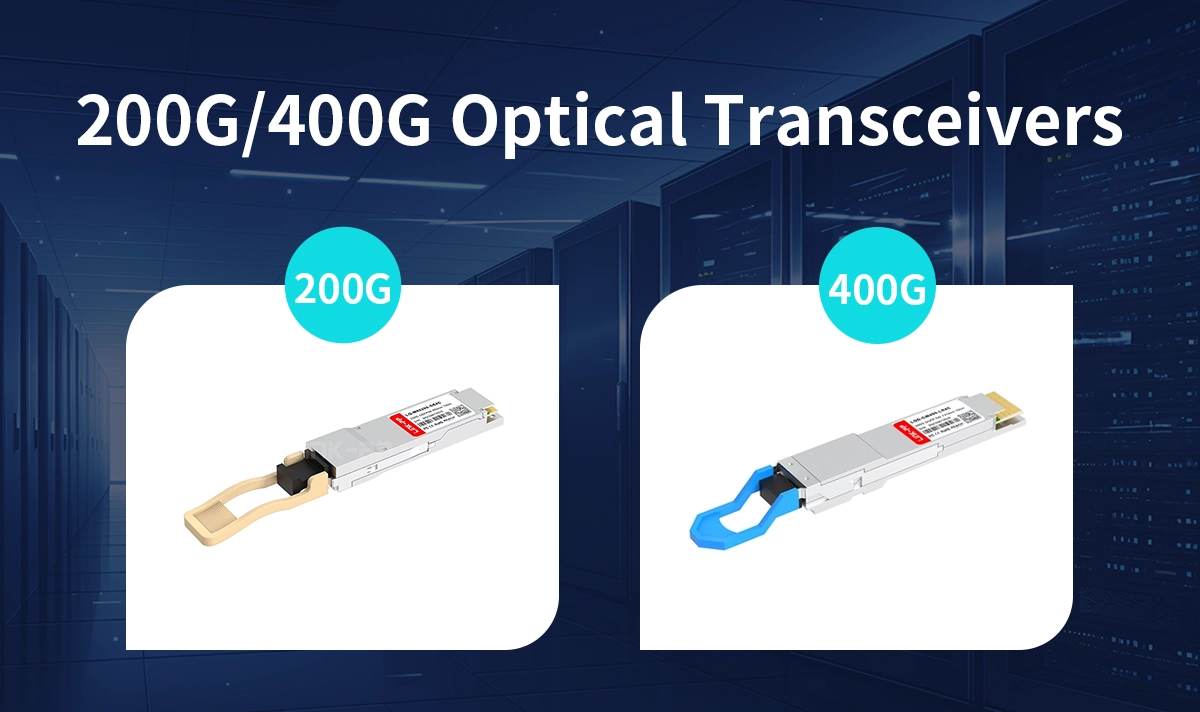
The ratification of IEEE 802.3bs directly spurred the development of next-generation pluggable optical modules, most notably the QSFP-DD (Quad Small Form-factor Pluggable Double Density) and OSFP (Octal Small Form-factor Pluggable) form factors.
These modules house the complex optics and digital signal processing (DSP) necessary to implement the PAM4 signaling and RS-FEC defined in the standard. For industry leaders like LINK-PP, compliance with IEEE 802.3bs is non-negotiable, ensuring interoperability, reliability, and guaranteed performance.
Enabling Hyper-Scalability and Energy Efficiency
The underlying technology of 802.3bs directly addresses the growing operational challenges of large-scale networks:
Lower Cost per Bit: By utilizing high-density PAM4 signaling, the need for a higher number of lower-speed parallel components is reduced, significantly driving down the cost-per-bit metric.
Power Optimization: The inherent efficiency of PAM4, combined with optimized transceiver design, helps reduce power consumption per gigabit—a critical factor for cooling massive data centers.
Future-Proofing: IEEE 802.3bs laid the groundwork for future standards (e.g., 802.3ck for 100G per lane electrical) by proving the viability of PAM4 for ultra-high-speed interfaces, paving the way for 800G and 1.6T systems.
▶ Conclusion: IEEE 802.3bs—The Standard That Defines Modern Bandwidth
IEEE 802.3bs is far more than a technical document; it is the blueprint for the current generation of high-speed optical networking. Its introduction of PAM4 and essential PMD specifications for 200G and 400G transmission has revolutionized the interconnects used in hyperscale cloud environments, AI compute clusters, and core telecom networks.
For network engineers and procurement professionals, selecting compliant 200G/400G optical transceivers is the only path to ensuring true plug-and-play interoperability and future-proof scalability. Trusting in products built upon the established, authoritative standards like IEEE 802.3bs is critical for navigating the complexity of next-generation data center buildouts.
Ready to upgrade your network backbone to the IEEE 802.3bs standard?
Explore LINK-PP's selection of reliable, high-performance 200G/400G Optical Transceivers today and ensure your infrastructure is ready for the future of data.
👉 View Our 200G/400G Optical Transceiver Modules