
📌 What Is IEEE 802.3cd?
IEEE 802.3cd is the Ethernet standard that defines Physical Layer (PHY) and Physical Medium Dependent (PMD) specifications for 50 GbE, 100 GbE and 200 GbE networks using 50G PAM4 lanes. Finalized in 2018, the standard introduced single-lane 50G signaling and multi-lane combinations (2×50G and 4×50G), enabling scalable high-speed Ethernet with improved port efficiency and reduced cost per bit.
The standard plays a central role in modern data centers, where PAM4 optical transceivers—particularly SFP56, QSFP28, QSFP56, and QSFP-DD—are widely deployed in 25G-to-200G migration paths.
📌 Why IEEE 802.3cd Uses PAM4 Modulation
A defining feature of 802.3cd is the transition from NRZ (PAM2) to PAM4 modulation.
Key Advantages of PAM4
Higher data density: PAM4 encodes two bits per symbol, effectively doubling throughput within the same bandwidth.
Single-lane 50G feasibility: Achieves 50 Gb/s per lane at approximately 50 GBd symbol rate.
Better scalability: Enables 50G → 100G → 200G bandwidth expansion without redesigning port form factors.
With PAM4, Ethernet could evolve using familiar module formats while supporting much higher aggregate speeds.
📌 PMDs and Interface Types Defined Under IEEE 802.3cd
50 GbE PMDs
50GBASE-SR – Short-reach multimode fiber using a single 50G PAM4 lane.
50GBASE-FR – Single-mode fiber, typically up to 2 km.
50GBASE-LR – SMF with 10 km reach for campus and metro applications.
100 GbE PMDs (2×50G)
100GBASE-FR2 – Two PAM4 lanes over SMF, moderate reach.
100GBASE-LR2 – Two-lane long-reach SMF applications.
100GBASE-DR/DR2 – Optimized for data center short-to-medium SMF links.
200 GbE PMDs (4×50G)
200GBASE-SR4 – Four 50G lanes on parallel MMF; ideal for high-density leaf/spine connectivity.
200GBASE-FR4 / LR4 – Four-lane SMF solutions enabling 2 km and 10 km reaches, respectively.
802.3cd defines electrical and optical parameters for these interfaces, including TDECQ, transmitter OMAouter, receiver sensitivity, and lane-by-lane BER objectives.
📌 Deployment Use Cases in Modern Data Centers
1. Single-Lane 50G for Servers
Many hyperscale and enterprise data centers adopt 50G SFP56 interfaces for server access links, replacing 25G as the standard node bandwidth.
2. 100G as an Uplink Tier
Using 2×50G lanes, 100G links remain a primary aggregation layer between Top-of-Rack (ToR) and leaf switches. 100G QSFP28 or SFP-DD modules offer efficient density and backward compatibility.
3. 200G for Leaf-to-Spine Fabrics
200G QSFP56 or QSFP-DD transceivers enable four-lane 50G architectures with breakout flexibility. A single 200G port can be split into 4×50G for servers or aggregation nodes.
4. Breakout Flexibility
The lane-based architecture makes 802.3cd ideal for:
200G QSFP56 → 4×50G SFP56
100G QSFP28 → 2×50G SFP56
This aligns well with next-generation 25G-to-50G server transitions.
📌 Selecting the Right Optical Transceivers for IEEE 802.3cd
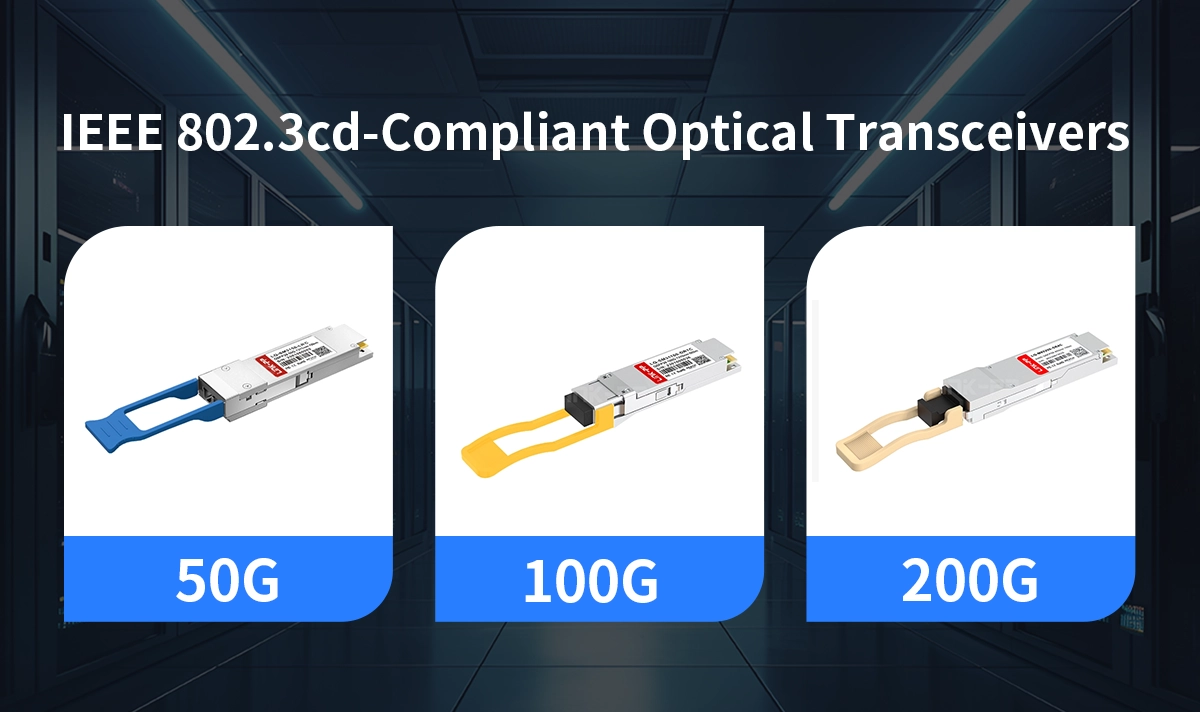
When planning a 50G/100G/200G network, transceiver selection must match PMD type, fiber reach and switch port form factor.
For IEEE 802.3cd deployments, LINK-PP provides the following product categories:
▷ 50G Optical Transceivers (SFP56 / QSFP28)
For single-lane 50GBASE-SR/FR/LR and 50G server access:
🔗 https://www.l-p.com/store-27046-50g-qsfp28-sfp56.htm
▷ 100G Optical Transceivers (QSFP28 / SFP-DD)
Ideal for 2×50G uplinks, 100G spine aggregation, and DR/FR/LR applications:
🔗 https://www.l-p.com/store-27045-100g-qsfp28-sfp-dd.htm
▷ 200G Optical Transceivers (QSFP-DD / QSFP56)
Designed for 4×50G leaf-spine fabrics and breakout compatibility:
🔗 https://www.l-p.com/store-26224-200g-qsfp-dd-qsfp56.htm
These modules support PAM4 signaling and meet IEEE interoperability targets such as TDECQ performance, receiver sensitivity, and lane BER consistency.
📌 Interoperability and Validation Checklist
To ensure reliable 802.3cd deployment, engineers typically verify:
Correct PMD type (SR, FR, LR, DR) for link budget and reach.
Form factor matching (SFP56, QSFP28, QSFP56, QSFP-DD).
Optical power levels including OMAouter and average launch power.
Receiver sensitivity under stressed PAM4 conditions.
Lane BER targets and FEC compatibility.
Breakout mapping when mixing 200G ↔ 50G endpoints.
📌 Conclusion
IEEE 802.3cd established the technical building blocks for today’s 50G, 100G ,and 200G Ethernet, bringing PAM4 modulation into mainstream deployment. Its lane-based architecture enables scalable, cost-efficient bandwidth upgrades while maintaining familiar module formats.
As data centers continue migrating from 25G and 40G to higher-speed fabrics, 802.3cd-compliant optical transceivers—such as LINK-PP’s 50G/100G/200G product families—provide a reliable foundation for next-generation connectivity.
For detailed specifications and product selection, explore LINK-PP’s full range of IEEE 802.3cd-compatible transceivers.
📌 Key Optical & Electrical Terms in IEEE 802.3cd (Mini Glossary)
★ TDECQ (Transmitter and Dispersion Eye Closure for PAM4)
TDECQ is a transmitter quality metric used in PAM4-based interfaces. It quantifies how much the optical eye diagram “closes” after the signal experiences dispersion, noise and other channel impairments. A lower TDECQ value indicates a cleaner PAM4 signal with better link margin. IEEE 802.3cd uses TDECQ as a primary requirement for 50G, 100G and 200G optical transmitters.
★ OMAouter (Outer Optical Modulation Amplitude)
OMAouter represents the difference between the highest and lowest optical power levels (Level 3 and Level 0) in a PAM4 signal. Since PAM4 uses four discrete levels, OMAouter provides a more accurate representation of modulation depth than average power. A higher OMAouter generally improves receiver sensitivity and helps ensure standards-compliant performance for 50GBASE-SR/FR/LR and multi-lane variants.
★ BER (Bit Error Rate)
BER measures the ratio of erroneous bits to the total number of transmitted bits. IEEE 802.3cd specifies lane-by-lane BER objectives, typically using a pre-FEC BER target of 2.4×10⁻⁴ for PAM4 lanes. With strong Forward Error Correction (such as KP4 FEC), the post-FEC BER achieves the reliability required for hyperscale and cloud data-center networks.
📌 FAQ
1. What is IEEE 802.3cd?
IEEE 802.3cd is an Ethernet standard that defines physical layer specifications for 50GbE, 100GbE, and 200GbE using PAM4 modulation. It includes interfaces such as 50GBASE-SR/FR/LR, 100GBASE-SR2, and 200GBASE-SR4, targeting modern data-center and high-performance networking environments.
2. What modulation format does IEEE 802.3cd use?
IEEE 802.3cd mandates PAM4 (4-level Pulse Amplitude Modulation) for all 50G-per-lane interfaces. PAM4 doubles the bit rate per lane compared with NRZ while keeping the same baud rate, enabling scalable 50G, 100G, and 200G Ethernet architectures.
3. Does IEEE 802.3cd support backward compatibility with NRZ?
Yes, in many deployments PAM4-based links can coexist with NRZ interfaces as long as the host port, electrical interface, and optical module are designed to support mixed environments. However, PAM4 and NRZ cannot interoperate on a single link; both ends must use the same modulation format.
4. What are the typical use cases of IEEE 802.3cd?
IEEE 802.3cd is widely used for:
50G server access (SFP56, QSFP28)
100G spine/aggregation layers
200G leaf-spine fabrics
Cloud, AI/ML clusters, and hyperscale networks
50G-per-lane uplinks in modular architectures (2×50G, 4×50G)
5. What optical transceivers are compliant with IEEE 802.3cd?
IEEE 802.3cd supports a wide range of 50G, 100G, and 200G optical modules, including:
50GBASE-SR/FR/LR (SFP56 / QSFP28) for single-lane 50GbE
100GBASE-SR2 and 2×50G breakout modules (QSFP28 / SFP-DD)
200GBASE-SR4/DR4/FR4 (QSFP-DD / QSFP56)
LINK-PP provides IEEE 802.3cd-compliant options across all speed classes.
6. How does IEEE 802.3cd relate to IEEE 802.3bs (400G) and 802.3cu?
802.3bs defines 400GbE and also relies on 50G lanes but focuses on higher-lane-count architectures (e.g., 8×50G).
802.3cu extends 100G/400G to longer-reach SMF applications (DR/FR/LR).
802.3cd fills the gap for single-lane and multi-lane 50G-per-lane Ethernet, enabling scalable migration paths from 25G → 50G → 100G/200G → 400G.
7. Is IEEE 802.3cd suitable for next-generation AI/ML and HPC workloads?
Yes. The standard’s 50G-per-lane PAM4 architecture aligns with high-bandwidth fabrics used in AI clusters, HPC systems, and large-scale GPU networks. It enables low-latency spine-leaf topologies with flexible breakout options such as 4×50G or 2×100G.