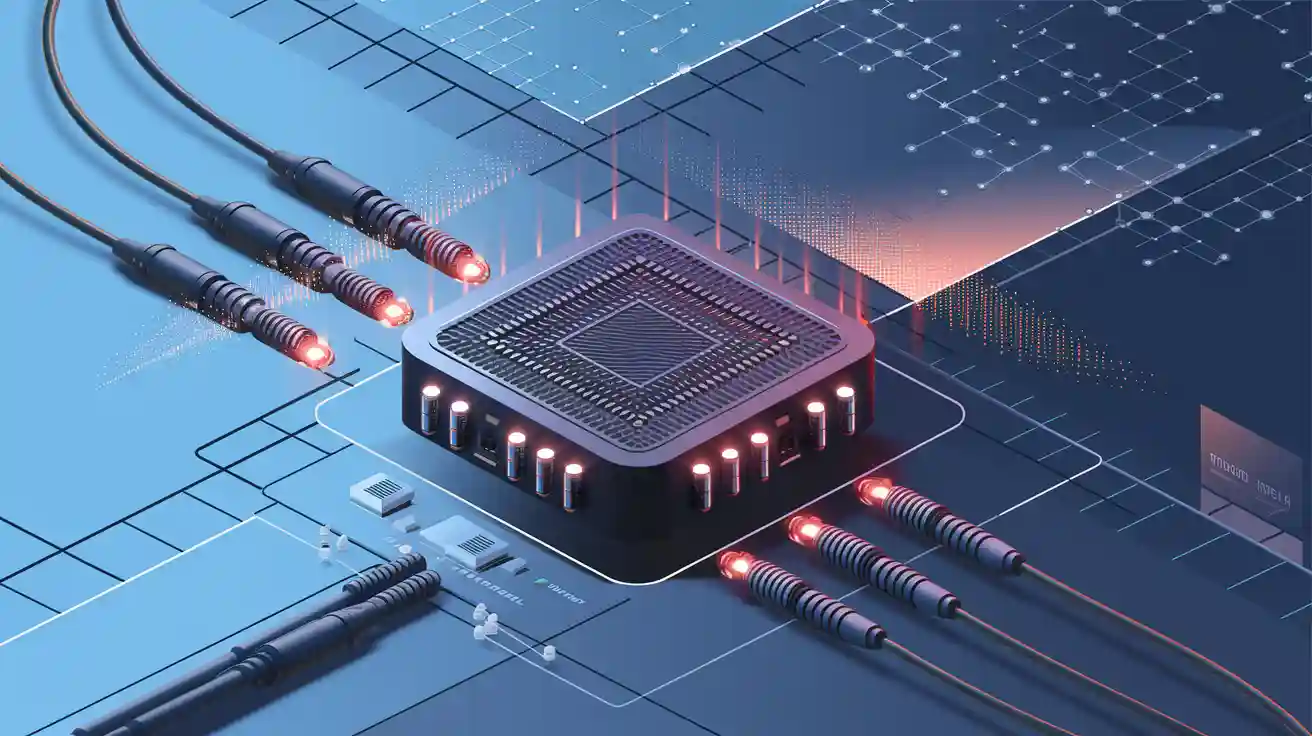

In today’s high-demand network environments, achieving optimal performance in terms of speed, efficiency, and scalability is critical. As the need for faster and more reliable data transfer increases, technologies like XLPPI (Extended Low-Voltage Parallel Pseudorandom Interface) have become essential for next-generation networks. This blog will explore the key advantages of XLPPI electrical interfaces and how they are transforming high-speed data transmission in modern networks.
🛡️ What is XLPPI Electrical Interface?
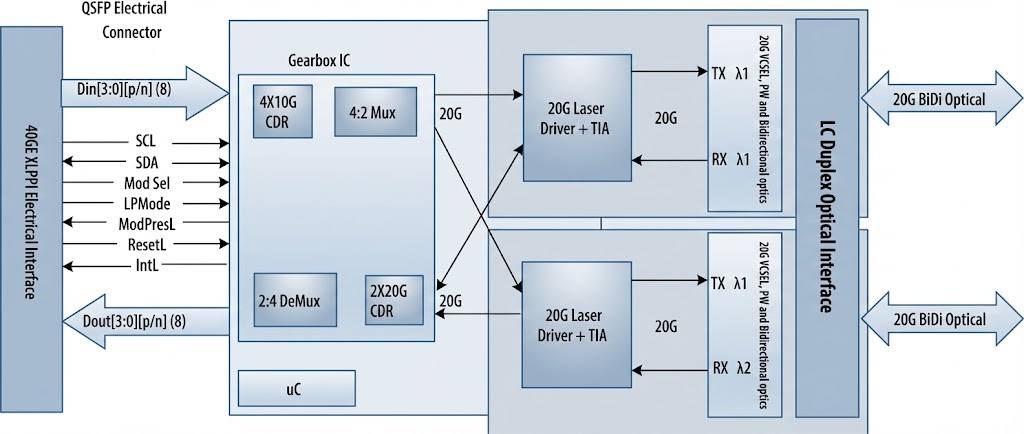
XLPPI is an advanced electrical interface designed to support high-speed, parallel data transmission in networks that require significant bandwidth. Unlike traditional serial interfaces, which transmit data bit-by-bit, XLPPI uses multiple parallel lanes to send data simultaneously, offering faster data transfer speeds and greater overall throughput. It is commonly used in optical modules, particularly in 40G and 100G Ethernet networks, data centers, and cloud computing environments.
🛡️ Key Benefits of XLPPI Electrical Interface
1. High-Speed Data Transmission
One of the standout features of XLPPI is its ability to handle high-speed data transmission. Through parallel data channels, XLPPI allows the transmission of up to 40Gbps or 100Gbps depending on the configuration. This makes it an ideal choice for high-bandwidth applications such as data center interconnects and cloud services that need to manage vast amounts of data at speeds faster than traditional systems can handle.
2. Reduced Latency for Real-Time Applications
In addition to offering high speeds, XLPPI minimizes latency, which is crucial for real-time applications like video conferencing, cloud computing, and high-frequency trading. With faster parallel data transmission, the time it takes to send data between devices is significantly reduced, improving performance in environments that require near-instantaneous data delivery.
3. Low Power Consumption
Energy efficiency is becoming increasingly important as data traffic continues to rise. XLPPI's low-voltage design helps reduce overall power consumption, making it a more sustainable choice for large-scale networks. By reducing energy usage while maintaining high performance, XLPPI is helping data centers and other large network infrastructures meet their green energy goals.
4. Reduced Electromagnetic Interference (EMI)
High-speed networks are susceptible to electromagnetic interference (EMI), which can degrade data transmission quality. XLPPI mitigates this problem by using low-voltage signals and parallel transmission, significantly reducing the likelihood of EMI. This ensures more stable and reliable data communication, even in environments with high electromagnetic noise, such as data centers and telecommunications networks.
5. Scalable and Future-Proof
As network demands increase, scalability becomes crucial. XLPPI’s design allows it to support future-proofing of networks, offering easy scalability from 10G to 40G and even 100G speeds. With its high bandwidth and compatibility with current network infrastructure, XLPPI ensures that networks can evolve without requiring a complete overhaul.
🛡️ Applications of XLPPI Electrical Interface
1. Data Centers and Cloud Computing
In data centers, where high-speed interconnects are essential, XLPPI electrical interfaces provide a robust solution for handling massive amounts of data. By offering low-latency and high-bandwidth capabilities, XLPPI ensures that cloud services and large-scale applications operate smoothly, providing seamless data transmission between servers, storage units, and network switches.
2. Optical Modules and Fiber Optic Networks
XLPPI is widely used in optical modules, especially those operating over fiber optic networks. These modules can support ultra-fast Ethernet links (such as 40GBASE-SR4 and 100GBASE-SR4) with reduced signal degradation over long distances. In applications like telecommunications and fiber-optic backbones, XLPPI provides an efficient means of transferring large amounts of data with minimal interference.
3. High-Performance Computing (HPC)
For high-performance computing systems, which require extremely fast data exchanges between processors and memory, XLPPI’s ability to support parallel data transmission at high speeds ensures optimal performance. Its low-latency and energy-efficient characteristics make it ideal for environments like supercomputers, where both speed and efficiency are paramount.
🛡️ Conclusion: The Future of High-Speed Networking with XLPPI
As networks continue to evolve, the demand for faster, more reliable, and energy-efficient systems will only increase. XLPPI electrical interfaces provide a scalable solution that not only meets these demands but also future-proofs networks for the challenges ahead. By enabling high-speed data transmission, reducing latency, and improving power efficiency, XLPPI is revolutionizing how data is transferred across networks, ensuring that modern infrastructures can keep up with the ever-growing data traffic.
Adopting XLPPI in your network ensures that you remain at the forefront of networking technology, ready to handle future demands with ease and efficiency.
Related Product
For more information on 40GBASE-SR4 optical modules compatible with XLPPI interfaces, visit LQ-SW40-SR4C 40G QSFP+ Optical Module.
🛡️ FAQ: XLPPI Electrical Interfaces
1. What is an XLPPI electrical interface?
The XLPPI (Extended Low-Power/Low-Voltage Parallel Interface) electrical interface is a high-speed, low-voltage, parallel electrical connection used in modern optical transceivers such as QSFP+, QSFP28, QSFP56, and QSFP-DD. It defines how high-speed electrical signals move between a host system (switch, router, NIC) and the optical module.
2. What is the purpose of the XLPPI interface in optical transceivers?
XLPPI ensures reliable high-speed electrical signaling over short distances on the host PCB. Its primary purpose is to maintain signal integrity, support multi-lane parallel data architectures, minimize power consumption, and enable seamless interoperability between hosts and modules.
3. What speeds does XLPPI support?
Depending on the generation of the host and optical module, XLPPI supports:
10 Gbps per lane (QSFP+ / 40G)
25 Gbps per lane (QSFP28 / 100G)
50 Gbps per lane PAM4 (QSFP56 / 200G)
100 Gbps per lane PAM4 (QSFP-DD / 400G & 800G roadmaps)
4. How does XLPPI differ from SFI or CAUI interfaces?
SFI is serial, typically used for SFP+/SFP28 single-lane modules.
CAUI/CAUI-4/CAUI-8 are IEEE-defined multi-lane interfaces for 100G/400G links.
XLPPI is optimized for low-voltage, short-reach, high-density QSFP architectures, offering superior power efficiency and PCB-level signal integrity.
5. Why is XLPPI considered energy-efficient?
It reduces signal swing amplitude and uses optimized termination schemes, minimizing power consumption at both the host SerDes and the optical module. This benefits high-density platforms such as spine/leaf switches and modular data center systems.
6. Does XLPPI support PAM4 modulation?
Yes. Newer XLPPI variants support PAM4 signaling, enabling 50G and 100G per lane data rates while staying within comparable electrical power and loss budgets.
7. What types of modules typically use XLPPI interfaces?
XLPPI is commonly found in:
QSFP+ (40G)
QSFP28 (100G)
QSFP56 (200G)
QSFP-DD (400G/800G)
Because these form factors require multi-lane parallel signaling with high bandwidth efficiency.
8. What are the key advantages of XLPPI interfaces?
High bandwidth scalability
Low voltage swing, reducing power and noise
Better crosstalk and EMI performance
Multi-lane parallel architecture that maps efficiently to optical engines
Strong ecosystem adoption across leading switch and NIC vendors
9. How does XLPPI enhance signal integrity?
By using shorter electrical trace lengths, optimized impedance control, and low-voltage signaling, XLPPI minimizes insertion loss, reflection, and jitter — all critical for reliable high-speed operation.
10. Are XLPPI interfaces backward compatible?
Yes. Although each speed generation has specific electrical requirements, the XLPPI architecture remains consistent across QSFP families, allowing backward compatibility at the form factor level even when electrical speeds differ.