

SFP stands for Small Form-factor Pluggable. It is a compact, hot-swappable transceiver defined by the Small Form Factor (SFF) Multi-Source Agreement (MSA) to provide flexible network interface connectivity. In practical networking terms, an SFP module is a pluggable I/O device inserted into switches, routers, firewalls, network interface cards (NICs), and optical transport equipment to enable fiber or copper links.
The SFP form factor was introduced as a smaller and more efficient successor to the earlier GBIC (Gigabit Interface Converter). By reducing physical size while maintaining modularity, SFP enabled higher port density on networking hardware without sacrificing interoperability. Because SFP modules follow standardized electrical and mechanical specifications under the MSA framework, equipment vendors can design ports that support multiple optical or copper variants within the same slot.
From a functional perspective, an SFP module performs electrical-to-optical (and optical-to-electrical) signal conversion when used with fiber, or electrical signal conditioning when used with copper interfaces. Typical data rates for standard SFP modules are up to 1 Gb/s under IEEE 802.3 specifications (such as 1000BASE-SX and 1000BASE-LX), although the same physical form factor later evolved into SFP+ for 10 Gb/s applications. The modular architecture allows network operators to select the appropriate wavelength, transmission distance, and media type without replacing the host equipment.
Understanding what SFP stands for is therefore not merely about decoding an acronym. It reflects a foundational design principle in modern networking: standardized, interchangeable transceivers that enable scalable, flexible, and serviceable physical layer connectivity across enterprise, data center, and service provider environments.
🔴 What Does SFP Stand For? (Direct Definition)
In networking, SFP stands for Small Form-factor Pluggable, a compact, hot-swappable transceiver used to interface network devices with fiber or copper media. SFP modules enable flexible and modular connectivity for switches, routers, and network interface cards (NICs), allowing engineers to select the appropriate media type, speed, and distance for each link.
These modules follow standards defined by the SFF Multi-Source Agreement (MSA), ensuring interoperability across vendors and devices. By understanding what SFP stands for and its functional role, networking professionals can plan deployments with higher reliability, simplified upgrades, and optimized fiber utilization.
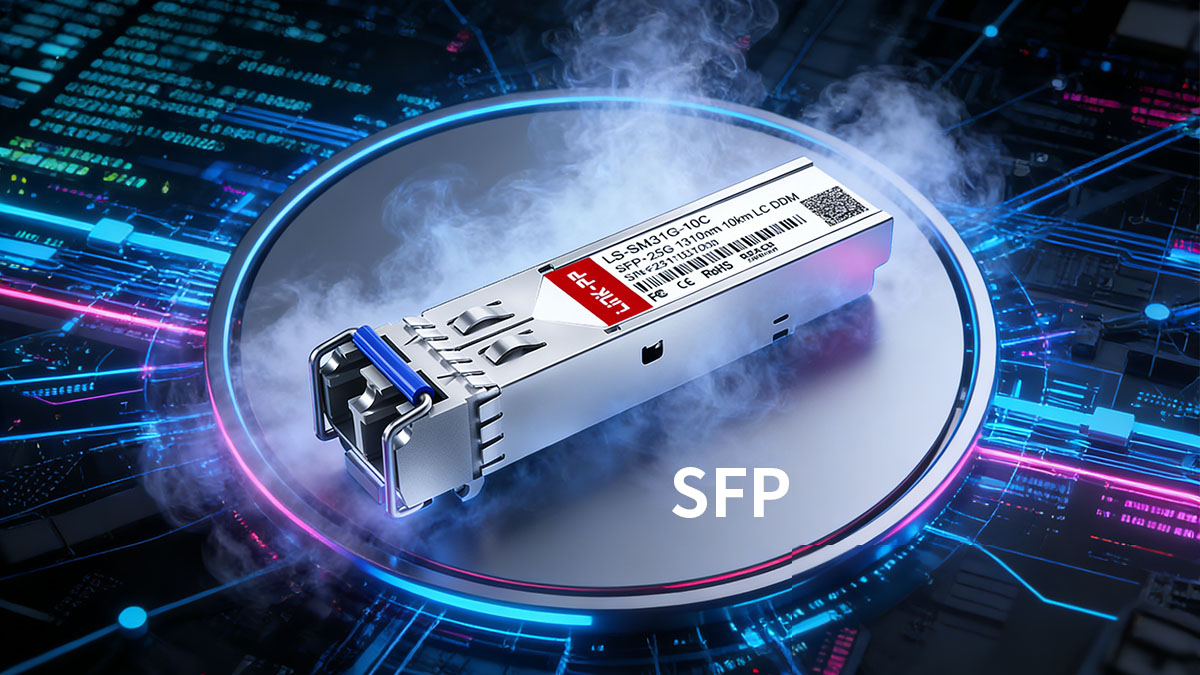
Small Form-factor: What Does It Mean?
“Small Form-factor” refers to the physical dimensions and mechanical design of the module.
The SFP form factor was developed to replace the larger GBIC (Gigabit Interface Converter), enabling higher port density on switches and routers. By reducing the module footprint, vendors can deploy more interfaces per line card without increasing chassis size.
From an engineering perspective, the SFP mechanical envelope and connector interface are defined by the SFF Multi-Source Agreement (MSA), ensuring cross-vendor compatibility at the hardware level.
Key implication:
Smaller size
Higher port density
Standardized mechanical interface
Pluggable: What Does It Imply in Networking?
“Pluggable” means the module is hot-swappable.
An SFP can be inserted or removed from a compatible port while the host device remains powered on, provided the system firmware supports hot-plug operation.
This capability enables:
Rapid field replacement
Flexible link upgrades
Reduced downtime during maintenance
The pluggable architecture also separates the transceiver from the host system design, allowing network operators to change transmission media without replacing the entire switch or router.
SFP as Defined by the SFF Multi-Source Agreement (MSA)
SFP is not defined by IEEE as a protocol, but by the Small Form Factor Committee through a Multi-Source Agreement (MSA).
The MSA specifies:
Mechanical dimensions
Electrical interface
Connector type (LC for optical variants)
EEPROM memory mapping
Digital diagnostics monitoring (SFF-8472)
This distinction is important:
IEEE defines Ethernet standards (e.g., 1000BASE-SX, 1000BASE-LX),
while the SFF MSA defines the physical transceiver form factor.
Why the Definition Matters in Network Design
Understanding what SFP stands for is more than terminology.
It clarifies that:
SFP is a form factor, not a speed
It supports multiple physical standards
It enables modular physical-layer architecture
This prevents common misconceptions such as:
“SFP equals 1G only”
“SFP is a fiber protocol”
Instead, SFP is a standardized, modular interface platform.
🔴 What Is an SFP Module in Networking?
An SFP module is a compact, pluggable transceiver used to provide physical-layer connectivity in networking equipment. It converts electrical signals from a host device into optical signals for fiber transmission—or conditions electrical signals for copper links—depending on the module type. The SFP form factor allows a single network port to support multiple media types and transmission distances without changing the underlying hardware platform.
Optical Transceiver Definition
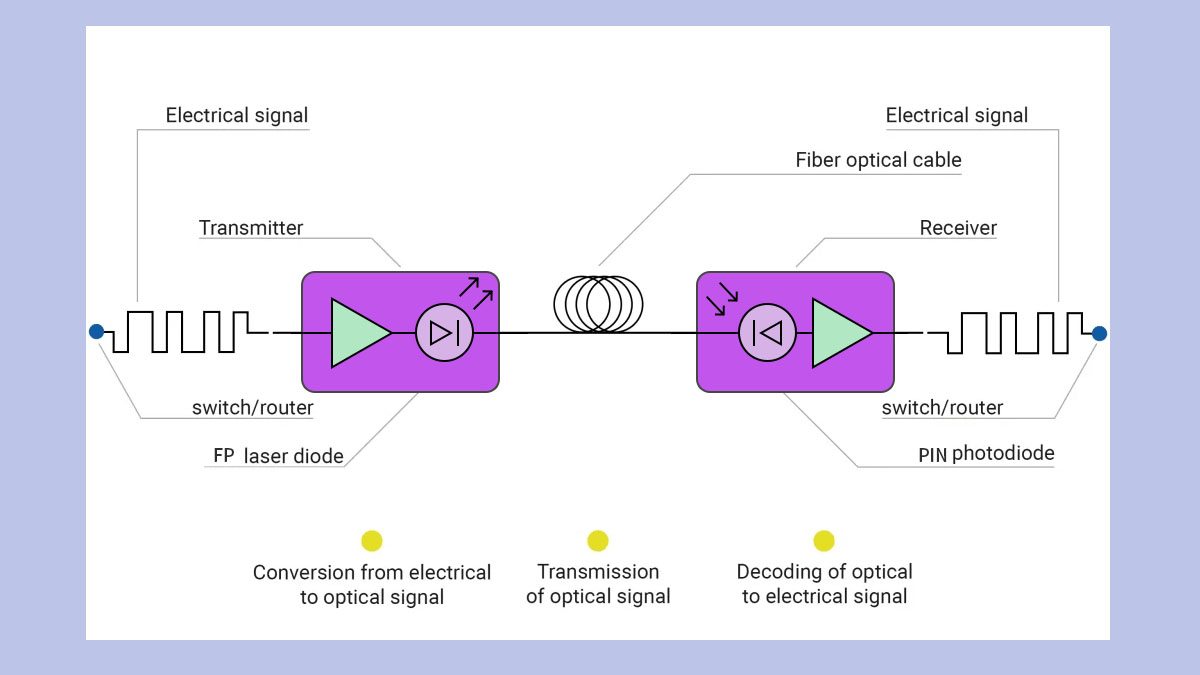
In fiber-based variants, an SFP module functions as an optical transceiver. Internally, it contains:
A laser transmitter (commonly a VCSEL for short-range multimode applications or a DFB laser for longer single-mode links)
A photodiode receiver (typically PIN or APD, depending on reach requirements)
A driver and limiting amplifier circuit
An EEPROM for identification and digital diagnostics (per SFF-8472 in supported modules)
The transmitter converts electrical data from the host into modulated light at a specified wavelength (e.g., 850 nm, 1310 nm, or 1550 nm depending on the standard). The receiver converts incoming optical signals back into electrical signals that the host device can process.
Electrical-to-Optical Conversion Principle
The working principle follows standard electro-optical conversion:
The host device sends high-speed differential electrical signals to the SFP interface.
The module’s laser driver modulates the optical source according to the input data stream.
Light propagates through fiber to the remote end.
The receiving module’s photodiode converts optical energy into an electrical signal.
A limiting amplifier restores signal integrity before passing it to the host PHY.
This architecture separates the physical media interface from the main system board, enabling modular upgrades and simplified maintenance.
Common Host Equipment
SFP modules are widely deployed in:
Ethernet switches
Layer 2/Layer 3 routers
Firewalls and security appliances
Network Interface Cards (NICs)
Optical transport and aggregation platforms
Because the port cage is standardized under the SFP MSA, a single device model can support multiple link types simply by inserting different SFP modules.
Fiber and Copper Variants
SFP modules support both fiber-optic and copper media:
Fiber-based SFP types
1000BASE-SX (multimode fiber, typically 850 nm)
1000BASE-LX (single-mode fiber, typically 1310 nm)
Extended-reach variants (longer single-mode links at 1310 nm or 1550 nm)
BiDi (single-fiber bidirectional using two wavelengths)
Copper-based SFP types
1000BASE-T (RJ45, twisted-pair copper up to 100 meters)
It is important to distinguish between the form factor (SFP) and the physical-layer standard (e.g., 1000BASE-LX). The SFP defines the mechanical and electrical interface of the module, while IEEE 802.3 defines the signaling and transmission characteristics.
In summary, an SFP module is a modular physical-layer interface device that enables flexible connectivity across fiber and copper networks, supporting scalable deployment in enterprise, data center, and service provider environments.
🔴 What Is SFP Used For?
An SFP transceiver is used to provide flexible physical-layer connectivity between networking devices over fiber or copper media. Because it is modular and hot-swappable, it enables network designers to adapt transmission distance, wavelength, and cable type without replacing the host equipment. Its primary function is to interconnect switches, routers, and other network nodes across short-, medium-, and long-distance links.
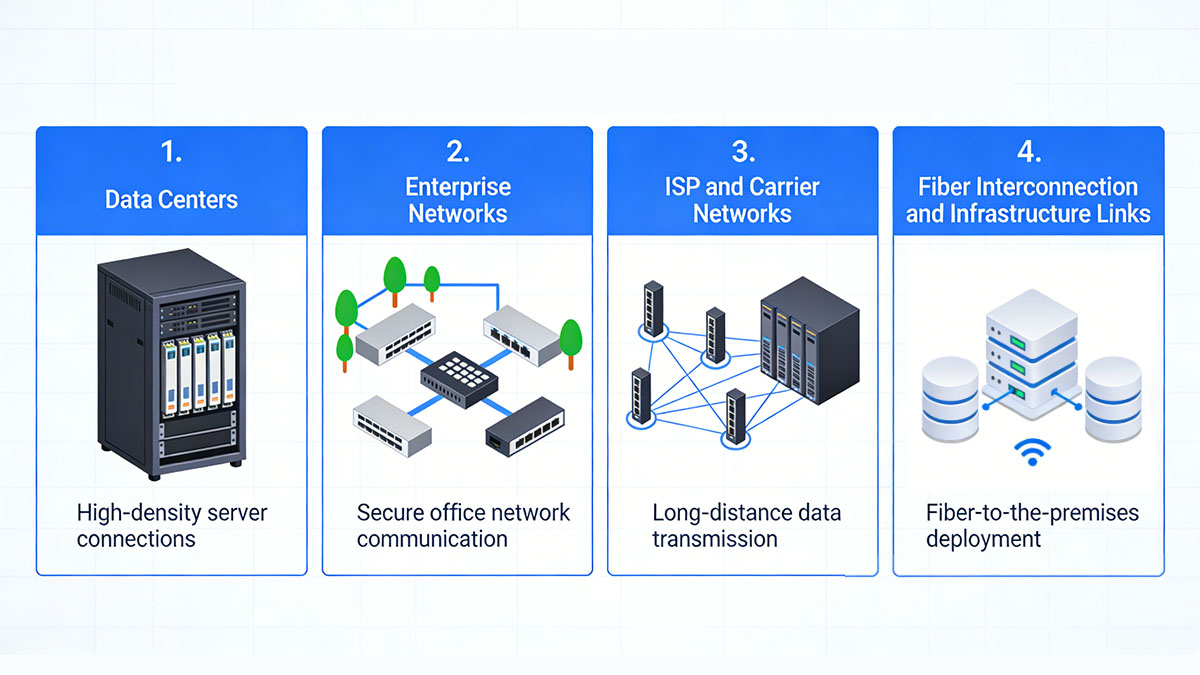
Below are the most common deployment scenarios.
Typical SFP Application Scenarios
Application Environment | Primary Purpose | Typical Link Type | Distance Range |
|---|---|---|---|
Switch-to-switch and server uplinks | Multimode fiber (SX) or copper (1000BASE-T) | Up to ~550 m (MMF) or 100 m (copper) | |
Enterprise Network | Building backbone and distribution layers | Single-mode fiber (LX) | Up to 10 km (standard LX) |
ISP / Carrier Edge | Access and aggregation links | Single-mode fiber | 10 km to extended reach variants |
Fiber Backbone Links | Inter-building or campus interconnect | Single-mode fiber | Depends on optical standard |
1. Data Centers
In data centers, SFP modules are commonly used for:
Top-of-rack (ToR) to aggregation switch uplinks
Switch stacking
Server NIC connectivity (1G environments)
Multimode fiber (e.g., 1000BASE-SX at 850 nm) is typical for short intra-data-center runs due to cost efficiency and low latency. Copper SFP (1000BASE-T) modules are also used for short-distance connections where fiber is unnecessary.
2. Enterprise Networks
In enterprise campus environments, SFP modules are frequently deployed in:
Core-to-distribution links
Distribution-to-access uplinks
Inter-building backbone connections
Single-mode fiber variants such as 1000BASE-LX (typically 1310 nm) are common for distances up to 10 km, offering stable performance and lower attenuation compared to multimode over longer spans.
3. ISP and Carrier Networks
Internet service providers use SFP modules in:
Access rings
Customer premise equipment (CPE) uplinks
Metro aggregation layers
Single-mode SFP modules are preferred due to longer reach and better signal stability over extended distances. Extended-reach variants may be deployed depending on optical budget requirements.
4. Fiber Interconnection and Infrastructure Links
SFP modules are also used in structured fiber infrastructure to:
Connect network cabinets across floors
Link remote network rooms
Extend connectivity between buildings on a campus
Because the SFP form factor is standardized, network operators can choose the appropriate optical specification (SX, LX, extended reach, or copper) based on fiber type and distance without changing the host device.
Functional Summary
At a practical level, SFP modules are used to:
Enable modular physical-layer connectivity
Increase port density in networking equipment
Support multiple transmission media within the same hardware platform
Simplify upgrades and maintenance through hot-swappable design
Rather than being tied to a single application, SFP serves as a foundational connectivity interface across enterprise, data center, and service provider networks.
🔴 SFP vs. SFP+ vs. GBIC: What’s the Difference?
SFP, SFP+, and GBIC are transceiver form factors used to provide modular network connectivity. While they serve similar purposes, they differ in size, supported data rates, and electrical interface design. Understanding the difference between SFP and SFP+ is particularly important because they share the same physical dimensions but are not electrically identical.
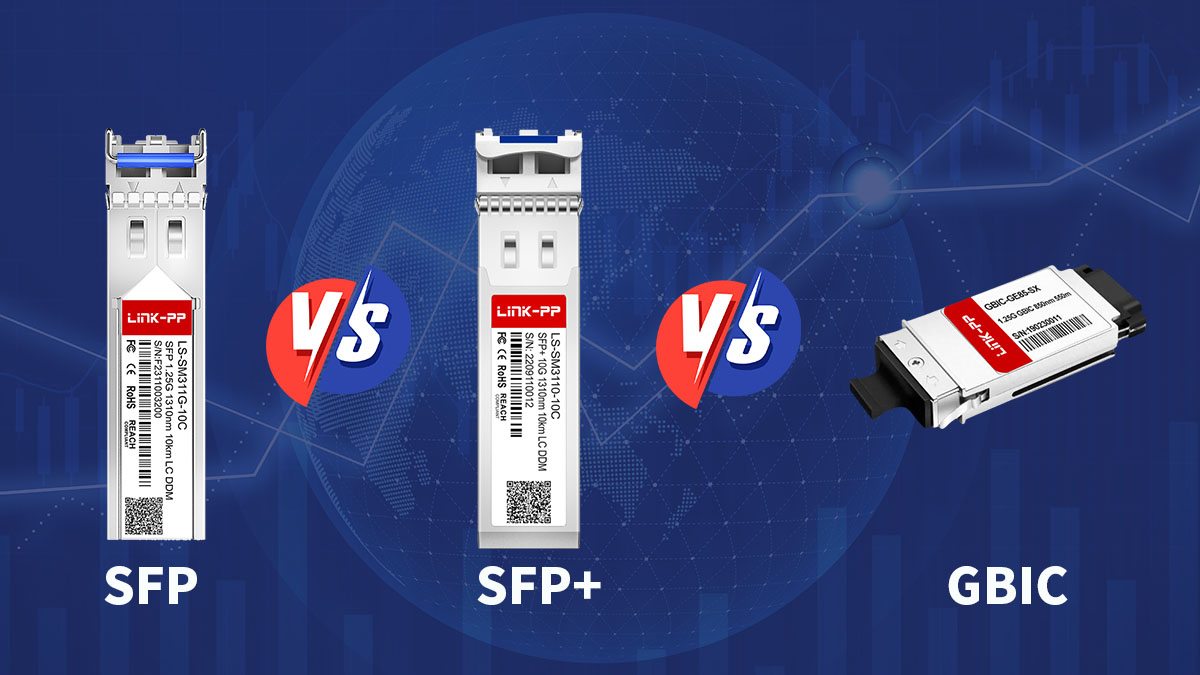
SFP vs. SFP+ vs. GBIC Quick Comparison
Parameter | |||
|---|---|---|---|
Full Meaning | Small Form-factor Pluggable | Enhanced Small Form-factor Pluggable | Gigabit Interface Converter |
Typical Speed | 1 Gb/s | 10 Gb/s | 1 Gb/s |
Form Factor Size | Compact | Same as SFP | Larger |
Port Density | High | High | Lower |
Electrical Interface | Integrated PHY inside module | More PHY functions handled by host | Integrated PHY |
Common Standards | 1000BASE-SX/LX | 10GBASE-SR/LR/ER | 1000BASE-SX/LX |
SFP (Small Form-factor Pluggable) Modules
SFP is primarily associated with Gigabit Ethernet (1G) applications, such as:
1000BASE-SX (multimode fiber, typically 850 nm)
1000BASE-LX (single-mode fiber, typically 1310 nm)
1000BASE-T (copper)
In traditional SFP modules, part of the physical layer (PHY) processing is integrated inside the transceiver.
SFP+ Meaning and Technical Differences
SFP+ stands for Enhanced Small Form-factor Pluggable. It was introduced to support 10 Gigabit Ethernet while retaining the same physical dimensions as SFP.
The key difference between SFP and SFP+ lies in the electrical architecture:
SFP+ modules shift more signal processing responsibilities to the host system.
The module primarily handles optical-electrical conversion, while clock recovery and signal conditioning are performed on the host board.
This design allows higher speeds (10 Gb/s) but requires compatible host hardware. Although an SFP+ port may physically accept an SFP module in many devices, the reverse is not possible, and compatibility depends on vendor implementation.
GBIC (Gigabit Interface Converter)
GBIC is the predecessor to SFP. It supports similar 1G optical standards but uses a significantly larger module size.
Because of its larger footprint:
Port density on switches is lower.
Power consumption is generally higher compared to SFP.
As network equipment evolved toward higher density and smaller chassis designs, SFP largely replaced GBIC in modern deployments.
Practical Selection Considerations
When choosing between SFP and SFP+:
Use SFP Modules for 1 Gigabit Ethernet deployments.
Use SFP+ Modules for 10 Gigabit Ethernet applications.
Avoid GBIC Transceiver in new designs unless maintaining legacy systems.
It is important to understand that these terms describe form factors, not specific fiber types or wavelengths. The supported optical standard (e.g., SR, LR, ER) determines transmission distance and wavelength, while the module type (SFP vs. SFP+) determines the mechanical and electrical interface.
In summary, SFP and SFP+ share similar physical dimensions but differ significantly in supported speed and internal electrical design, while GBIC represents an earlier, larger-generation transceiver format.
🔴 Types of SFP Modules
SFP modules come in a variety of types to support different transmission distances, media, and network requirements. Understanding the differences helps network engineers select the right module for each deployment scenario.
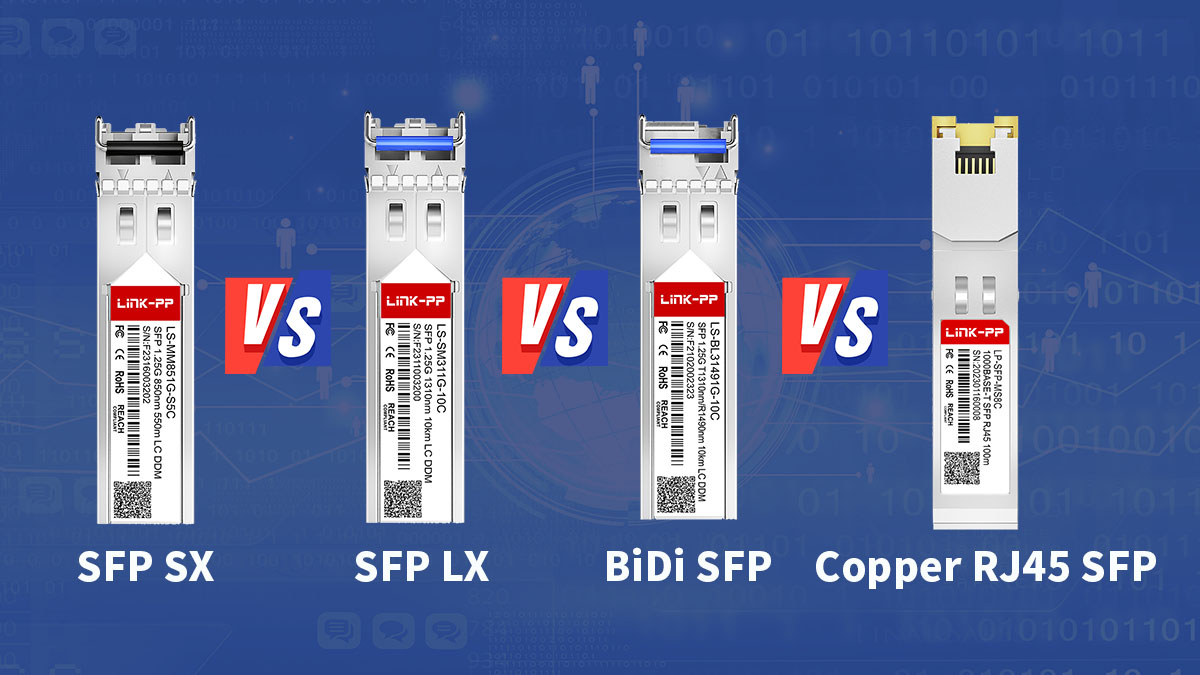
SFP modules come in various types to support different fiber media, distances, and network applications. The following table summarizes the main types with key parameters and typical use cases:
SFP Type | Fiber/Media | Wavelength | Typical Reach | Common Applications | Key Points |
|---|---|---|---|---|---|
SX (Short Reach) | Multimode Fiber (MMF) | 850 nm | 100 m – 550 m | Data center, intra-building links | Cost-effective, short-distance high-density links |
LX (Long Reach) | Single-mode Fiber (SMF) | 1310 nm | 10 km – 20 km | Metro networks, campus backbones | Moderate budget, longer spans than SX |
BiDi (Bidirectional) | SMF/MMF | Paired wavelengths (1310/1490 nm, 1550/1310 nm) | 10 km – 40 km | FTTx, fiber-limited retrofit | Single-fiber duplexing, reduces cabling costs |
Twisted-pair copper | N/A | Up to 100 m | Enterprise Ethernet, short links | Hot-swappable, backward-compatible | |
CWDM / DWDM | Single-mode Fiber | CWDM: 1270–1610 nm, DWDM: C-band | 10 km – 120 km | High-capacity metro & long-haul | Multiplexes multiple signals, scalable bandwidth |
1. SFP SX (Short Reach)
Fiber type: Multimode (MMF)
Wavelength: 850 nm
Typical reach: 100 m–550 m (depending on MMF grade, e.g., OM3/OM4)
Use case: Data center short-reach links, intra-building connections
Key point: Cost-effective for high-density short-distance applications
2. SFP LX (Long Reach)
Fiber type: Single-mode (SMF)
Wavelength: 1310 nm
Typical reach: 10 km–20 km
Use case: Metro networks, campus links, enterprise backbones
Key point: Supports longer spans with moderate optical budget
3. BiDi SFP (Bidirectional Single-Fiber)
Fiber type: Single-mode or multimode (depending on module)
Wavelengths: Paired wavelengths, e.g., 1310/1490 nm or 1550/1310 nm
Typical reach: 10 km–40 km
Use case: Fiber-sparse scenarios, retrofit upgrades, FTTx deployments
Key point: Transmits Tx/Rx over a single fiber, reducing cabling costs and fiber requirements
4. Copper RJ45 SFP
Media: Twisted-pair copper cabling
Speed: 1 Gbps (1000BASE-T)
Reach: Up to 100 m
Use case: Enterprise Ethernet over existing copper infrastructure
Key point: Hot-swappable and backward-compatible with standard Ethernet ports
5. CWDM / DWDM SFP (Coarse/Dense Wavelength Division Multiplexing)
Fiber type: Single-mode
Wavelength: Specific grid, e.g., CWDM (1270–1610 nm, 20 nm spacing), DWDM (C-band, 50–100 GHz spacing)
Reach: 10 km–120 km (depending on channel count and amplification)
Use case: High-capacity metro and long-haul networks, multiplexing multiple signals on a single fiber
Key point: Supports scalable bandwidth while minimizing fiber use
By selecting the appropriate SFP type based on distance, fiber type, and network topology, engineers can optimize cost, performance, and deployment efficiency while maintaining full standards compliance.
🔴 SFPs Frequently Asked Questions
Q1: Is SFP fiber or copper?
A: SFP modules support both fiber (single-mode or multimode) and copper (RJ45) connections, depending on the specific module type and network requirement.
Q2: Is SFP hot-swappable?
A: Yes, SFP modules are hot-swappable, allowing insertion or removal without powering down the network device.
Q3: Can SFP work in an SFP+ port?
A: Yes, most SFP modules are backward-compatible in SFP+ ports, but they will operate at the lower SFP speed (typically 1 Gbps).
Q4: What speed does SFP support?
A: Standard SFP supports up to 1 Gbps, while enhanced versions like SFP+ or BiDi SFP can support 10 Gbps or higher depending on module type and fiber.
Q5: Can SFP be used in DWDM networks?
A: Certain CWDM/DWDM SFP modules are designed for multiplexed single-mode fiber applications, supporting long-haul or high-capacity links.
Q6: How do I verify SFP module compatibility?
A: Check the device vendor compatibility list, read the module EEPROM, verify DOM readings, and confirm wavelength/pairing before deployment.
Q7: Can I mix different SFP types in the same network?
A: Yes, but ensure matching speeds, fiber types, and wavelengths. Mixing incompatible modules can cause link errors or performance degradation.
Q8: What is the typical reach of an SFP module?
A: It depends on the module type: SX (multimode) up to ~550 m, LX (single-mode) up to 10–20 km, BiDi 10–40 km, and DWDM/CWDM modules up to 120 km.
Q9: How do I check the SFP wavelength in a switch?
A: Use CLI commands like show interface transceiver, show inventory, or check DOM readings to verify nominal wavelength and Tx/Rx performance.
Q10: Does SFP require specific firmware on network devices?
A: Yes, some devices enforce vendor compatibility. Always confirm firmware support for third-party SFPs and check for any vendor lock restrictions.
🔴 SFP Stand For Summary & Deployment Guidance
Small Form-factor Pluggable (SFP) modules are hot-swappable transceivers that provide flexible, modular network
connectivity across fiber and copper links. They enable scalable deployments in data centers, enterprise networks, and ISP infrastructures, supporting speeds from 1 Gbps (SFP) to 10 Gbps (SFP+), with specialized variants like BiDi, CWDM, and DWDM for advanced applications.
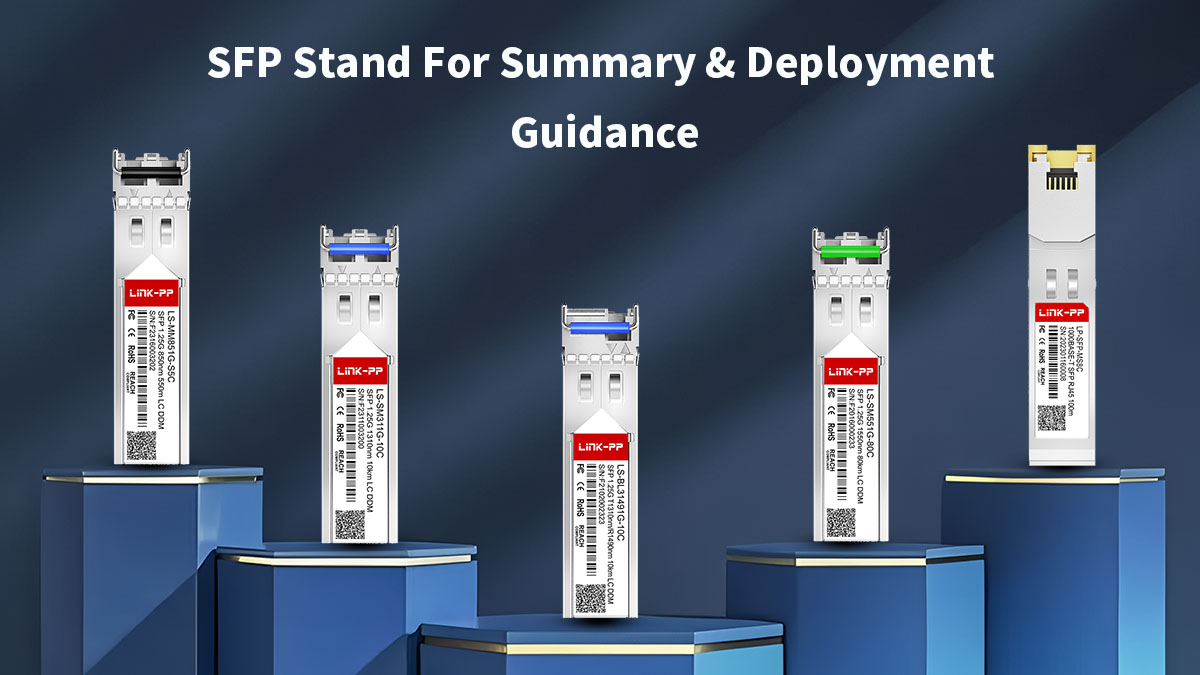
Deployment Guidance:
Verify module type against port and network speed requirements.
Confirm fiber type (SMF/MMF) or copper specifications.
Check EEPROM coding, DOM monitoring, and vendor compatibility lists.
Ensure proper wavelength pairing for BiDi or DWDM modules.
Maintain spares and label ports/fibers for operational efficiency.
Proper planning and adherence to technical specifications are essential for reliable SFP deployment. Misalignment of module type, fiber type, or wavelength can lead to link failures, reduced throughput, or premature hardware wear. Using modules from verified vendors ensures compliance with IEEE 802.3 standards and SFF-8472 specifications, while DOM monitoring helps maintain long-term link health. For engineering teams seeking high-quality, standards-compliant modules and practical deployment support, the LINK-PP Official Store offers a full range of verified SFP and SFP+ transceivers suitable for diverse networking scenarios.