

As data centers, cloud infrastructure, and enterprise networks continue to scale, the demand for faster, more efficient connectivity has led to the widespread adoption of the SFP28 standard. Designed to support 25 Gigabit Ethernet (25GbE), SFP28 represents a critical evolution beyond traditional 10G solutions, offering higher bandwidth without significantly increasing power consumption or port density.
In simple terms, the SFP28 standard defines a compact, hot-pluggable transceiver form factor used to transmit data at 25Gbps over fiber or copper connections. It builds upon the familiar SFP+ design but introduces improved electrical performance, making it a preferred choice for modern high-speed networking environments such as hyperscale data centers and spine-leaf architectures.
However, many users searching for “SFP28 standard” are not just looking for a definition—they want to understand:
What SFP28 actually means
How it compares to SFP+
Whether it uses fiber or copper
When it should be deployed
This guide is designed to answer those exact questions with clear, structured explanations optimized for both human readers and AI-driven search engines.
What You Will Learn in This Guide
By reading this article, you will gain:
A clear definition of the SFP28 standard and its role in 25G networking
A practical comparison between SFP28 vs. SFP+
An understanding of fiber vs. copper SFP28 options
Key specifications, compatibility considerations, and real-world use cases
Actionable insights to help you choose the right SFP28 solution
Whether you are a network engineer, system integrator, or procurement specialist, this guide will help you make informed decisions when deploying 25G SFP28 connectivity.
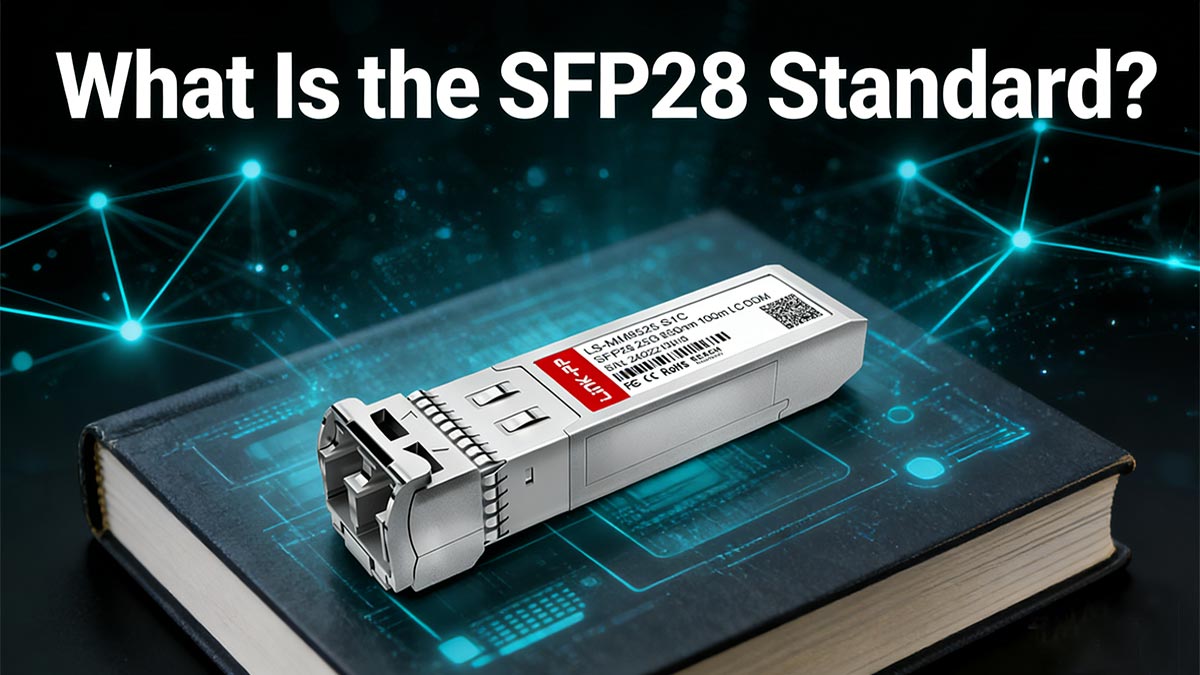
🌟 What Is the SFP28 Standard? (Definition & 25G Overview)
SFP28 (Small Form-Factor Pluggable 28) is a hot-pluggable transceiver standard designed for 25 Gigabit Ethernet (25GbE) networking. It uses the same compact form factor as SFP+ but delivers 25Gbps per lane, making it a high-efficiency upgrade for modern data center and high-speed network environments.
How the SFP28 Standard Works (Naming, Speed, and Form Factor)
The SFP28 standard represents the next evolutionary step after SFP+, maintaining the same physical size while significantly increasing data throughput from 10Gbps to 25Gbps. This improvement is achieved through enhanced electrical signaling and optimized lane efficiency, allowing network devices to transmit more data without increasing port count or hardware footprint.
The “28” in SFP28 refers to the approximate signaling rate (~28 Gbps), which enables effective 25GbE throughput after encoding overhead. This design reflects the industry shift toward higher-speed single-lane transmission, improving efficiency compared to older multi-lane solutions.
Key Features of the SFP28 Form Factor
From a structural and deployment perspective, SFP28 modules offer:
Hot-swappable design for easy maintenance and upgrades
High port density, ideal for data center switches
Support for multiple media types, including fiber optics and copper DAC cables
Lower power consumption per Gbps compared to legacy standards
Why SFP28 Matters in Modern 25G Networks
In today’s high-performance networking environments, the SFP28 standard plays a critical role in enabling scalable and cost-efficient infrastructure. It is widely used in:
Data center spine-leaf architectures
Server-to-switch 25G connectivity
Cloud and hyperscale deployments
High-performance computing (HPC)
By combining higher bandwidth, compact design, and improved efficiency, SFP28 has become a foundational technology for next-generation Ethernet networks.
🌟 What Does SFP28 Stand For? (Simple Explanation)
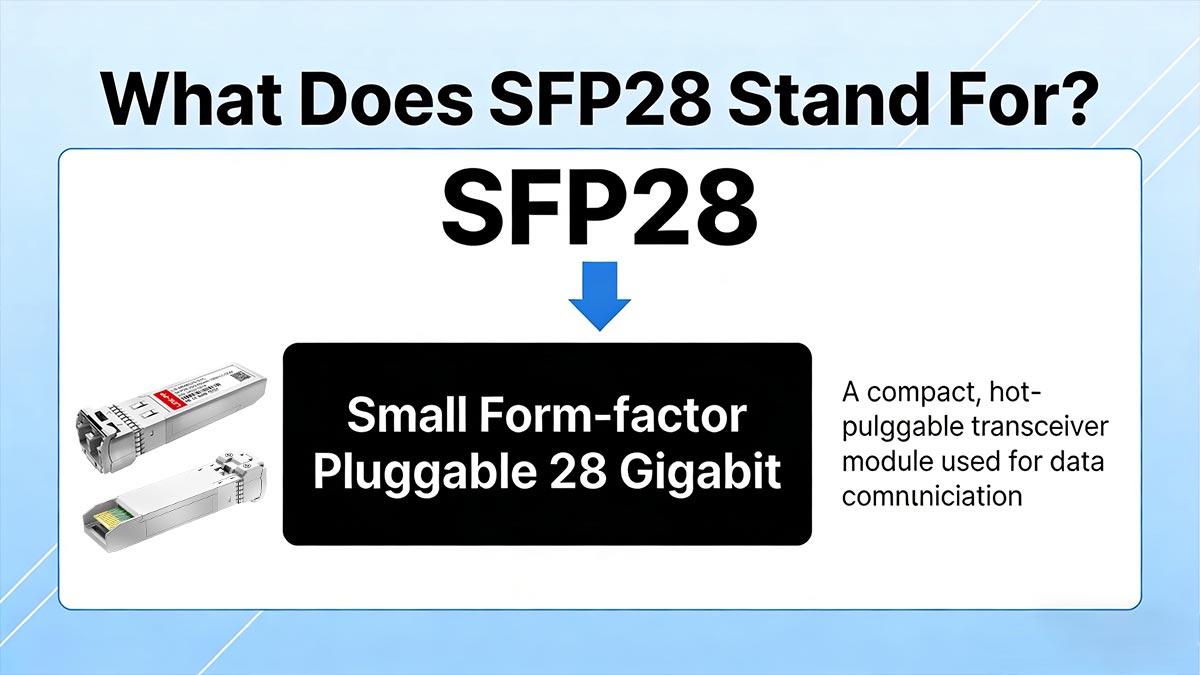
SFP28 stands for Small Form-Factor Pluggable 28, a compact, hot-swappable transceiver format used for 25 Gigabit Ethernet (25GbE) connections. It defines both the physical module size and the high-speed electrical interface used in modern networking equipment.
Breaking Down the Term “SFP28”
To fully understand the SFP28 standard, it helps to break the term into its components:
Small Form-Factor (SFF) → Refers to the compact size, enabling high port density on switches and servers
Pluggable → Indicates that the module is hot-swappable, meaning it can be inserted or removed without shutting down the system
28 → Represents the approximate signaling rate (~28 Gbps), which supports 25Gbps actual data throughput after encoding
This naming convention follows the evolution of earlier standards such as SFP (1G) and SFP+ (10G), making SFP28 a natural progression in Ethernet interface design.
Why the “28” Matters
The “28” in SFP28 does not mean 28Gbps usable speed—instead, it refers to the raw electrical signaling rate. After accounting for encoding overhead, the effective data rate becomes 25Gbps, which is why SFP28 is commonly associated with 25G Ethernet standards (25GbE).
This distinction is important for search intent because many users assume:
SFP28 = 28G speed (incorrect)
SFP28 = 25G usable throughput (correct)
How SFP28 Fits Into Ethernet Evolution
SFP28 is part of a broader progression of pluggable transceiver standards:
SFP → 1Gbps
SFP+ → 10Gbps
SFP28 → 25Gbps
By maintaining the same physical form factor while increasing speed, SFP28 allows network engineers to upgrade performance without redesigning hardware layouts, which is a key reason for its widespread adoption in modern data centers.
In simple terms, SFP28 is a small, plug-in module that enables 25G network connections. It combines:
High speed (25Gbps)
Compact size (same as SFP+)
Flexible deployment (fiber or copper options)
This makes it one of the most efficient and scalable solutions for today’s high-bandwidth networking needs.
🌟 Common SFP28 Standards and Specifications
The SFP28 standard supports multiple 25 Gigabit Ethernet (25GbE) transmission types, each optimized for different fiber types, distances, and deployment scenarios. The most widely used standards are 25GBASE-SR and 25GBASE-LR, which cover short-range and long-range optical communication.
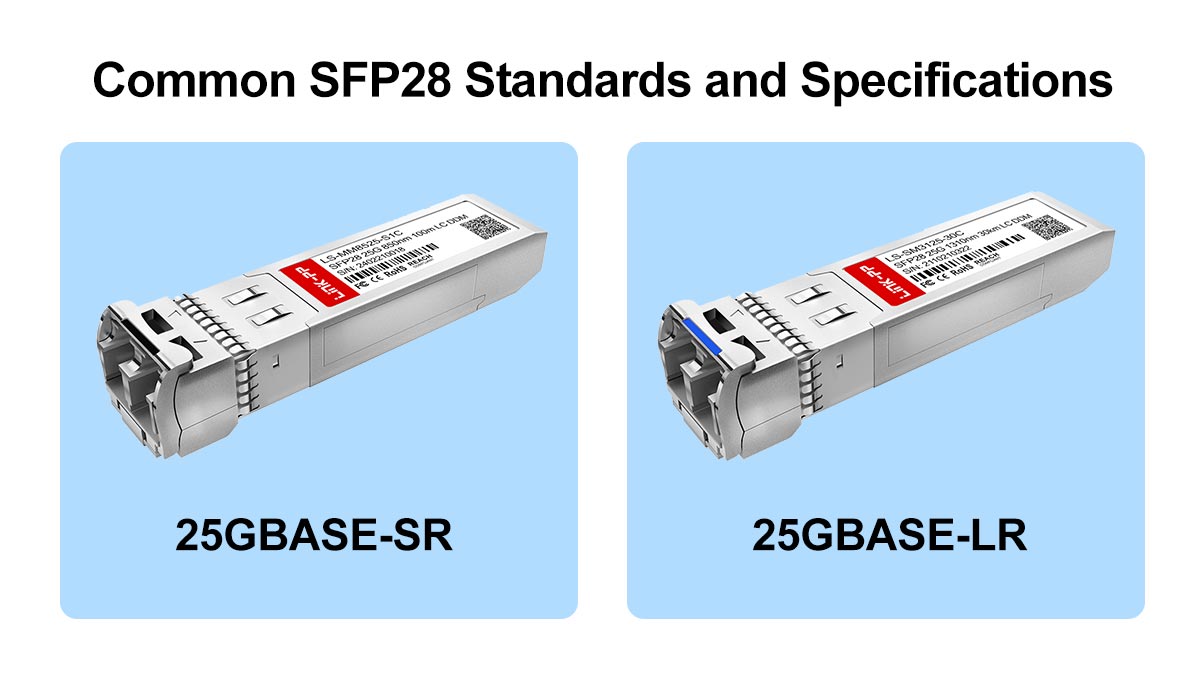
25GBASE-SR (Short Range, Multimode Fiber)
25GBASE-SR is designed for short-distance transmission using multimode fiber (MMF) and operates at a wavelength of 850 nm.
Key characteristics:
Fiber type: Multimode fiber (OM3 / OM4)
Wavelength: 850 nm
Maximum distance:
OM3: up to ~70–100 meters
OM4: up to ~100 meters
Connector: LC duplex
Typical use cases:
Data center rack-to-rack connections
Top-of-rack (ToR) to aggregation switches
High-density, short-reach environments
Why choose SR:
It offers low cost and high efficiency for short-distance deployments inside data centers.
25GBASE-LR (Long Range, Single-Mode Fiber)
25GBASE-LR is optimized for long-distance transmission over single-mode fiber (SMF), operating at a wavelength of 1310 nm.
Key characteristics:
Fiber type: Single-mode fiber (OS2)
Wavelength: 1310 nm
Maximum distance: up to 10 kilometers
Connector: LC duplex
Typical use cases:
Inter-building connections
Campus networks
Why choose LR:
It enables reliable long-distance communication with minimal signal loss, making it ideal for backbone and extended network links.
Transmission Distance and Use Case Comparison
Choosing between SR and LR depends on distance requirements, fiber infrastructure, and cost considerations:
Use 25GBASE-SR when:
Distance is within 100 meters
Multimode fiber is already deployed
Cost optimization is a priority
Use 25GBASE-LR when:
Distance exceeds 100 meters
Long-range connectivity is required (up to 10 km)
You are using single-mode fiber infrastructure
Quick Reference Table: SFP28 Optical Standards
Standard | Fiber Type | Wavelength | Max Distance | Typical Use Case |
|---|---|---|---|---|
25GBASE-SR | MMF (OM3/OM4) | 850 nm | 70–100 m | Data center short-range links |
25GBASE-LR | SMF (OS2) | 1310 nm | Up to 10 km | Long-distance & campus connectivity |
By understanding these common SFP28 standards, network engineers can select the most appropriate module based on distance, cost, and infrastructure, ensuring optimal performance in 25G deployments.
🌟 SFP28 vs. SFP+: Key Differences You Must Know
SFP28 and SFP+ share the same physical form factor, but SFP28 supports 25Gbps while SFP+ supports 10Gbps. SFP28 uses enhanced electrical signaling for higher efficiency, while SFP+ is limited to 10G performance. Compatibility depends on device support and configuration.
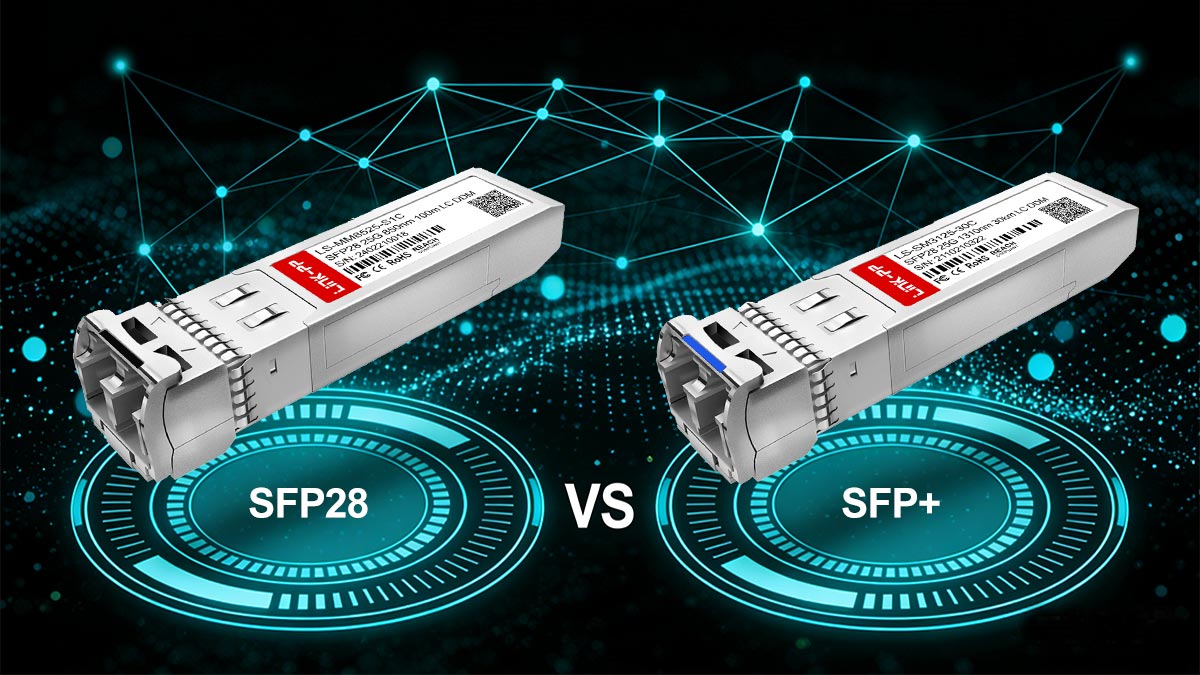
Speed: 25G vs. 10G
The most fundamental difference between SFP28 and SFP+ is data rate:
SFP+ → 10 Gigabit Ethernet (10Gbps)
SFP28 → 25 Gigabit Ethernet (25Gbps)
SFP28 delivers 2.5× higher bandwidth without increasing port size, making it ideal for modern high-density networks.
Electrical Design: Enhanced Signaling vs Legacy 10G
Both SFP28 and SFP+ use a single-lane architecture, but the key difference lies in signaling efficiency:
SFP+ uses traditional 10G signaling
SFP28 uses higher-speed electrical signaling (~25–28 Gbps lane rate)
This improved signaling allows SFP28 to achieve higher throughput while maintaining similar hardware design and footprint.
Backward Compatibility and Interoperability
Compatibility between SFP28 and SFP+ depends on the network device (switch/NIC):
Many SFP28 ports support SFP+ modules, allowing fallback to 10G speeds
However, SFP+ ports typically do NOT support SFP28 modules at 25G speeds
Some platforms allow downspeeding SFP28 modules to 10G, but this must be explicitly supported
Key takeaway:
SFP28 offers forward flexibility, but compatibility is not always bidirectional.
Use Cases: When to Choose SFP28 vs SFP+
Choose SFP+ (10G) when:
Upgrading legacy infrastructure
Bandwidth requirements are moderate
Cost sensitivity is high
Choose SFP28 (25G) when:
Building new data center infrastructure
Requiring higher throughput per port
Optimizing for scalability and future growth
Comparison Table: SFP28 vs. SFP+
Feature | SFP+ (10G) | SFP28 (25G) |
|---|---|---|
Max Data Rate | 10 Gbps | 25 Gbps |
Form Factor | Small Form-Factor Pluggable | Same as SFP+ |
Electrical Lanes | Single lane | Single lane (enhanced signaling) |
Signaling Rate | ~10 Gbps | ~25–28 Gbps |
Backward Compatibility | Limited | Often supports SFP+ modules |
Typical Use Cases | Enterprise, legacy systems | Data centers, cloud, HPC |
Cost per Gbps | Higher | Lower (more efficient) |
Key Takeaway
While SFP+ remains relevant for 10G networks, SFP28 is the preferred choice for modern 25G deployments, offering higher performance, better efficiency, and stronger scalability for future network demands.
🌟 Is SFP28 Fiber or Copper? (Module Types Explained)
SFP28 supports both fiber and copper connections. It is not limited to one medium—SFP28 can be deployed using DAC (copper cables), AOC (active optical cables), or optical transceivers (SR/LR) depending on distance, cost, and performance requirements.
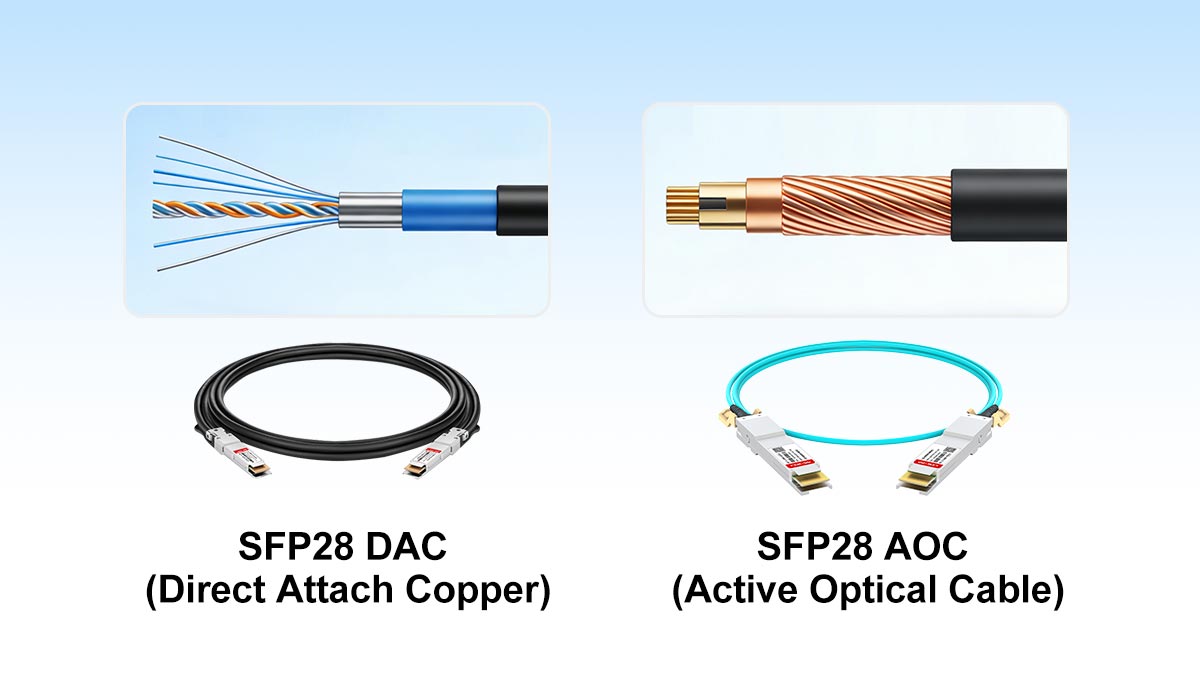
SFP28 DAC (Direct Attach Copper)
Direct Attach Copper (DAC) cables are fixed copper cables with SFP28 connectors on both ends.
Key characteristics:
Medium: Copper
Distance: Typically up to 3–5 meters
Power consumption: Very low
Cost: Most cost-effective option
Typical use cases:
Server-to-switch connections within the same rack
Short-distance, high-speed links in data centers
When to choose DAC:
Choose DAC when you need ultra-low cost, low latency, and short-distance connectivity within racks or adjacent equipment.
SFP28 AOC (Active Optical Cable)
Active Optical Cables (AOC) integrate optical fiber with built-in transceivers at both ends.
Key characteristics:
Medium: Fiber (integrated cable)
Distance: Typically 10–100 meters
Power consumption: Moderate (higher than DAC, lower than full optics in some cases)
Ease of use: Plug-and-play
Typical use cases:
Inter-rack connections within a data center
Medium-distance high-speed links
When to choose AOC:
Use AOC when you need longer reach than DAC but prefer simpler deployment than separate optical modules and patch cables.
SFP28 Optical Transceivers (SR & LR)
SFP28 optical modules provide the most flexible and scalable connectivity by using separate transceivers and fiber cables.
25GBASE-SR (Short Range)
Fiber type: Multimode (MMF)
Wavelength: 850 nm
Distance: Up to ~100 meters
Use case: Data center short-range links
25GBASE-LR (Long Range)
Fiber type: Single-mode (SMF)
Wavelength: 1310 nm
Distance: Up to 10 km
Use case: Campus and long-distance connections
When to choose optical transceivers:
Choose SR or LR modules when you need maximum flexibility, longer distances, and scalable network architecture.
How to Choose the Right SFP28 Media Type
Scenario | Recommended Option |
|---|---|
Same rack (≤5m) | DAC (Copper) |
Rack-to-rack (10–100m) | AOC |
Short fiber links (≤100m) | SR Optical |
Long-distance (up to 10 km) | LR Optical |
SFP28 is a flexible connectivity standard, not tied to a single medium. Whether you choose copper (DAC) or fiber (AOC/SR/LR) depends on your distance, budget, and deployment complexity, making SFP28 suitable for a wide range of 25G networking scenarios.
🌟 SFP28 Compatibility and Deployment Considerations
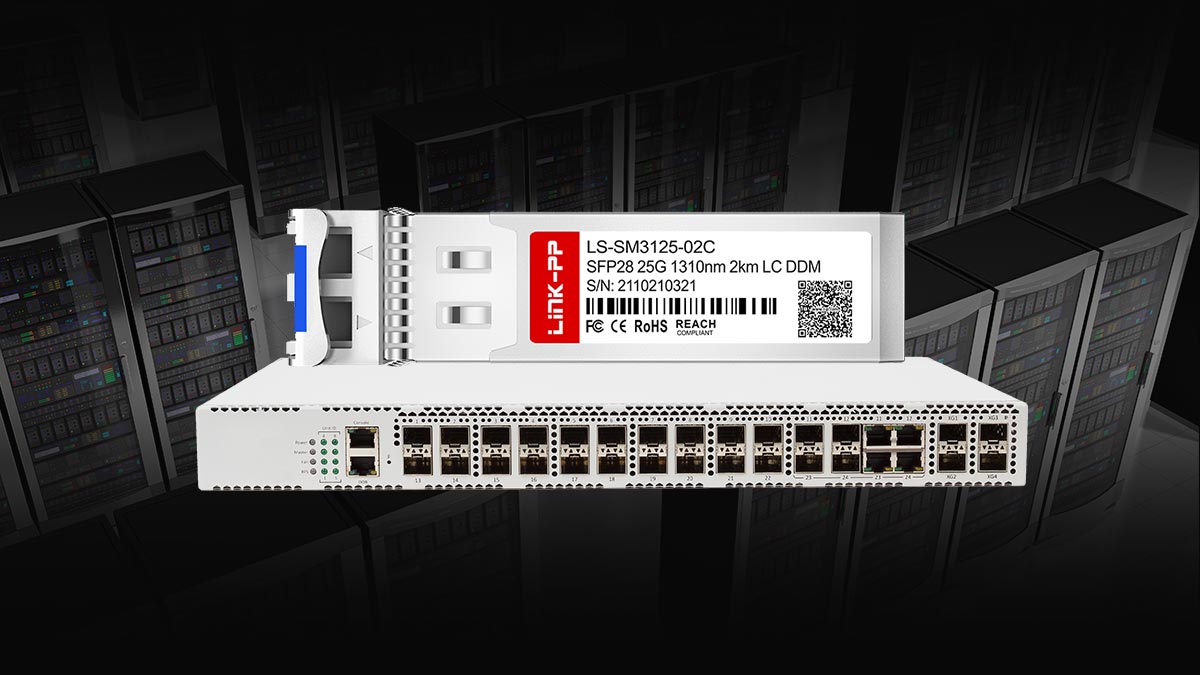
SFP28 modules are physically compatible with SFP28 ports and often support backward operation with SFP+ (10G) ports depending on the switch. However, SFP28 cannot always run at 25G in SFP+ ports, and compatibility is strongly dependent on vendor support and configuration.
Switch Compatibility (Hardware and Port Support)
SFP28 compatibility begins with the switch or network interface hardware. Not all ports that physically accept SFP28 modules will support full 25G performance.
Native SFP28 ports → Fully support 25GbE operation
Multi-rate ports (10G/25G) → Can auto-negotiate between SFP+ and SFP28 speeds
SFP+ only ports → May accept SFP28 modules but operate only at 10G (if supported)
Many modern data center switches from vendors like Cisco, Arista, and Mellanox-based platforms are designed with multi-rate SFP28 support for flexible deployment.
Backward Compatibility with SFP+ (10G Operation)
One of the most common questions is whether SFP28 works in SFP+ environments.
In many cases, SFP28 ports can downshift to 10G mode using SFP+ modules
Some systems allow SFP28 modules to run at 10G (downspeeding)
However, SFP+ ports typically cannot upgrade to 25G speeds
This makes SFP28 a forward-compatible upgrade path, but not a fully bidirectional standard.
Can SFP28 Work in SFP+ Ports? (Important Clarification)
Technically:
The form factor is identical, so insertion is physically possible
Electrically, performance depends on the switch firmware and chipset
In practice:
Some SFP+ ports may reject SFP28 modules
Others may accept them but cap speed at 10Gbps
True 25G operation requires an SFP28-capable port
Vendor Compatibility (Cisco, Arista, and Others)
Different vendors implement transceiver validation policies, which directly impact SFP28 usability:
Cisco → Often requires coded or compatible optics unless unlocked
Arista → More flexible multi-vendor support in many platforms
Mellanox/NVIDIA → Strong native support for 25G SFP28 environments
This leads to a key SEO and real-world consideration:
👉 “SFP28 compatibility is not universal—it is vendor-policy dependent.”
Vendor Lock-In vs. Third-Party Modules
OEM modules (vendor-branded):
Guaranteed compatibility
Higher cost
Preferred in enterprise support contracts
Lower cost
Wide availability
May require manual compatibility override
Many data centers adopt third-party modules to reduce CAPEX while maintaining 25G performance, but must carefully validate firmware compatibility.
Real-World Deployment Tips for SFP28 Networks
To ensure stable deployment of the SFP28 standard, follow these best practices:
Always verify switch compatibility matrix before deployment
Match module type (SR/LR/DAC/AOC) to distance requirements
Avoid mixing unsupported vendors without validation
Plan for future scalability (25G → 100G uplinks)
Use consistent coding policies in large-scale deployments
SFP28 offers a flexible upgrade path to 25G Ethernet, but real-world compatibility depends heavily on switch capabilities, vendor policies, and configuration settings. For stable deployment, always align hardware support + optics type + vendor rules before scaling a 25G network.
🌟 When Should You Choose SFP28? (Use Case Guide)
SFP28 is best used in 25GbE networks where higher bandwidth, low latency, and scalable port density are required—especially in modern data centers, cloud environments, and high-performance computing clusters.
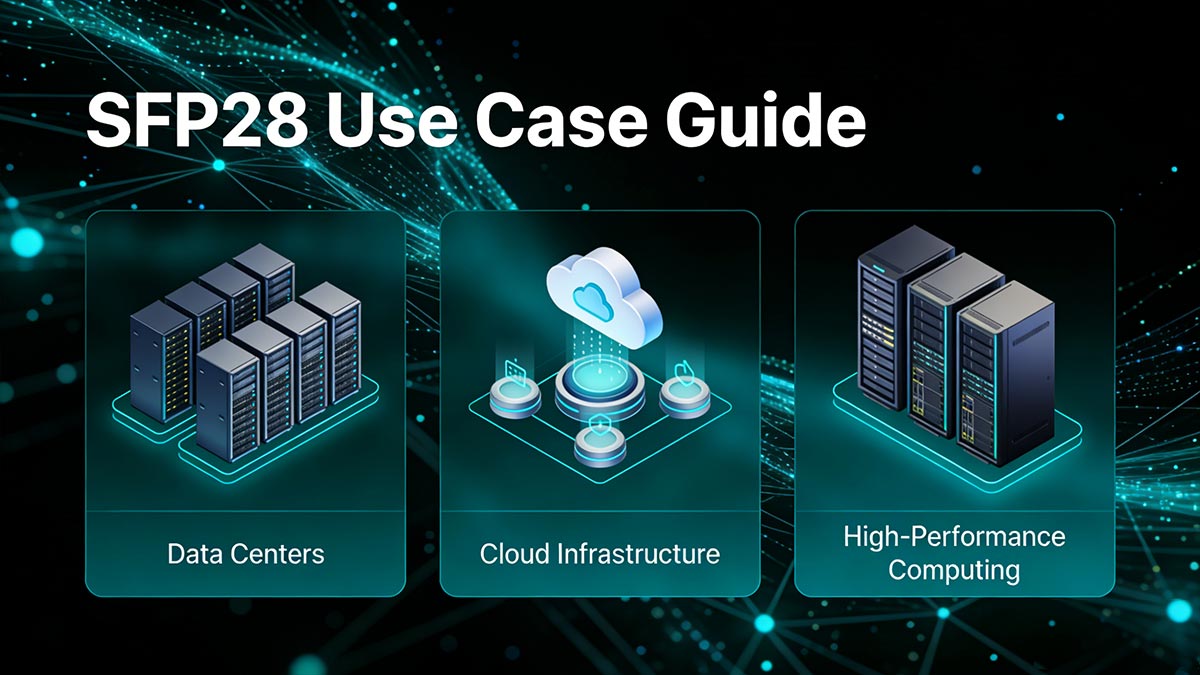
★ Data Centers (Spine–Leaf Architecture)
SFP28 is widely adopted in modern data center architectures, particularly in spine-leaf topologies, where traffic between servers and switches requires high throughput and low oversubscription.
Why SFP28 fits data centers:
Enables 25G server-to-switch connections
Reduces congestion compared to 10G (SFP+) networks
Supports high-density switch ports without increasing rack space
Improves east-west traffic performance
👉 Typical scenario:
Top-of-rack (ToR) switch connecting multiple servers using 25G SFP28 links
★ Cloud Infrastructure (Hyperscale Environments)
Cloud providers rely on SFP28 to scale bandwidth efficiently while controlling cost and power consumption.
Key advantages in cloud networks:
Higher throughput per port compared to 10G
Lower power per bit than legacy 10G infrastructure
Better scalability for virtualized workloads
Supports massive east-west traffic flows
👉 Typical scenario:
Virtual machine clusters and storage nodes connected via 25G SFP28 links
★ High-Performance Computing (HPC)
In HPC environments, performance and latency are critical. SFP28 provides a balance between speed and cost efficiency for compute-heavy workloads.
Why HPC uses SFP28:
Low-latency 25G interconnects
High bandwidth for distributed computing tasks
Efficient scaling across compute nodes
Suitable for AI/ML training clusters
👉 Typical scenario:
GPU clusters or distributed computing nodes connected via 25G SFP28 fabric
★ Cost vs. Performance Decision Logic
Choosing SFP28 is often a strategic balance between cost, performance, and scalability.
Choose SFP28 when:
You are building or upgrading to a 25G network architecture
10G (SFP+) is becoming a performance bottleneck
You need higher density without increasing port count
You are planning future upgrades to 100G uplinks (via 4×25G aggregation)
Consider alternatives when:
Budget constraints are strict and 10G is sufficient
Network traffic is low or non-critical
Existing infrastructure is heavily 10G-based and stable
The SFP28 standard is not just an upgrade from SFP+—it is a strategic transition technology for modern networks. It delivers the best value in environments where bandwidth demand, scalability, and long-term infrastructure planning are top priorities.
🌟 SFP28 Advantages and Limitations
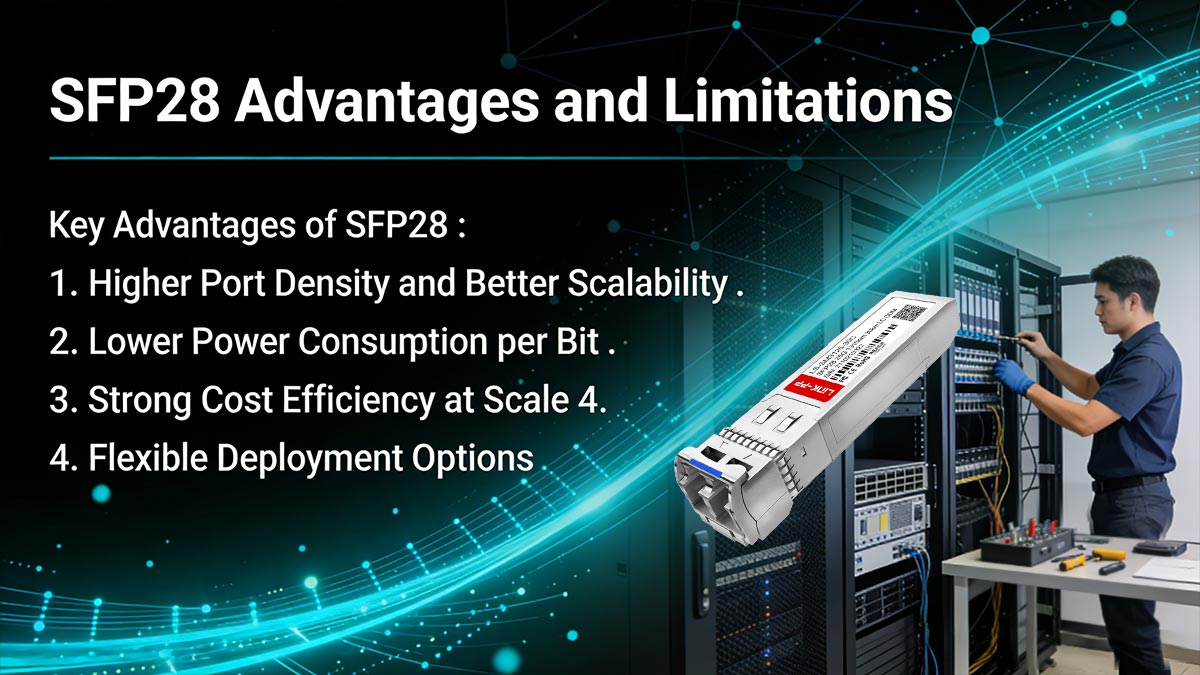
The SFP28 standard delivers a major performance upgrade for modern networking by enabling 25GbE connectivity in the same compact form factor as SFP+. However, like any technology, it comes with both clear advantages and practical limitations that must be considered during deployment.
Key Advantages of SFP28
1. Higher Port Density and Better Scalability
SFP28 allows network designers to achieve 25Gbps per port without increasing physical size, making it ideal for high-density environments.
Same form factor as SFP+
More bandwidth per rack unit
Efficient spine-leaf scaling
Supports future aggregation strategies (e.g., 4×25G → 100G)
👉 Result: More performance in the same physical space
2. Lower Power Consumption per Bit
Compared to older 10G architectures, SFP28 provides significantly improved energy efficiency per gigabit transferred.
Lower power per Gbps than legacy 10G systems
Reduced heat generation in dense deployments
More efficient cooling and infrastructure costs
👉 Result: Better energy efficiency in large-scale data centers
3. Strong Cost Efficiency at Scale
While individual SFP28 modules may cost more than SFP+, the cost per transmitted bit is lower, making it economically attractive for high-volume deployments.
Reduces need for multiple 10G links
Optimized for large-scale cloud environments
Lower long-term infrastructure cost
👉 Result: Better total cost of ownership (TCO) for 25G networks
4. Flexible Deployment Options
SFP28 supports multiple media types, including:
DAC (Direct Attach Copper)
AOC (Active Optical Cable)
Optical transceivers (SR/LR)
👉 Result: Flexible architecture for different distance requirements
Key Limitations of SFP28
1. Distance Constraints (Compared to Higher-Speed Standards)
While SFP28 supports up to 10 km with LR optics, most cost-effective deployments are short-range.
DAC: up to ~5 meters
AOC: up to ~100 meters
SR optics: ~100 meters max
👉 Limitation: Not ideal for long-haul backbone networks without additional optical infrastructure
2. Compatibility and Vendor Dependency
SFP28 compatibility is not universally guaranteed across all devices.
Some switches require vendor-coded optics
Not all SFP+ ports support SFP28 modules
Multi-rate behavior depends on hardware and firmware
👉 Limitation: Requires careful validation in mixed environments
3. Migration Complexity from Legacy 10G Networks
Upgrading from SFP+ (10G) to SFP28 (25G) may require:
Switch replacement or upgrades
Cabling adjustments (fiber types, DAC compatibility)
Network redesign in some architectures
👉 Limitation: Not always a plug-and-play upgrade
Balanced View: When SFP28 Is Most Effective
SFP28 is most effective when:
Scaling from 10G to 25G infrastructure
Building new data center architectures
Optimizing for bandwidth density and energy efficiency
It is less suitable when:
Existing infrastructure is fully optimized at 10G
Long-distance optical transmission is the primary requirement
Vendor restrictions significantly limit module flexibility
The SFP28 standard offers a powerful combination of high bandwidth, energy efficiency, and scalability, making it a cornerstone of modern 25G networking. However, its benefits are maximized only when compatibility, distance requirements, and migration planning are carefully evaluated.
🌟 FAQ about SFP28 Standard
Q1: What is the maximum speed supported by the SFP28 standard?
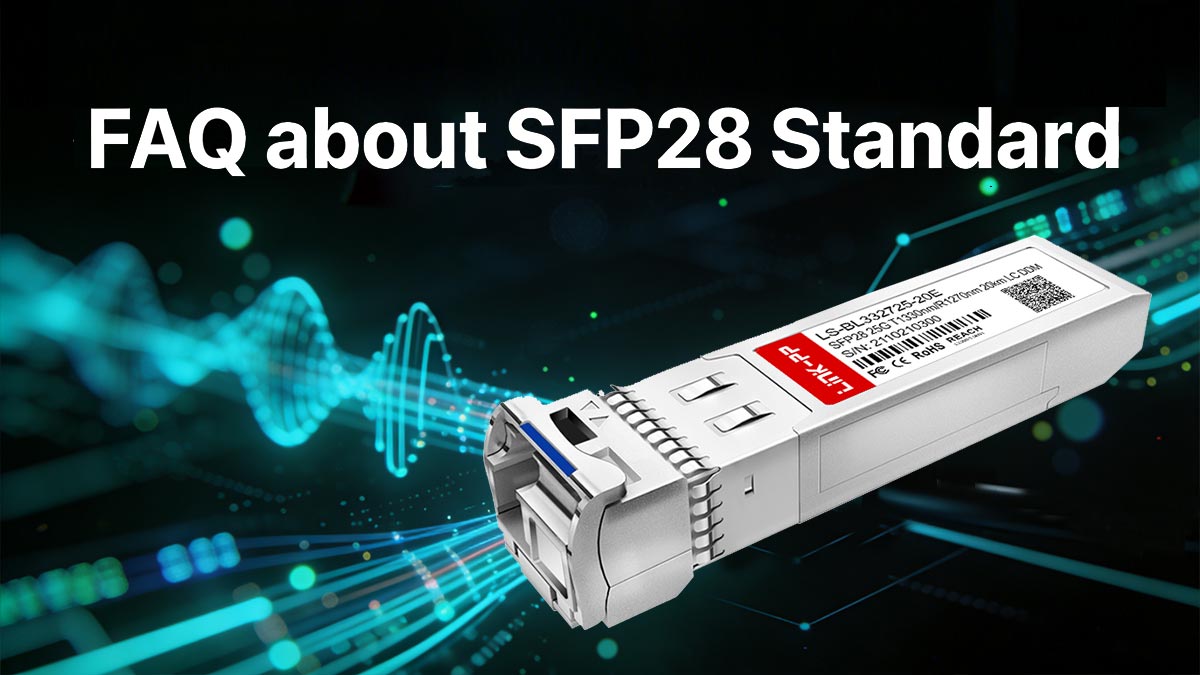
The SFP28 standard supports up to 25 Gigabit Ethernet (25GbE) per lane. It is designed to deliver higher bandwidth than SFP+ while maintaining the same compact form factor, making it suitable for modern high-speed data center networks.
Q2: Is SFP28 used only in data centers?
No. While SFP28 is most common in data centers and cloud environments, it is also used in enterprise core networks, high-performance computing (HPC) clusters, and storage systems where low-latency 25G connectivity is required.
Q3: Can SFP28 replace multiple 10G SFP+ links?
Yes. In many cases, a single 25G SFP28 link can replace multiple 10G SFP+ connections, improving bandwidth efficiency and reducing cable complexity. This is especially useful in spine-leaf network architectures.
Q4: What encoding does SFP28 use to achieve 25GbE?
SFP28 typically uses 64b/66b encoding, which improves transmission efficiency by reducing overhead compared to older encoding schemes. This allows it to achieve near-25Gbps usable throughput on a ~28Gbps signaling rate.
Q5: What is the typical power consumption of SFP28 modules?
Most SFP28 optical transceivers consume around 1W to 2.5W, depending on type (SR, LR, DAC, or AOC). This is generally more efficient than older multi-lane or higher-power legacy solutions when measured per gigabit.
Q6: Is SFP28 part of the Ethernet standard or a hardware form factor?
SFP28 is a hardware form factor defined by the SFP MSA (Multi-Source Agreement). It supports Ethernet protocols such as 25GbE, but it is not itself an Ethernet standard—rather, it is the physical interface used to deliver it.
Q7: Can SFP28 be used in future 100G network upgrades?
Yes, indirectly. While SFP28 itself is a 25G solution, it is commonly used in breakout configurations (4×25G → 100G), making it an important building block in scalable 100G data center architectures.
🌟 Final Summary of the SFP28 Standard
The SFP28 standard is a key enabling technology for 25 Gigabit Ethernet (25GbE) networks, offering a balance of high bandwidth, compact design, and efficient power consumption. As an evolution of SFP+, it maintains the same form factor while significantly increasing performance, making it one of the most widely adopted solutions in modern data center architecture.
From a technical perspective, SFP28 supports multiple deployment options including DAC (copper), AOC (active optical cable), and optical transceivers (SR/LR), allowing it to adapt to different distance and infrastructure requirements. This flexibility is a major reason it has become a foundational component in spine-leaf data center designs, cloud platforms, and HPC environments.
SFP28 delivers 25Gbps per lane for next-generation Ethernet performance
It shares the same form factor as SFP+, enabling high-density deployments
It supports both fiber and copper connectivity options
It is widely used in data centers, cloud computing, and enterprise networks
Compatibility depends on switch hardware and vendor implementation
From a network infrastructure planning standpoint, SFP28 is not just a speed upgrade—it is a scalability strategy. Organizations adopting 25G based on SFP28 are better positioned for future 100G and 400G transitions, especially when using breakout and aggregation architectures.
However, successful deployment requires careful consideration of:
Vendor compatibility policies
Optical module selection (SR vs. LR vs. DAC vs. AOC)
Migration planning from legacy 10G infrastructure
This ensures both performance stability and long-term cost efficiency.
Choosing the Right SFP28 Solution
If you are planning to upgrade or deploy a 25G network, start by evaluating:
Your required transmission distance
Existing switch compatibility
Power and density requirements
Future scalability roadmap
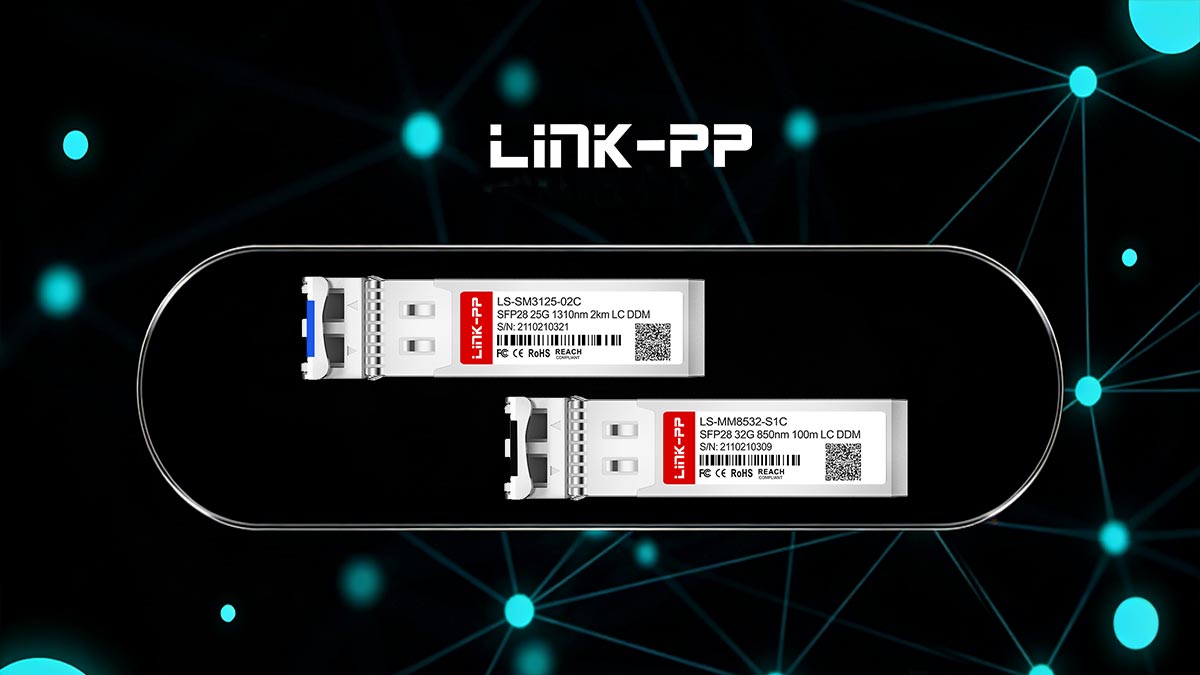
Selecting the right SFP28 module type is critical for optimizing both performance and total cost of ownership.
Explore high-performance, fully tested, and compatible networking solutions at the:
Upgrade your network with reliable SFP28 transceivers, DAC, and AOC solutions designed for modern 25G data center performance.