

In modern high-capacity optical communication systems, especially Dense Wavelength Division Multiplexing (DWDM) networks, maintaining signal integrity over long distances is one of the most critical engineering challenges. As data rates continue to increase from 10G to 100G and beyond, optical impairments such as chromatic dispersion become a major limiting factor for transmission performance.
A Dispersion Compensation Module (DCM) is a key component used in traditional long-haul optical networks to mitigate this issue. It is designed to counteract the spreading of optical pulses as they travel through standard single-mode fiber (SMF), where different wavelengths of light propagate at slightly different speeds. Without compensation, this dispersion leads to pulse broadening, inter-symbol interference (ISI), and ultimately higher bit error rates (BER).
By introducing controlled negative dispersion, a DCM restores the original shape of the optical signal, enabling it to travel longer distances without degradation. This makes it an essential building block in legacy DWDM systems, metro networks, and long-haul backbone infrastructure.
However, with the evolution of modern coherent optical technologies and digital signal processing (DSP)-based dispersion compensation, the role of traditional DCMs is gradually changing. Many new-generation optical networks now rely less on physical compensation modules and more on advanced transceiver-level processing.
In this article, we will explore what a dispersion compensation module is, how it works in DWDM systems, where it is used, and how it compares with modern alternatives such as EDFA and coherent optics. This will provide a complete understanding of its role in both legacy and contemporary optical network architectures.
🔄 What Is DCM?
A Dispersion Compensation Module (DCM) is a device used in DWDM optical networks to correct chromatic dispersion, a transmission impairment that causes optical pulses to spread as they travel through fiber.
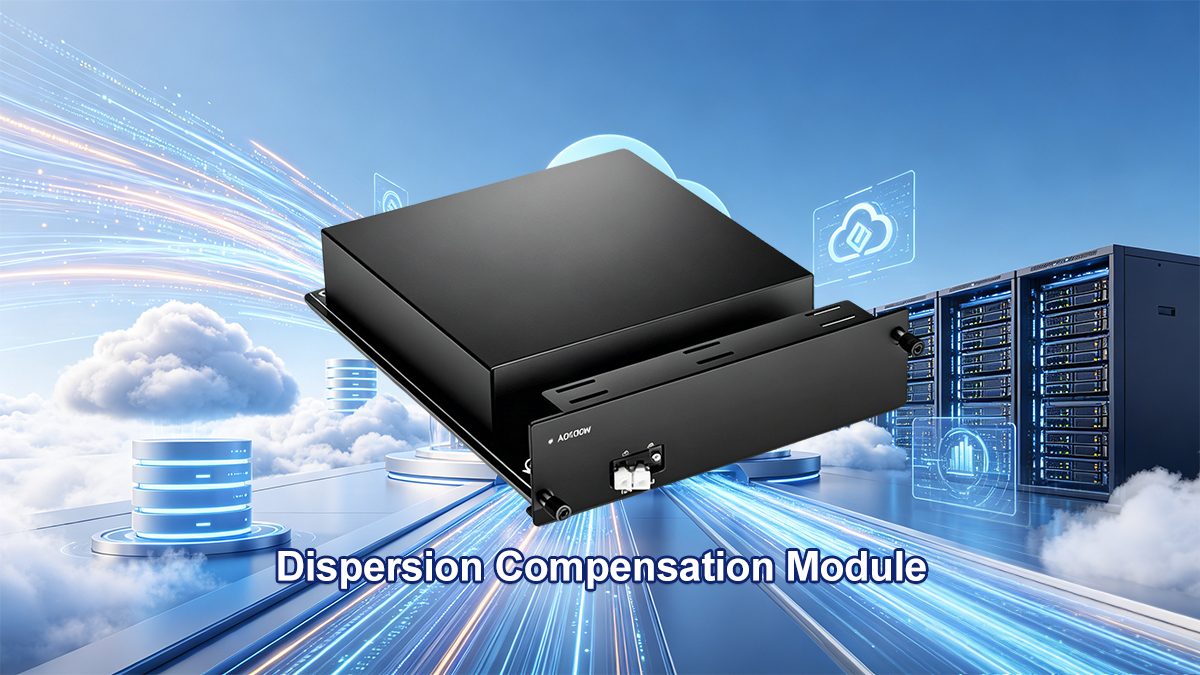
In simple terms, a DCM restores signal quality by applying negative dispersion that counteracts the distortion accumulated in standard single-mode fiber. This helps maintain clear signal separation and reduces bit errors in long-distance transmission.
DCMs are typically used in metro, regional, and long-haul DWDM systems, where fiber spans are long enough for dispersion to significantly impact performance. They are placed in the optical line system alongside components such as amplifiers and multiplexers, but they do not perform amplification or electrical processing.
Unlike modern coherent systems that use DSP-based compensation, traditional DCMs perform optical-domain dispersion correction, making them important in legacy DWDM architectures.
In short:
A DCM is a DWDM line-system module that compensates chromatic dispersion to keep long-distance optical signals stable and readable.
What a DCM Usually Contains
Traditional DCMs are often built around dispersion compensation fiber (DCF) or similar optical components that introduce a negative dispersion profile to cancel the positive dispersion accumulated in the transmission fiber. Manufacturer documentation from passive DCM modules describes them as passive devices that provide negative dispersion for DWDM transmission systems and increase transmission reach.
🔄 How Does a DCM Work in a DWDM System?
A Dispersion Compensation Module (DCM) works by introducing a controlled amount of negative chromatic dispersion to counteract the dispersion accumulated in standard single-mode fiber during DWDM transmission. This process helps restore optical signal integrity without converting the signal into the electrical domain.
In a DWDM system, multiple wavelength channels travel through long fiber spans. As the signal propagates, different wavelengths travel at slightly different speeds, causing pulse broadening and signal distortion. This is known as chromatic dispersion, and it becomes more severe over long distances and higher bit rates.
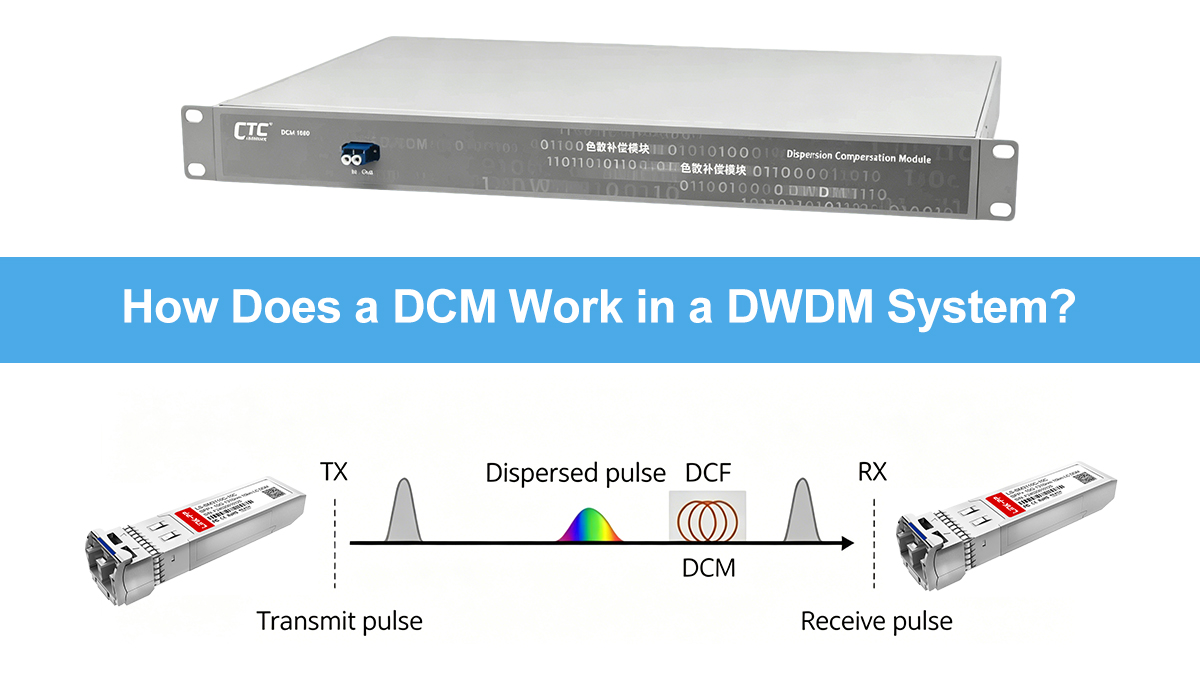
Working principle of a DCM in the optical path
The DCM is placed strategically in the DWDM line system between fiber spans and optical amplifiers (EDFA). Its role is to balance the accumulated dispersion from the transmission fiber.
A typical signal flow looks like this:
Fiber span: chromatic dispersion accumulates
EDFA: amplifies optical power (no dispersion correction)
DCM: applies negative dispersion to compensate distortion
Next fiber span / receiver: receives corrected signal
How dispersion is compensated
Inside the DCM, dispersion compensating fiber (DCF) or equivalent optical structures are used. These are specially designed to have an opposite dispersion slope compared to standard transmission fiber.
As the optical signal passes through the DCM:
Different wavelength components are delayed in reverse order
Stretched pulses are recompressed
Timing alignment between bits is restored
This optical-domain correction improves signal clarity and reduces inter-symbol interference (ISI).
Impact on DWDM system performance
By compensating chromatic dispersion, a DCM helps:
Reduce bit error rate (BER)
Improve eye diagram opening
Extend transmission distance in long-haul links
Maintain stable performance in high-capacity DWDM systems
It is especially important in legacy 10G and 40G optical networks where dispersion is not handled digitally.
In summary:
A DCM works by inserting negative dispersion into a DWDM link using dispersion compensating fiber, effectively canceling fiber-induced signal distortion and improving long-distance transmission quality.
🔄 Why Chromatic Dispersion Matters in Long-Haul Fiber Links
Chromatic dispersion (CD) is a key limiting factor in long-haul optical fiber transmission because it causes optical pulses to spread over distance, leading to signal distortion in DWDM systems.
It occurs because different wavelengths of light travel at slightly different speeds in standard single-mode fiber. As the signal propagates, pulses become wider and begin to overlap.
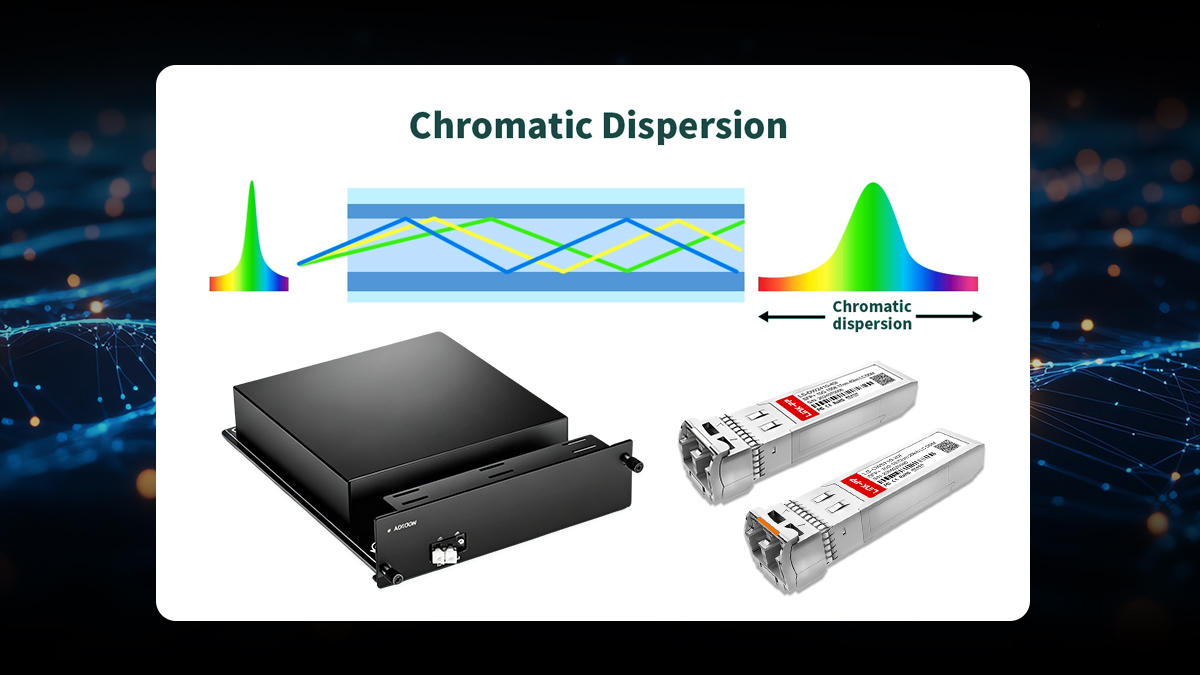
Key Impact on Long-distance Transmission
In long-haul DWDM links, accumulated dispersion can cause:
Pulse broadening over fiber distance
Inter-symbol interference (ISI) between adjacent bits
Increased bit error rate (BER) at the receiver
Reduced maximum transmission reach
Why DCM is critical in DWDM systems
In DWDM systems, multiple wavelengths are transmitted through the same fiber simultaneously. Each channel experiences slightly different dispersion behavior depending on its wavelength.
This creates additional challenges:
Different channels degrade at different rates
Signal quality becomes uneven across the spectrum
System design must account for worst-case dispersion accumulation
As a result, chromatic dispersion is not just a physical effect—it becomes a system-level design constraint in DWDM planning.
In short:
Chromatic dispersion matters because it directly limits signal clarity and transmission distance in long-haul DWDM fiber links.
🔄 Where Is a DCM Used in Optical Networks?
A Dispersion Compensation Module (DCM) is mainly used in DWDM optical transport networks to manage chromatic dispersion in long-distance fiber links. It is deployed in the optical line system layer, not at the client or access layer, and is typically installed where fiber spans become long enough for dispersion to significantly impact signal quality.

1. Long-haul DWDM backbone networks
DCMs are most commonly used in long-haul optical backbone networks, where transmission distances can reach tens or even hundreds of kilometers.
In these systems, DCMs help:
Maintain signal integrity over multiple fiber spans
Reduce accumulated chromatic dispersion
Support stable transmission in 10G / 40G legacy systems
2. Metro and regional optical networks
DCMs are also widely deployed in metro DWDM networks, especially in ring or multi-span architectures.
Typical use cases include:
City-wide optical transport networks
Interconnection between data centers
Regional telecom aggregation networks
These environments still rely on optical-domain dispersion compensation in many legacy deployments.
3. DWDM line systems with optical amplifiers
DCMs are often placed together with EDFA (Erbium-Doped Fiber Amplifiers) in the optical line system.
They are used between fiber spans to:
Balance dispersion after signal amplification
Maintain signal quality across multiple amplifier stages
Extend overall transmission reach
4. Legacy high-speed optical systems
DCMs are especially important in older or non-coherent systems such as:
10G DWDM networks
40G intensity-modulated systems
Early-generation long-haul optical links
In these systems, dispersion is managed optically rather than digitally.
In short:
A DCM is used in DWDM metro and long-haul optical networks, typically in the line system between fiber spans, to compensate chromatic dispersion and maintain signal quality over distance.
🔄 DCM vs. EDFA vs. OEO: What Is the Difference?
These three acronyms are often mentioned together, but they solve different problems. A DCM handles dispersion, an EDFA handles optical loss, and an OEO conversion stage handles re-timing, reshaping, and sometimes regeneration in the electrical domain. Cisco’s DWDM documentation highlights EDFA as a key enabling technology for DWDM, while also describing dispersion as a separate transmission impairment that needs its own mitigation strategy.
In DWDM optical networks, DCM, EDFA, and OEO are often deployed together, but they solve completely different transmission problems. Understanding their roles is essential for designing and troubleshooting optical line systems.
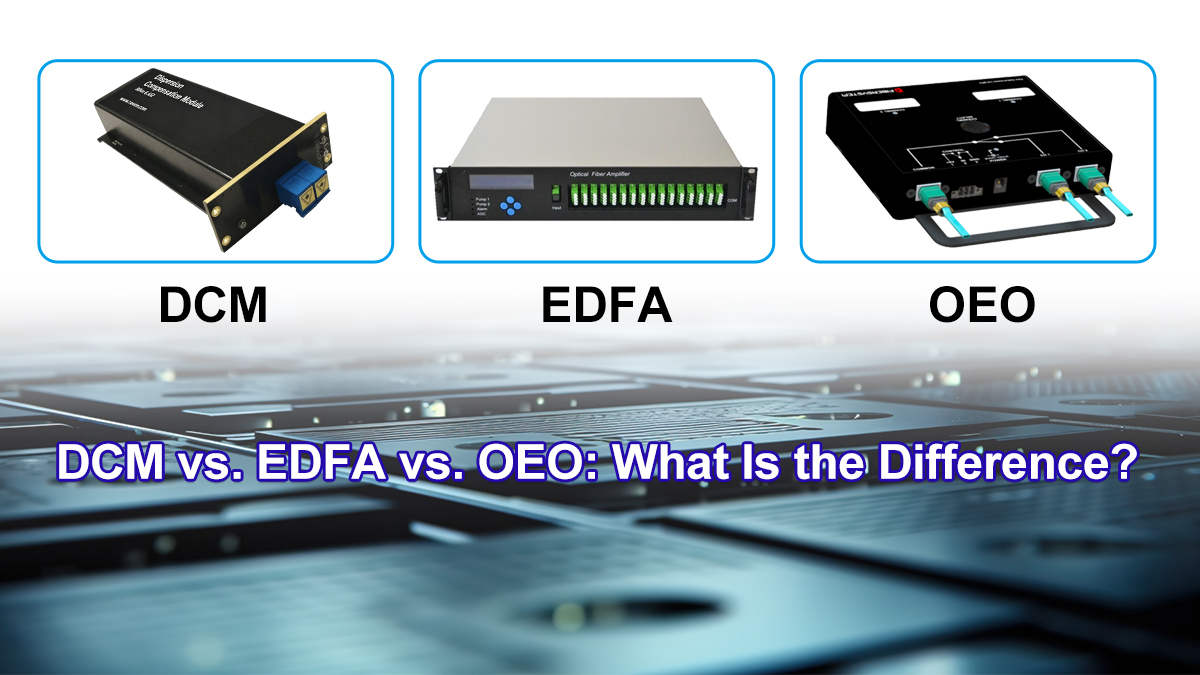
1. DCM (Dispersion Compensation Module): fixes signal distortion
A DCM is used to correct chromatic dispersion, which causes optical pulses to spread over distance.
Problem solved: signal distortion (pulse broadening)
Method: optical-domain negative dispersion compensation
Location: between fiber spans in DWDM line system
Does not amplify or convert signals
Role: keeps the signal shape clean
2. EDFA (Erbium-Doped Fiber Amplifier): boosts signal power
An EDFA is an optical amplifier used to compensate for signal loss (attenuation) in fiber.
Problem solved: optical power loss
Method: amplifies light signal directly (no conversion)
Location: placed every fiber span or mid-span
Does not fix dispersion
Role: keeps the signal strong
3. OEO (Optical-Electrical-Optical): regenerates signal
An OEO device converts optical signals into electrical signals, processes them, and converts them back to optical form.
Problem solved: severe signal degradation (loss + noise + distortion)
Method: full signal regeneration (3R: reshape, retime, retransmit)
Location: regeneration points in long-haul networks
More complex and costly than optical solutions
Role: rebuilds the signal completely
Key Differences in Simple Terms
Device | Main Function | Problem Solved | Domain |
|---|---|---|---|
DCM | Dispersion compensation | Signal distortion | Optical |
EDFA | Signal amplification | Power loss | Optical |
OEO | Signal regeneration | Severe degradation | Electrical |
How They Work Together in a DWDM Link
In a typical long-haul system:
EDFA compensates loss after each fiber span
DCM corrects dispersion accumulated in fiber
OEO is used only when signal quality is too poor to recover optically
Each device addresses a different layer of optical impairment.
In short:
DCM fixes dispersion, EDFA fixes loss, and OEO fixes complete signal degradation through regeneration.
🔄 Key Benefits and Limitations of Dispersion Compensation Modules
The biggest benefit of a DCM is straightforward: it helps preserve signal integrity over long fiber spans by reducing chromatic dispersion. Passive DCM documentation highlights advantages such as fixed chromatic dispersion compensation, low latency, and support for long-haul DWDM transmission.
A Dispersion Compensation Module (DCM) plays an important role in traditional DWDM optical networks by correcting chromatic dispersion in long-distance fiber transmission. However, like any optical component, it has both advantages and limitations depending on the system design.

Key Benefits of DCM
1. Effective chromatic dispersion correction
DCMs provide optical-domain negative dispersion compensation, which directly offsets the dispersion accumulated in standard single-mode fiber. This helps maintain signal clarity over long distances.
2. Improved signal quality
By reducing pulse broadening, DCMs help:
Lower bit error rate (BER)
Reduce inter-symbol interference (ISI)
Improve eye diagram opening
3. Extended transmission distance
DCMs enable DWDM systems to support long-haul and regional links without requiring electrical regeneration at every span.
4. Fully optical operation
DCMs work entirely in the optical domain, meaning:
No optical-to-electrical conversion
No added processing latency
Simple line system integration
Key Limitations of DCM
1. Fixed compensation design
Most DCMs provide predefined dispersion values, which means they are not adaptive. If the fiber span or system design changes, the compensation may become suboptimal.
2. Additional insertion loss
DCMs introduce extra optical loss, which often requires stronger amplification or careful power budget planning.
3. Limited impairment correction
DCMs only address chromatic dispersion. They do not solve:
Optical power loss (handled by EDFA)
Nonlinear effects in fiber
Noise accumulation
4. Reduced relevance in modern networks
In modern coherent DWDM systems, DSP-based dispersion compensation has replaced many traditional DCM functions, reducing their usage in new deployments.
In short:
DCMs are effective for fixed optical dispersion compensation in long-haul DWDM systems, but their limitations in flexibility and modern compatibility have reduced their role in next-generation coherent networks.
🔄 How to Choose the Right DCM for Your Optical Link
Selecting the right Dispersion Compensation Module (DCM) is a critical step in designing a stable and efficient DWDM optical network. The choice depends on system architecture, fiber characteristics, transmission distance, and whether the network is based on legacy or coherent technology.

1. Match dispersion compensation value to fiber span
The most important factor is ensuring the DCM’s negative dispersion value matches the accumulated dispersion of the fiber link.
You should consider:
Total fiber length (km)
Dispersion coefficient of the fiber type
Number of spans in the link
Incorrect matching can lead to:
Under-compensation → residual dispersion
Over-compensation → signal distortion
2. Check system architecture (legacy vs. coherent)
DCMs are mainly used in legacy DWDM systems, while modern coherent networks often rely on DSP-based compensation.
Always confirm whether your system actually requires optical-domain compensation before selecting a DCM.
3. Evaluate insertion loss and power budget
DCMs introduce additional optical loss, so they must be included in the link power budget calculation.
Key considerations:
EDFA placement for amplification
Total span loss vs. system margin
Connector and splice losses
A poorly planned DCM deployment can reduce overall link performance even if dispersion is corrected.
4. Consider wavelength band and compatibility
Most DCMs are designed for C-band DWDM systems, but compatibility should always be verified:
Operating wavelength range
Channel spacing (e.g., 100 GHz / 50 GHz grids)
DWDM system vendor compatibility
5. Deployment environment and scalability
For metro vs. long-haul networks, the required compensation level may differ. Additionally, future scalability should be considered:
Will fiber routes change?
Will bit rates increase?
Will the system migrate to coherent optics?
Choosing a flexible design helps avoid unnecessary upgrades later.
Final Summary
A properly selected DCM ensures stable long-distance DWDM transmission by matching dispersion compensation with fiber characteristics, system architecture, and power budget requirements. However, it should always be evaluated in the context of modern optical network evolution, especially the shift toward coherent DSP-based systems.
Looking for high-quality optical components for DWDM and fiber networks?
Visit the LINK-PP Official Store for professional DWDM SFP Modules and networking solutions designed for telecom and data center applications.