

Modern data centers no longer handle only traditional Ethernet traffic. Today’s enterprise infrastructure must simultaneously support cloud applications, virtualization platforms, AI workloads, and high-speed storage networks while maintaining low latency, scalability, and operational efficiency. As storage performance requirements increased, organizations began searching for ways to simplify the complexity of running separate LAN and SAN infrastructures.
This is where FCoE (Fibre Channel over Ethernet) became an important networking technology.
FCoE is a converged networking protocol that encapsulates native Fibre Channel frames inside Ethernet packets, allowing storage traffic and standard network traffic to share the same physical Ethernet infrastructure. Instead of maintaining independent Fibre Channel switches, adapters, and cabling alongside Ethernet networks, data centers can transport both types of traffic through a unified high-speed Ethernet environment.
In simple terms, FCoE combines the reliability and storage capabilities of traditional Fibre Channel SANs with the flexibility and scalability of Ethernet networking.
The technology was originally developed to reduce:
Data center cabling complexity
Hardware and infrastructure costs
Power and cooling requirements
Network management overhead
At the same time, FCoE preserves many of the characteristics that enterprise storage environments require, including deterministic performance, low latency, and lossless transport behavior.
Unlike protocols such as iSCSI or NVMe/TCP, FCoE does not convert storage traffic into TCP/IP packets. Instead, it keeps the Fibre Channel protocol intact while transporting it over Ethernet through specialized mechanisms such as Data Center Bridging (DCB) and Priority Flow Control (PFC).
As a result, FCoE became widely adopted in converged data center architectures from vendors such as Cisco, Dell EMC, Brocade, NetApp, and VMware, especially during the transition from traditional Fibre Channel infrastructures toward Ethernet-based storage networking.
Another important aspect of FCoE is its close relationship with modern Ethernet optical connectivity. Because FCoE operates over Ethernet physical layers, it typically uses standard Ethernet optical transceivers such as:
10G SFP+ SR/LR modules
25G SFP28 modules
40G QSFP+ modules
100G QSFP28 modules
DAC and AOC high-speed cabling solutions
This creates a strong connection between FCoE deployment strategies and data center optical module selection, compatibility, and interoperability.
In this guide, you will learn:
What FCoE Fibre Channel over Ethernet is
How FCoE works inside modern data centers
The relationship between FCoE and optical transceivers
How FCoE compares with Fibre Channel, Ethernet, and iSCSI
Which optical modules are commonly used in FCoE networks
The advantages, limitations, and real-world use cases of FCoE
Whether you are a network engineer, system integrator, storage architect, or optical transceiver buyer, understanding FCoE remains valuable for designing efficient, high-performance converged infrastructures in modern enterprise environments.
✅ What Is FCoE Fibre Channel over Ethernet?
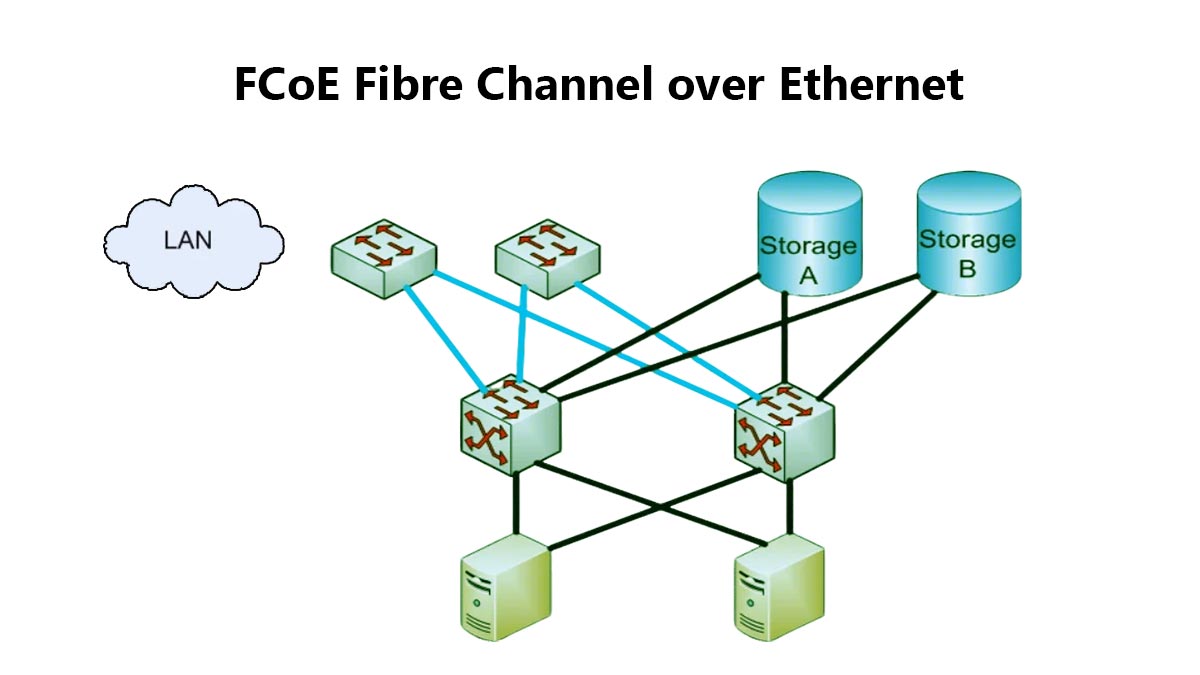
FCoE (Fibre Channel over Ethernet) is a storage networking technology that enables native Fibre Channel traffic to be transmitted across high-speed Ethernet networks. Instead of using a completely separate Fibre Channel SAN infrastructure with dedicated switches, adapters, and cabling, FCoE encapsulates Fibre Channel frames inside Ethernet frames, allowing both storage traffic and standard LAN traffic to operate on the same converged network infrastructure. The goal of FCoE is not to replace Fibre Channel itself, but to simplify data center architecture by combining storage and Ethernet networking into a unified transport environment while preserving the low latency, reliability, and lossless characteristics required by enterprise storage systems.
Simple Definition of FCoE
Term | Definition |
|---|---|
FCoE | Fibre Channel over Ethernet |
Main Purpose | Transport Fibre Channel storage traffic over Ethernet |
Core Function | Encapsulates FC frames inside Ethernet frames |
Primary Benefit | Converged LAN and SAN infrastructure |
Typical Environment | Enterprise data centers and storage networks |
Common Speeds | 10G, 25G, 40G, and 100G Ethernet |
Key Requirement | Lossless Ethernet using Data Center Bridging (DCB) |
What FCoE Stands For
FCoE stands for:
Fibre Channel over EthernetThe name directly describes how the technology works:
Fibre Channel (FC) is the traditional high-performance storage networking protocol used in SAN (Storage Area Network) environments.
Over Ethernet means those Fibre Channel frames are transported through Ethernet infrastructure rather than through dedicated Fibre Channel physical networks.
Importantly, FCoE does not convert Fibre Channel into TCP/IP traffic. The original Fibre Channel protocol remains intact throughout transmission. FCoE simply changes the transport layer from native Fibre Channel cabling and switching to Ethernet-based transport.
Why FCoE Exists
Traditional enterprise data centers historically maintained two completely separate network infrastructures:
Network Type | Purpose |
|---|---|
Ethernet LAN | Standard data and application traffic |
Fibre Channel SAN | Storage traffic |
This architecture increased:
Cabling complexity
Switch count
Adapter requirements
Power consumption
Cooling demands
Infrastructure cost
FCoE was introduced to solve this problem through network convergence.
Instead of deploying separate Ethernet NICs and Fibre Channel HBAs inside each server, organizations could use a single converged network infrastructure capable of carrying both traffic types simultaneously.
This approach simplified large-scale data center deployment while reducing operational overhead and improving infrastructure efficiency.
The Simplest Way to Understand FCoE
The easiest way to understand FCoE is:
FCoE allows Fibre Channel storage traffic to travel through Ethernet networks.Or even more simply:
FCoE = Fibre Channel traffic packaged inside Ethernet framesA traditional Fibre Channel network looks like this:
Server → FC Switch → Storage ArrayAn FCoE network looks like this:
Server → Ethernet Switch → Storage ArrayIn an FCoE deployment, the Ethernet network becomes the shared transport platform for both:
Normal IP network traffic
Enterprise storage traffic
Because storage workloads are highly sensitive to packet loss and latency, FCoE environments typically require specialized Ethernet features such as:
Data Center Bridging (DCB)
Priority Flow Control (PFC)
Enhanced Transmission Selection (ETS)
These technologies help create a lossless Ethernet environment capable of supporting enterprise-class storage communication.
✅ How FCoE Works in a Data Center Network
FCoE works by transporting native Fibre Channel storage traffic across Ethernet networks without converting it into TCP/IP. Instead of using separate Fibre Channel switches and cabling, FCoE encapsulates Fibre Channel frames inside Ethernet frames, allowing both LAN and SAN traffic to share the same high-speed Ethernet infrastructure.
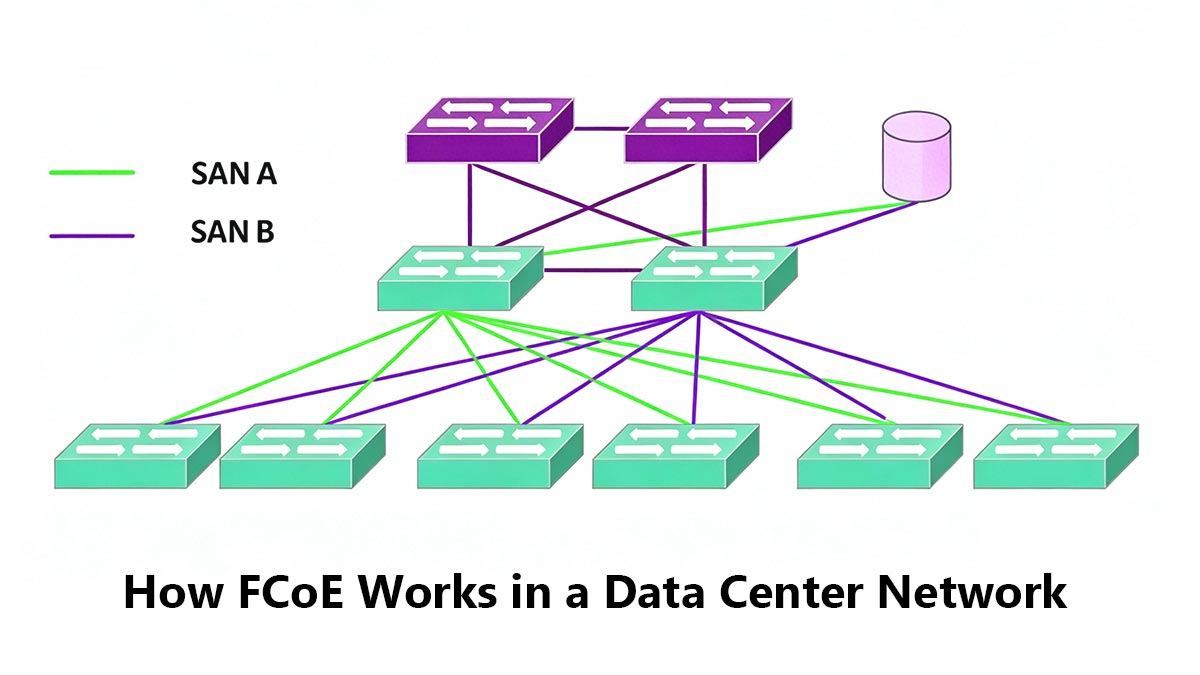
This converged networking model reduces hardware complexity while maintaining the low latency and reliability required for enterprise storage environments.
FC Frames Encapsulated Into Ethernet
The core function of FCoE is Fibre Channel frame encapsulation.
The transmission process works as follows:
Fibre Channel Frame
↓
FCoE Header
↓
Ethernet Frame
↓
Ethernet Network
Unlike iSCSI or NVMe/TCP, FCoE does not convert storage traffic into TCP/IP packets. The original Fibre Channel protocol remains intact during transport.
Protocol | Transport Method |
|---|---|
Fibre Channel | Native FC Fabric |
FCoE | FC over Ethernet |
iSCSI | SCSI over TCP/IP |
NVMe/TCP | NVMe over TCP/IP |
CNA, Switch, and Storage Path
A typical FCoE deployment follows this path:
Server → CNA → Ethernet Switch → StorageCNA (Converged Network Adapter)
The CNA combines:
Ethernet NIC functionality
Fibre Channel HBA functionality
This allows a single adapter to handle both network and storage traffic.
FCoE-Capable Switch
FCoE switches support technologies such as:
Data Center Bridging (DCB)
Priority Flow Control (PFC)
These switches may also function as:
FCF (Fibre Channel Forwarder)which manages Fibre Channel services inside the Ethernet network.
Why DCB Is Required for Lossless Transport
Traditional Ethernet networks are lossy, meaning packets can be dropped during congestion. Fibre Channel storage traffic, however, requires highly reliable and predictable transport.
To support this, FCoE relies on: Data Center Bridging (DCB)
DCB enhances Ethernet with features designed for lossless transmission.
Key technologies include:
DCB Feature | Purpose |
|---|---|
PFC | Prevents frame loss |
ETS | Allocates bandwidth |
DCBX | Exchanges configuration settings |
These features help Ethernet behave more like a Fibre Channel storage network.
How FCoE Enables Converged Networking
Traditional data centers often required separate connections for LAN and SAN traffic:
Ethernet Network + Fibre Channel SANFCoE allows both to operate on the same Ethernet infrastructure:
LAN + SAN over EthernetThis reduces:
Cabling
Adapter count
Switch complexity
Power consumption
Ethernet Optical Modules Used for FCoE
Because FCoE runs on Ethernet physical layers, it uses standard Ethernet optical transceivers rather than native Fibre Channel optics.
Common FCoE optical modules include:
Ethernet Speed | Typical Modules |
|---|---|
10G | SFP+ SR/LR |
25G | SFP28 SR/LR |
40G | |
100G | QSFP28 SR4/LR4 |
These modules carry both Ethernet traffic and encapsulated Fibre Channel storage traffic across the same network infrastructure.
✅ FCoE vs. Fibre Channel vs. Ethernet vs. iSCSI
FCoE, Fibre Channel, Ethernet, and iSCSI are all used in enterprise networking and storage environments, but they serve different purposes and use different transport methods.
The simplest distinction is:
Fibre Channel (FC) is a dedicated storage networking protocol
FCoE carries Fibre Channel traffic over Ethernet
Ethernet is a general-purpose networking technology
iSCSI transports storage traffic over TCP/IP networks
Understanding these differences helps organizations choose the right infrastructure for performance, scalability, and cost.
FCoE vs. Fibre Channel
Traditional Fibre Channel uses a dedicated SAN infrastructure with:
FC switches
FC HBAs
FCoE simplifies deployment by transporting Fibre Channel frames across Ethernet networks instead of native FC fabrics.
Feature | Fibre Channel | FCoE |
|---|---|---|
Transport Network | Native FC Fabric | Ethernet |
Infrastructure | Separate SAN | Converged LAN + SAN |
Optical Modules | FC Optics | Ethernet Optics |
Protocol | Native FC | FC Encapsulated in Ethernet |
FCoE preserves the Fibre Channel protocol while changing the transport layer to Ethernet.
FCoE vs. Ethernet
Ethernet is designed for general data communication, while FCoE is optimized for storage traffic.
Unlike standard Ethernet, FCoE requires lossless transport technologies such as:
Data Center Bridging (DCB)
Priority Flow Control (PFC)
Feature | Ethernet | FCoE |
|---|---|---|
Purpose | General Networking | Storage Networking |
Packet Loss | Allowed | Controlled |
Transport Type | Ethernet Frames | FC over Ethernet |
Requires DCB | No | Yes |
In simple terms:
FCoE uses Ethernet infrastructure for storage networking.FCoE vs. iSCSI
Both FCoE and iSCSI transport storage traffic over Ethernet, but they use different protocols.
iSCSI uses TCP/IP
FCoE preserves native Fibre Channel communication
Feature | FCoE | iSCSI |
|---|---|---|
Protocol | Fibre Channel | TCP/IP |
Transport | FC over Ethernet | SCSI over TCP/IP |
Network Type | Lossless Ethernet | Standard Ethernet |
Latency | Lower | Higher |
Deployment Complexity | Higher | Lower |
iSCSI is typically easier and less expensive to deploy, while FCoE is commonly used in enterprise SAN environments that require low latency and integration with existing Fibre Channel infrastructure.
Optical Module Differences
Traditional Fibre Channel networks use dedicated FC optical modules such as:
8G FC SFP+
16G FC SFP+
32G FC SFP28
FCoE networks use standard Ethernet optical transceivers, including:
10G SFP+ SR/LR
25G SFP28
40G QSFP+
100G QSFP28
Because FCoE operates on Ethernet physical layers, Ethernet optical modules are required instead of native Fibre Channel optics.
✅ Common Optical Modules Used in FCoE Networks
Because FCoE operates on Ethernet physical layers, it uses standard Ethernet optical transceivers rather than native Fibre Channel optics. The choice of optical module depends on factors such as network speed, transmission distance, switch compatibility, and data center architecture.
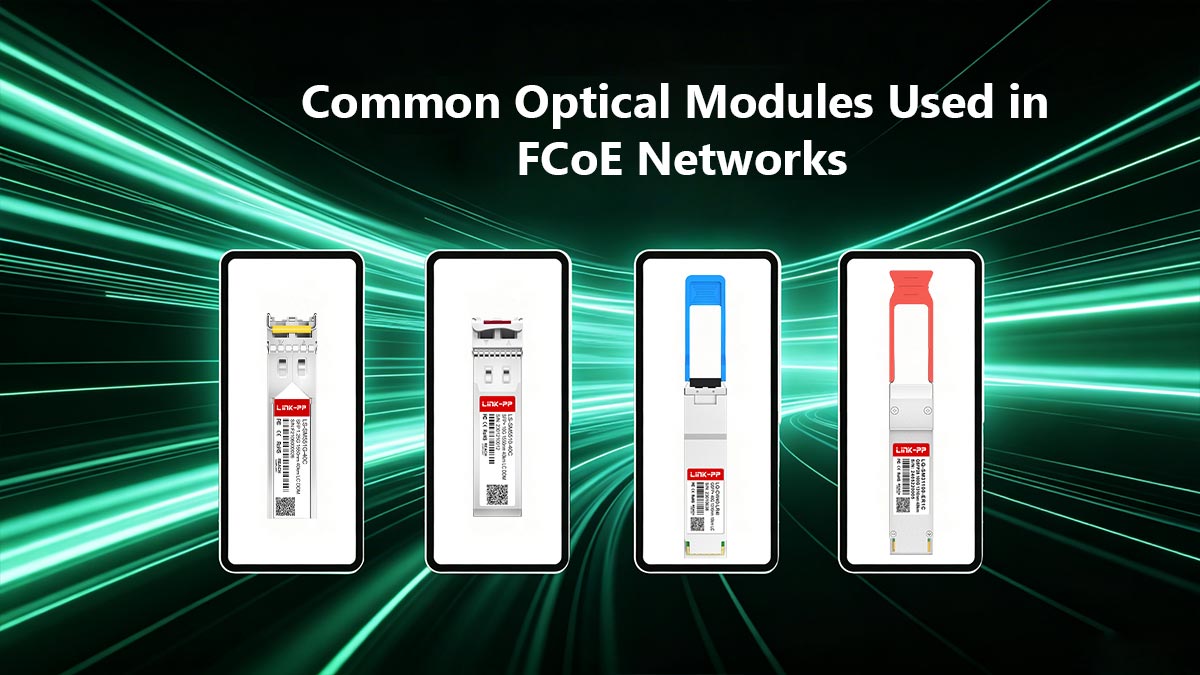
In most deployments, FCoE networks prioritize:
Low latency
Stable link performance
High interoperability
Enterprise switch compatibility
Reliable lossless Ethernet operation
The following optical modules are commonly used in modern FCoE environments.
10G SFP+ Modules for Classic FCoE Deployments
10G Ethernet was the most widely adopted platform during the early growth of FCoE, especially in enterprise blade server and converged infrastructure deployments.
Common 10G FCoE optical modules include:
Module Type | Fiber Type | Typical Reach |
|---|---|---|
10GBASE-SR SFP+ | Multimode Fiber (OM3/OM4) | Up to 300 m |
10GBASE-LR SFP+ | Single-Mode Fiber (OS2) | Up to 10 km |
10G SFP+ modules are commonly used with:
Cisco UCS
VMware environments
Enterprise SAN convergence
Top-of-rack (ToR) switching
For short in-rack connections, many deployments also use:
10G DAC cables
10G AOC cables
to reduce cost and power consumption.
25G SFP28 Modules for Newer Converged Networks
As data center bandwidth requirements increased, many organizations migrated from 10G to 25G Ethernet.
25G SFP28 modules provide:
Higher bandwidth
Better lane efficiency
Lower cost per gigabit
Improved scalability
Common options include:
Module Type | Fiber Type | Typical Reach |
|---|---|---|
25GBASE-SR SFP28 | Multimode Fiber | Up to 100 m |
25GBASE-LR SFP28 | Single-Mode Fiber | Up to 10 km |
25G FCoE deployments are common in:
Modern enterprise data centers
Virtualized storage networks
High-density server environments
40G QSFP+ Modules for Higher-Density Links
40G QSFP+ modules are often used for aggregation and switch uplink connections in converged FCoE infrastructures.
Typical modules include:
Module Type | Fiber Type | Typical Reach |
|---|---|---|
40GBASE-SR4 QSFP+ | Multimode Fiber | Up to 150 m |
40GBASE-LR4 QSFP+ | Single-Mode Fiber | Up to 10 km |
These modules are commonly deployed in:
Spine-leaf architectures
Aggregation layers
High-density switch interconnects
40G links can consolidate multiple lower-speed server connections into fewer high-bandwidth uplinks.
100G QSFP28 Modules for Modern Data Center Backbones
100G Ethernet is increasingly used in large-scale converged infrastructures and modern data center backbones.
Common 100G FCoE optical modules include:
Module Type | Fiber Type | Typical Reach |
|---|---|---|
100GBASE-SR4 QSFP28 | Multimode Fiber | Up to 100 m |
100GBASE-LR4 QSFP28 | Single-Mode Fiber | Up to 10 km |
100G QSFP28 modules are ideal for:
Core data center switching
High-performance storage fabrics
Cloud-scale infrastructure
Large virtualization clusters
These higher-speed links help support increasing storage traffic volumes while reducing overall port density requirements.
DAC and AOC Options for Short-Reach Links
In many FCoE deployments, especially inside racks or between adjacent racks, DAC and AOC solutions are often more cost-effective than traditional optical transceivers.
DAC (Direct Attach Copper)
DAC cables are passive or active copper cables with integrated connectors.
Advantages include:
Lower cost
Very low latency
Reduced power consumption
Typical use cases:
Server-to-switch connections
Short top-of-rack links
AOC (Active Optical Cable)
AOCs combine optical fiber with integrated transceiver technology.
Advantages include:
Longer reach than DAC
Lower cable weight
Better EMI resistance
Typical use cases:
Cross-rack connections
Medium-distance high-speed links
Choosing the Right Optical Module for FCoE
When selecting optical modules for FCoE networks, important considerations include:
Selection Factor | Importance |
|---|---|
Switch Compatibility | Ensures interoperability |
Transmission Distance | Determines module type |
Network Speed | Matches bandwidth requirements |
Fiber Type | |
Latency and Stability | Critical for storage traffic |
DCB Environment Support | Required for reliable FCoE operation |
Because FCoE environments are highly sensitive to network reliability, enterprise-grade Ethernet optical transceivers with stable performance and broad switch compatibility are typically preferred.
✅ Key Requirements for FCoE Performance and Stability
FCoE environments are more sensitive to network quality than standard Ethernet networks because storage traffic requires predictable latency, reliable delivery, and stable long-term operation. Although FCoE uses Ethernet infrastructure, enterprise deployments typically demand higher standards for switch configuration, optical module quality, and overall network interoperability.
To maintain stable FCoE performance, organizations must focus on several critical deployment factors.
DCB and Lossless Ethernet
One of the most important requirements for FCoE is: Lossless Ethernet
Traditional Ethernet networks allow packet drops during congestion, but Fibre Channel storage traffic is designed for highly reliable transport.
To support this behavior, FCoE relies on: Data Center Bridging (DCB)
DCB is a collection of Ethernet enhancements that help create a more predictable and lossless environment.
Key DCB technologies include:
Technology | Function |
|---|---|
Priority Flow Control (PFC) | Prevents frame loss during congestion |
Enhanced Transmission Selection (ETS) | Allocates bandwidth between traffic classes |
DCBX | Exchanges DCB configuration information |
Without properly configured DCB, FCoE storage traffic may experience instability, congestion issues, or packet loss.
Low Latency and Low Error Rate
Storage traffic is highly sensitive to latency variation and transmission errors.
For stable FCoE operation, networks should maintain:
Low latency
Low jitter
Low bit error rate (BER)
Stable optical signal quality
Poor-quality links can lead to:
Frame retransmissions
Performance degradation
Storage access interruptions
Link instability
Because of this, enterprise FCoE deployments typically prioritize high-quality Ethernet optical modules and reliable cabling infrastructure.
Switch Compatibility
FCoE requires Ethernet switches that support:
DCB
PFC
FCoE forwarding features
Common enterprise platforms include:
Cisco Nexus
Dell EMC
Brocade
HPE
Compatibility is especially important because some switches enforce strict transceiver validation policies through EEPROM checks and vendor coding requirements.
In many production environments, using unsupported optical modules may result in:
Warning messages
Link failures
Reduced stability
Disabled monitoring functions
Module Interoperability and Vendor Certification
Although FCoE uses standard Ethernet optical transceivers, interoperability remains critical in enterprise storage networks.
When selecting optical modules for FCoE deployments, organizations typically evaluate:
Requirement | Importance |
|---|---|
Vendor compatibility | Ensures switch recognition |
Stable DOM/DDM monitoring | Supports troubleshooting |
Low BER performance | Improves storage reliability |
Thermal stability | Supports long-term operation |
Enterprise qualification | Reduces deployment risk |
For this reason, many data centers prefer:
instead of uncertified generic transceivers.
In FCoE environments, stable interoperability is often more important than simply achieving link connectivity.
✅ FAQ About FCoE Fibre Channel over Ethernet
1. Is FCoE Still Used Today?
Yes. FCoE is still used in many enterprise data centers, especially in environments that already rely on Fibre Channel SAN infrastructure and converged networking architectures.
Although newer technologies such as NVMe/TCP and RoCE are becoming more common in cloud and hyperscale environments, FCoE remains relevant for:
Enterprise storage networks
Cisco UCS deployments
Virtualized data centers
Converged LAN and SAN infrastructures
2. Does FCoE Require Special Optical Modules?
No. FCoE typically uses standard Ethernet optical modules rather than dedicated Fibre Channel optics.
Common FCoE optical transceivers include:
10G SFP+ SR/LR
25G SFP28 SR/LR
40G QSFP+
100G QSFP28
However, enterprise FCoE environments often require:
Better switch compatibility
Lower error rates
Stable DCB operation
Reliable interoperability
Therefore, enterprise-grade Ethernet optical modules are generally preferred.
3. Is FCoE the Same as Fibre Channel?
No. FCoE and Fibre Channel are closely related, but they are not the same technology.
Traditional Fibre Channel uses a dedicated FC SAN infrastructure, while FCoE transports Fibre Channel traffic across Ethernet networks.
The key difference is:
Technology | Transport Network |
|---|---|
Fibre Channel | Native FC Fabric |
FCoE | Ethernet |
FCoE preserves the native Fibre Channel protocol while changing the physical transport layer to Ethernet.
4. Can Standard Ethernet Switches Support FCoE?
Not always.
FCoE requires Ethernet switches that support:
Data Center Bridging (DCB)
Priority Flow Control (PFC)
FCoE forwarding capabilities
Standard unmanaged Ethernet switches typically do not support these features.
Enterprise switches commonly used for FCoE include:
Cisco Nexus
Dell EMC switches
Brocade data center switches
These platforms are designed to support the lossless Ethernet environment required for stable FCoE storage traffic.
✅ When to Use FCoE Protocol
FCoE was developed to simplify enterprise storage networking by combining Fibre Channel SAN traffic and Ethernet LAN traffic into a single converged infrastructure. While newer Ethernet-based storage technologies continue to evolve, FCoE still remains valuable in specific enterprise environments where low latency, storage reliability, and SAN integration are important.
The best deployment choice depends on factors such as existing infrastructure, scalability requirements, operational complexity, and long-term data center strategy.
Best-Fit Scenarios for FCoE
FCoE is most suitable for organizations that already operate Fibre Channel storage environments but want to reduce infrastructure complexity and cabling overhead.
Typical FCoE deployment scenarios include:
Enterprise data centers with existing FC SAN infrastructure
Cisco UCS converged networking environments
Virtualized server clusters
Blade server architectures
High-density rack deployments
Organizations migrating from traditional FC to Ethernet-based infrastructures
FCoE is especially useful when companies want to preserve Fibre Channel storage performance while simplifying physical network deployment.
Its main advantages include:
Reduced cabling
Fewer adapters and switch ports
Simplified infrastructure management
Lower power and cooling requirements
Shared Ethernet optical connectivity
Because FCoE operates on Ethernet physical layers, organizations can also leverage standard Ethernet optical transceivers such as:
for converged network deployments.
When Fibre Channel Still Makes Sense
Traditional Fibre Channel remains a strong choice for highly specialized enterprise SAN environments that prioritize maximum stability, deterministic performance, and long-established operational practices.
Native FC SANs are still commonly used in:
Large enterprise storage networks
Mission-critical database systems
Financial institutions
Legacy SAN environments
High-performance storage fabrics
Advantages of traditional Fibre Channel include:
Mature SAN ecosystem
Dedicated storage isolation
Extremely predictable performance
Proven long-term reliability
However, FC infrastructure typically requires:
Separate FC switches
Dedicated FC optical modules
Independent SAN cabling
Higher deployment complexity
For organizations heavily invested in existing Fibre Channel architectures, continuing with native FC may still be the most practical option.
When iSCSI or NVMe/TCP May Be a Better Choice
In many modern cloud and hyperscale environments, organizations increasingly choose IP-based storage protocols such as:
iSCSI
NVMe/TCP
instead of FCoE.
These protocols are often preferred because they:
Operate on standard Ethernet networks
Require less specialized configuration
Simplify large-scale deployment
Integrate easily with cloud infrastructure
Reduce operational complexity
iSCSI is commonly selected for:
Small and medium business storage
Cost-sensitive deployments
General-purpose virtualization
NVMe/TCP is becoming increasingly important for:
High-speed flash storage
AI infrastructure
Modern software-defined data centers
Scalable cloud architectures
Compared with FCoE, these technologies generally offer simpler deployment models and broader ecosystem adoption in newer environments.
Final Thoughts
FCoE remains an important technology in the evolution of converged data center networking. It bridges the gap between traditional Fibre Channel SAN infrastructure and modern Ethernet-based architectures by allowing storage traffic and network traffic to share the same physical Ethernet environment.
Although newer storage networking technologies continue to grow, FCoE still provides real value in enterprise environments that require:
Fibre Channel compatibility
Converged networking
Low-latency storage communication
Simplified infrastructure deployment
For stable FCoE operation, selecting reliable Ethernet optical transceivers and compatible networking hardware is critical.
If you are building or upgrading a converged Ethernet storage network, the LINK-PP Official Store offers enterprise-grade optical transceivers, DAC/AOC solutions, and high-speed connectivity products designed for modern data center and FCoE networking environments.