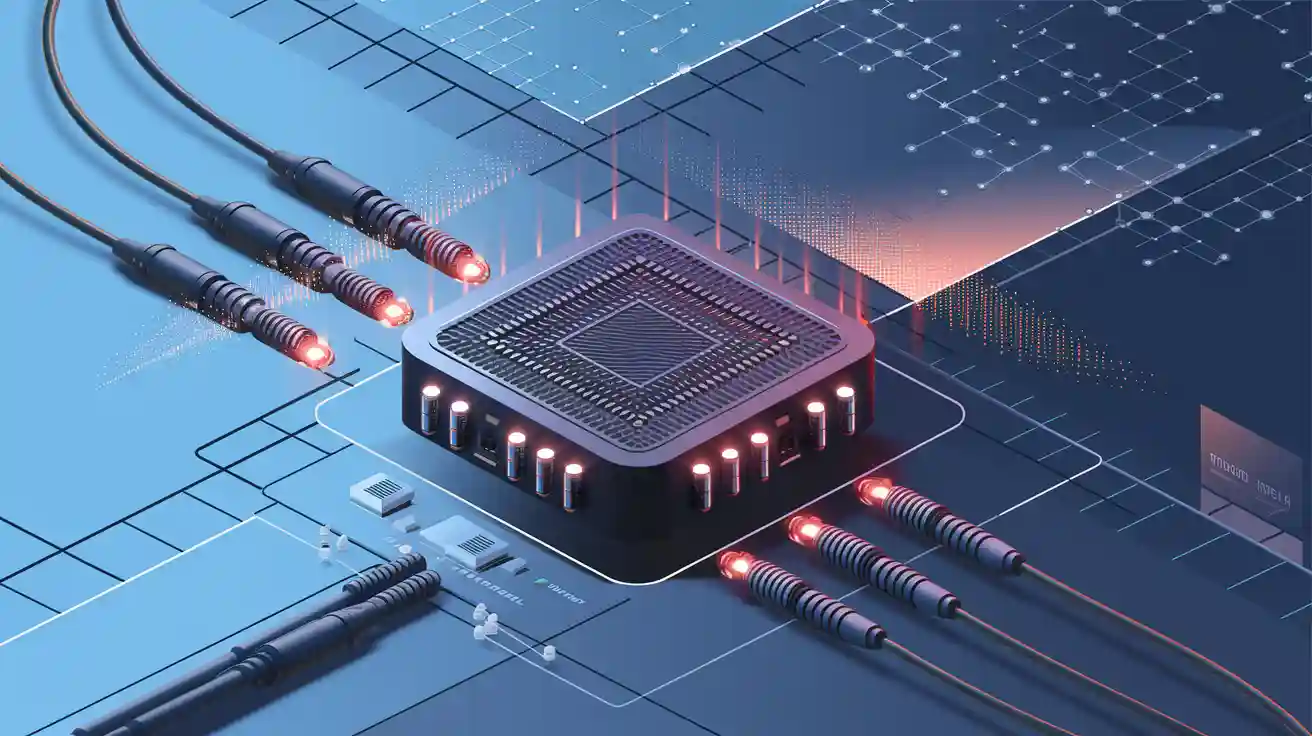


In modern optical communication networks, especially in DWDM (Dense Wavelength Division Multiplexing) systems, maintaining signal quality over long distances is a major technical challenge. As optical signals travel through fiber, they gradually degrade due to attenuation, dispersion, and noise accumulation. When this degradation becomes too severe, simple optical amplification or dispersion compensation is no longer sufficient.
This is where Optical-Electrical-Optical (OEO) technology plays a critical role.
OEO is a signal regeneration process that converts an incoming optical signal into an electrical signal, processes it, and then retransmits it as a clean optical signal. Unlike passive optical components, OEO enables full signal recovery through what is commonly known as 3R regeneration: re-amplify, reshape, and retime.
Traditionally, OEO has been widely used in long-haul optical transmission systems, regeneration nodes, and legacy DWDM networks where signal impairments accumulate over extended distances. However, with the evolution of coherent optics and DSP-based technologies, the role of OEO is gradually changing in modern network architectures.
In this article, we will explain what OEO is, how it works, why it is used, and how it compares with other key optical technologies such as DCM and EDFA—helping you fully understand its role in both legacy and next-generation optical networks.
🟧 What Is OEO in Optical Communication?
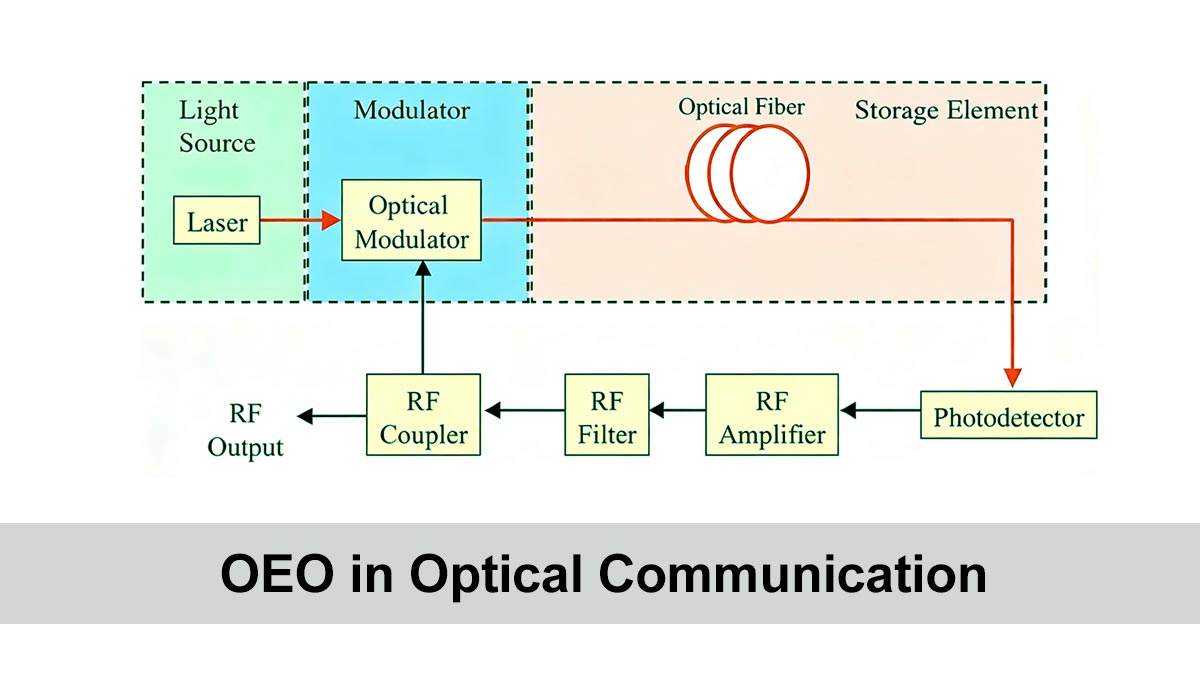
OEO is a regeneration method that converts optical signals to electrical signals and back to optical signals. Cisco’s DWDM documentation notes that TXP and MXP cards perform OEO conversion, which means they are not optically transparent because the signal is intentionally processed in the electrical domain before being sent onward.
OEO in One Sentence
A useful definition is: OEO is a 3R signal regeneration process used in optical networks to restore degraded data before retransmission. A transport planning guide explains that regeneration involves reamplification, regeneration, and retiming, which is exactly why OEO is used at regeneration points rather than on ordinary line spans.
Why Optical-Electrical-Optical Matters
The term OEO appears frequently in DWDM, OTN, and long-haul optical transport documentation because it describes a full recovery step, not a partial fix. If a link only needs more power, an optical amplifier may be enough; if it needs dispersion correction, a DCM may help. But if the signal is too damaged for optical-only methods, OEO becomes the stronger option.
🟧 How Does OEO Work in an Optical Network?
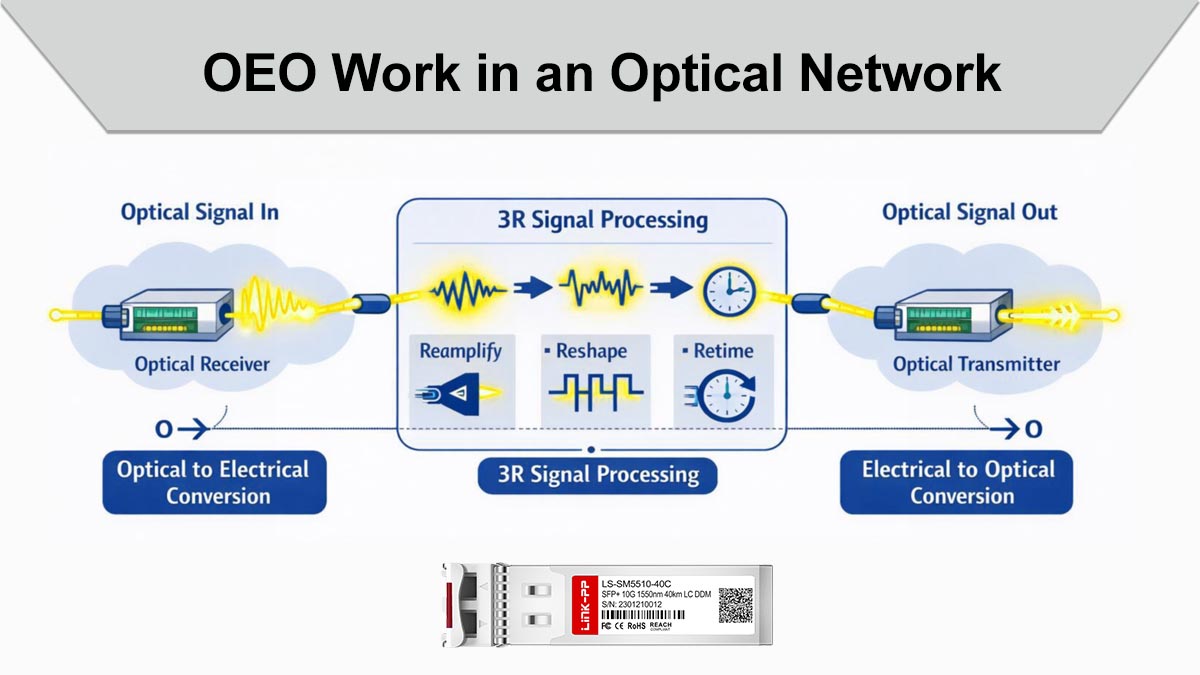
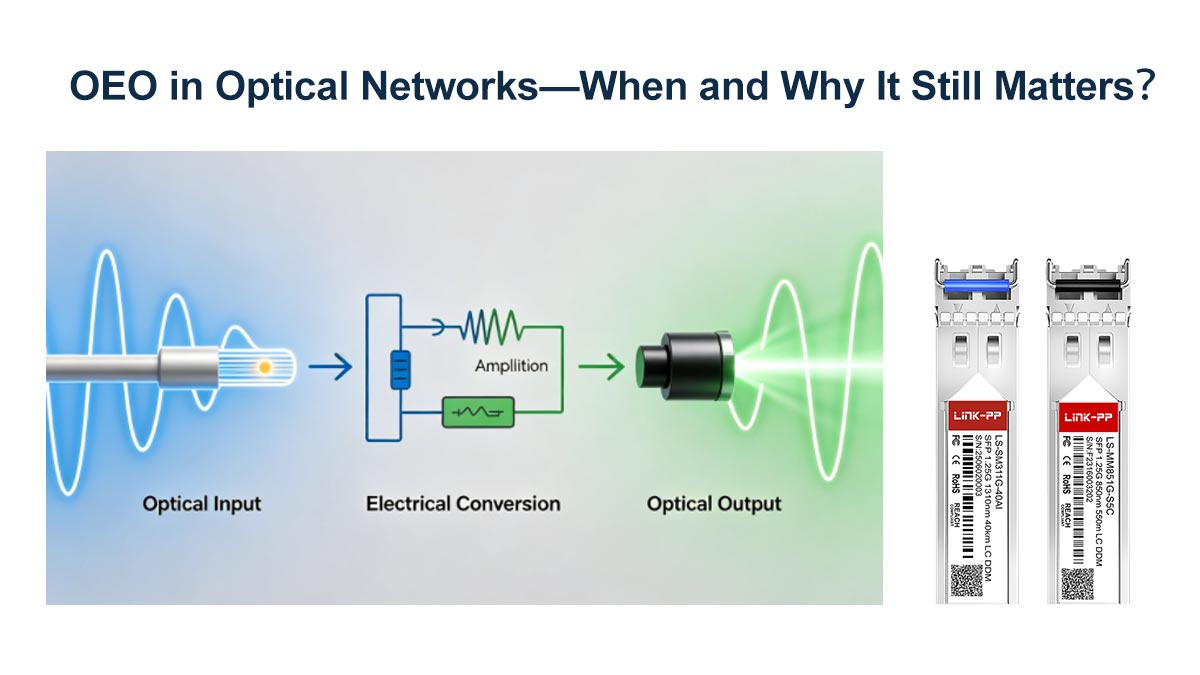
OEO works in three stages: optical in, electrical processing, optical out. Cisco describes this as O-E-O conversion, where the regenerator recreates weak and distorted optical signals by first converting them to electrical form and then transmitting them again as optical signals.
Step 1: Optical Signal Reception
The incoming optical signal is received by the network element and converted from light into an electrical signal. This is the moment where the device can inspect the actual data content rather than only the optical power level. OEO references make clear that the conversion is done so the system can operate on the signal itself.
Step 2: Electrical-Domain Processing
Once the signal is electrical, the equipment can perform the classic 3R functions: reamplify, reshape, and retime. Cisco explicitly identifies these as part of regeneration, which helps remove noise and distortion that optical amplification alone cannot fix.
Step 3: Optical Retransmission
After processing, the cleaned signal is converted back into optical form and launched into the next span of fiber. This is why OEO is often used at regeneration sites in long-distance transport networks rather than at every hop.
Why OEO is More Than Amplification
An optical amplifier such as an EDFA only raises the power of the signal; it does not correct the bit pattern or remove accumulated timing errors. OEO goes further because it rebuilds the signal before it is transmitted again. That is why OEO is used when the degradation is severe enough that power boost alone is not sufficient.
🟧 Why Is OEO Used in DWDM and Long-Haul Links?
OEO is used in DWDM and long-haul links because optical signals accumulate impairment as distance increases. Cisco’s DWDM planning material explains that attenuation and dispersion reduce signal quality over fiber, and that a regenerator is required when the signal becomes too weak and distorted for direct continuation.
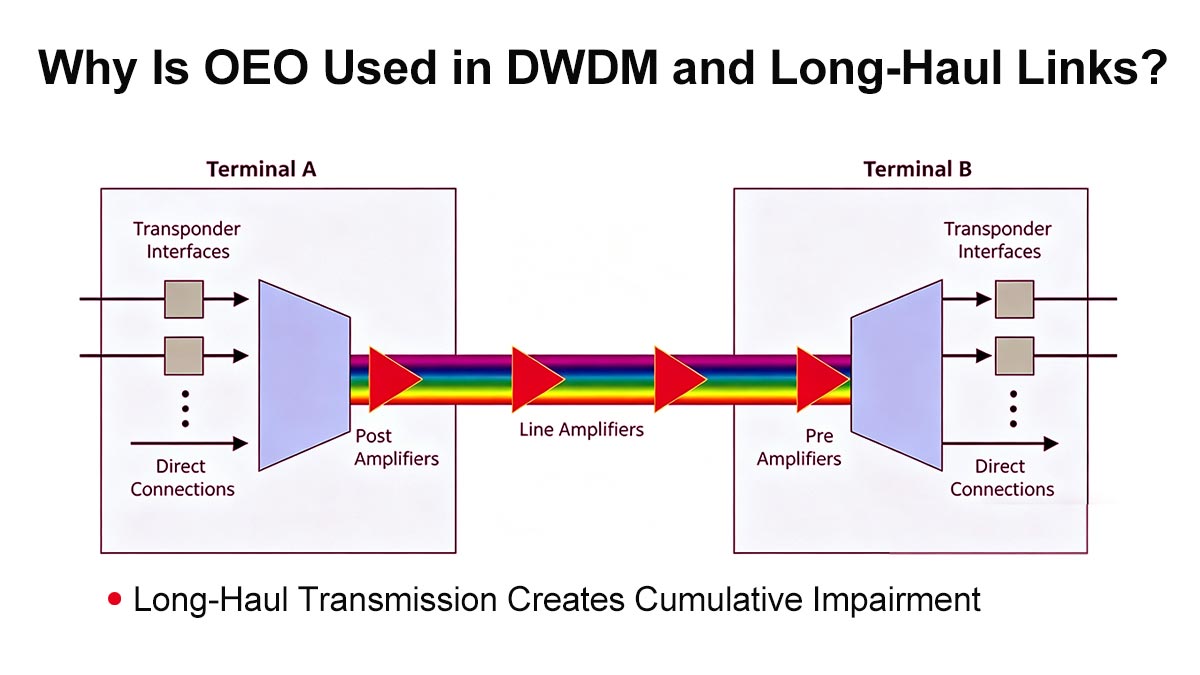
Long-Haul Transmission Creates Cumulative Impairment
Over multiple spans, the signal experiences loss, dispersion, and noise. When the accumulated impairment exceeds what optical-only methods can handle, OEO provides a full recovery point in the network. That makes it especially useful in long-haul backbone designs and in older DWDM systems with tighter impairment budgets.
Regeneration sites in the network
In terminology, regeneration sites are network locations where weakened optical signals are restored by converting them to electrical signals and back again. In other words, OEO is not a random extra step; it is a deliberate architecture choice at points where the link needs signal recreation instead of simple amplification.
Where OEO still matters most
OEO is still relevant in legacy DWDM networks, older metro systems, and links where the installed base was designed before coherent DSP became common. In those environments, optical regeneration remains a practical way to extend reach and stabilize performance.
🟧 OEO vs. DCM vs. EDFA: What Is the Difference?
These three technologies are often mentioned together because they solve different problems in the same transmission chain. DCM handles dispersion, EDFA handles attenuation, and OEO handles full regeneration of a degraded signal. Cisco’s DWDM references separate these functions clearly: DCMs compensate chromatic dispersion, EDFAs provide optical amplification, and OEO regenerators recreate the signal through optical-electrical-optical conversion.
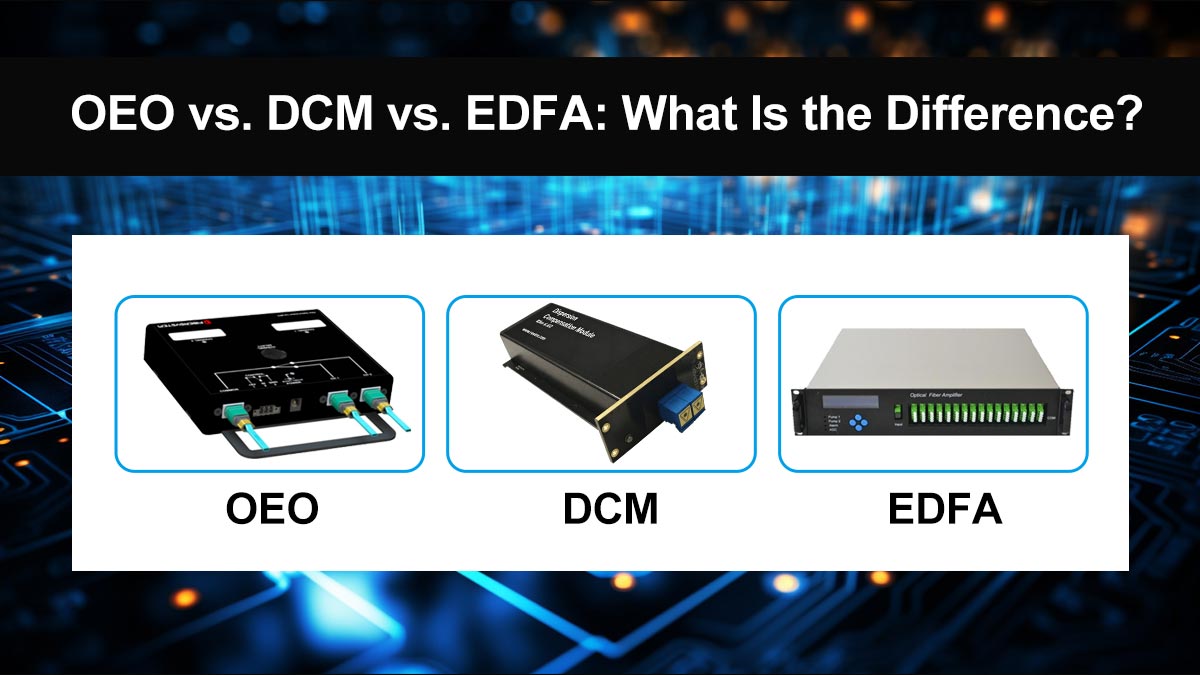
DCM: Fixes Chromatic Dispersion
A DCM uses negative dispersion to offset the pulse spreading that occurs in fiber. DCU documentation says the unit compensates for accumulated chromatic dispersion in the transmission fiber and provides a way to do so without dropping and regenerating the wavelengths.
EDFA: Boosts Optical Power
An EDFA is an optical amplifier. Industry common sense describes EDFA amplifier cards as devices that provide gain to the DWDM signal, helping preserve power over multiple spans. However, amplification alone does not repair dispersion or timing degradation.
OEO: Rebuilds the Signal
OEO is the most complete option of the three. Some DWDM guides show that regeneration removes noise and distortion by converting optical to electrical and then back to optical. That makes OEO the right choice when the signal has moved beyond what simple compensation or amplification can recover.
The Practical Difference
Category | OEO | DCM | EDFA |
|---|---|---|---|
Full Name | Optical-Electrical-Optical | Dispersion Compensation Module | Erbium-Doped Fiber Amplifier |
Main Function | Signal regeneration (3R: re-amplify, reshape, retime) | Dispersion compensation | Optical amplification |
Problem Solved | Severe signal degradation (noise, distortion, timing errors) | Chromatic dispersion (pulse broadening) | Signal attenuation (power loss) |
Working Domain | Electrical + Optical | Optical | Optical |
Signal Conversion | Yes (O → E → O) | No | No |
Typical Use Case | Long-haul regeneration sites, legacy DWDM networks | Inline amplification in DWDM and metro networks |
A simple way to remember the split is this: DCM fixes shape, EDFA fixes strength, and OEO fixes both quality and timing by regenerating the signal. That is why they are often used at different points in the same optical transport design.
🟧 What Is the Relationship Between OEO and Optical Transceivers?
The relationship is that optical transceivers are often the hardware that makes OEO possible, but OEO itself is the regeneration process, not the module name. Cisco’s DWDM documentation states that TXP and MXP cards perform OEO conversion, which means the card receives optical input, processes it electrically, and outputs optical again.
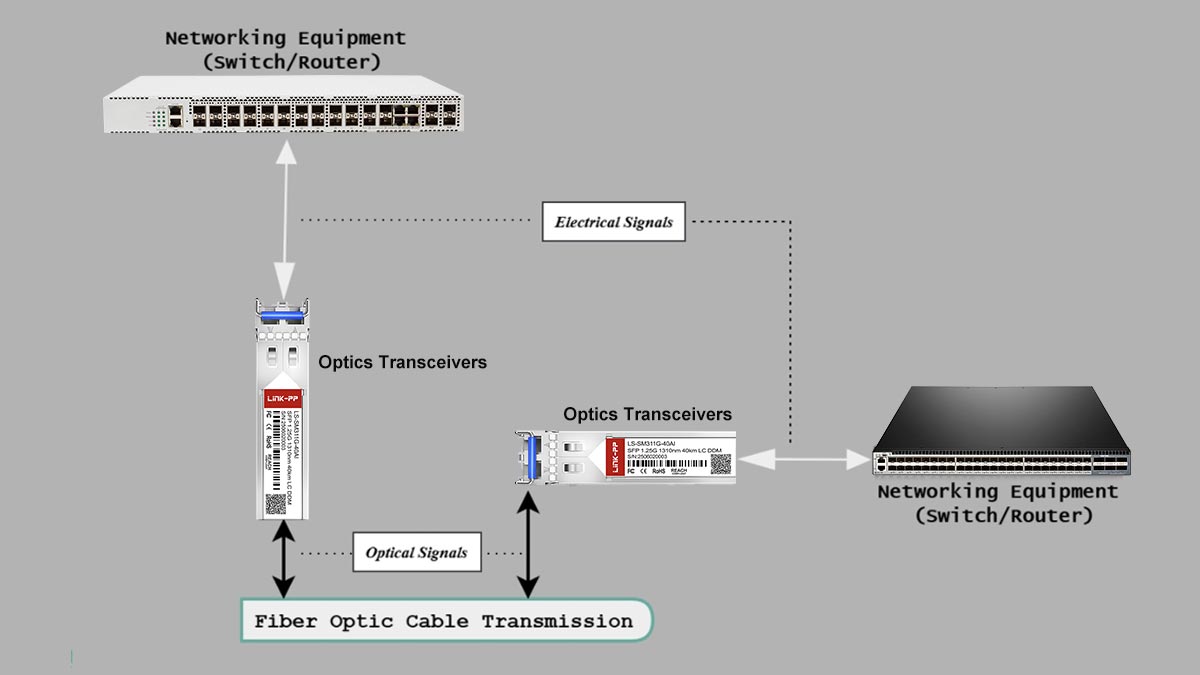
Transceiver as The Interface, OEO as the Process
An optical module is the physical interface that handles optical-to-electrical and electrical-to-optical conversion. OEO describes what the system does with that capability when it is used for regeneration. In other words, the transceiver is the tool, and OEO is the function being performed.
Why this matters in network design
This distinction matters because not every transceiver is being used for regeneration. Some simply move data between electrical and optical domains at the edge of the network. In OEO-based architectures, the same conversion capability is used deliberately to clean up the signal before it continues.
Where Transceivers and OEO Overlap
In regenerator shelves, transport cards, and certain DWDM platforms, the transceiver stage is part of a larger system that performs OEO regeneration. The 100G coherent DWDM documentation also shows OTU-4 regeneration performed in back-to-back card configurations, reinforcing that OEO is often implemented inside broader transport equipment rather than as a standalone box.
🟧 Is OEO Still Used in Modern Optical Networks?
Yes, but it is used less often than before. Modern coherent optical systems rely heavily on DSP-based impairment compensation, which can handle dispersion and other distortions in the digital domain. Juniper’s coherent optics documentation says DSP applies inverse mathematical filters to reverse chromatic dispersion and can eliminate the need for physical DCMs on the line.

Coherent Optics Reduced the Need for OEO
Coherent optics has changed the design of many DWDM systems because the DSP can compensate for many impairments that used to require physical regeneration or dispersion hardware. Juniper notes that coherent optics can compensate for large amounts of chromatic dispersion, while Nokia explains that coherent DSPs enable digital compensation of network impairments including chromatic dispersion and PMD.
But OEO Has Not Disappeared
Even with coherent technology, OEO still appears in some networks where the signal is too degraded, where the architecture is legacy-based, or where regeneration is preferred over more complex optical-only strategies. Cisco’s regenerator documentation and transport guides still treat OEO as a valid network function for signal recreation.
The modern rule of thumb
If the link can be handled by coherent DSP, that is often the cleaner approach. If the signal must be fully rebuilt at a regeneration point, OEO remains useful. That is why OEO is now more selective, but still technically important.
🟧 Benefits and Limitations of OEO Regeneration
The biggest benefit of OEO regeneration is that it can restore a degraded optical signal more completely than optical amplification or dispersion compensation alone. Cisco’s regeneration guidance describes OEO as a way to recreate weak and distorted optical signals through reamplification, regeneration, and retiming, which makes it especially effective at breaking the impairment chain in long-haul systems.
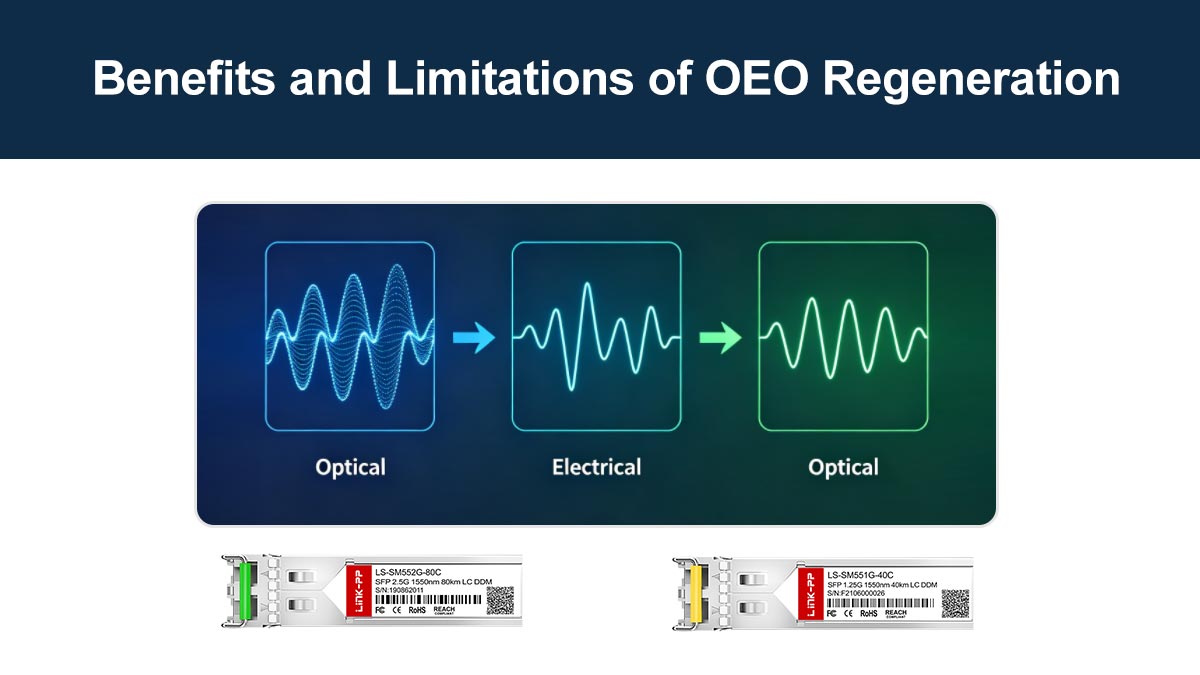
Main Benefits
OEO can improve signal quality, extend reach, and allow the network to continue operating when optical-only methods are no longer enough. It also gives network engineers a strong regeneration point where they can restore timing and remove accumulated distortion before the next span begins.
Main Limitations
The tradeoff is complexity. OEO requires electrical processing, which adds cost, power use, and equipment overhead compared with passive or all-optical methods. It is also less attractive in modern coherent systems where DSP can perform many compensation tasks without a separate regenerator site. Juniper’s documentation makes clear that DSP has taken over much of the dispersion-compensation burden in contemporary optics.
Best-fit Use Cases
OEO is most appropriate where the network needs full regeneration rather than simple correction. That includes long-haul regenerator sites, legacy DWDM systems, and scenarios where multiple impairments have accumulated beyond what amplification or dispersion compensation can solve.
🟧 Conclusion: OEO in Optical Networks—When and Why It Still Matters
OEO (Optical-Electrical-Optical) is a signal regeneration method used in optical communication networks to convert degraded light signals into electrical form, process them, and send them back out as clean optical signals. It is a core concept in DWDM and long-haul transport because it solves a different problem from DCM or EDFA: it rebuilds the signal itself. Cisco’s transport documentation shows that OEO is used at regenerator sites, while Juniper and Nokia show how coherent DSP has reduced the need for physical regeneration in many modern designs.
For legacy networks and difficult long-distance links, OEO remains a practical and well-established solution. For newer systems, it is increasingly replaced by DSP-driven coherent optics. Understanding that shift is essential if you want to read optical network architecture correctly, compare technologies accurately, and choose the right regeneration strategy for a given link.
Looking for reliable optical components and solutions for your DWDM or fiber network?
Explore the LINK-PP Official Store to find high-quality optical modules and connectivity products tailored for telecom and data center applications.