

Dispersion Compensation Fiber (DCF) is a specialty optical fiber designed to offset chromatic dispersion in a transmission link. In plain terms, it helps correct pulse broadening that builds up as light travels through fiber, especially in long-distance and dense wavelength-division multiplexing (DWDM) systems. In modern network design, DCF is often discussed alongside dispersion compensation modules (DCMs) or dispersion slope compensation modules (DSCMs), which package this function into deployable units for long-haul links.
✅ What Is Dispersion Compensation Fiber (DCF)?
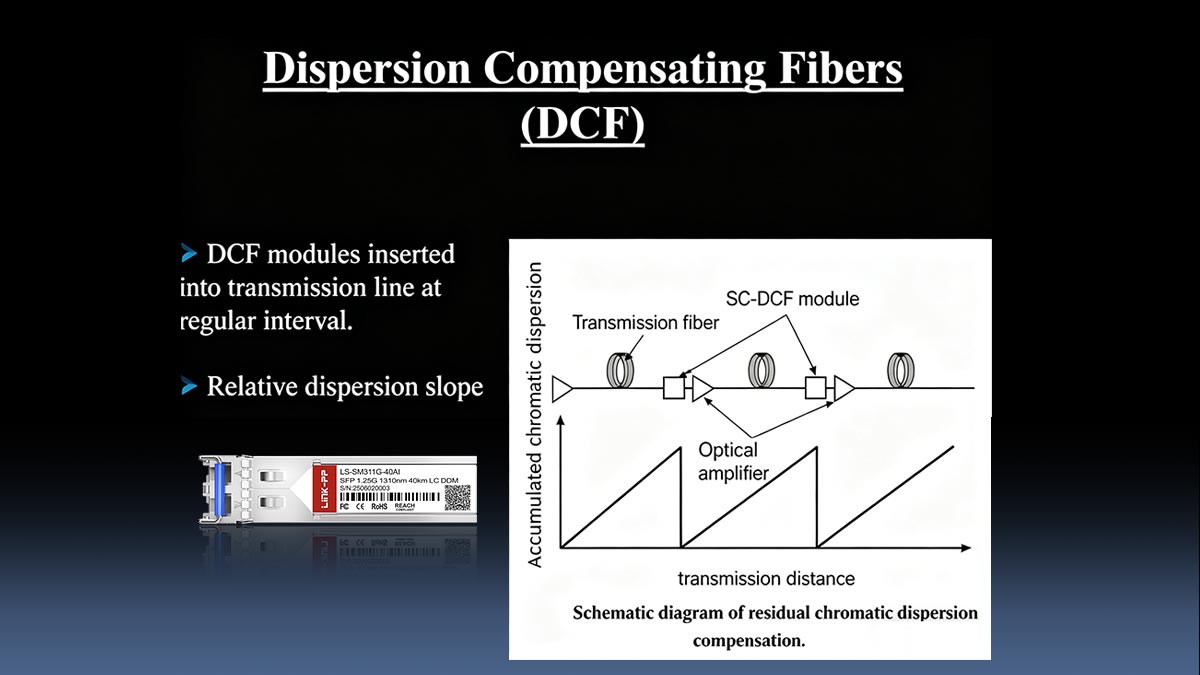
DCF is a fiber-based dispersion management solution that introduces negative chromatic dispersion to counteract the positive dispersion accumulated in standard transmission fiber. The core idea is simple: when a pulse stretches out in one fiber, another fiber with the opposite dispersion characteristic can compress it back toward its original shape. ITU-T defines the linear, deterministic parameters used to characterize single-mode fibers and cables, including chromatic dispersion, while DCF is built specifically to work against that parameter in a system context.
In practice, DCF is not just a theoretical fiber type; it is usually implemented as part of a module used in long-distance optical transport. Lightera describes dispersion compensation modules as a response to longer distances, higher bandwidths, and higher data rates, and notes that these modules are designed for major transmission fiber types. That is why DCF is still a meaningful term in telecom engineering, even though many newer coherent systems now rely more heavily on digital methods.
✅ How Chromatic Dispersion Affects Optical Transmission
Chromatic dispersion is one of the most critical physical impairments in fiber optic communication systems. As transmission speeds and link distances continue to increase, its impact on signal integrity becomes more pronounced. Understanding how dispersion affects optical signals is essential for designing reliable high-speed networks and selecting the right compensation technologies such as DCF.
What Causes Chromatic Dispersion in Optical Fiber
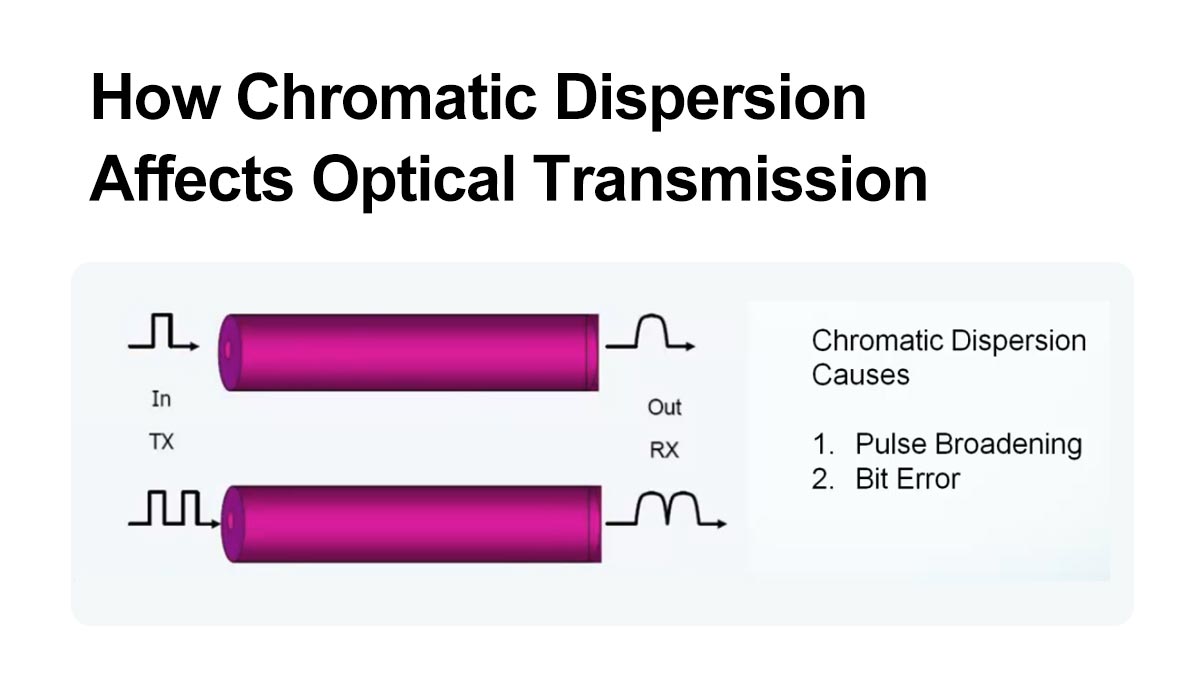
Chromatic dispersion occurs because different wavelengths within a light pulse travel at slightly different speeds through the fiber. This wavelength-dependent velocity variation leads to temporal spreading of the signal as it propagates along the link.
Signal Degradation Caused by Pulse Broadening
As dispersion accumulates, the optical pulse broadens and begins to overlap with adjacent pulses, a phenomenon known as inter-symbol interference (ISI). This reduces signal integrity, limits transmission distance, and increases bit error rates (BER), especially in high-speed optical systems.
Impact on Bandwidth and Transmission Distance
Pulse broadening directly reduces the usable bandwidth of the optical channel. In long-distance transmission, dispersion becomes a critical limiting factor, constraining both data rate and reach. Without proper compensation, system performance degrades rapidly as distance increases.
Role of ITU-T Fiber Standards in Dispersion Management
Standards such as ITU-T G.652 define conventional single-mode fiber with a zero-dispersion wavelength around 1310 nm. In contrast, ITU-T G.655 specifies fibers designed with controlled non-zero dispersion to mitigate nonlinear effects like four-wave mixing in DWDM systems.
Why Dispersion Is Critical in DWDM Networks
In Dense Wavelength Division Multiplexing systems, multiple wavelengths are transmitted simultaneously over a single fiber. This increases susceptibility to dispersion and nonlinear effects, making precise dispersion management essential for maintaining signal quality and system stability.
✅ How DCF Works to Counteract Fiber Dispersion
Dispersion Compensation Fiber (DCF) is specifically engineered to neutralize chromatic dispersion accumulated in optical transmission systems. By introducing an opposite (negative) dispersion effect, DCF restores signal integrity and enables longer transmission distances without significant degradation. Understanding its working mechanism is essential for designing efficient DWDM and long-haul optical networks.
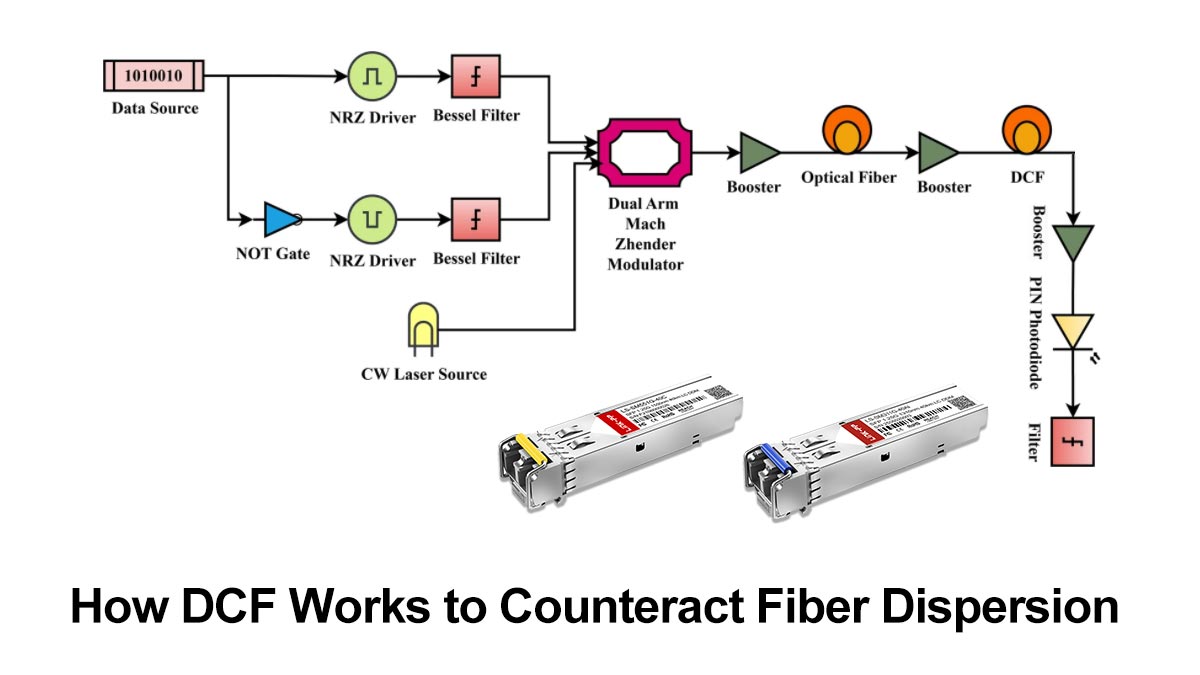
Negative Dispersion Principle of DCF
DCF operates by providing a large negative dispersion coefficient that counteracts the positive dispersion generated by standard transmission fiber. The goal is not simply to reduce dispersion, but to balance the total link dispersion to an optimal level for signal transmission.
D total=D transmission+D DCF≈0
The “Counterweight” Concept in Optical Design
A practical way to understand DCF is to view it as a counterweight in the optical link. Standard fiber introduces dispersion-induced distortion as signals propagate, while DCF intentionally introduces the opposite distortion to cancel it out.
System designers calculate the required compensation based on:
This precise balancing act is critical to achieving stable and predictable transmission performance.
Key Performance Factors of DCF Modules
Modern DCF is typically deployed as part of a dispersion compensation module (DCM), rather than as standalone fiber. To ensure effective performance, several parameters must be optimized:
Low insertion loss → minimizes signal attenuation
Low polarization mode dispersion (PMD) → maintains signal integrity
Dispersion slope matching → ensures consistent compensation across wavelengths
These characteristics ensure that dispersion is corrected without introducing additional transmission impairments.
Practical Implementation in Optical Networks
In real-world deployments, DCF is integrated into optical links using modular solutions. These modules are designed for compatibility with specific fiber types and network architectures, making deployment more flexible and scalable.
Common implementation types include:
Fixed broadband compensation modules
Reconfigurable dispersion compensation modules
Tunable (colorless) compensation modules
Such flexibility allows network engineers to adapt dispersion management strategies based on evolving bandwidth and distance requirements.
✅ Key Types and Deployment Methods of DCF in Optical Networks
In practical optical network design, Dispersion Compensation Fiber (DCF) is not deployed as a one-size-fits-all solution. Instead, it is categorized based on deployment method, flexibility, and system requirements. Understanding these types helps engineers choose the most effective dispersion compensation strategy for different transmission scenarios.
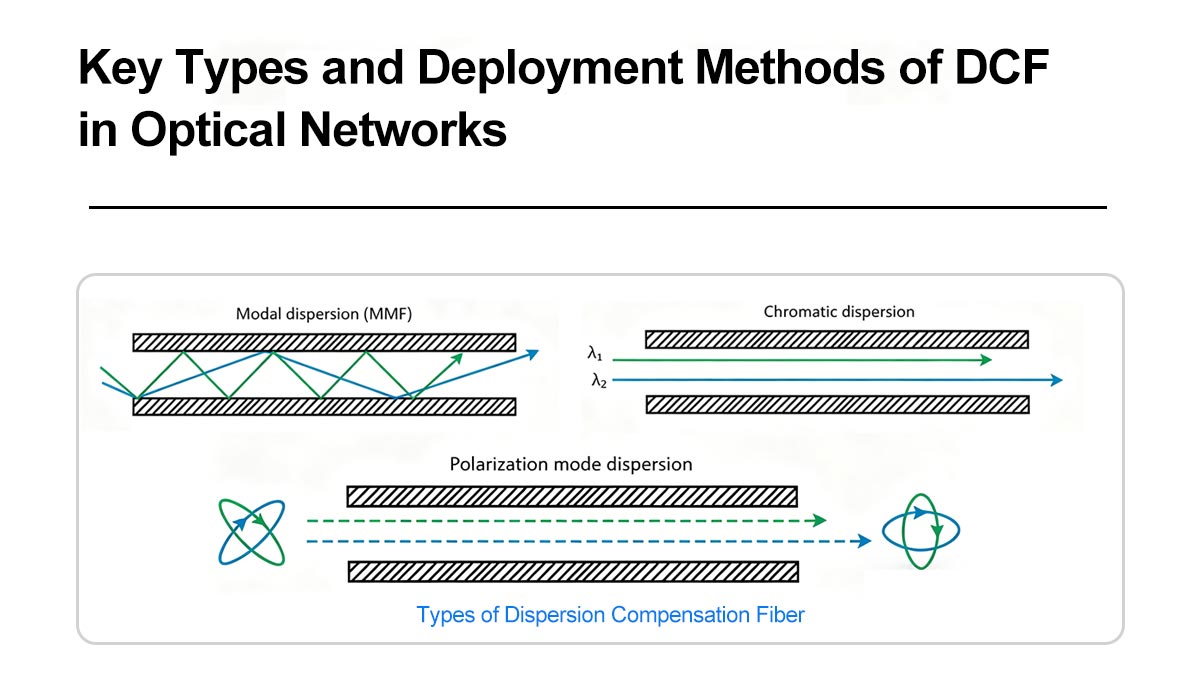
Fixed Broadband DCF Modules
Fixed broadband dispersion compensation modules are designed for stable optical links where dispersion characteristics are well-defined and unlikely to change.
These modules:
Provide predefined dispersion compensation values
Are optimized for specific fiber types and link distances
Offer high reliability with minimal need for adjustment
They are commonly used in long-haul systems with predictable network conditions.
Reconfigurable and Tunable DCF Solutions
In dynamic or evolving networks, more flexible solutions are required. Reconfigurable and tunable DCF modules allow operators to adjust dispersion compensation as network conditions change.
Key benefits include:
Adaptability to different link lengths and wavelengths
Support for network upgrades and reconfiguration
Improved operational flexibility in multi-service environments
These solutions are particularly useful in modern transport networks where scalability is critical.
DCF Compatibility with Modulation Formats
DCF solutions must be selected based on the modulation format used in the optical system.
For example:
Traditional systems use NRZ (Non-Return-to-Zero) modulation
Modern systems increasingly adopt high-speed formats such as PAM4
DCF remains relevant in both scenarios where optical-domain dispersion compensation is required, especially in systems that have not fully transitioned to digital signal processing.
Matching DCF with Fiber Types and Standards
Effective dispersion compensation depends on compatibility with the transmission fiber. Standards such as ITU-T G.655 define fibers with controlled non-zero dispersion to reduce nonlinear effects in DWDM systems.
Different fiber types have unique dispersion characteristics, so DCF modules must be carefully matched to:
Fiber category (e.g., standard SMF vs. NZ-DSF)
Operating wavelength band
Target residual dispersion
Deployment Strategies in Real Optical Networks
DCF can be deployed at different points within an optical link depending on system design requirements:
Pre-compensation: applied before transmission
Post-compensation: applied at the receiver side
Inline compensation: inserted between spans (most common in long-haul systems)
Each method offers different trade-offs in terms of performance, cost, and system complexity.
✅ Advantages and Limitations of Dispersion Compensation Fiber
Dispersion Compensation Fiber (DCF) has played a critical role in long-haul optical communication by providing an effective way to manage chromatic dispersion in the optical domain. However, like any engineering solution, it comes with both strengths and trade-offs. Understanding these advantages and limitations is essential for selecting the right dispersion compensation strategy in modern network design.
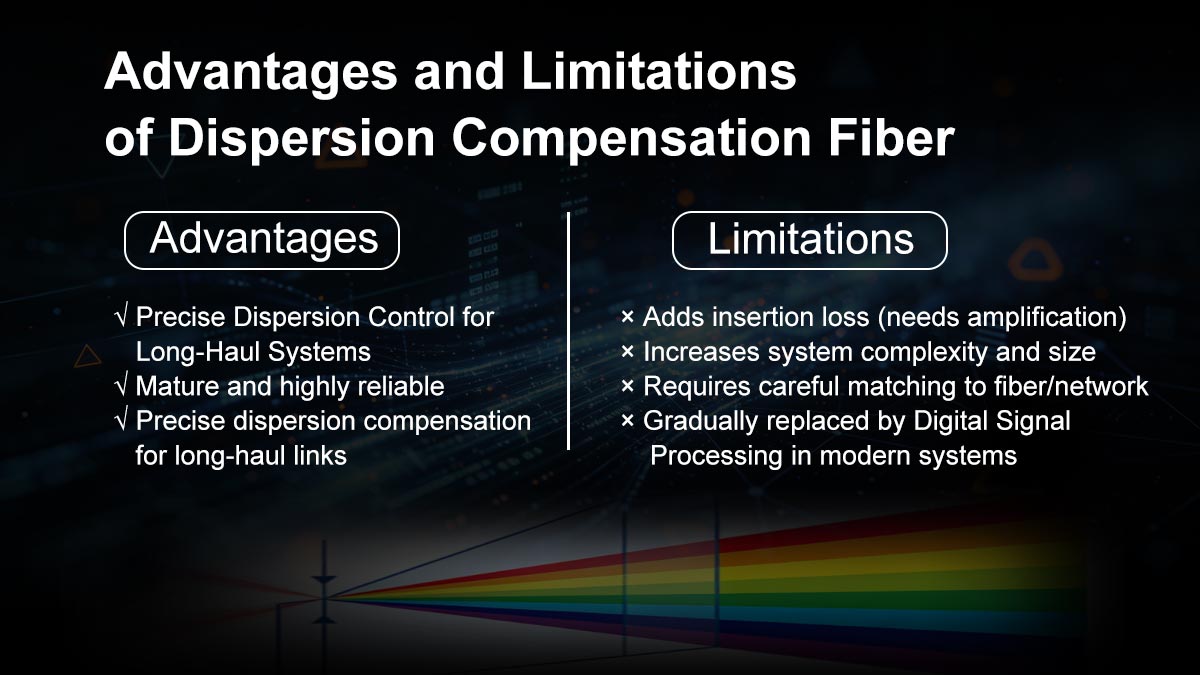
Key Advantages of DCF in Optical Networks
One of the primary advantages of DCF is its ability to provide all-optical dispersion compensation without relying on complex electronic processing.
Key benefits include:
Passive optical solution → no need for additional signal processing
Mature and reliable technology → widely deployed in legacy systems
Stable long-term performance → predictable behavior over time
This makes DCF particularly valuable in existing infrastructure where upgrading to digital compensation may not be practical.
Precise Dispersion Control for Long-Haul Systems
DCF enables engineers to directly compensate for accumulated dispersion by selecting modules tailored to specific transmission spans.
Important performance characteristics include:
Low insertion loss
Low polarization mode dispersion (PMD)
Accurate dispersion slope matching
These features allow DCF to effectively restore signal integrity while minimizing additional impairments in high-speed optical links.
Limitations: Insertion Loss and System Complexity
Despite its advantages, DCF introduces additional optical components into the transmission link, which can create new challenges.
Common drawbacks include:
Insertion loss → may require additional optical amplification (e.g., EDFA)
Increased system complexity → careful planning and integration required
Physical footprint → larger compared to purely digital solutions
As a result, DCF is often considered a trade-off between improved signal quality and added system overhead.
Dependency on Fiber Type and Network Design
DCF is not a universal solution and must be carefully matched to the transmission environment.
Factors that affect performance:
Fiber type (e.g., standard SMF vs. ITU-T G.655)
Operating wavelength range
Target residual dispersion
Incorrect matching can reduce compensation effectiveness or even degrade overall system performance.
Impact of Coherent Optics and Digital Compensation
In modern optical networks, the role of DCF is being reduced by the rise of digital signal processing technologies.
In coherent systems:
Chromatic dispersion is compensated electronically at the receiver
Inline optical dispersion compensation becomes less necessary
Network design becomes more flexible and scalable
This shift means that while DCF remains important in legacy and specific use cases, many new deployments increasingly rely on digital dispersion compensation instead of optical methods.
✅ DCF vs. Electronic Dispersion Compensation: What Is the Difference?
Dispersion Compensation Fiber (DCF) and Electronic Dispersion Compensation (EDC) are two fundamentally different approaches to solving the same problem—chromatic dispersion in optical communication systems. While both aim to restore signal integrity, they operate at different layers of the network and are suited to different system architectures. Understanding their differences is essential for making the right design and investment decisions.
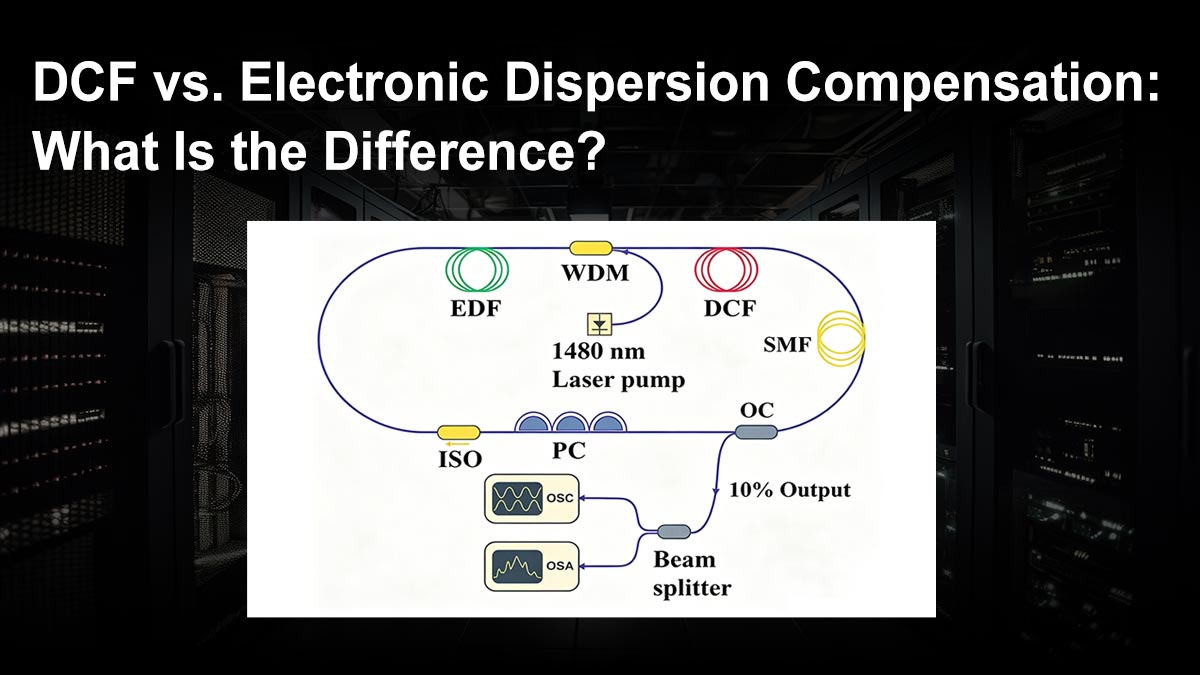
Optical vs Digital Compensation Mechanism
DCF and EDC differ primarily in how and where dispersion is corrected.
DCF: Works in the optical domain by introducing negative dispersion through specially designed fiber or modules
EDC: Works in the electrical domain using digital signal processing (DSP) after optical-to-electrical conversion
This means DCF physically alters the signal during transmission, while EDC corrects it after reception.
Role in Modern Coherent Optical Systems
The rise of coherent optical communication has significantly shifted dispersion compensation strategies.
In coherent systems:
Dispersion is handled digitally at the receiver
Inline optical compensation (like DCF) is often unnecessary
System design becomes simpler and more scalable
As a result, EDC (and DSP-based compensation) has become the dominant approach in modern long-haul and high-speed networks.
Flexibility and Network Adaptability
One of the key advantages of EDC is its flexibility compared to DCF.
DCF: Fixed physical characteristics → must be carefully matched to fiber type and link design
EDC: Software-based → can adapt dynamically to changing link conditions
This makes EDC more suitable for dynamic, reconfigurable, and future-proof network architectures.
Deployment Scenarios and Use Cases
Both technologies still have their place depending on the network environment:
DCF is preferred in:
Legacy optical systems
Non-coherent transmission networks
Scenarios requiring passive optical compensation
EDC is preferred in:
DCF vs. EDC Comparison Table
Feature | DCF (Dispersion Compensation Fiber) | EDC (Electronic Dispersion Compensation) |
|---|---|---|
Compensation Domain | Optical | Electrical (DSP-based) |
Working Principle | Negative dispersion fiber | Digital signal processing |
Deployment Location | Inline / Pre / Post fiber link | Receiver side |
Flexibility | Low (fixed physical design) | High (software configurable) |
Insertion Loss | Yes (requires amplification) | No additional optical loss |
Compatibility | Legacy & non-coherent systems | Modern coherent systems |
Scalability | Limited | Highly scalable |
Typical Use Case | DWDM long-haul (legacy) | 100G/400G coherent networks |
✅ Common Applications of DCF in DWDM and Long-Haul Systems
Dispersion Compensation Fiber (DCF) is primarily used in optical transmission scenarios where chromatic dispersion accumulates over long distances and begins to degrade signal quality. Although modern coherent systems increasingly rely on digital compensation, DCF remains a critical solution in specific network environments where optical-domain correction is still required. Understanding where DCF is most effectively applied helps optimize both performance and cost in real-world deployments.
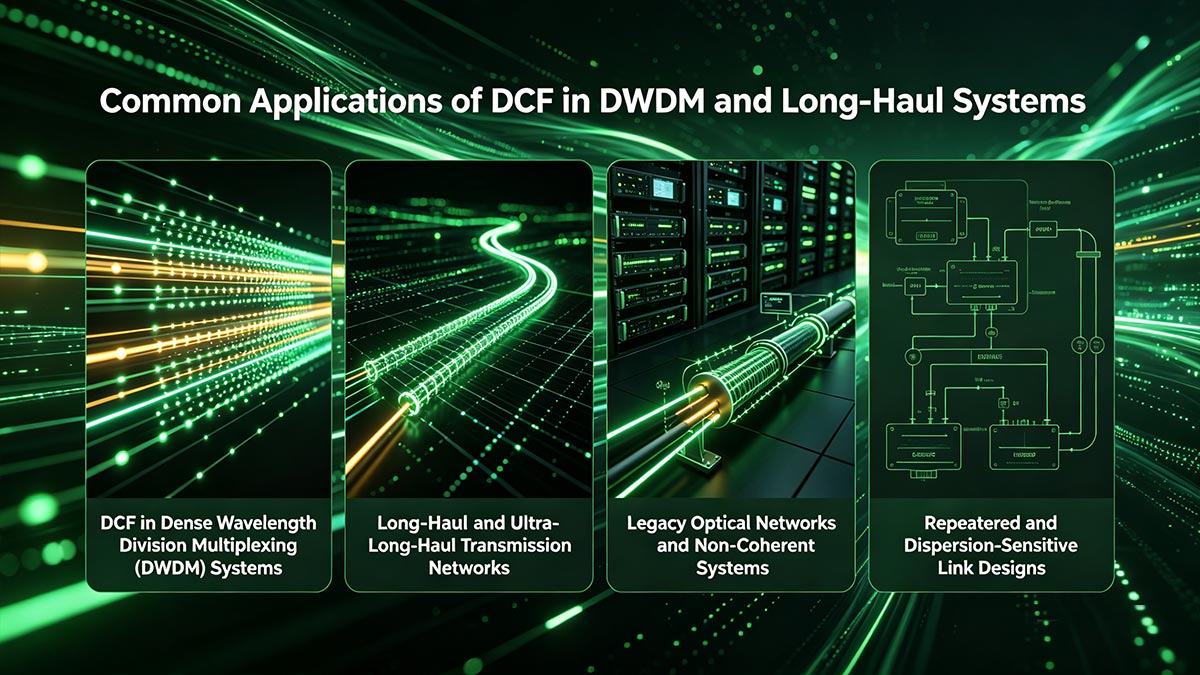
DCF in Dense Wavelength Division Multiplexing (DWDM) Systems
DCF has historically been a key component in DWDM systems, where multiple wavelengths are transmitted simultaneously over a single fiber.
In these environments:
Dispersion accumulates rapidly across channels
Nonlinear effects become more significant
Signal integrity must be tightly controlled
DCF helps maintain channel performance by compensating dispersion across the wavelength band, enabling stable high-capacity transmission.
Long-Haul and Ultra-Long-Haul Transmission Networks
In long-distance optical links, dispersion becomes a major limiting factor for both reach and data rate.
DCF is widely used in:
Inter-city and cross-country backbone networks
Submarine or ultra-long-haul transmission systems
High-capacity transport links exceeding hundreds of kilometers
By compensating accumulated dispersion at intervals, DCF extends transmission distance and improves overall system reliability.
Legacy Optical Networks and Non-Coherent Systems
DCF remains highly relevant in legacy infrastructure where digital signal processing is limited or unavailable.
Typical scenarios include:
Older backbone networks without coherent detection
Systems using direct detection (e.g., NRZ modulation)
Networks where upgrading to DSP-based solutions is not cost-effective
In these cases, DCF provides a practical and proven method for maintaining signal performance.
Repeatered and Dispersion-Sensitive Link Designs
In optical systems with multiple amplification stages (e.g., EDFA-based repeatered links), dispersion can accumulate between spans and degrade signal quality.
DCF is used to:
Compensate dispersion between amplifier stages
Control residual dispersion across the link
Maintain consistent performance over long distances
This is especially important in systems requiring precise dispersion management across specific wavelength bands.
Selective Use in Modern Hybrid Optical Architectures
In modern network design, DCF is no longer deployed universally but is used selectively based on system requirements.
Current trends include:
Combining optical (DCF) and digital (DSP-based) compensation
Using DCF only in segments where dispersion cannot be fully handled electronically
Optimizing cost-performance by minimizing unnecessary optical components
This hybrid approach reflects the industry shift toward more flexible and efficient dispersion management strategies.
✅ FAQ About Dispersion Compensation Fiber
1. What Does DCF Stand For?
DCF stands for Dispersion Compensation Fiber. It is a specialty optical fiber designed to counteract Chromatic Dispersion in fiber optic transmission systems, helping maintain signal integrity over long distances.
2. Is DCF Still Used Today?
Yes, but more selectively. DCF is still widely used in long-haul, Dense Wavelength Division Multiplexing (DWDM), and legacy optical systems. However, many modern coherent networks now rely on digital dispersion compensation instead of inline optical solutions.
3. What Is the Difference Between DCF and DCM?
DCF refers to the dispersion-compensating fiber itself, while DCM (Dispersion Compensation Module) is a packaged device that typically contains DCF and can be easily deployed within an optical link. In some cases, DSCM (Dispersion Slope Compensation Module) is also used to address wavelength-dependent dispersion variations.
4. Does DCF Remove Dispersion Completely?
No. The goal of DCF is to reduce accumulated dispersion to an acceptable residual level rather than eliminate it entirely. Effective system design focuses on achieving optimal balance through dispersion slope matching, low insertion loss, and controlled residual dispersion.
5. Why Is DCF Important in DWDM Systems?
In Dense Wavelength Division Multiplexing systems, multiple wavelengths are transmitted simultaneously through a single fiber, increasing the impact of dispersion and nonlinear effects. Standards such as ITU-T G.655 highlight how controlled dispersion can help reduce nonlinear issues like four-wave mixing, making dispersion management essential.
✅ How to Select the Right Dispersion Compensation Solution
Choosing the right dispersion compensation solution is a critical step in designing high-performance optical networks. As technologies evolve from traditional optical compensation to digital signal processing, engineers must evaluate not only current system requirements but also future scalability. This section provides a practical framework for selecting the optimal approach while summarizing the key role of Dispersion Compensation Fiber (DCF) in modern networks.

Evaluate System Architecture First
The selection process should begin with the overall network architecture.
In coherent systems with DSP, electronic dispersion compensation is often preferred due to its flexibility and reduced hardware complexity
In legacy or non-coherent systems, DCF-based solutions remain highly effective for optical-domain compensation
Understanding whether your system relies on optical or digital correction is the foundation of any decision.
Match the Solution to Fiber Type and Wavelength Plan
Dispersion characteristics vary significantly across fiber types and operating wavelengths.
Standards such as ITU-T G.652 and ITU-T G.655 define different dispersion profiles.
When selecting a solution, consider:
Fiber category (SMF vs. NZ-DSF)
Operating wavelength band (e.g., C-band)
Target residual dispersion
Proper matching ensures optimal compensation performance and avoids system inefficiencies.
Assess Key Performance Parameters of DCF Modules
When deploying DCF or DCM solutions, module quality directly impacts network performance.
Critical parameters include:
Low insertion loss → minimizes signal attenuation
Low PMD (Polarization Mode Dispersion) → preserves signal integrity
Accurate dispersion slope matching → ensures consistent compensation across wavelengths
A well-designed module should improve signal quality without introducing new impairments.
Consider Future Network Evolution
Modern optical networks are rapidly transitioning toward coherent transmission and DSP-based compensation.
Before selecting a solution, evaluate:
Will the network upgrade to coherent optics?
Is long-term scalability a priority?
Can digital compensation replace optical components in the future?
Planning ahead helps avoid unnecessary investment in hardware that may become obsolete.
Final Thoughts on DCF in Modern Optical Networks
Dispersion Compensation Fiber remains a fundamental technology in optical communication, particularly in DWDM and long-haul systems where optical-domain correction is still required.
However, its role is evolving:
Still essential in legacy and specific high-precision scenarios
Less dominant in fully coherent, DSP-driven architectures
Increasingly used in selective or hybrid deployment strategies
The key is not simply choosing DCF, but understanding when and where it delivers the most value.
Where to Source Reliable Optical Components for High-Speed Networks
For engineers and system designers, selecting the right supplier is just as important as choosing the right dispersion compensation strategy. Even when dispersion is handled digitally, high-quality optical components remain critical to overall link performance, reliability, and scalability.
👉 At the LINK-PP Official Store, you can explore a wide range of optical transceivers and SFP cages designed for high-speed data transmission, compatibility, and real-world deployment scenarios. Whether you are upgrading legacy infrastructure or building modern coherent-ready networks, reliable hardware is the foundation of stable optical performance.