

As 100G networks continue to scale across modern data centers and telecom infrastructure, choosing the right optical transceiver form factor has become a critical decision for engineers and procurement teams. Among the most frequently compared options, CFP4 vs. QSFP28 stands out as a high-intent search query—because both modules deliver 100G performance, yet differ significantly in design philosophy, efficiency, and long-term viability.
At first glance, CFP4 and QSFP28 may seem functionally similar: both support 100 Gigabit Ethernet and are widely used in high-speed optical communication. However, when you look deeper into size, power consumption, port density, and deployment scenarios, the differences become highly impactful—especially in environments where scalability, energy efficiency, and rack space optimization are top priorities.
This is exactly why professionals searching for “CFP4 vs. QSFP28” are not just looking for definitions—they are trying to answer a much more practical question:
Which 100G optical module is the better choice for my network—now and in the future?
In today’s market, where hyperscale data centers and cloud infrastructure demand higher density and lower power per bit, QSFP28 has rapidly become the dominant standard. At the same time, CFP4 still exists in certain legacy telecom and long-haul deployments, creating a transitional landscape where both technologies may coexist.
This guide is designed to give you a clear, engineering-focused comparison of CFP4 vs. QSFP28, aligned with real-world deployment needs and industry trends. By the end of this article, you will:
Understand the core differences between CFP4 and QSFP28
Learn where each form factor still makes sense
Evaluate power, cost, and scalability trade-offs
Get a practical decision framework for upgrades or new deployments
Whether you're planning a new 100G rollout, optimizing an existing network, or deciding whether to migrate away from CFP4, this article will help you make a confident, future-proof choice.
⏩ What Are CFP4 and QSFP28?
Before comparing CFP4 vs. QSFP28, it’s important to clearly understand what each form factor is and why both exist in the 100G optical ecosystem.
What Is CFP4?
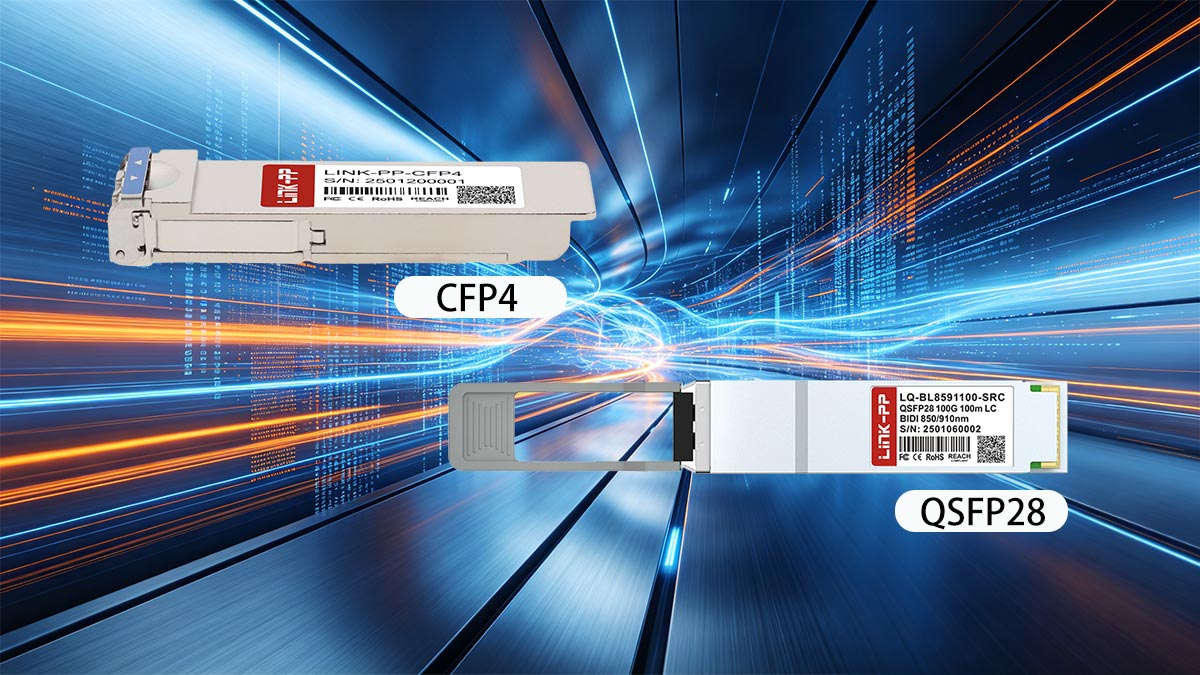
CFP4 (C Form-factor Pluggable 4) is a 100G optical transceiver standard developed as a smaller and more efficient evolution of earlier CFP modules (CFP/CFP2). It was designed primarily for telecom and carrier-grade applications, where high-performance optical transmission—especially over longer distances—is required.
CFP4 modules typically use a 4×25G lane architecture, meaning they combine four electrical lanes of 25 Gbps to achieve 100G throughput. Compared to earlier CFP generations, CFP4 significantly reduces:
Physical size
Power consumption
Heat output
However, despite these improvements, CFP4 modules are still larger and more power-hungry than newer alternatives, which limits their use in high-density environments.
What Is QSFP28?
QSFP28 (Quad Small Form-factor Pluggable 28) is the dominant 100G transceiver form factor in modern networking, especially in data centers and cloud infrastructure.
Like CFP4, QSFP28 also uses a 4×25G lane design, but it is built with a much more compact footprint. This allows network devices—such as switches and routers—to support significantly higher port density, which is a critical requirement for scalable architectures.
QSFP28 modules are widely used in:
Hyperscale data centers
Enterprise core networks
High-performance computing (HPC) environments
Their advantages include:
Smaller size (higher port density)
Lower power consumption
Broad ecosystem compatibility
Why Compare CFP4 vs. QSFP28?
At a technical level, both CFP4 and QSFP28 deliver the same 100G data rate, and both rely on similar lane structures. So naturally, many engineers ask:
If performance is similar, what actually differentiates them?
The answer lies in efficiency, scalability, and deployment context.
Users compare CFP4 vs. QSFP28 because they need to decide:
Whether to continue using existing CFP4 infrastructure
Or migrate to QSFP28 for better density and lower cost per bit
In other words, this is not just a specification comparison—it’s a strategic decision about network design and future-proofing.
In the next section, we’ll break down the key differences side by side, so you can quickly identify which form factor aligns best with your specific use case.
⏩ CFP4 vs. QSFP28: Key Differences at a Glance
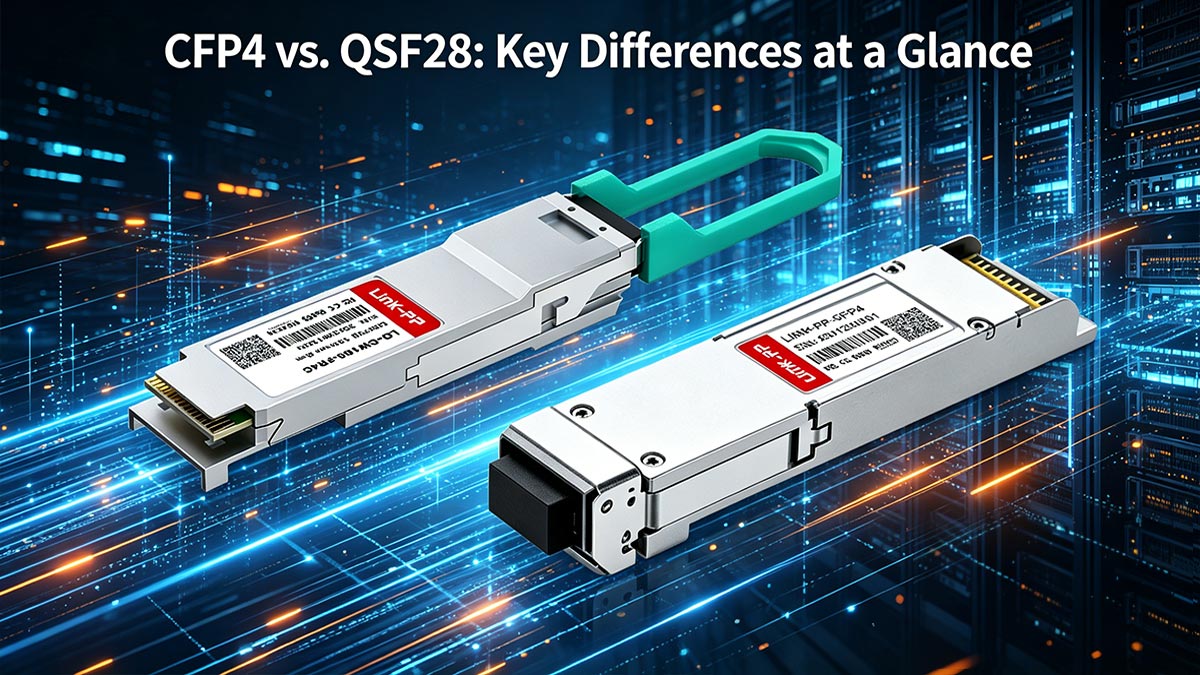
When evaluating CFP4 vs. QSFP28, the most important differences come down to physical design, efficiency, and deployment flexibility. While both support 100G transmission using similar electrical architectures, their real-world performance impact is very different—especially in modern high-density environments.
Below is a side-by-side comparison of the key factors engineers and decision-makers care about most:
CFP4 vs. QSFP28 Comparison Table
Feature | CFP4 | QSFP28 |
|---|---|---|
Form Factor Size | Larger (telecom-oriented) | Compact (data center optimized) |
Power Consumption | Higher (typically 6–12W) | Lower (typically 2.5–4W) |
Port Density | Limited (fewer ports per switch) | High (more ports per rack unit) |
Lane Architecture | 4 × 25G | 4 × 25G |
Thermal Efficiency | Moderate | High |
Typical Deployment | Telecom, long-haul, legacy systems | Data centers, cloud, enterprise networks |
Market Adoption | Declining | Dominant |
Size and Port Density
One of the most noticeable differences in CFP4 vs. QSFP28 is physical size.
CFP4 modules are significantly larger, which limits how many ports can fit on a single switch or router.
QSFP28 modules, by contrast, are much smaller—allowing 3× to 4× higher port density on the same hardware.
This makes QSFP28 the preferred choice for:
Hyperscale data centers
Spine-leaf architectures
High-density switching environments
Power Consumption and Efficiency
Power efficiency is a major factor in modern network design.
CFP4 modules typically consume more power, leading to higher cooling requirements and operational costs.
QSFP28 modules are designed for low power per bit, making them ideal for large-scale deployments.
Over time, this translates into:
Lower OPEX (operational expenditure)
Reduced thermal management complexity
Lane Architecture (Why Performance Looks Similar)
Interestingly, both CFP4 and QSFP28 use the same fundamental structure:
4 lanes × 25 Gbps = 100G total bandwidth
This means that in terms of raw throughput, there is no major difference. However:
QSFP28 integrates this architecture into a more efficient, compact design
CFP4 retains a bulkier, legacy-oriented implementation
So the real difference is not speed—but how efficiently that speed is delivered
Deployment Environments
The intended use cases further highlight the difference between CFP4 and QSFP28:
CFP4 is still found in:
Telecom infrastructure
Long-haul or metro networks
Legacy systems requiring backward compatibility
QSFP28 dominates in:
Data centers
Cloud computing environments
Enterprise core and aggregation layers
Key Takeaway
Although both modules deliver 100G performance, the comparison of CFP4 vs. QSFP28 ultimately comes down to this:
CFP4 is a transitional, telecom-focused form factor, while QSFP28 is the modern standard built for high-density, energy-efficient networking.
⏩ CFP4 vs. QSFP28 for Data Centers
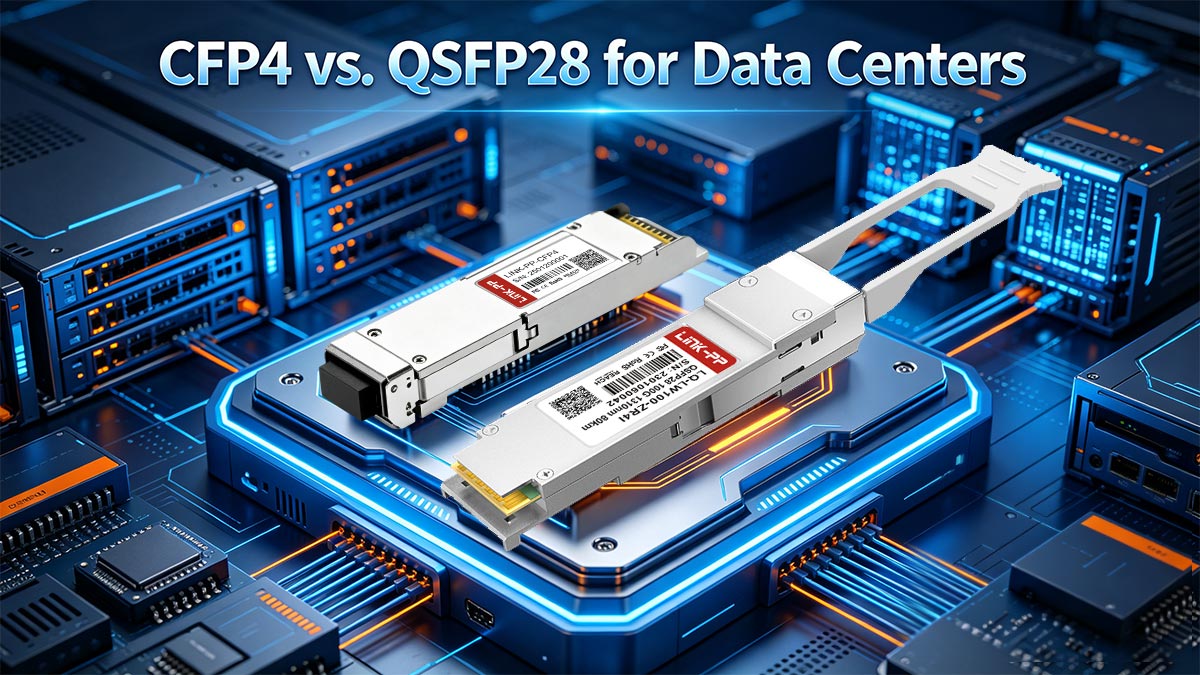
In modern data center design, the comparison of CFP4 vs. QSFP28 is heavily influenced by one dominant priority: port density per rack unit. As hyperscale cloud providers and enterprise operators continue to scale 100G networks, the physical efficiency of transceiver form factors has become just as important as bandwidth itself.
Why QSFP28 Dominates Data Center Deployments
In nearly all modern leaf-spine architectures, QSFP28 has become the default 100G interface. The reasons are straightforward and strongly tied to operational efficiency:
High port density: More QSFP28 ports can fit into a single switch chassis, maximizing throughput per rack unit
Lower power per port: Critical for reducing cooling load in dense environments
Flexible deployment: Supports SR4, LR4, and DAC/AOC options across short and long reach scenarios
Ecosystem maturity: Broad vendor support across switches, NICs, and optical modules
In practical terms, QSFP28 enables data centers to scale horizontally without being constrained by physical space or thermal limitations.
Why CFP4 Is Rare in Data Centers
Although CFP4 also supports 100G, it is rarely used in modern data center builds due to several limitations:
Larger physical footprint reduces switch port density
Higher power consumption increases operational cost
Less flexibility in high-density switching platforms
Limited adoption in newer cloud-native infrastructure
As a result, CFP4 is typically absent from greenfield data center deployments and is mostly found in older or transitional systems.
Rack Efficiency: The Deciding Factor
When evaluating CFP4 vs. QSFP28, rack efficiency becomes the decisive metric:
QSFP28 allows more 100G links per rack unit, directly improving:
Bandwidth density
Space utilization
Cost per gigabit
CFP4, while capable of the same 100G throughput, reduces:
Port scalability
Switching efficiency per chassis
This is why QSFP28 is strongly preferred in hyperscale environments where every rack unit matters.
For modern data centers, the conclusion is clear:
QSFP28 is the standard choice for 100G deployments due to its superior density, efficiency, and scalability. CFP4 is largely considered legacy in this environment.
⏩ CFP4 vs. QSFP28 for Telecom and Long-Distance Networks
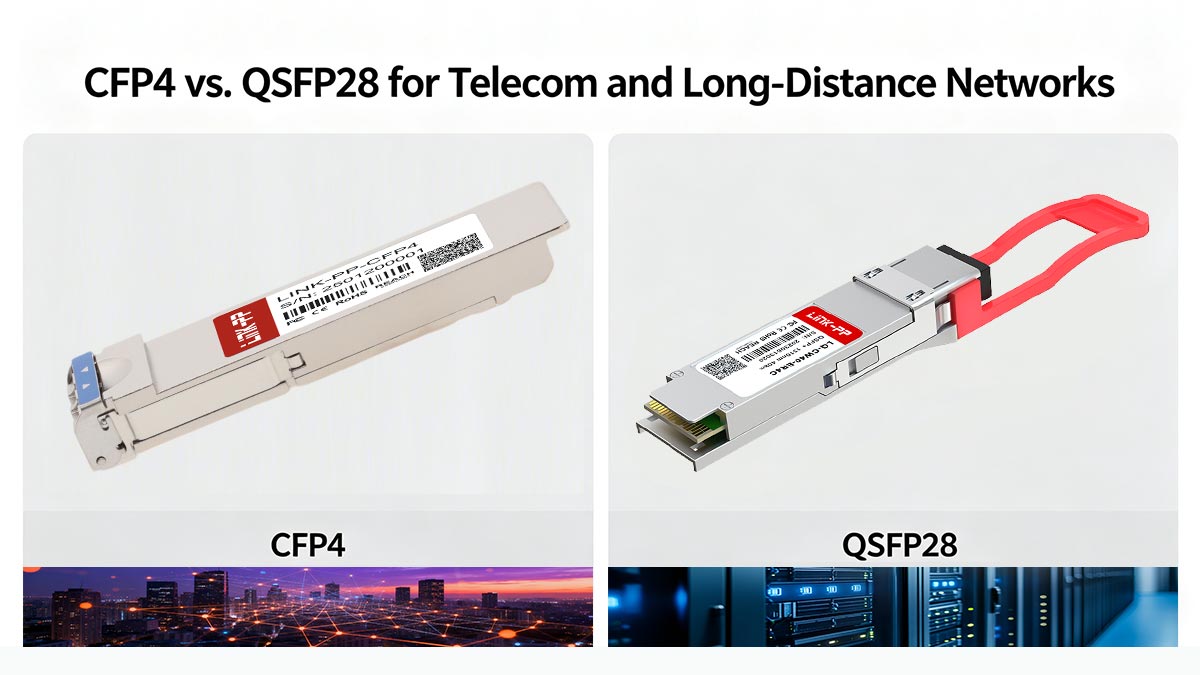
While QSFP28 dominates data centers, the comparison changes when we move into telecom, metro, and long-haul optical transport networks. In these environments, design priorities shift from density to reach, robustness, and system compatibility.
Where CFP4 Still Appears
CFP4 continues to be used in certain carrier-grade and telecom infrastructures, especially in:
Metro aggregation networks
Long-haul transmission systems (DWDM-based architectures)
Legacy 100G transport platforms
High-performance optical transport equipment (OTN systems)
In these scenarios, CFP4 is often integrated into systems designed before QSFP28 became dominant.
Why CFP4 Remains Relevant in Telecom
Unlike data centers, telecom networks prioritize:
Optical reach and signal stability
Integration with existing transport equipment
Carrier-grade reliability over density
CFP4 modules are often paired with:
Coherent optics platforms
Long-distance DWDM systems
Optical line systems requiring robust power budgets
In such cases, CFP4’s larger form factor is less of a disadvantage and sometimes even beneficial for thermal and optical performance management.
When QSFP28 Enters Telecom Environments
QSFP28 is increasingly used in telecom networks, but typically in:
Edge aggregation layers
Short-reach interconnects between routers
Data center interconnect (DCI) scenarios
However, for true long-haul transmission, CFP4 (or even CFP2-DCO/CFP8 in newer systems) may still be preferred depending on equipment compatibility.
What Network Planners Should Evaluate
When choosing between CFP4 vs. QSFP28 in telecom environments, engineers should assess:
Existing installed base compatibility
Optical reach requirements (ZR/ZR+ or DWDM systems)
Equipment vendor ecosystem support
Upgrade path toward coherent QSFP-DD or OSFP modules
Total lifecycle cost of migration
The key decision is not just performance—but system continuity and upgrade risk.
In telecom and long-distance optical networks, CFP4 is not obsolete—it is situationally relevant, especially in legacy or transport-heavy infrastructures. QSFP28, however, is increasingly used at the network edge and in hybrid architectures.
⏩ Power, Density, and Total Cost of Ownership
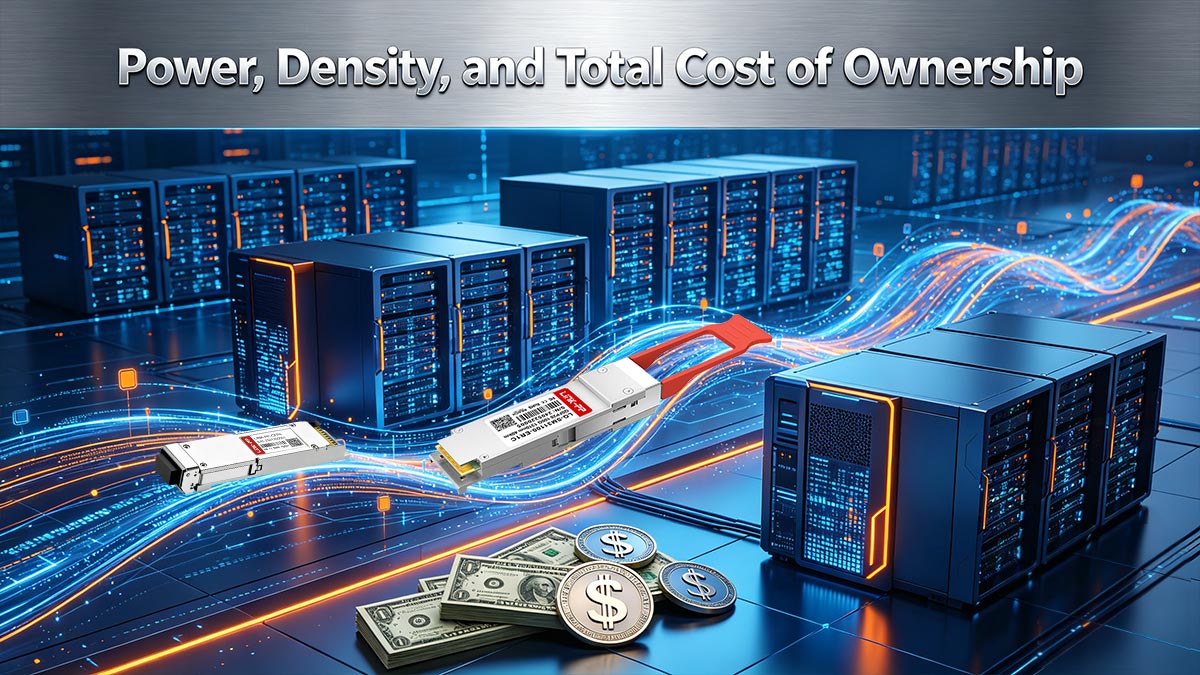
When evaluating CFP4 vs. QSFP28, performance alone is not the deciding factor—especially since both deliver the same 100G bandwidth capability. In real-world network planning, the most important considerations are power efficiency, port density, and total cost of ownership (TCO) over the lifecycle of the deployment.
Power Consumption: Efficiency at Scale
Power usage is one of the most critical differentiators in modern optical networks.
CFP4 modules typically consume higher power per port, often in the range of ~6–12W depending on optics type and reach.
QSFP28 modules are designed for efficiency, generally operating around 2.5–4W per port.
While this difference may seem small at the single-module level, it becomes significant at scale:
A switch with 128 ports can result in hundreds of watts of additional power draw if CFP4 is used instead of QSFP28.
Higher power directly increases:
Cooling requirements
Data center energy consumption
Operational costs (OPEX)
Key insight: QSFP28 is optimized for “power-per-bit efficiency,” making it far more suitable for large-scale deployments.
Port Density: The Rack Space Multiplier
In modern network architecture, physical space is money.
CFP4’s larger form factor limits how many ports can fit into a switch or line card.
QSFP28’s compact design allows significantly higher port density within the same hardware footprint.
This impacts:
Number of 100G links per rack unit
Switching capacity per chassis
Overall infrastructure scalability
In hyperscale environments, QSFP28 can deliver 2× to 4× higher port density compared to CFP4-based systems.
This is why QSFP28 has become the standard for:
Leaf-spine data center networks
Cloud infrastructure
High-density aggregation layers
Total Cost of Ownership (TCO)
When comparing CFP4 vs. QSFP28, TCO is the most important long-term metric—not just initial module price.
TCO includes:
Hardware cost (switches + optics)
Power consumption
Cooling infrastructure
Rack space utilization
Maintenance and scalability costs
CFP4 TCO Profile
CFP4 systems tend to have:
Higher power consumption → higher electricity cost
Lower port density → more hardware required for same capacity
Increased cooling demands
Potentially higher per-bit infrastructure cost
CFP4 may still be cost-effective in stable, legacy telecom environments, but scales poorly in modern dense deployments.
QSFP28 TCO Profile
QSFP28 provides:
Lower power per port → reduced OPEX
Higher density → fewer switches needed
Better scalability → delayed infrastructure expansion
Strong vendor ecosystem → competitive pricing
This leads to a lower cost per 100G link over time, especially in cloud-scale environments.
Real-World Impact: Why Operators Choose QSFP28
In practical deployments, operators often find that:
Even if CFP4 modules are functionally sufficient,
The infrastructure overhead outweighs the benefits
QSFP28 reduces:
Rack space consumption
Energy usage
Cooling system load
And increases:
Bandwidth per rack
Deployment flexibility
Long-term ROI
While CFP4 and QSFP28 offer identical 100G throughput, QSFP28 delivers a significantly lower total cost of ownership due to superior power efficiency and higher port density.
This makes QSFP28 the preferred choice for most modern networks, while CFP4 remains relevant only in specialized or legacy environments where migration is not yet feasible.
⏩ Should You Replace CFP4 with QSFP28?
One of the most common high-intent questions behind CFP4 vs. QSFP28 is not theoretical—it is operational:
“Should I replace my existing CFP4 infrastructure with QSFP28?”
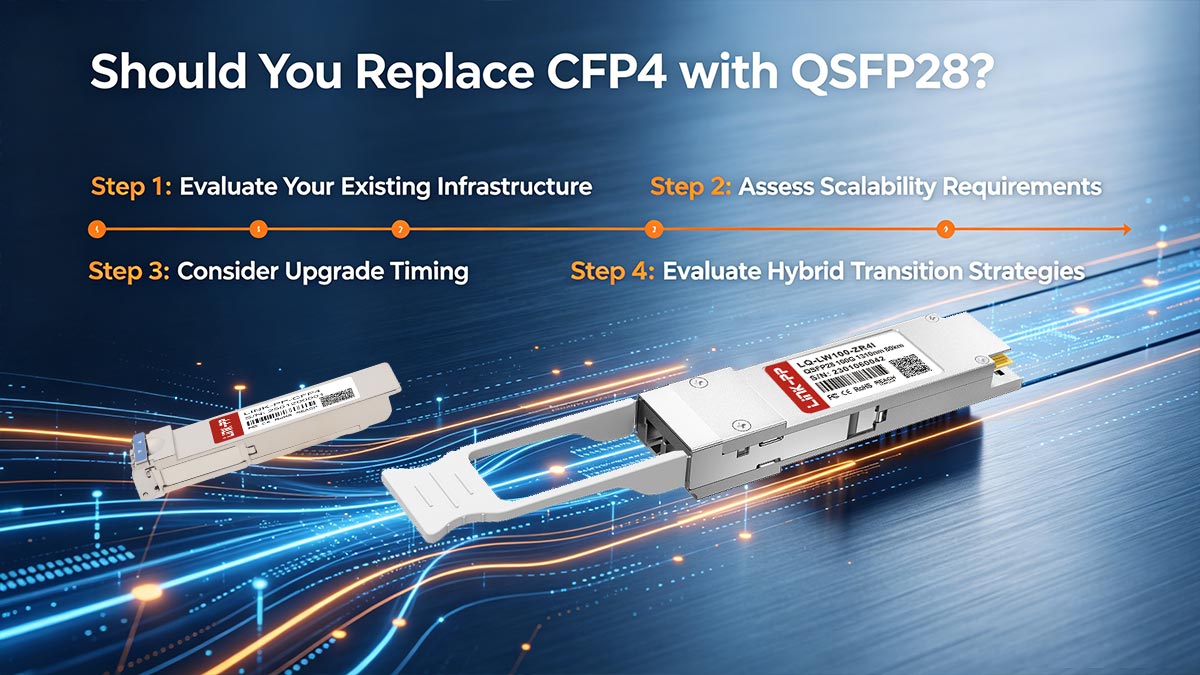
The answer is not universal. It depends on your current network architecture, scalability requirements, and upgrade lifecycle timing. In practice, this is a migration decision framework, not a simple product comparison.
Step 1: Evaluate Your Existing Infrastructure
The first and most important factor is what you already have deployed.
You should consider keeping CFP4 if:
Your network is based on legacy 100G telecom or transport platforms
CFP4 modules are deeply integrated into line cards or optical transport systems
The infrastructure is stable and not approaching capacity limits
Vendor support for CFP4 is still active in your ecosystem
In these cases, replacing CFP4 may introduce unnecessary cost and operational risk.
You should consider migrating to QSFP28 if:
You are operating a data center or cloud-oriented architecture
You are experiencing port exhaustion or density limitations
Your switches support QSFP28 natively
You are planning a refresh cycle or hardware upgrade
In modern Ethernet-based networks, QSFP28 is typically the default path forward.
Step 2: Assess Scalability Requirements
Scalability is the key driver behind most migration decisions.
Ask yourself:
Will traffic double or triple in the next 2–3 years?
Do I need more 100G ports per rack unit?
Am I constrained by physical space or switch density?
CFP4 limitations in scaling:
Larger form factor limits port expansion
Higher power per port increases thermal bottlenecks
Slower path toward higher-density architectures
QSFP28 advantages in scaling:
Enables high-density leaf-spine designs
Supports modular, incremental expansion
Reduces cost per additional 100G link
If your network is growth-oriented, QSFP28 is almost always the more future-proof choice.
Step 3: Consider Upgrade Timing (Lifecycle Strategy)
Migration is not only technical—it is also timing-sensitive.
Ideal time to replace CFP4:
During scheduled hardware refresh cycles
When migrating to new switch generations
When expanding data center capacity
When transitioning to cloud-native or SDN architectures
Avoid replacing CFP4 when:
Equipment is still under depreciation lifecycle
Migration requires full system replacement (high disruption)
There is no immediate performance or capacity bottleneck
A poorly timed migration can significantly increase both CAPEX and operational downtime.
Step 4: Evaluate Hybrid Transition Strategies
In many real-world deployments, the best answer is not “replace immediately,” but transition gradually.
Common hybrid approach:
Keep CFP4 in core or long-haul transport layers
Introduce QSFP28 in edge, aggregation, and data center layers
Plan gradual migration toward QSFP28-based infrastructure
This reduces risk while still improving density and efficiency.
Is CFP4 Obsolete in 2026?
CFP4 is not completely obsolete in 2026, but it is clearly in a declining lifecycle phase within modern networking.
Where CFP4 is becoming less relevant:
New data center builds (almost fully QSFP28/QSFP-DD driven)
High-density Ethernet switching environments
Cloud-native and hyperscale architectures
In these scenarios, CFP4 is increasingly avoided due to its:
Larger size
Higher power consumption
Lower port density
This is why QSFP28 has effectively become the default 100G standard in Ethernet-based systems.
Where CFP4 is still relevant:
CFP4 continues to exist in specific telecom and transport environments, especially where:
Existing CFP4-based systems are still in service
Long-haul or metro optical transport platforms are deployed
Upgrading hardware is costly or operationally disruptive
Vendor ecosystems still support CFP4 optics
In these cases, CFP4 remains a maintenance-oriented technology, not a growth technology.
Market Reality
The industry trend can be summarized as:
QSFP28 = mainstream 100G Ethernet standard
CFP4 = legacy + niche telecom continuity form factor
Most operators are no longer choosing CFP4 for new designs—they are only maintaining or gradually replacing it.
Key Takeaway
CFP4 is not fully obsolete in 2026, but it is no longer a forward-looking choice for new deployments. QSFP28 has become the dominant standard for scalable, cost-efficient 100G Ethernet networks.
⏩ FAQ About CFP4 vs. QSFP28
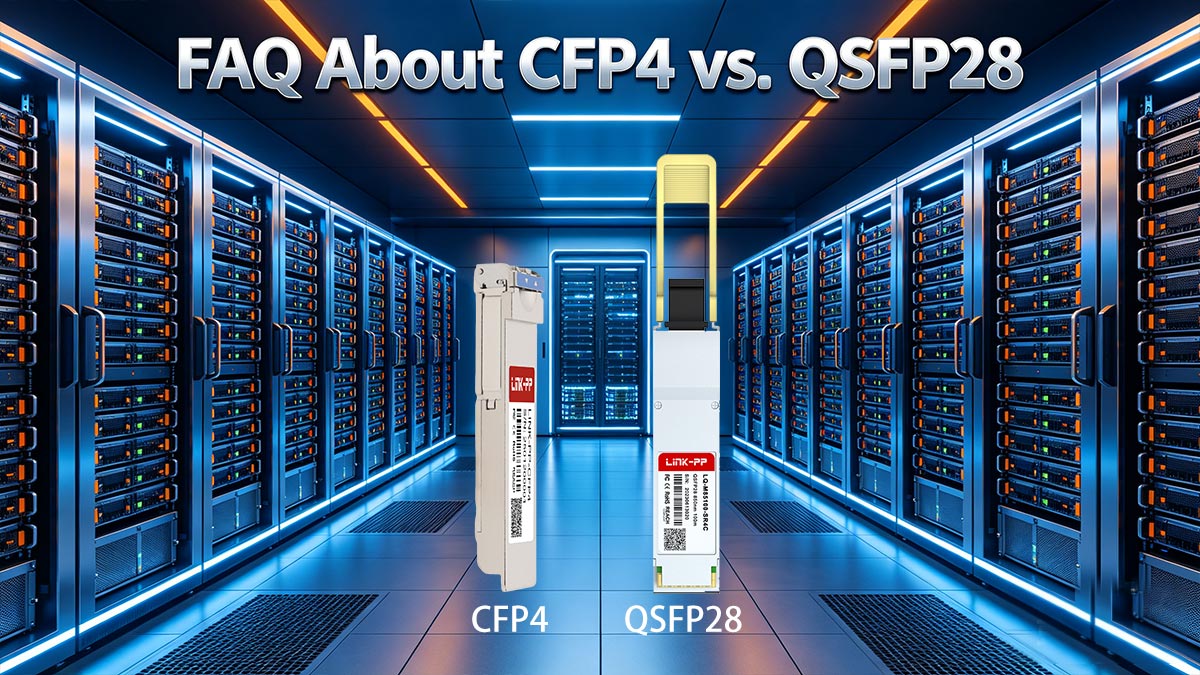
1. What is the main difference between CFP4 and QSFP28?
CFP4 and QSFP28 both support 100G Ethernet, but differ in design efficiency. CFP4 is larger and more telecom-oriented, while QSFP28 is smaller, more power-efficient, and optimized for high-density data center deployments.
2. Which is more widely used in modern networks, CFP4 or QSFP28?
QSFP28 is significantly more widely used today because it has become the standard 100G form factor in data centers and enterprise networks, while CFP4 is mostly limited to legacy or specialized telecom systems.
3. Do CFP4 and QSFP28 support the same transmission speed?
Yes. Both CFP4 and QSFP28 commonly support 100G transmission using 4×25G lanes, meaning their raw data rate capability is essentially equivalent.
4. Why is QSFP28 preferred for high-density switching?
QSFP28 is preferred because its smaller form factor allows more ports per switch, improving rack utilization and enabling scalable leaf-spine architectures with higher bandwidth per unit space.
5. Can CFP4 and QSFP28 be used in the same network?
Yes, they can coexist in the same network, but typically in different layers. CFP4 is often used in transport or legacy core systems, while QSFP28 is used in aggregation and data center layers.
6. Which module has better power efficiency: CFP4 or QSFP28?
QSFP28 has better power efficiency. It consumes less energy per port, which reduces cooling requirements and lowers overall operational costs in large-scale deployments.
7. Is there a performance difference between CFP4 and QSFP28?
In terms of raw throughput, there is no major performance difference, as both support 100G. The key differences lie in efficiency, scalability, and physical design, not speed.
8. What factors should influence the choice between CFP4 and QSFP28?
The decision should be based on:
Network architecture type (data center vs. telecom)
Required port density
Power and cooling constraints
Upgrade and scalability plans
Existing hardware compatibility
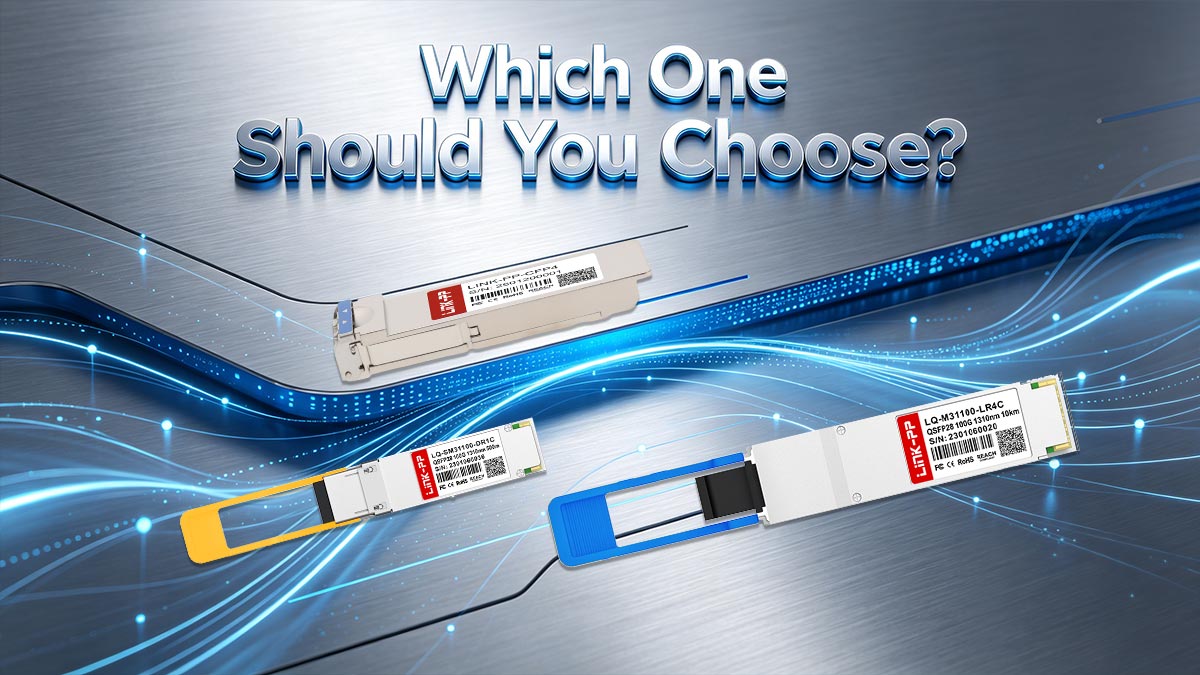
⏩ Conclusion: Which One Should You Choose?
When comparing CFP4 vs. QSFP28, the key takeaway is that both technologies deliver the same 100G Ethernet capability, but they serve very different network design philosophies.
CFP4 is best understood as a legacy-friendly, telecom-oriented form factor, still relevant in specific long-haul or existing transport infrastructures where stability and compatibility matter more than density.
QSFP28, on the other hand, is the modern standard for 100G Ethernet, widely adopted in data centers, cloud platforms, and enterprise networks due to its superior port density, power efficiency, and scalability.
Final Recommendation
If you are building a new network or planning a scalable upgrade, QSFP28 is the clear and future-proof choice.
If you are maintaining a legacy telecom or transport system, CFP4 may still be appropriate, but should be considered a transitional technology rather than a growth path.
In most modern deployments, the industry trend is decisive: networks are steadily standardizing around QSFP28 and higher-density form factors.
🔗 Need Reliable 100G Optical Solutions?
For high-quality, compatible optical modules and connectivity solutions for modern network infrastructure, you can explore the LINK-PP Official Store, where a wide range of QSFP28 and related optical products are available to support data center and telecom deployments.