

In modern communication infrastructure, SFP in Telecom is a fundamental concept that enables flexible, high-speed data transmission across a wide range of network environments. Whether you are building enterprise backbone networks, deploying fiber-to-the-home (FTTH) services, or scaling carrier-grade infrastructure, SFP modules play a critical role in connecting equipment and ensuring reliable signal delivery.
SFP, short for Small Form-factor Pluggable, refers to a compact, hot-swappable transceiver used in switches, routers, and optical networking devices. What makes SFP especially valuable in telecom is its versatility—it supports both fiber optic (single-mode and multimode) and copper connections (1000BASE-T), allowing network engineers to adapt to different transmission distances and deployment scenarios without changing hardware platforms.
Another key advantage is its hot-swappable capability, which means SFP modules can be inserted or replaced without shutting down network equipment. This is essential for telecom environments where uptime, scalability, and rapid maintenance directly impact service quality and operational efficiency.
From a practical perspective, SFP modules are widely used across multiple telecom applications, including:
Ethernet transmission networks
SONET/SDH systems
Passive Optical Networks (PON) for FTTH
Metro and long-haul fiber infrastructure
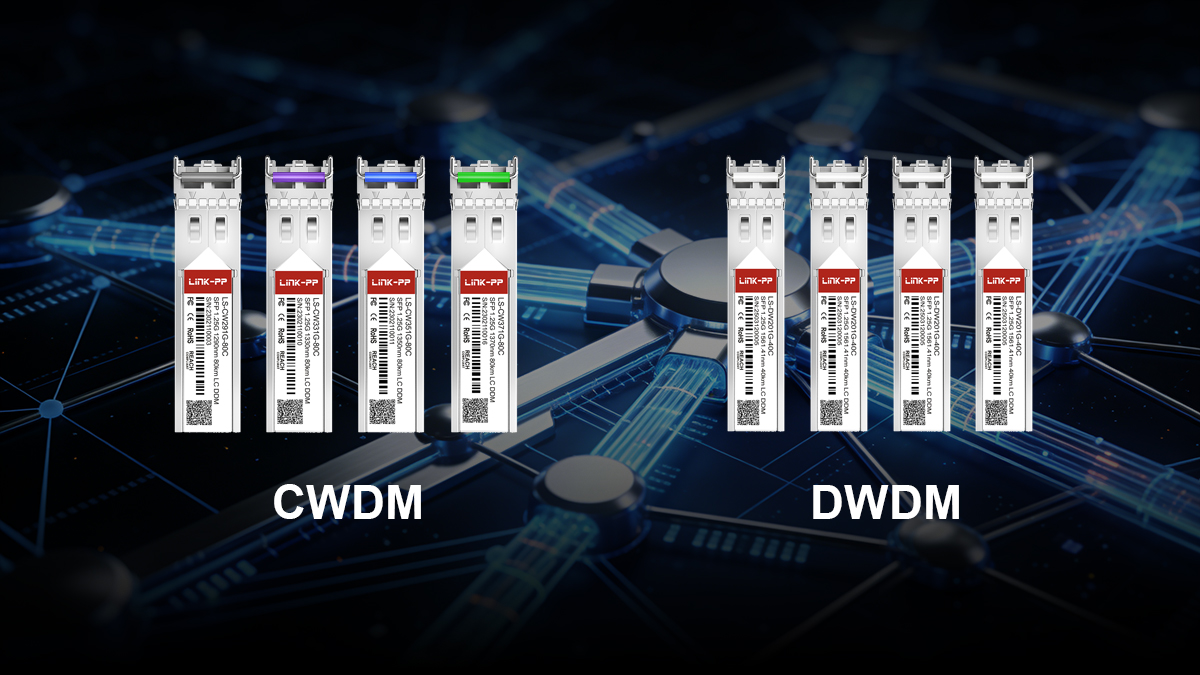
Different SFP types are designed for specific distances and use cases. For example, 1000BASE-SX is typically used for short-distance multimode links (up to 550 meters), while 1000BASE-LX, EX, and ZX support long-distance single-mode transmission ranging from 10 km to over 80 km. In advanced telecom deployments, CWDM and DWDM SFP modules enable multiple signals to travel over a single fiber, significantly increasing bandwidth capacity for service providers.
What You’ll Learn in This Guide
By reading this article, you will gain a clear and practical understanding of:
What SFP in telecom really means and why it matters
The different types of SFP modules and their distances
How to choose between fiber and copper SFP solutions
Where SFP is used in real-world telecom networks
How to select the right SFP module for your deployment
This guide is designed to help both beginners and professionals make informed decisions—whether you are learning the basics or selecting the right SFP for a telecom project.
🔄 What Does SFP Mean in Telecom?
In telecom, SFP is more than just a transceiver—it is a flexible, scalable, and cost-effective interface that enables modern networks to support diverse transmission technologies, distances, and service requirements.
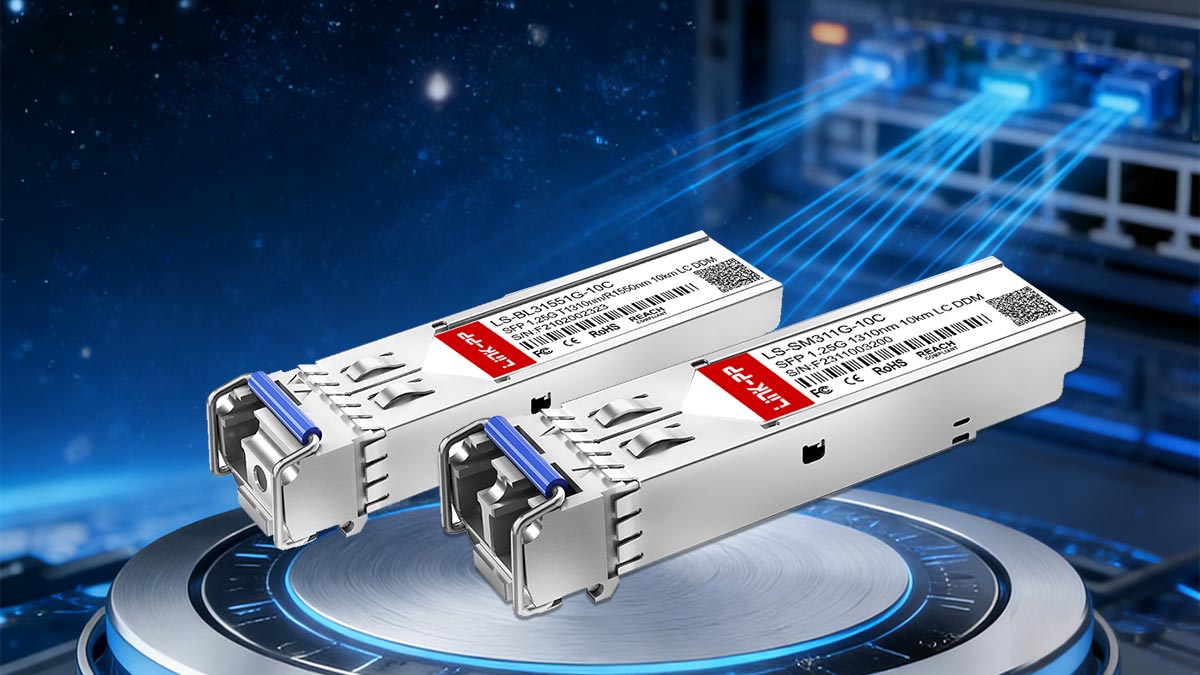
Definition: Small Form-factor Pluggable
In telecom, SFP (Small Form-factor Pluggable) refers to a compact, modular transceiver used to connect networking equipment—such as switches, routers, and optical line terminals—to different types of transmission media.
An SFP module acts as an interface between the network device and the physical cable, converting electrical signals into optical signals (for fiber) or transmitting electrical signals directly (for copper connections like 1000BASE-T). Because of its standardized form factor (MSA compliant), SFP modules from different vendors can often be used interchangeably, provided compatibility requirements are met.
A key feature of SFP is that it is hot-swappable, meaning it can be inserted or removed without powering down the device. This makes it highly suitable for telecom environments where minimizing downtime is critical.
Role in Telecom Infrastructure
In modern telecom networks, SFP modules serve as the physical layer connectivity backbone. They are widely deployed across multiple layers of the network:
Access Layer (FTTH / PON):
Used in Optical Line Terminals (OLTs) and aggregation switches to deliver broadband services to end users.Metro and Aggregation Networks:
Enable high-speed connections between base stations, access nodes, and core infrastructure.Core and Long-Haul Networks:
Support long-distance transmission using single-mode fiber and advanced technologies like CWDM and DWDM.Enterprise & Data Center Interconnects:
Provide flexible connectivity for Ethernet-based services and cloud infrastructure.
Because telecom networks must handle large-scale data transmission over varying distances, SFP modules allow operators to choose the right optical interface without replacing entire devices.
Why SFP Is Essential in Modern Networks
SFP has become a standard in telecom for several key reasons:
1. Flexibility Across Media Types
SFP supports both:
Fiber optic cables (single-mode and multimode) for long and short distances
Copper cables (RJ45) for cost-effective short-range connections
This flexibility allows a single device to adapt to multiple deployment scenarios.
2. Scalable Network Design
Instead of fixed ports, SFP-based devices let engineers upgrade or change transmission types easily—for example, switching from short-range multimode (SX) to long-range single-mode (LX or ZX) without replacing hardware.
3. High Availability with Hot-Swap Capability
Telecom systems require continuous uptime. SFP optical modules can be replaced or upgraded without interrupting network operations, reducing maintenance risks.
4. Support for Advanced Optical Technologies
SFP modules are not limited to basic Ethernet. They also support:
SONET/SDH transmission
PON (GPON, EPON) for FTTH
CWDM/DWDM for high-capacity fiber links
This makes them suitable for both legacy systems and next-generation telecom infrastructure.
5. Cost Efficiency and Standardization
Because SFP follows industry standards, telecom operators benefit from:
Lower hardware costs
Multi-vendor compatibility
Easier inventory management
🔄 Why SFP Modules Are Widely Used in Telecom Networks
SFP Transceivers have become a standard interface in telecom infrastructure because they offer a unique combination of flexibility, efficiency, and scalability. Unlike fixed-port designs, SFP-based systems allow operators to adapt quickly to changing network requirements without major hardware changes.
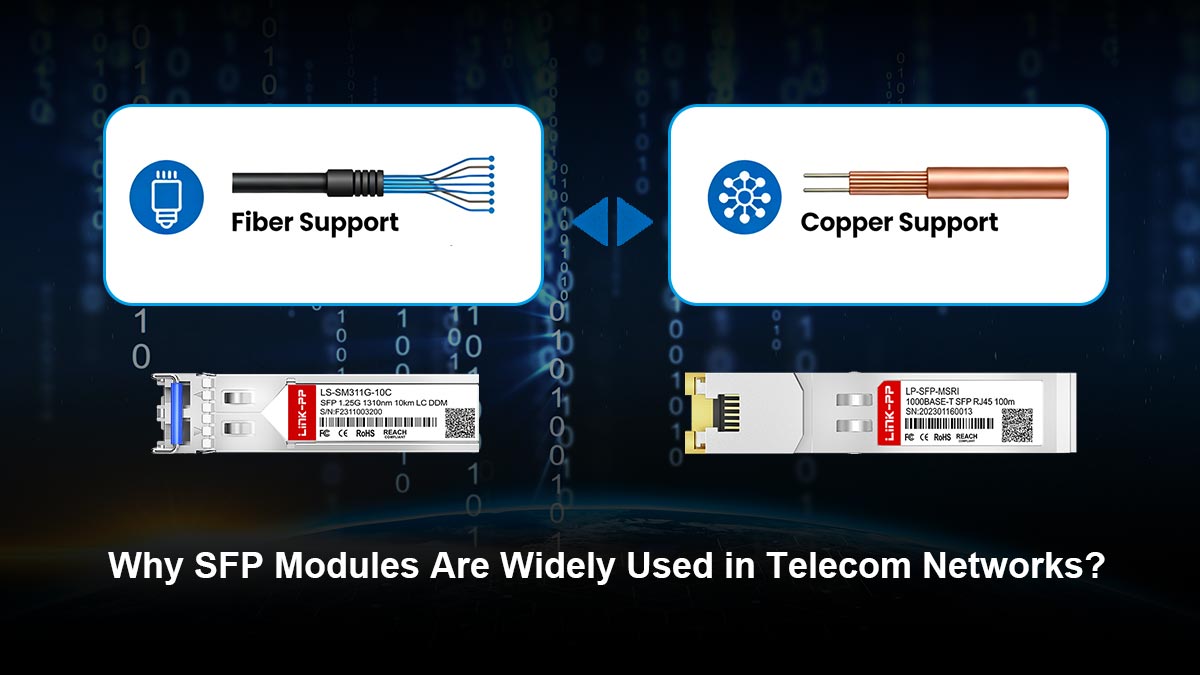
Versatility: Support for Fiber and Copper
One of the biggest advantages of SFP modules is their ability to support multiple transmission media within the same hardware platform.
Fiber optic SFP Modules
Single-mode fiber (SMF) for long-distance transmission (10 km to 80 km+)
Multimode fiber (MMF) for short-distance, high-speed links (up to 550 m)
Copper SFPs (1000BASE-T)
Use standard RJ45 Ethernet cables
Ideal for short-range connections (typically up to 100 m)
This versatility allows telecom operators to deploy one type of switch or router and simply choose the appropriate SFP module based on the network scenario—whether it’s a data center, metro network, or FTTH deployment.
Hot-Swappable Advantages
SFP modules are hot-swappable, meaning they can be installed or replaced without powering down the device.
This provides major operational benefits in telecom environments:
Minimized downtime → critical for service providers with strict uptime requirements
Faster maintenance → faulty modules can be replaced instantly
Seamless upgrades → change transmission types without interrupting services
In carrier-grade networks, where even seconds of downtime can impact thousands of users, this feature is essential.
Scalability for Network Upgrades
Telecom networks are constantly evolving to meet increasing bandwidth demands. SFP modules enable scalable and future-proof network design.
Instead of replacing entire switches or routers, engineers can:
Upgrade from short-distance to long-distance modules
Transition from standard optics to CWDM/DWDM SFPs for higher capacity
Adapt to new deployment requirements (e.g., expanding FTTH coverage)
This modular approach allows networks to grow incrementally and cost-effectively, reducing capital expenditure over time.
Cost Efficiency vs. Fixed Interfaces
Compared to fixed-port hardware, SFP-based designs offer significant cost advantages:
Lower upfront investment
Buy only the SFP modules needed for current deploymentReduced inventory complexity
One device can support multiple connection typesLonger equipment lifespan
Upgrade connectivity without replacing the entire systemMulti-vendor flexibility
Standardized SFP form factors allow sourcing from different suppliers (with compatibility considerations)
For telecom operators managing large-scale networks, this translates into better ROI and operational efficiency.
SFP modules are widely used in telecom networks because they provide unmatched flexibility, hot-swappable reliability, scalable upgrades, and cost efficiency—making them the ideal choice for modern, high-performance communication systems.
🔄 Types of SFP Modules and Their Transmission Distances
Choosing the right SFP in telecom networks largely depends on transmission distance, fiber type, and wavelength. Different SFP modules are designed for specific scenarios—from short-range data center links to long-haul carrier networks.
Understanding these types helps ensure stable performance, cost efficiency, and compatibility in your deployment.
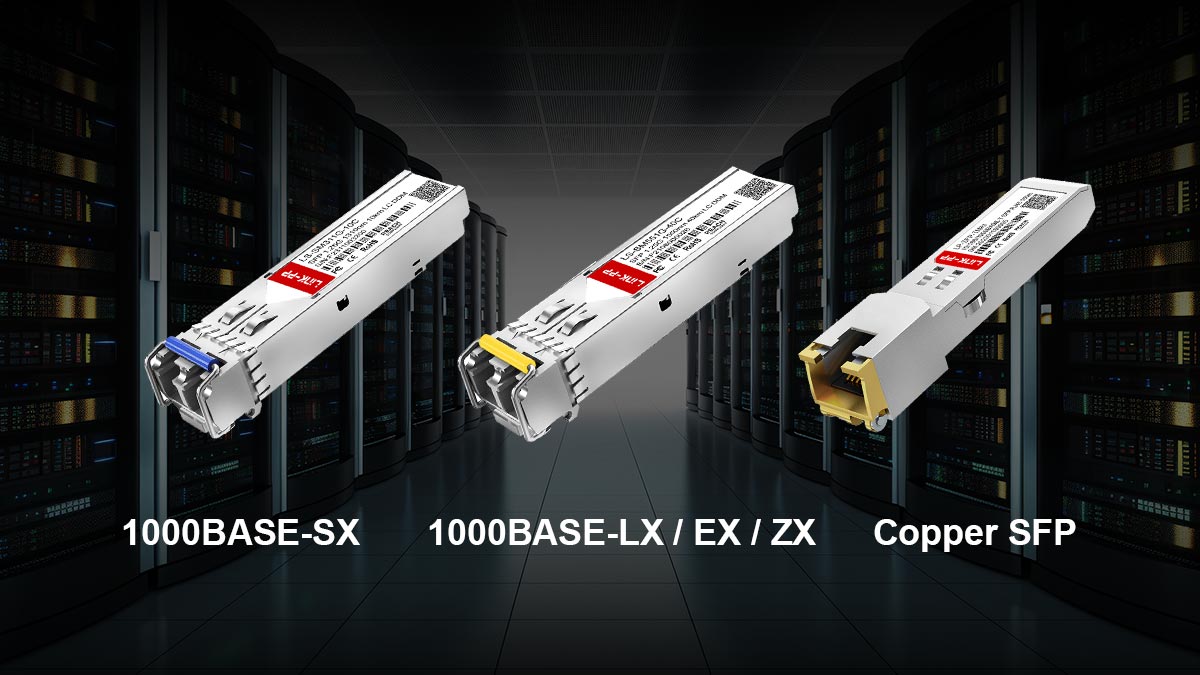
1000BASE-SX (Multimode Fiber, up to 550m)
1000BASE-SX SFP is designed for short-distance transmission over multimode fiber (MMF).
Typical distance: up to 220m–550m (depending on OM fiber type)
Wavelength: 850 nm
Fiber type: Multimode (OM1 / OM2 / OM3 / OM4)
Common use cases:
Data centers
Enterprise LANs
Short-range switch-to-switch links
This is the most cost-effective option for short-distance, high-speed connections.
1000BASE-LX / EX / ZX (Single-Mode Fiber, 10km–80km+)
These SFP modules are designed for long-distance transmission over single-mode fiber (SMF) and are widely used in telecom and carrier networks.
Distance: up to 10 km
Wavelength: 1310 nm
Use case: campus networks, metro access
Distance: up to 40 km
Wavelength: 1310 nm (extended reach)
Use case: metro and aggregation networks
Distance: up to 70–80 km (or more with amplification)
Wavelength: 1550 nm
Use case: long-haul telecom links, backbone infrastructure
These modules are essential for telecom operators handling long-distance data transmission.
Copper SFP (1000BASE-T)
1000BASE-T SFP modules use copper Ethernet cables (RJ45) instead of fiber.
Distance: up to 100 meters
Medium: Cat5e / Cat6 / Cat6a
Use cases:
Office networks
Short-distance equipment connections
Cost-sensitive deployments
While limited in distance, copper SFPs are simple, flexible, and cost-efficient for short-range applications.
SFP Module Comparison Table
SFP Type | Fiber / Medium | Max Distance | Wavelength | Typical Use Case |
|---|---|---|---|---|
1000BASE-SX | Multimode (MMF) | up to 550 m | 850 nm | Data centers, short links |
1000BASE-LX | Single-mode (SMF) | up to 10 km | 1310 nm | Campus, metro access |
1000BASE-EX | Single-mode (SMF) | up to 40 km | 1310 nm | Metro aggregation |
1000BASE-ZX | Single-mode (SMF) | up to 80 km+ | 1550 nm | Long-haul telecom backbone |
1000BASE-T | Copper (RJ45) | up to 100 m | N/A | Office / short-distance links |
Different SFP modules are optimized for specific distances and media types:
Use SX for short multimode links
Use LX/EX/ZX for increasing single-mode distances
Use 1000BASE-T for short copper connections
Selecting the correct type ensures reliable transmission, optimal cost, and network stability.
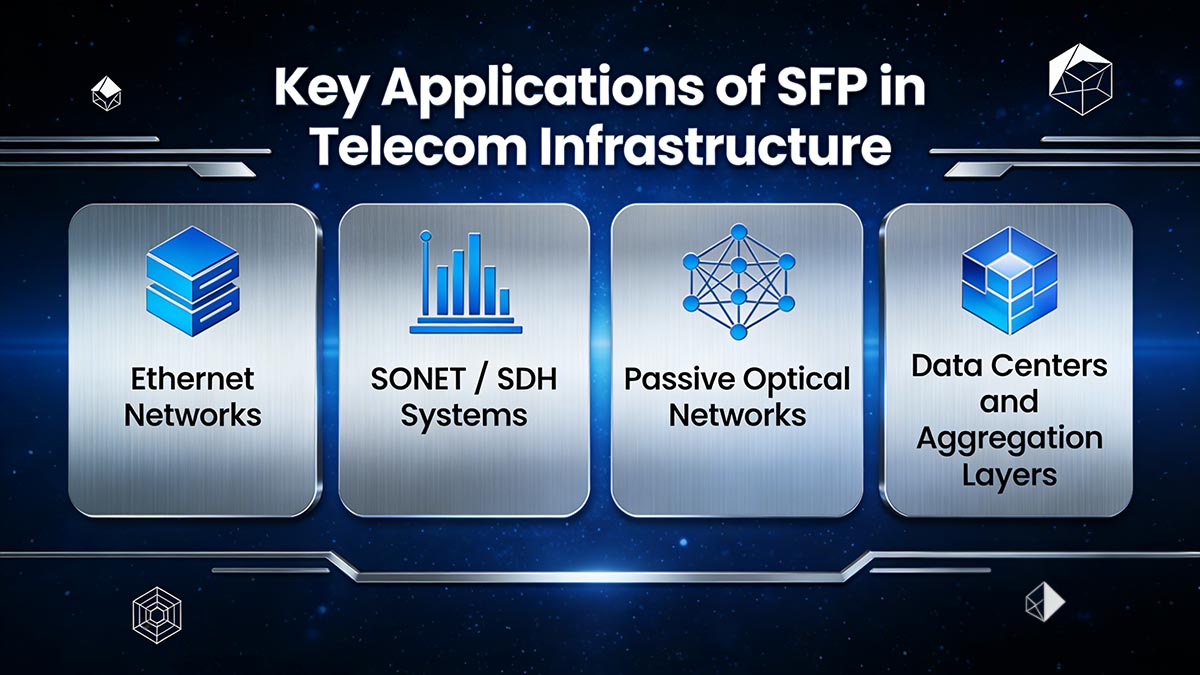
🔄 Key Applications of SFP in Telecom Infrastructure
SFP modules are not limited to a single type of network—they are widely deployed across multiple layers of telecom infrastructure, from access networks to core backbones. Their flexibility and compatibility make them a universal interface solution for different transmission technologies and architectures.
1. Ethernet Networks
One of the most common uses of SFP in telecom is in Ethernet-based networks, which form the foundation of modern IP communications.
SFP modules are used to:
Connect switches, routers, and transmission equipment
Enable Gigabit Ethernet (1G) links over fiber or copper
Support scalable network expansion in metro and enterprise environments
In telecom scenarios, Ethernet SFPs are widely used in:
Metro Ethernet networks
Enterprise WAN connections
Base station backhaul (4G/5G)
Ethernet + SFP provides a cost-effective and flexible alternative to traditional telecom transport technologies.
2. SONET / SDH Systems
Although newer IP-based technologies dominate today, SONET (Synchronous Optical Network) and SDH (Synchronous Digital Hierarchy) are still widely used in legacy and hybrid telecom systems.
SFP modules in SONET/SDH environments:
Provide optical interfaces for synchronous transmission systems
Support standardized telecom rates (e.g., OC-3, OC-12, STM-1)
Ensure high reliability and low latency for critical services
SFP enables seamless integration between legacy telecom infrastructure and modern optical networks.
3. Passive Optical Networks (PON / FTTH)
In access networks, SFP modules play a key role in Passive Optical Networks (PON), especially for Fiber-to-the-Home (FTTH) deployments.
Typical use cases include:
OLT (Optical Line Terminal) uplinks
Aggregation switches connecting multiple access nodes
SFP modules help telecom operators:
Deliver high-speed broadband services to end users
Extend coverage efficiently using fiber infrastructure
Optimize bandwidth usage in shared optical networks
In FTTH deployments, SFP modules are critical for scalable and cost-efficient last-mile connectivity.
4. Data Centers and Aggregation Layers
SFP modules are also heavily used in data centers and telecom aggregation layers, where high port density and flexibility are essential.
In these environments, SFPs are used for:
Top-of-Rack (ToR) to aggregation switch connections
Server-to-switch fiber links
Interconnection between data centers (DCI)
Key benefits include:
High-density port configurations
Easy upgrades without replacing switches
Support for both short-range (MMF) and long-range (SMF) links
In telecom architectures, data centers act as traffic hubs, and SFP modules ensure efficient data flow between access, aggregation, and core layers.
SFPs are widely used across telecom infrastructure because they support:
Ethernet networks for flexible IP-based communication
SONET/SDH systems for legacy and high-reliability transport
PON/FTTH deployments for broadband access
Data centers and aggregation layers for scalable connectivity
Their ability to adapt to different technologies makes SFP a core building block of modern telecom networks.
🔄 CWDM and DWDM SFP Modules for Telecom Backbones
As telecom networks continue to scale, simply increasing fiber count is no longer the most efficient solution. Instead, operators rely on Wavelength Division Multiplexing (WDM) technologies—implemented through SFP modules—to dramatically increase capacity over existing fiber infrastructure.
What Is WDM?
Wavelength Division Multiplexing (WDM) is a technology that allows multiple optical signals to be transmitted simultaneously over a single fiber, using different wavelengths (colors) of light.
Instead of sending one signal per fiber, WDM enables:
Multiple independent data channels
Higher bandwidth utilization
Reduced need for additional fiber deployment
There are two main types used in telecom:
CWDM (Coarse Wavelength Division Multiplexing)
DWDM (Dense Wavelength Division Multiplexing)
Both are widely implemented using SFP transceivers in modern telecom networks.
CWDM vs. DWDM: Key Differences
Feature | DWDM SFP | |
|---|---|---|
Channel spacing | Wide (20 nm) | Very narrow (0.8 nm / 100 GHz) |
Number of channels | Up to 18 channels | 40, 80, or more channels |
Distance | Up to ~80 km | 80 km to 1000+ km (with amplification) |
Cost | Lower | Higher (more complex technology) |
Use case | Metro / access networks | Long-haul / core backbone networks |
CWDM is ideal for cost-sensitive metro deployments, while DWDM is used for high-capacity, long-distance telecom backbones.
Benefits for Telecom Operators
Using CWDM and DWDM SFP modules provides several strategic advantages:
1. Massive Capacity Expansion
Operators can transmit dozens of signals over a single fiber, significantly increasing bandwidth without laying new cables.
2. Efficient Fiber Utilization
Fiber infrastructure is expensive to deploy. WDM maximizes the value of existing fiber assets.
3. Scalable Network Growth
New wavelengths (channels) can be added incrementally as demand grows, without disrupting existing services.
4. Support for High-Speed Services
WDM systems support advanced telecom services, including:
Cloud and data center interconnect (DCI)
High-capacity enterprise connectivity
Bandwidth Scaling Over a Single Fiber
Without WDM, one fiber carries one data stream per direction. With WDM:
Each wavelength acts as an independent communication channel
Multiple SFP modules operate simultaneously on different wavelengths
Total bandwidth is multiplied by the number of channels
For example:
A single fiber with 8 CWDM channels → 8× capacity
A DWDM system with 80 channels → 80× capacity
This makes WDM SFP modules essential for modern telecom backbone networks, where bandwidth demand is constantly increasing.
CWDM and DWDM SFP modules enable telecom operators to:
Scale bandwidth efficiently
Reduce infrastructure costs
Extend transmission distances
Future-proof their networks
They are a cornerstone technology for building high-capacity, carrier-grade optical networks.
🔄 FAQ about SFP in Telecom Networks
To address common user concerns and improve clarity, here are answers to frequently asked questions about SFP in telecom networks. These focus on practical understanding without repeating earlier sections.
Q1: What is SFP used for in telecom?
In telecom, SFP modules are primarily used to enable flexible connectivity between network equipment and transmission media. They allow operators to adapt ports on switches, routers, and optical devices for different link types—whether connecting access networks, aggregation layers, or backbone infrastructure.
They are especially valuable in scenarios where network design needs to remain adaptable over time, such as expanding broadband coverage or upgrading transmission links.
Q2: Can SFP work with both fiber and copper?
Yes. One of the key advantages of SFP modules is that they support both fiber optic and copper connections.
Fiber SFP → used for longer distances and high-performance links
Copper SFP (RJ45) → used for short-range Ethernet connections
This allows the same network device to handle different media types simply by changing the SFP module, rather than replacing the entire hardware.
Q3: What distance can SFP support?
SFP modules can support a wide range of transmission distances, depending on the type used.
Short-range connections → tens to hundreds of meters
Medium-range links → several kilometers
Long-distance telecom links → tens of kilometers or more
The exact distance depends on factors such as fiber type, wavelength, and network design, rather than a single fixed limit.
Q4: Are SFP modules hot-swappable?
Yes. SFP modules are designed to be hot-swappable, meaning they can be inserted or removed while the equipment is powered on.
This allows:
Quick replacement of faulty modules
Seamless upgrades or configuration changes
Minimal disruption to network operations
This feature is particularly important in telecom environments where continuous uptime is critical.
Q5: What is the difference between SFP and SFP+?
The main difference lies in data rate and performance:
SFP → typically supports up to 1 Gbps (Gigabit Ethernet)
SFP+ → supports up to 10 Gbps (10 Gigabit Ethernet)
While they share a similar physical form factor, they are not always directly interchangeable, and compatibility depends on the device port.
In simple terms:
SFP is used for standard telecom links, while SFP+ is used for higher-speed network upgrades.
🔄 Conclusion: How to Select the Right SFP for Telecom Networks
Selecting the right SFP in telecom networks is not just about choosing a transceiver—it is about ensuring long-term stability, compatibility, and performance efficiency across your entire optical infrastructure. A proper selection process helps avoid link failures, signal degradation, and unnecessary upgrade costs.
Decision Summary (Distance + Application + Compatibility)
When choosing an SFP module, the decision should always be based on three core factors:
Distance requirement → Short-range (SX), medium (LX/EX), or long-haul (ZX / DWDM)
Application scenario → Ethernet, FTTH/PON, data center, or telecom backbone
Device compatibility → Switch/router support and vendor specifications
A correct match between these three ensures stable transmission and optimal network performance.
Compatibility Checklist (Switch / Vendor)
Before deploying an SFP module, verify:
Switch or router MSA compatibility
Supported data rate and port type
Firmware restrictions or whitelist rules
Compatibility is often the most critical factor in real-world telecom deployments.
Distance and Optical Budget
The optical budget determines how far your signal can travel reliably.
Key considerations include:
Fiber attenuation (loss per km)
Connector and splice losses
Transmit power vs receiver sensitivity
Always ensure the selected SFP provides sufficient link margin for stable long-term operation.
Fiber Type (OS2 vs. OM3/OM4)
Choosing the correct fiber type is essential:
OS2 (Single-mode fiber)
Used for long-distance telecom and backbone networks
Supports 10 km to 80 km+ transmission
OM3 / OM4 (Multimode fiber)
Used for short-range, high-speed data center links
Typically up to 300–550 meters
Matching fiber type with SFP specification prevents signal loss and performance issues.
Temperature and Industrial Requirements
In telecom environments, deployment conditions can vary significantly.
Consider:
Standard commercial grade (0°C to 70°C)
Industrial grade (-40°C to 85°C) for harsh environments
Outdoor or base station deployments with temperature fluctuations
Choosing the correct temperature rating ensures reliability in real-world operating conditions.
The best SFP selection strategy combines:
Correct distance classification
Proper fiber matching
Verified device compatibility
Environmental suitability
This ensures a stable, scalable, and cost-efficient telecom network architecture.
If you are sourcing reliable, high-performance optical modules for telecom deployments, explore the LINK-PP Official Store for compatible SFP solutions designed for enterprise and carrier-grade networks.
For telecom engineers and procurement teams, the most important principle is:
Do not select SFP based only on speed—select it based on distance, fiber type, and network architecture.
A well-chosen SFP module ensures:
Reliable optical performance
Lower maintenance cost
Easier future network upgrades
Better long-term ROI for telecom infrastructure