

In modern Ethernet and fiber networking, SFP data rate is one of the most important specifications engineers evaluate when selecting optical transceivers. It directly determines how much traffic a link can carry, how stable a connection will be under load, and whether a network can scale efficiently from access layers to high-speed data center backbones.
At a high level, SFP-based modules are grouped into three major speed families: 1G SFP, 10G SFP+, and 25G SFP28. While they often share the same physical form factor, their internal signaling rates, encoding methods, and hardware requirements are fundamentally different. This is why a module that physically fits into a port may still fail to link—or perform far below expectations—if the data rate is not properly matched.
In real-world deployments, engineers frequently encounter confusion around questions such as “Is SFP+ always 10Gb?” or “How do I tell if my SFP is 1G or 10G?” These are not just theoretical concerns. Misinterpreting SFP data rate compatibility can lead to link instability, reduced throughput, or complete connectivity failure, especially in mixed-vendor environments or during network upgrades.
This guide breaks down the SFP data rate hierarchy (1G vs. 10G vs. 25G) in a clear, engineering-focused way. It also explains how to identify module speeds, avoid compatibility issues, and choose the correct transceiver for your specific network scenario. Whether you're maintaining legacy Gigabit Ethernet systems or building next-generation high-speed infrastructure, understanding SFP data rate behavior is essential for ensuring reliable and scalable network performance.
🔄 What Is the Data Rate of SFP?
The SFP data rate refers to the maximum signaling speed that a Small Form-factor Pluggable (SFP) transceiver can transmit and receive over a network link. In simple terms, it defines how much digital information (bandwidth) the module can carry per second between network devices such as switches, routers, and servers.
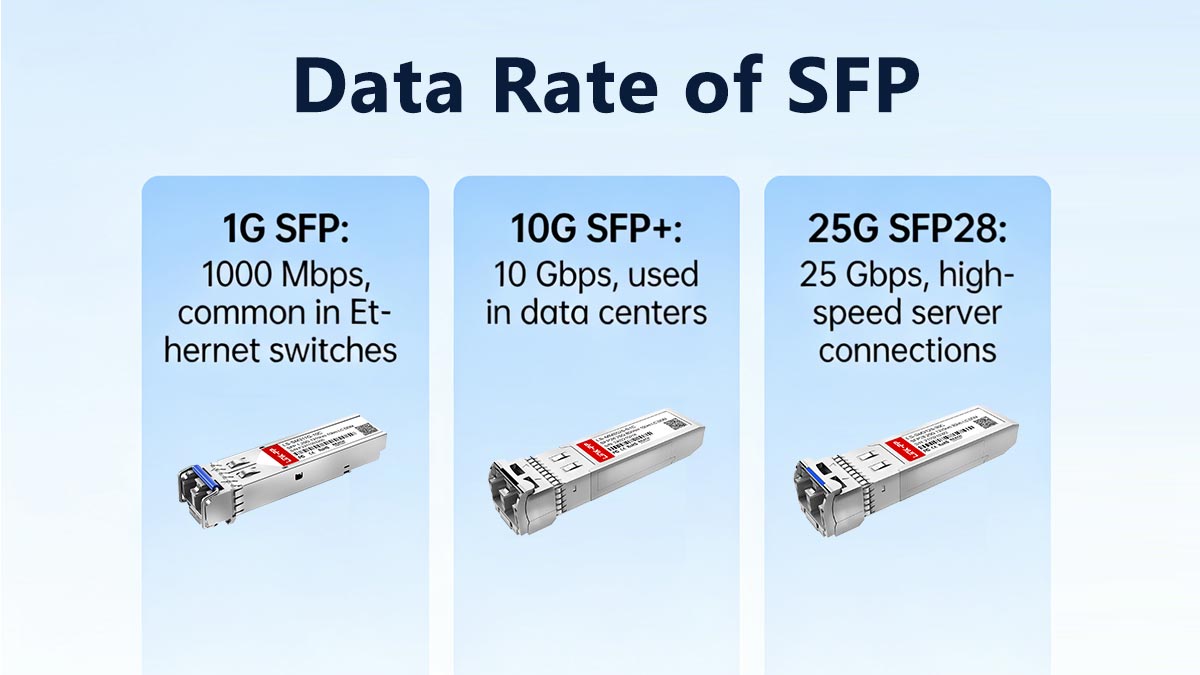
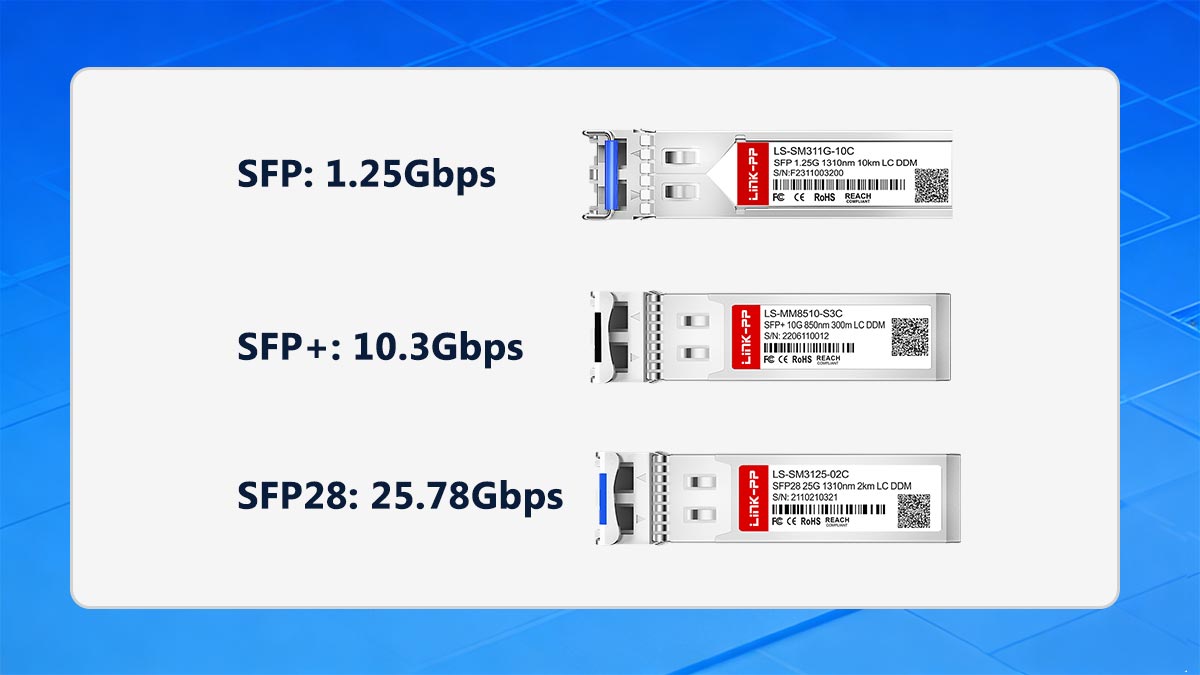
In most Ethernet deployments, the term “SFP data rate” is commonly used to describe three major speed categories:
Although these modules may share a similar physical shape, their data rates are determined by their internal electronics, laser/receiver design, and supported signaling standards—not by their external appearance.
Optical Transceiver Speed vs. Form Factor
A common misconception in networking is that the physical port type (SFP cage) determines speed. In reality, there is a clear separation between form factor and data rate capability:
Form factor (SFP / SFP+ / SFP28):
Refers to the physical size and interface standard of the module and port.Data rate (1G / 10G / 25G):
Refers to the actual transmission speed supported by the optical or electrical signaling inside the module.
This distinction is critical because many switches use the same SFP-style cage across multiple generations of hardware, yet support very different speeds depending on the port design and ASIC capability. For example, an SFP+ cage may physically accept a 1G SFP module, but whether it will operate correctly depends entirely on the switch’s hardware and firmware support.
In other words:
Form factor determines “fit,” while data rate determines “speed.”
1G / 10G / 25G Classification Explained
To standardize Ethernet evolution, SFP-based optics are divided into clear generations based on increasing bandwidth requirements:
1G SFP (Gigabit Ethernet)
This is the original SFP category, widely used in access-layer networking and enterprise LAN environments. It supports Gigabit Ethernet standards such as 1000BASE-SX and 1000BASE-LX, making it suitable for stable, low-to-medium traffic links.
10G SFP+ (10 Gigabit Ethernet)
SFP+ represents the next major evolution, increasing bandwidth by 10× compared to 1G SFP. It is commonly used in uplinks, aggregation switches, and server connectivity, where higher throughput and lower latency are required.
25G SFP28 (25 Gigabit Ethernet)
SFP28 is designed for modern high-density data center architectures. It delivers 25Gbps per lane and is often used in leaf-spine networks, cloud infrastructure, and high-performance computing environments.
The SFP data rate is not defined by the physical module shape alone, but by the Ethernet generation and internal signaling standard it supports. Understanding the distinction between form factor and data rate is essential for selecting compatible optics and ensuring reliable network performance across 1G, 10G, and 25G infrastructures.
🔄 SFP vs. SFP+ vs. SFP28 Speed Comparison
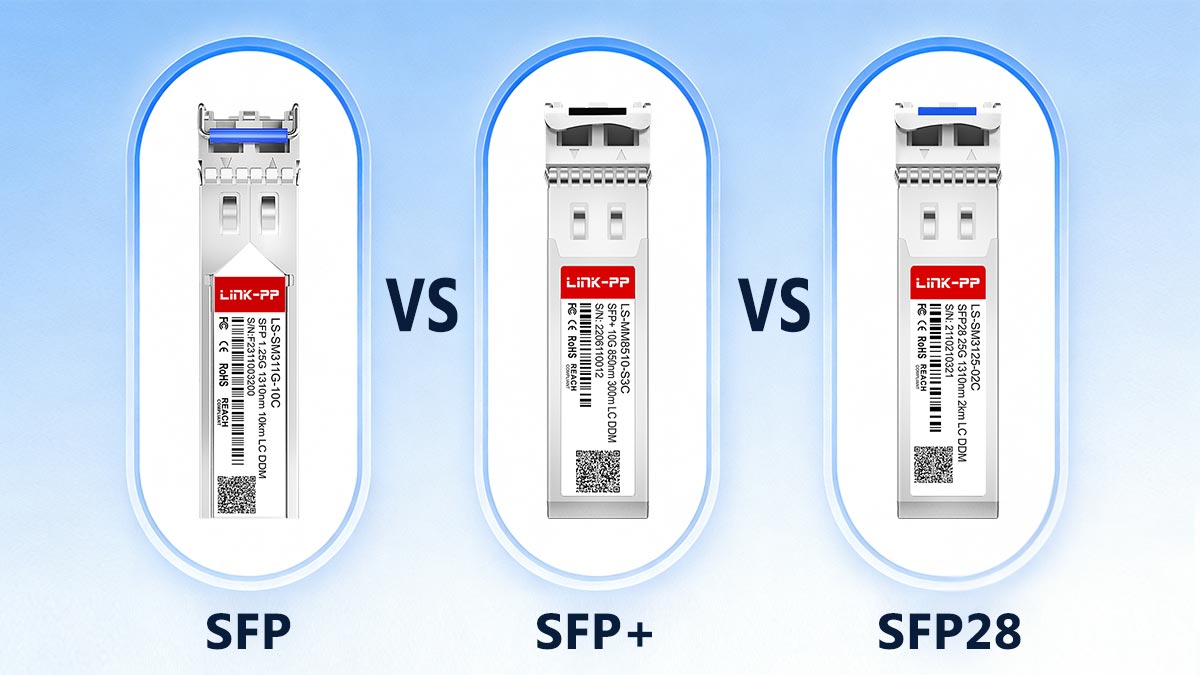
To properly understand SFP data rate evolution, it is essential to compare the three main optical transceiver families: SFP, SFP+, and SFP28. While they share a similar physical form factor and are often confused in real deployments, each generation represents a significant increase in signaling speed, bandwidth capacity, and use-case scenarios in modern Ethernet networks.
1G SFP (1000BASE-SX / 1000BASE-LX)
The original SFP (Small Form-factor Pluggable) standard is designed for Gigabit Ethernet (1G) applications. It typically operates at 1.25 Gbps signaling rate, supporting standards such as:
1000BASE-SX SFP (short-range multimode fiber)
1000BASE-LX SFP (long-range single-mode fiber)
1G SFP modules are widely used in enterprise access networks, campus switches, and legacy infrastructure where traffic demands are moderate and stability is prioritized over raw throughput.
Typical use cases:
Access layer switches
Enterprise LAN connectivity
Legacy fiber uplinks
Cost-sensitive deployments
10G SFP+ (10GBASE-SR / 10GBASE-LR)
The SFP+ (enhanced SFP) standard increases bandwidth by supporting 10.3125 Gbps signaling, enabling full 10 Gigabit Ethernet performance. It is one of the most widely deployed high-speed optical standards in enterprise and data center networks.
Common variants include:
10GBASE-SR (short-range multimode fiber)
10GBASE-LR (long-range single-mode fiber)
SFP+ also supports DAC (Direct Attach Copper) cables, making it a flexible and cost-efficient option for short-distance high-speed links.
Typical use cases:
Data center uplinks
Server-to-switch connections
Network aggregation layers
High-throughput enterprise cores
25G SFP28 (25GBASE-SR)
SFP28 is the next-generation evolution of SFP+ and is designed for 25 Gigabit Ethernet (25G) environments. It uses a 25.78 Gbps signaling rate per lane, offering significantly higher bandwidth efficiency compared to 10G.
Common variant:
25GBASE-SR (short-range multimode fiber)
SFP28 is widely used in modern cloud and hyperscale data center architectures, particularly in leaf-spine designs where bandwidth scaling is critical.
Typical use cases:
Cloud data centers
AI / HPC clusters
Leaf-spine network architecture
High-density switch fabrics
Key Differences in Signaling and Use Cases
Although SFP, SFP+, and SFP28 share a similar physical cage design, their performance differences come from signaling rate, encoding technology, and system-level design requirements.
Category | Ethernet Speed | Signaling Rate | Common Use Case |
|---|---|---|---|
SFP | 1G | 1.25 Gbps | Access networks, legacy LAN |
SFP+ | 10G | 10.3125 Gbps | Data center uplinks, servers |
SFP28 | 25G | 25.78 Gbps | Cloud infrastructure, HPC |
Engineering Insight
From a deployment perspective, the most important distinction is not only speed, but scalability strategy:
1G SFP prioritizes compatibility and cost efficiency
10G SFP+ balances performance and widespread adoption
25G SFP28 optimizes bandwidth density for modern data centers
Each step represents not just a speed increase, but a shift in network architecture design philosophy.
The progression from SFP → SFP+ → SFP28 reflects the evolution of Ethernet from enterprise LAN environments to high-density cloud computing systems. Understanding these differences ensures correct module selection, stable link performance, and future-proof network design.
🔄 What Is the Data Rate of SFP in Real Deployment?
While SFP specifications clearly define theoretical speeds such as 1G, 10G, and 25G, real-world network performance often behaves differently. In production environments, the actual throughput of an SFP link is influenced by multiple system-level factors, including switch hardware limitations, encoding overhead, and optical signal quality. Understanding this gap between theory and practice is essential for accurate network planning and troubleshooting.
Theoretical vs Real-World Throughput
The theoretical SFP data rate refers to the raw signaling speed defined by Ethernet standards:
1G SFP → 1.25 Gbps signaling
10G SFP+ → 10.3125 Gbps signaling
25G SFP28 → 25.78 Gbps signaling
However, the real usable throughput is always lower due to protocol overhead such as:
Ethernet framing
8b/10b or 64b/66b encoding
TCP/IP overhead
Device processing limitations
For example:
A 10G SFP+ link typically delivers ~9.4–9.8 Gbps of usable throughput under ideal conditions.
A 1G SFP link usually delivers ~930–950 Mbps in real traffic tests.
This is why engineers often observe that “line rate” does not equal application-level speed.
Switch Port Limitations
Another critical factor affecting real SFP data rate performance is the switch hardware itself.
Even if a transceiver supports a certain speed, the switch may impose limitations such as:
Port ASIC capacity
Backplane bandwidth
Shared uplink oversubscription
Firmware or licensing restrictions
For example:
Some entry-level switches include 10G-capable SFP+ ports, but internally share limited backplane bandwidth, causing congestion under heavy traffic.
Certain platforms support 1G SFP modules in SFP+ ports, but only if explicitly enabled in firmware.
This means the actual SFP data rate experienced in production is often constrained by the switch architecture rather than the optical module itself.
Optical Module Performance Factors
Beyond switch limitations, the optical transceiver itself plays a major role in real deployment performance. Key influencing factors include:
1. Optical signal quality
Fiber cleanliness
Connector quality
Insertion loss and return loss
2. Transmission distance
Short-range modules (SR) vs. long-range (LR)
Signal degradation over distance directly impacts stability
3. Compatibility and coding
Vendor-specific coding (Cisco, Juniper, Arista, etc.)
Third-party optics compatibility issues
4. Temperature and power stability
High-temperature environments can reduce optical performance
Power fluctuations can affect laser stability
Practical Engineering Insight
In real deployments, engineers often find that SFP performance issues are not caused by the data rate itself, but by a combination of:
Mismatched optics and switch compatibility
Poor fiber quality or excessive link distance
Oversubscribed switching architecture
Firmware or configuration inconsistencies
This is why two identical “10G SFP+” links can perform very differently in different environments.
The SFP data rate in theory defines speed, but the real-world throughput is determined by the entire system stack—including switching hardware, optical quality, and network configuration. For stable performance, engineers must evaluate not only the module specification, but also the full end-to-end deployment environment.
🔄 Common SFP Data Rate Problems in Real Networks
In real-world deployments, SFP data rate issues rarely come from the transceiver specification itself. Instead, most problems originate from mismatched configurations, platform limitations, or compatibility gaps between hardware and firmware. These issues are especially common in mixed-vendor environments and during network upgrades from 1G to 10G.
Understanding these failure patterns is essential for diagnosing performance issues and preventing downtime in production networks.
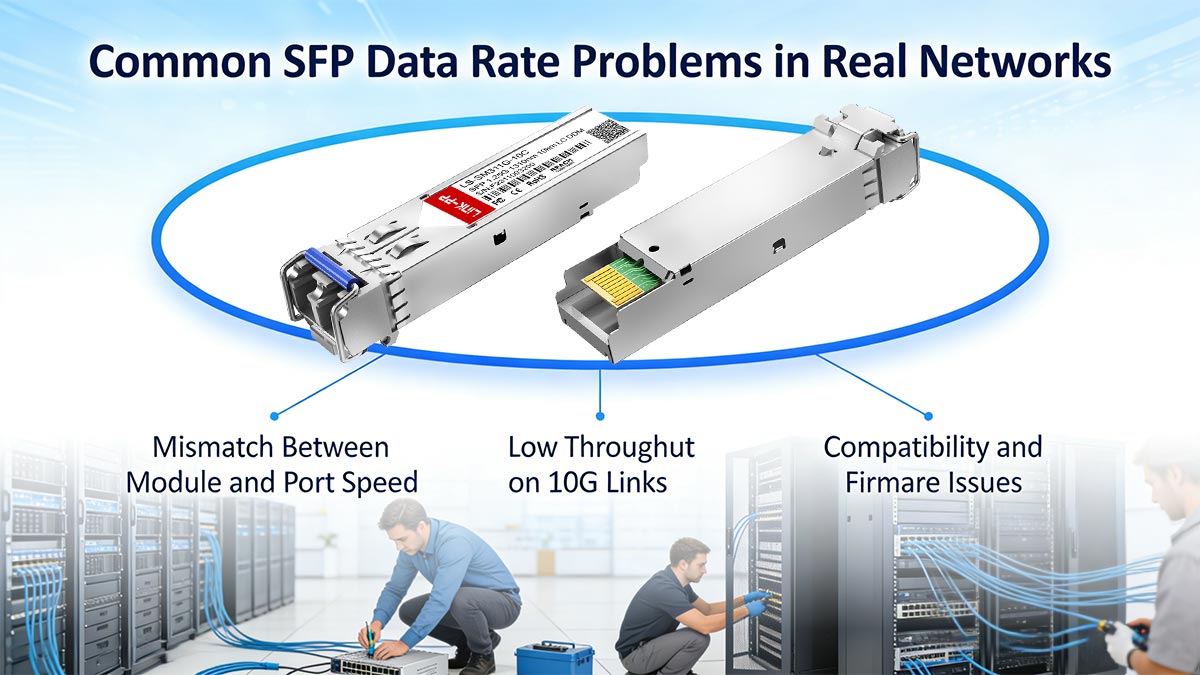
Mismatch Between Module and Port Speed
One of the most frequent SFP data rate problems occurs when the optical module speed does not match the switch port capability or configuration.
Typical scenarios include:
A 1G SFP inserted into a 10G SFP+ port
A 10G SFP+ module forced to run at 1G
Auto-negotiation disabled or incorrectly configured
Ports locked to a fixed speed that does not match the optic
In many cases, the module may still physically link, but performance will be unstable or significantly reduced. Some switches allow dual-rate operation, while others strictly enforce speed matching at the hardware level.
Engineering takeaway:
Always verify both the module coding and the port configuration, not just physical compatibility.
Low Throughput on 10G Links
Another common issue is when a 10G SFP+ link fails to deliver expected performance, often showing significantly lower throughput than 10 Gbps.
Typical symptoms include:
Speed tests capped at 2–5 Gbps instead of ~9.4 Gbps
Intermittent packet loss under load
High latency during burst traffic
Common root causes:
Oversubscribed switch backplane
Faulty or low-quality DAC/fiber cables
Incompatible or third-party optics
Incorrect MTU settings or QoS bottlenecks
CPU-bound traffic processing on the switch
In some cases, engineers initially suspect the SFP module, but the real issue lies in network architecture limitations rather than the optical transceiver itself.
Compatibility and Firmware Issues
Compatibility problems are among the most difficult SFP data rate issues to diagnose, especially in multi-vendor environments.
Common real-world scenarios include:
1. Vendor-coded optics mismatch
Switches from vendors like Cisco, Juniper, or Arista may reject or limit third-party SFP modules due to EEPROM coding restrictions.
2. Firmware-dependent behavior
Some switches require firmware updates to:
Enable 10G support on specific ports
Allow 1G modules in SFP+ cages
Fix optical detection bugs
3. “Link up but no traffic” situation
A frequent engineer-reported issue:
Port shows “up/up”
But no actual traffic passes
Often caused by compatibility or duplex mismatches
4. Dual-rate confusion
Dual-rate SFP modules (1G/10G) may:
Fail to negotiate correctly on unsupported switches
Default to unexpected speeds depending on port configuration
Engineering Insight from Real Deployments
Across production environments, experienced network engineers consistently observe that:
80% of SFP data rate issues are configuration-related
15% are hardware or cable-related
Only a small portion are actual optical module failures
This aligns with common troubleshooting patterns seen in large-scale enterprise and data center networks, where swapping optics alone rarely resolves performance issues unless the root cause is correctly identified.
Most SFP data rate problems in real networks are not speed limitations of the module itself, but instead arise from:
Speed mismatches between ports and optics
Switch architecture and oversubscription
Firmware or vendor compatibility restrictions
A systematic approach—checking configuration, compatibility, and infrastructure first—leads to faster and more accurate troubleshooting than replacing modules blindly.
🔄 How to Choose the Right SFP Data Rate for Your Network?
Selecting the correct SFP data rate is not just about choosing the fastest module available—it is about matching bandwidth requirements with network architecture, scalability goals, and cost efficiency. In modern enterprise and data center environments, the decision typically revolves around 1G SFP, 10G SFP+, and 25G SFP28, each serving a different layer of the network.
Access Layer vs. Aggregation vs Data Center
A practical way to choose the right SFP data rate is to map it directly to the network hierarchy:
Access Layer (End Devices & Edge Switches)
The access layer connects endpoints such as PCs, IP phones, access points, and IoT devices.
Typical speed: 1G SFP
Reason: End devices rarely require more than 1Gbps individually
Focus: Cost efficiency and compatibility
Aggregation Layer (Distribution Switches)
This layer aggregates traffic from multiple access switches and forwards it upstream.
Typical speed: 10G SFP+
Reason: Handles traffic concentration from many 1G links
Focus: Higher throughput and reduced congestion
Data Center / Core Layer
This is where high-speed switching and large-scale data movement occur.
Typical speed: 10G SFP+ → 25G SFP28
Reason: High-density traffic, virtualization, cloud workloads
Focus: Scalability, low latency, and bandwidth efficiency
When to Choose 1G, 10G, or 25G SFP
Choosing the correct SFP data rate depends on both current demand and future scalability requirements.
Choose 1G SFP when:
You are deploying or maintaining legacy networks
Traffic demand is low to moderate
Cost optimization is a priority
Devices only support Gigabit Ethernet
👉 Best for: campus access switches, enterprise LAN edge
Choose 10G SFP+ when:
You need high-speed uplinks or server connectivity
Traffic aggregation is required
You are upgrading from 1G infrastructure
Balanced cost-performance is needed
👉 Best for: enterprise cores, data center uplinks, virtualization hosts
Choose 25G SFP28 when:
You are building modern cloud or hyperscale environments
High bandwidth density is required per port
You need future-proof architecture
You are designing leaf-spine networks
👉 Best for: AI workloads, HPC clusters, cloud data centers
Migration Strategies (1G → 10G Upgrade Paths)
Upgrading network speed is rarely a single-step process. Most organizations follow a phased migration strategy to reduce cost and minimize downtime.
Phase 1: Identify Bottlenecks
Monitor uplink congestion on 1G links
Identify high-traffic aggregation points
Use traffic analysis tools to map bandwidth usage
Phase 2: Upgrade Aggregation Layer First
Replace 1G uplinks with 10G SFP+
Keep access layer at 1G to control cost
Immediately reduce congestion in core paths
Phase 3: Gradual Access Layer Upgrade
Transition high-demand endpoints to 10G where needed
Introduce dual-speed or compatible switches if available
Replace legacy copper/fiber links selectively
Phase 4: Evaluate 25G Adoption
Move from 10G to 25G in data center environments
Optimize for density and future scalability
Prepare for AI/HPC workload requirements
In real deployments, the most successful upgrades follow a “bottleneck-first” strategy, not a full replacement approach. Engineers typically avoid upgrading all endpoints at once and instead focus on:
Uplink congestion points
Core switch limitations
Traffic-heavy services (storage, virtualization, cloud workloads)
This ensures maximum performance improvement at minimal cost.
Choosing the right SFP data rate is a strategic network design decision. A well-balanced architecture typically uses:
1G SFP for access layers
10G SFP+ for aggregation and core
25G SFP28 for modern high-performance data centers
A structured migration plan ensures long-term scalability without unnecessary infrastructure replacement.
🔄 FAQ About SFP Data Rate
Q1: What Does the SFP Data Rate Mean?
The SFP data rate refers to the maximum Ethernet transmission speed supported by an SFP optical transceiver. It defines how fast data can be transmitted and received through the module between network devices such as switches, routers, and servers.
In practical networking terms, SFP data rate is grouped into three main categories:
1G SFP (Gigabit Ethernet)
10G SFP+ (10 Gigabit Ethernet)
25G SFP28 (25 Gigabit Ethernet)
It is important to note that the data rate is determined by the optical/electrical signaling standard, not just the physical size of the module.
Q2: How to Tell If SFP Is 1G or 10Gb?
There are three reliable ways to identify whether an SFP module is 1G or 10G:
1. Label and Part Number Analysis
The part number often clearly indicates the speed class.
2. Datasheet Verification
Checking the official datasheet is the most accurate method. It will specify:
Supported Ethernet standard
Signaling rate (1.25 Gbps vs. 10.3125 Gbps)
Compatible host interface (SFP vs. SFP+)
3. Vendor Coding (Cisco / HPE / Juniper Examples)
Enterprise vendors often use EEPROM coding to lock compatibility:
Cisco coded optics may only work on Cisco-approved devices
HPE Aruba and Juniper may enforce similar validation rules
Third-party modules may require “unlocked” or compatible coding
This is why two physically identical modules may behave differently depending on the switch.
Q3: Is SFP+ Always 10Gb?
SFP+ is primarily a 10 Gigabit Ethernet standard, but its real behavior depends on the platform.
SFP+ Speed Definition
Designed for 10.3125 Gbps signaling
Used for 10GBASE-SR, LR, and DAC connections
Dual-Rate SFP Behavior
Some optical modules are dual-rate (1G/10G):
Can operate at either 1G or 10G
Requires switch and firmware support
Must be explicitly configured in many cases
Platform Dependency (Switch ASIC / Firmware)
Whether SFP+ runs only at 10G or supports 1G depends on:
Switch ASIC design
Vendor firmware limitations
Port configuration settings
Approved transceiver list
👉 Conclusion: SFP+ is 10G by design, but real-world behavior is platform-dependent.
Q4: Is SFP+ 10G or 25G?
SFP+ is 10G. It is not 25G.
The 25G standard belongs to a different module family:
SFP+ → 10 Gigabit Ethernet
SFP28 → 25 Gigabit Ethernet
SFP28 is the evolutionary successor of SFP+, designed for higher bandwidth density in modern data centers, cloud environments, and high-performance computing systems.
🔄 Key Takeaways for SFP Data Rate Selection and Deployment
If you are comparing optical transceivers for a real network deployment, the safest and most reliable principle is simple: match the SFP module family to the correct port family, and always verify compatibility using the official vendor datasheet before purchase. This ensures that your selection aligns with both hardware capabilities and supported Ethernet standards, reducing the risk of deployment issues.
In practical networking environments, this step is critical because even small mismatches between SFP, SFP+, and SFP28 modules can lead to performance degradation, link instability, or complete failure to establish a connection. Major vendors such as Cisco and HPE clearly define these modules as separate speed classes—1G, 10G, and 25G—each designed for specific network layers and performance requirements.
Real-world engineering discussions, including those from network communities, consistently highlight the same issue: incorrect assumptions about compatibility are one of the most common causes of SFP-related troubleshooting cases. Problems such as slow throughput, failed auto-negotiation, or inconsistent link behavior are often not caused by the fiber itself, but by mismatched optics, firmware limitations, or unsupported configurations.
Ultimately, understanding SFP data rate behavior is not just about knowing the speed labels—it is about understanding how optics, switches, and system design interact in a real network environment.
To build stable and scalable networks:
Always match SFP type (1G / 10G / 25G) with switch port capability
Confirm compatibility using official datasheets
Avoid assumptions based on physical form factor alone
Consider real-world deployment behavior, not just theoretical speed
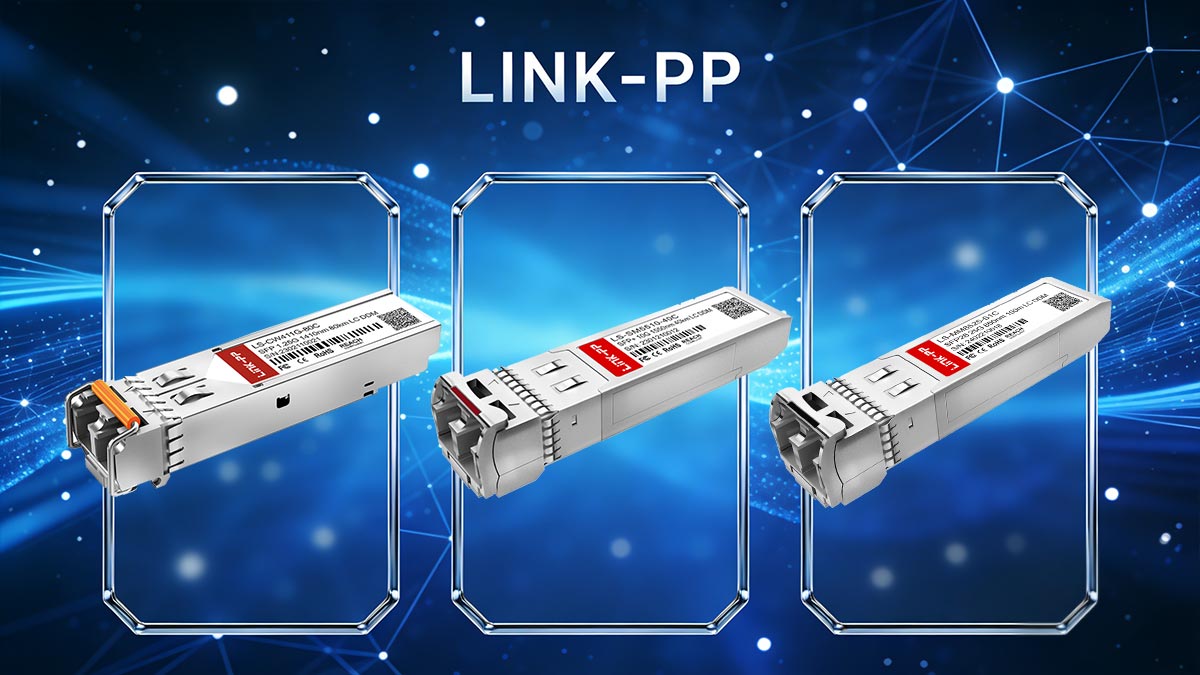
Explore Compatible SFP Solutions
For engineers, system integrators, and procurement teams looking for reliable optical transceivers and network connectivity solutions, you can explore high-quality compatible products and technical resources at the LINK-PP.
👉 Visit the LINK-PP Official Store to view SFP, SFP+ and SFP28 options, datasheets, and compatibility guidance for your network projects.