
✅ What Is FFE (Feed-Forward Equalizer)?
Feed-Forward Equalization (FFE) is one of the most critical technologies used in high-speed digital communication systems, especially in optical transceivers, SerDes interfaces, and backplane/high-speed copper links.
As data rates exceed 10G, 25G, 50G, and move into 100G, 200G, and 400G PAM4 signaling, channel loss and inter-symbol interference (ISI) dramatically increase. To overcome these impairments, modern transmitters rely heavily on FFE to precondition the signal before it enters the channel.
FFE is a linear transmit equalizer that shapes the output waveform using advanced filtering, typically implemented with multiple taps (e.g., main tap, pre-tap, post-tap).
Its goal is simple:
compensate for channel loss before the signal is transmitted, improving the eye opening at the receiver.
✅ How FFE Works in High-Speed Transmitters
FFE operates entirely in the forward path, meaning it does not rely on previous decisions (unlike DFE). Instead, it modifies the amplitude and timing of transitions through weighted taps.
H3: Core Functions of FFE
Pre-emphasis: Boosting high-frequency components that will be attenuated by the channel.
De-emphasis: Reducing low-frequency components to maintain balance.
ISI compensation: Minimizing both precursor and post-cursor ISI.
Eye diagram enhancement: Producing sharper transitions and improved vertical/horizontal margins.
FFE is typically implemented in either analog, DSP-based, or hybrid architectures, depending on the optical module form factor (SFP28, QSFP28, QSFP56, QSFP-DD, etc.).
✅ Why FFE Is Critical in Optical Transceivers
High-speed optical modules rely on FFE to ensure that transmitted electrical signals remain recoverable after passing through PCB traces, connectors, packages, and SerDes interfaces.
Benefits of FFE in Optical Modules
Compensates for high-frequency loss at the source
Reduces burden on the receiver equalizer (CTLE + DFE)
Improves link robustness over longer PCB and host channels
Handles both NRZ and PAM4 requirements
Reduces BER and enhances compliance with IEEE specs
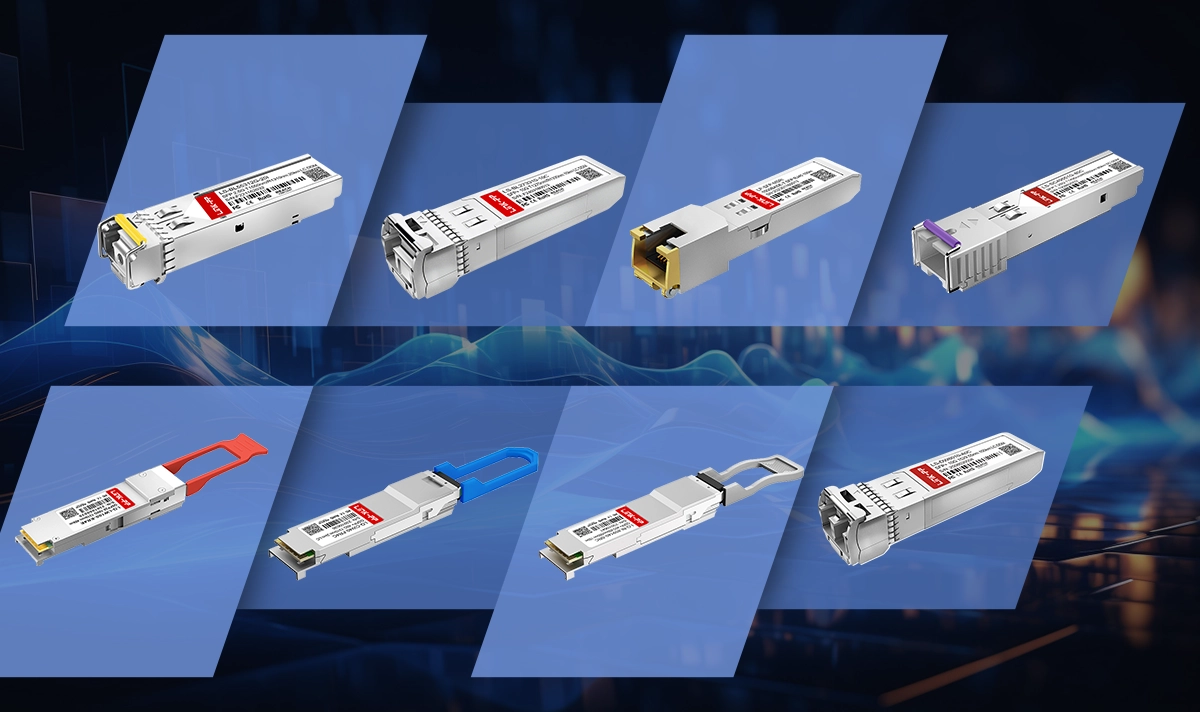
Modern optical transceivers—such as SFP+, SFP28, QSFP28, QSFP56, and QSFP-DD—require highly optimized FFE settings to pass host compliance tests like IEEE 802.3 KR/KR4/KP4.
✅ FFE Tap Structure Explained
FFE uses multiple taps, each contributing a weighted version of the signal:
▷ Main Tap
Defines the primary signal amplitude.
▷ Pre-Tap (Pre-Cursor Compensation)
Boosts or attenuates the signal before the current symbol to counteract precursor ISI.
▷ Post-Tap (Post-Cursor Compensation)
Corrects distortion from previously transmitted bits.
▷ PAM4 Optimization
For 50G/100G PAM4, FFE plays an essential role in shaping four-level signals while minimizing symbol overlap.
✅ FFE vs. CTLE vs. DFE — What’s the Difference?
Below is a compact comparison table that clarifies each equalizer's role:
Equalizer | Location | Function | Key Benefit |
|---|---|---|---|
FFE | Tx Front-End | Pre-emphasis / de-emphasis | Compensates for loss proactively before transmission |
Rx Analog Front-End | Linear HF boost | Restores bandwidth with low noise | |
Rx Digital Stage | Cancels post-cursor ISI | Highly effective for long channels |
Understanding the Hybrid EQ Architecture
Modern SerDes and optical modules rely on FFE + CTLE + DFE together:
FFE shapes the transmitted waveform
CTLE compensates analog high-frequency loss
DFE removes remaining ISI digitally
This multi-stage architecture ensures reliable communication even at extremely high baud rates.
✅ Applications of FFE in High-Speed Systems
FFE is essential across many systems:
Common Applications
Optical transceivers (SFP28, QSFP28, QSFP56, 100G/200G/400G modules)
Server NICs and AI accelerators
Switches and routers
High-speed backplane and midplane links
PCIe 4.0/5.0/6.0 SerDes
FFE is not optional—it is foundational to achieving compliance and maintaining robust signal integrity.
✅ Conclusion
FFE (Feed-Forward Equalizer) is a cornerstone technology in high-speed digital communication. It proactively compensates channel loss at the transmitter through pre-emphasis and de-emphasis, significantly improving eye quality and reducing BER.
Together with CTLE and DFE, FFE enables stable, standards-compliant operation of modern optical transceivers used in 5G, data centers, cloud infrastructure, and AI compute clusters.