

In the intricate world of fiber optic networks, passive components are the unsung heroes that manage and distribute light signals with remarkable efficiency. Among these, fiber optic splitters and fiber optic couplers are fundamental. While the terms are sometimes used interchangeably, they serve distinct purposes.
Understanding the difference between a splitter and a coupler is crucial for designing cost-effective, scalable, and high-performance networks, from sprawling FTTH (Fiber-to-the-Home) deployments to compact data centers. This guide will demystify these components, compare them head-to-head, and explore their synergy with active hardware like optical modules.
✅ Key Takeaways
Use a Fiber Optic Splitter to send one signal to many places. This makes your network easy and saves money.
Pick a Fiber Optic Coupler if you need to mix signals or watch network traffic. Couplers give you more ways to manage signals.
You will lose some signal when using splitters, especially with many outputs. Couplers keep more signal strength, so they are better for important connections.
Think about how your network might grow. Splitters are simple to add for more users. Couplers help control complex setups.
Always look at what your network needs before you choose. Knowing this helps you pick the best device for good performance.
✅ What is a Fiber Optic Splitter?
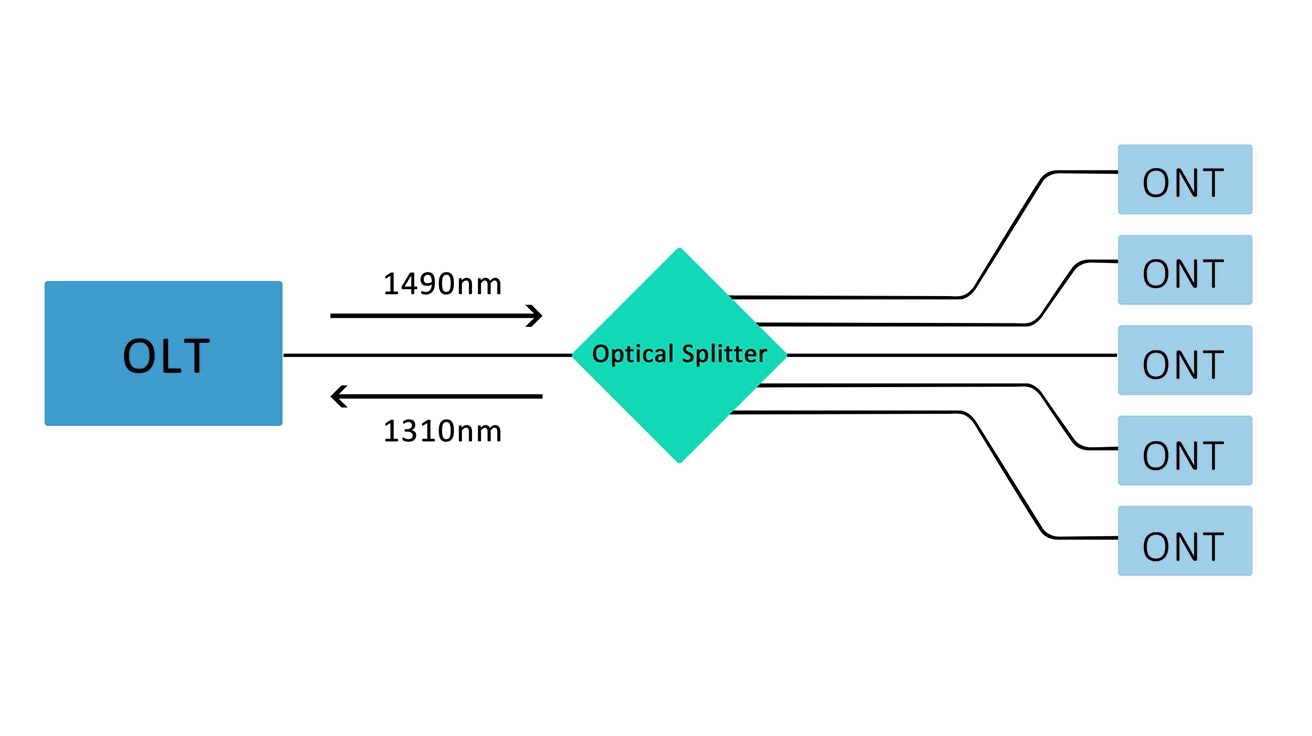
A fiber optic splitter, often called a beam splitter, is a passive device that takes a single optical input signal and divides it into multiple output signals. Its primary function is to enable a point-to-multipoint network architecture, which is the backbone of Passive Optical Networks (PON) like GPON and EPON.
How Does it Work?
Splitters utilize planar lightwave circuit (PLC) or fused biconical taper (FBT) technology to distribute optical power. A PLC splitter, for instance, uses a lithographically patterned waveguide on a silica chip to split the light precisely and uniformly.
Key Applications:
PON Networks: Distributing a single signal from an OLT (Optical Line Terminal) to multiple ONUs (Optical Network Units) in homes and businesses.
FTTH Deployments: Enabling a single fiber to serve multiple subscribers.
CATV Signal Distribution: Splitting a video signal to numerous receivers.
Choosing a high-quality splitter is vital for minimizing signal loss. For instance, when designing a network that requires reliable components, engineers often look for reputable manufacturers to ensure performance.
✅ What is a Fiber Optic Coupler?
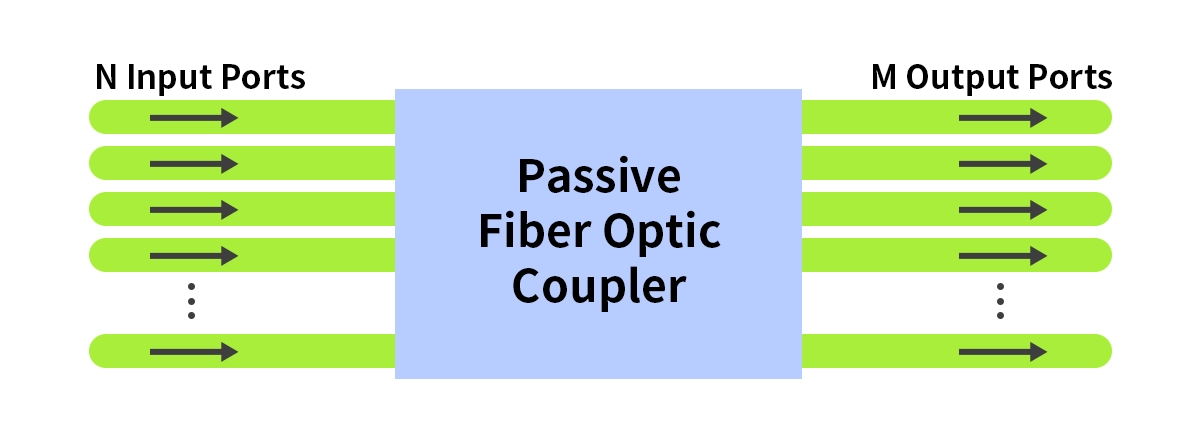
A fiber optic coupler is a broader category of passive components used to combine or distribute optical signals. While all splitters are a type of coupler, not all couplers are simple splitters. Couplers can have multiple inputs and multiple outputs, allowing for more complex signal routing.
How Does it Work?
Couplers work by placing optical fibers in close proximity so that light can couple from one to another. The specific configuration (e.g., 2x2, 1x4) defines its function. They can be designed for various splitting ratios, not just equal division.
Key Applications:
Signal Monitoring/Tapping: A 1x2 coupler can divert a small percentage of the signal (e.g., 5%) to a monitoring port while passing the majority (95%) to the main line.
Bi-directional Transmission: Facilitating upstream and downstream communication over a single fiber by combining and separating wavelengths.
Optical Amplifiers and Sensors: Combining pump laser light with a signal or distributing signals in sensing applications.
When searching for the best optical coupler for monitoring applications, it's essential to consider the insertion loss and the directivity of the component to ensure network integrity.
✅ Splitter vs Coupler: Head-to-Head Comparison
The table below provides a clear, side-by-side comparison to highlight the core differences.
Feature | Fiber Optic Splitter | Fiber Optic Coupler |
|---|---|---|
Primary Function | Divides one input into multiple outputs. | Can combine multiple inputs and/or distribute to multiple outputs. |
Common Configurations | 1xN, 2xN (e.g., 1x8, 1x32, 2x64) | MxN (e.g., 2x2, 1x2, 4x4) |
Splitting Ratio | Typically even (e.g., 50:50, 33:33:33). | Can be even or uneven (e.g., 90:10, 95:5). |
Technology | Primarily PLC or FBT. | FBT, PLC, or micro-optics. |
Key Application | Point-to-Multipoint (PON, FTTH). | Signal Combining/Monitoring (Taps, BiDi transmission). |
Wavelength Sensitivity | PLC is wavelength insensitive over a broad range. | Can be wavelength selective. |
Directivity | Not a primary feature; focuses on splitting. | High directivity is crucial to prevent back reflections. |
💡 Key Takeaway: Think of a splitter as a "one-to-many" device for distribution, and a coupler as a versatile "many-to-many" device for signal management. The choice between an FBT vs PLC splitter often comes down to the required uniformity, wavelength plan, and cost for your specific project.
✅ The Critical Link: Optical Modules in the Ecosystem
While splitters and couplers are passive, they work in concert with active devices to create a functional network. This is where optical modules come into play. An optical module, or transceiver, is the heart of the active equipment, converting electrical signals to optical signals and vice versa.
In a typical PON setup:
An optical module in the OLT (e.g., a GPON SFP) converts downstream electrical data to a 1490nm optical signal.
This signal travels through a single fiber to a 1x32 fiber optic splitter located near end-users.
The splitter divides the signal into 32 identical streams, sending one to each subscriber.
At the subscriber's home, an optical module in the ONU receives this signal and converts it back for use by a router or computer.
For this system to perform reliably, every component must be high-quality and compatible. This includes the passive splitter and the active transceiver. For network engineers looking for robust and interoperable solutions, integrating components from a trusted supplier like LINK-PP can streamline deployment.
A specific module perfectly suited for such splitter-based networks is the LINK-PP GPON-ONU SFP module. This module is designed for user-end applications, offering high sensitivity and stability, which is essential for maintaining a strong signal even after it has been split multiple ways. Ensuring compatibility between your optical transceivers and your passive splitters is a critical step in optimizing PON network performance.
✅ How to Choose: Splitter or Coupler?
Selecting the right component boils down to your network's architecture and requirements.
Choose a Fiber Optic Splitter if you need to:
Build a PON/FTTH network.
Broadcast the same signal to many users from a single source.
Achieve a simple, cost-effective point-to-multipoint layout.
Choose a Fiber Optic Coupler if you need to:
Tap or monitor a live fiber link without interrupting the main signal.
Combine two or more optical signals into one fiber.
Implement bidirectional communication over a single strand.
Create a specific, uneven splitting ratio.
For complex network designs, you might find yourself using both components in tandem. The goal is always to maximize performance while minimizing loss and cost.
✅ Conclusion
Fiber optic splitters and couplers are indispensable yet distinct tools in a network engineer's arsenal. Splitters excel at signal distribution for multi-user access, forming the foundation of modern FTTH services. Couplers offer greater versatility for signal monitoring, combination, and specialized routing.
The efficiency of your entire optical network depends on the seamless integration of these passive components with active hardware like high-performance optical transceiver modules. By selecting the right components—whether it's a standard PLC splitter or a specialized LINK-PP transceiver—you ensure a robust, scalable, and future-proof infrastructure. Understanding these differences is the first step toward mastering fiber optic network design and achieving superior signal integrity in passive optical networks.
✅ FAQ
What is the main difference between a fiber optic splitter and a coupler?
You use a splitter to send one signal to many outputs. You use a coupler to mix or split signals in two directions. Splitters work best for sharing. Couplers give you more control.
When should you choose a splitter instead of a coupler?
Pick a splitter if you want to share one signal with many places, like homes or offices. Couplers work better when you need to combine signals or monitor traffic.
Does a splitter or coupler cause more signal loss?
Splitters usually cause more signal loss because they divide one signal into many outputs. Couplers keep more signal strength, especially when you only split between two paths.
Can you use both splitters and couplers in the same network?
Yes, you can use both. You might use splitters to share data and couplers to monitor or mix signals. This helps you build a flexible network.
Which device is easier to install in a large network?
You find splitters easier to install for large networks. They have a simple design and connect many users quickly. Couplers need more planning if you want to mix or tap signals.