

In modern Gigabit Ethernet networks, choosing the right optical module is not just about speed—it is about matching the correct technology to your fiber infrastructure. One of the most widely used solutions for short-distance links is the 1G multimode SFP, commonly associated with 1000BASE-SX optics. But what exactly does this mean, and how does it apply to real-world network design?
A 1G multimode SFP is a Small Form-Factor Pluggable transceiver designed to deliver 1 Gigabit per second data rates over multimode fiber (MMF). Typically operating at an 850 nm wavelength, these modules are optimized for short-range transmission, making them ideal for data centers, enterprise networks, and campus environments where distances are relatively limited but reliability is critical.
However, confusion around this topic is extremely common. Many users ask:
Is 1000BASE the same as 1G?
What is the difference between SX and LX SFP modules?
Can a multimode SFP work with single-mode fiber—or vice versa?
These are not just beginner questions—they are real engineering challenges that frequently appear in field deployments and even in experienced network teams.
What You’ll Learn in This Guide
By the end of this article, you will clearly understand:
What a 1G multimode SFP actually is and how it works
How 1000BASE-SX enables short-range fiber communication
The key differences between multimode and single-mode SFP modules
When to choose SX optics for your network design
Common compatibility mistakes and how to avoid them
Whether you are designing a new network, upgrading existing infrastructure, or selecting components for procurement, this guide will help you make accurate, standards-based decisions—while avoiding costly mismatches between optics and fiber.
Let’s start by breaking down the fundamentals of what a 1G multimode SFP module really is.
🚩 What Is a 1G Multimode SFP Module?
When working with Gigabit fiber networks, one of the most common yet misunderstood components is the 1G multimode SFP module. Many users encounter terms like SFP, SX, and multimode fiber without fully understanding how they fit together in a real deployment. In simple terms, this module is the standard solution for short-range optical communication at 1 Gigabit speeds, widely used in enterprise, data center, and campus networks. To use it correctly, it is essential to understand not just what it is, but how it functions, where it fits in the network, and why multimode fiber is the preferred medium for short-distance links.
1G Multimode SFP Definition and Basic Function
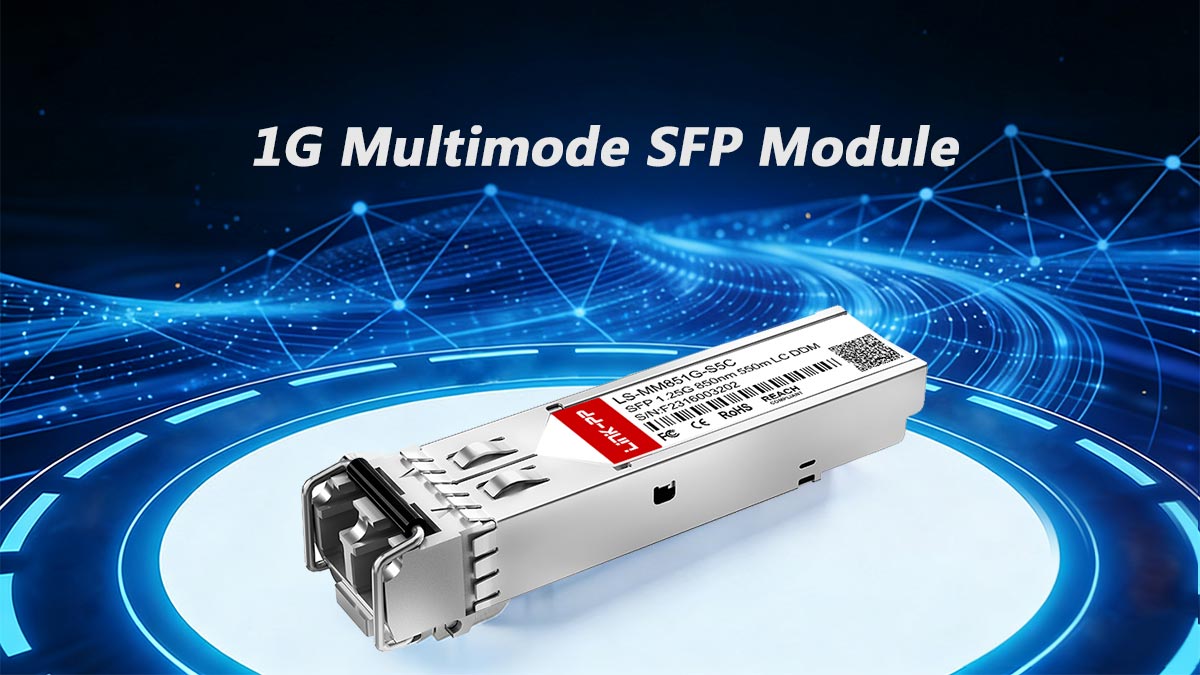
A 1G multimode SFP module is a hot-swappable optical transceiver designed to transmit and receive 1 Gigabit per second (1 GbE) data over multimode fiber (MMF). It follows the industry-standard Small Form-Factor Pluggable (SFP) interface, allowing it to be easily inserted into switches, routers, media converters, and network interface cards.
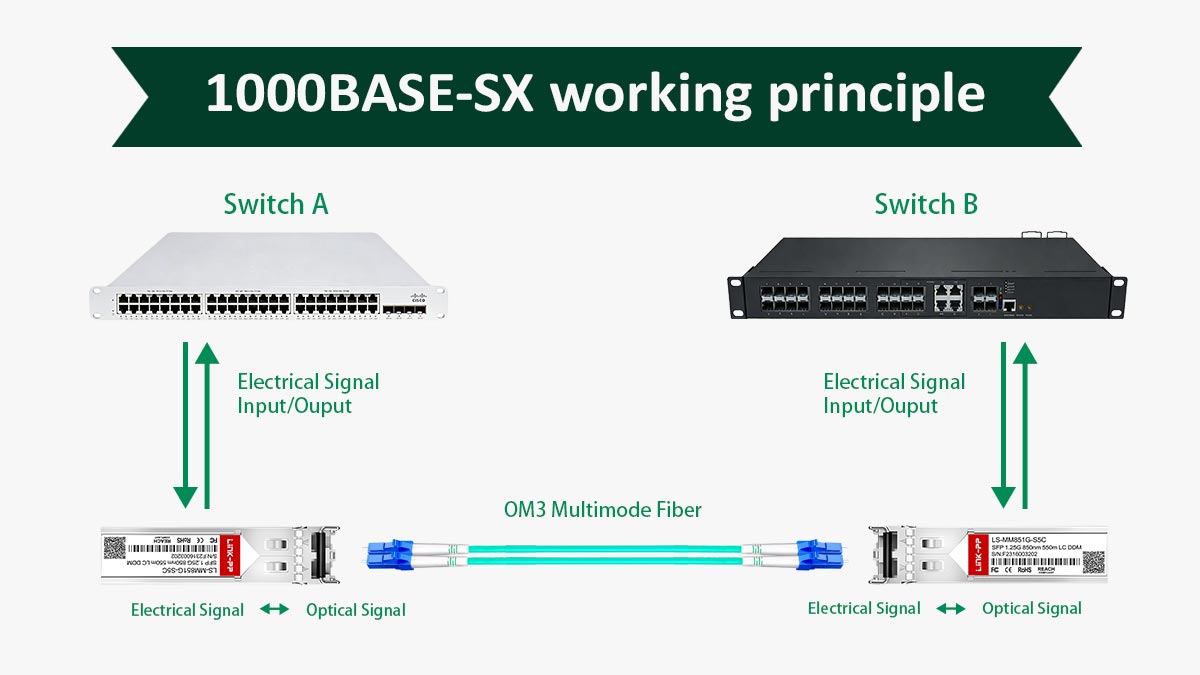
In most practical deployments, a 1G multimode SFP corresponds to the 1000BASE-SX standard, which operates at an 850 nm wavelength and is optimized for short-distance communication. The module converts electrical signals from network equipment into optical signals, transmits them over fiber, and then converts them back into electrical signals at the receiving end.
From a functional perspective, it acts as the bridge between copper-based electronics and fiber optic infrastructure, enabling high-speed, low-latency data transmission within localized environments.
Role in Gigabit Ethernet Networks
Within Gigabit Ethernet architectures, the 1G multimode SFP plays a critical role in enabling reliable, high-speed connectivity across short distances. It is commonly used in:
Data centers for switch-to-switch connections
Enterprise networks for wiring closets and floor distribution
Campus environments for building-to-building links (short range)
SMB and home lab setups for cost-effective fiber deployment
Because it adheres to standardized protocols like 1000BASE-SX, it ensures interoperability across vendors, provided compatibility requirements are met. This makes it a practical and scalable solution for both legacy Gigabit systems and modern hybrid networks.
Another important role is port flexibility. Since SFP ports are modular, network engineers can choose between fiber (SX/LX) or copper (RJ45) modules depending on the specific deployment scenario—without changing the core hardware.
Why Multimode Fiber Is Used for Short-Range Links
Multimode fiber is specifically designed for short-distance, high-bandwidth communication, which is why it pairs naturally with 1G SX SFP modules.
Here’s why MMF is preferred in these scenarios:
Larger core size (50/62.5 µm): Makes light injection easier and reduces alignment precision requirements
Lower cost optics: Multimode transceivers like SX are typically more affordable than single-mode (LX/LR) optics
Sufficient reach for most indoor deployments:
OM2: up to ~550 meters
OM3/OM4: optimized for high performance and stability
However, multimode fiber does have limitations. Due to modal dispersion (multiple light paths traveling at different speeds), it is not suitable for long-distance transmission. That is why it is categorized as a short-range solution, while single-mode fiber is used for long-haul links.
In real-world network design, this leads to a simple rule:
Use multimode SFP (SX) for short, cost-sensitive links, and single-mode SFP (LX/LR) for longer distances and future scalability.
Understanding this distinction is essential for avoiding one of the most common deployment mistakes—mismatching fiber type and optical module.
🚩 How 1000BASE-SX Works in Multimode Fiber Networks
Understanding how 1000BASE-SX operates is essential for selecting the right 1G multimode SFP and designing a reliable short-range fiber link. Unlike copper Ethernet, fiber transmission depends on light wavelength, fiber type, and signal behavior inside the core. SX optics are specifically engineered to perform efficiently within these constraints.
850 nm Wavelength: Why It Matters
The defining characteristic of 1000BASE-SX is its use of an 850 nanometer (nm) wavelength, which falls within the near-infrared spectrum. This wavelength is ideal for multimode fiber because it works efficiently with low-cost VCSEL (Vertical-Cavity Surface-Emitting Laser) technology.
Key advantages of 850 nm in SX modules:
Lower cost optics compared to longer wavelengths (e.g., 1310 nm used in LX)
Efficient coupling into larger multimode fiber cores
Reduced power consumption and heat generation
Optimized for short-distance transmission
However, 850 nm light also has higher attenuation over long distances compared to longer wavelengths, which is one reason SX modules are not used for long-haul links.
Typical Reach: OM2, OM3, and OM4 Performance
The transmission distance of a 1000BASE-SX SFP depends heavily on the type of multimode fiber used. Different MMF standards (OM2, OM3, OM4) are designed with varying bandwidth capabilities.
Typical reach guidelines:
OM2 (50/125 µm): up to ~550 meters
OM3 (laser-optimized MMF): up to ~550 meters (with improved signal quality)
OM4 (enhanced MMF): up to ~550 meters (greater margin and stability)
While the maximum rated distance is often similar at 1G speeds, higher-grade fibers like OM3 and OM4 provide:
Better signal integrity
Lower attenuation and dispersion
More stable performance in high-density or noisy environments
In real deployments, this means OM3/OM4 are preferred for future-proofing, even if current speeds are only 1G.
Why SX Optics Is Optimized for Short-Distance Transmission
The design of 1000BASE-SX is intentionally focused on short-range efficiency rather than long-distance reach. This is primarily due to how light behaves inside multimode fiber.
Key reasons include:
Modal dispersion: Multiple light paths (modes) travel at different speeds, causing signal spreading over distance
Higher attenuation at 850 nm: Limits effective transmission range compared to 1310 nm or 1550 nm
Cost-performance balance: SX prioritizes affordability and simplicity for short links
Because of these factors, SX modules are best suited for:
In-building links (rack-to-rack, floor-to-floor)
Data center interconnects
Short campus connections
This leads to a practical engineering guideline:
1000BASE-SX is the most efficient and cost-effective choice for short multimode fiber links, but it is not designed for long-distance transmission.
By understanding how wavelength, fiber type, and physical limitations interact, network designers can confidently deploy 1G multimode SFP modules in the environments where they perform best—short, high-speed, and cost-sensitive connections.
🚩 1G vs. 1000BASE: Are They the Same Thing?
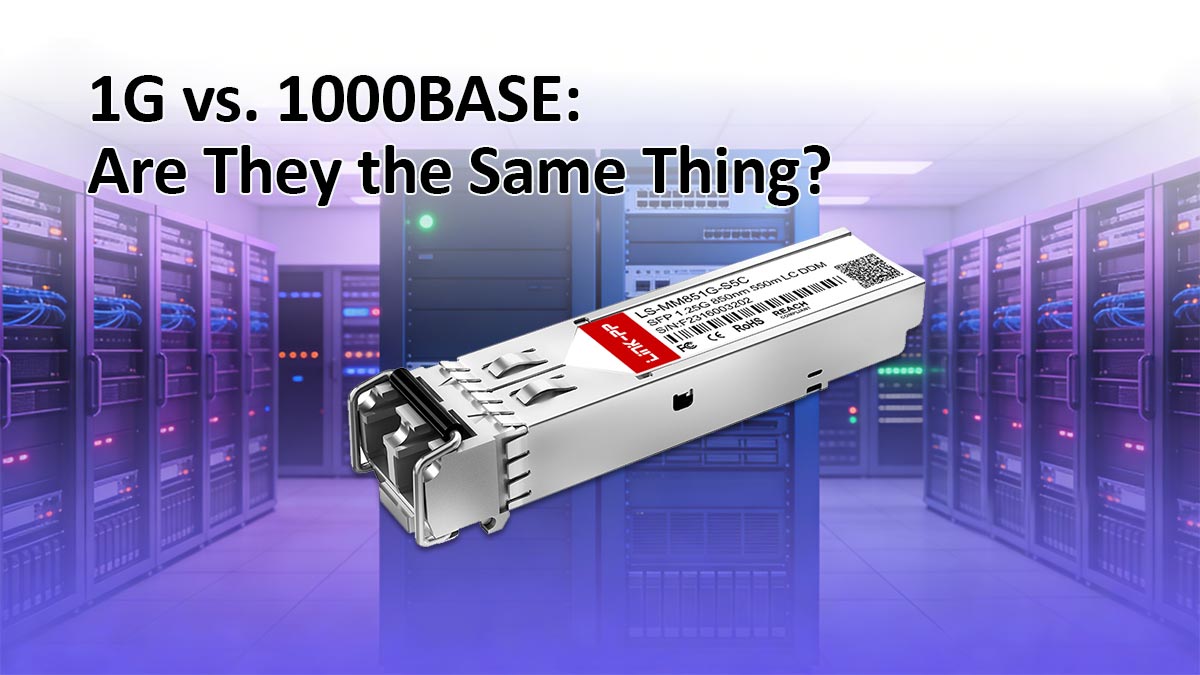
If you’ve ever compared SFP modules or read datasheets, you’ve probably noticed different terms like 1G, 1GbE, and 1000BASE-SX/LX used almost interchangeably. While they all refer to Gigabit Ethernet, understanding the naming conventions behind them is important for avoiding confusion—especially when selecting the right 1G multimode SFP.
Naming Conventions Explained (1G, 1GbE, 1000BASE)
At a fundamental level, these terms all describe the same data rate:
1G / 1Gbps: Informal shorthand for 1 Gigabit per second
1GbE (Gigabit Ethernet): Refers to the Ethernet standard operating at 1 Gbps
1000BASE: The official IEEE naming convention for Gigabit Ethernet over different media
The term 1000BASE comes from the IEEE 802.3 standard, where:
“1000” = 1000 Mbps (1 Gbps)
“BASE” = baseband transmission (as opposed to broadband)
The suffix (e.g., SX, LX, T) defines the physical medium and transmission characteristics
For example:
1000BASE-SX → Multimode fiber, short range, 850 nm
1000BASE-LX → Single-mode fiber, long range, 1310 nm
1000BASE-T → Copper Ethernet over RJ45
So, in practical terms:
“1G SFP” and “1000BASE SFP” usually refer to the same speed—but not necessarily the same type of module.
Industry Labeling Differences
Although the underlying technology is standardized, manufacturers and vendors often use different labeling styles, which can lead to confusion.
Common variations include:
Speed-first labeling:
“1G SFP”, “1.25G SFP”
Standard-based labeling:
“1000BASE-SX”, “1000BASE-LX”
Mixed labeling (very common):
“1G SX SFP”, “Gigabit LX Transceiver”
In many product listings, you’ll see both naming systems combined to improve clarity and searchability. For example:
“1G 1000BASE-SX SFP Module”
“Gigabit Ethernet SX Transceiver (850 nm MMF)”
How Vendors Describe the Same Technology Differently
Different vendors may describe essentially the same 1G multimode SFP in slightly different ways depending on their product strategy, audience, or branding.
For example, the same SX module might be described as:
“1G Multimode SFP (850 nm, 550 m)”
“1000BASE-SX Optical Transceiver”
“Gigabit Ethernet MMF SFP Module”
Despite the different wording, these typically refer to the same core specifications:
Speed: 1 Gbps
Fiber type: Multimode
Wavelength: 850 nm
Reach: Up to ~550 m
This variation can create confusion for buyers, especially when comparing products across vendors or platforms. That’s why experienced engineers rely less on marketing names and more on key technical parameters.
Key Takeaway
1G, 1GbE, and 1000BASE all refer to Gigabit Ethernet—but the suffix (SX, LX, T) is what truly defines the module type.
When selecting a module, always look beyond the “1G” label and verify:
Fiber type (multimode vs single-mode)
Transmission standard (SX, LX, etc.)
Wavelength and distance
Understanding these naming conventions ensures you choose the correct short range SFP module—and avoid one of the most common mistakes in fiber network deployments.
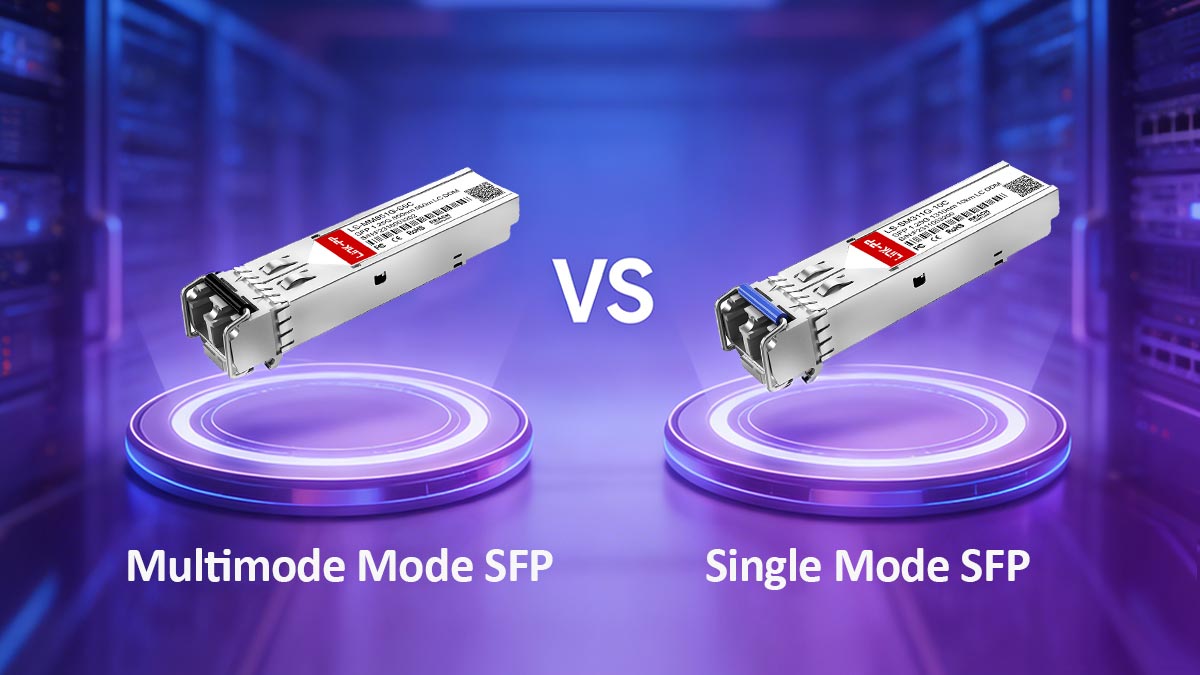
🚩 Multimode vs. Single Mode SFP: Key Differences
When selecting a 1G SFP module, one of the most critical decisions is choosing between multimode and single-mode optics. Although both support Gigabit Ethernet, they are designed for completely different transmission environments, with distinct differences in fiber structure, distance capability, and typical use cases.
Understanding these differences is essential to avoid compatibility issues and ensure optimal network performance.
1. Fiber Core Size Comparison
The most fundamental difference lies in the fiber core diameter, which directly affects how light travels through the cable.
Multimode Fiber (MMF):
Core size: 50 µm or 62.5 µm
Allows multiple light paths (modes)
Easier light injection, lower alignment precision required
Single-Mode Fiber (SMF):
Core size: ~9 µm
Allows only one light path
Requires more precise laser alignment
Because multimode fiber supports multiple light paths, it is more flexible and cost-effective for short distances. In contrast, single-mode fiber provides higher precision and signal integrity over long distances.
2. Distance and Performance Differences
Distance capability is where multimode and single-mode solutions diverge the most:
Multimode SFP (SX):
Typical reach: up to ~550 meters
Optimized for short-range communication
Lower cost, but limited by modal dispersion
Single-Mode SFP (LX/LH/LX10):
Typical reach: 10 km or more
Designed for long-distance transmission
Higher cost optics, but minimal signal dispersion
In practical terms:
Multimode is ideal for short, cost-sensitive links, while single-mode is the standard for long-distance and high-stability transmission.
3. SX vs. LX/LH/LX10 Classification
SFP modules are categorized based on their transmission standards, which define wavelength, fiber type, and reach.
Type | Wavelength | Fiber Type | Typical Reach | Key Notes |
|---|---|---|---|---|
SX (Short Wavelength) | 850 nm | Multimode fiber (MMF) | Up to ~550 m | Optimized for short-range, low-cost Gigabit links |
LX / LH (Long Wavelength) | 1310 nm | Primarily single-mode fiber (SMF) | Up to ~10 km or more | Designed for medium to long-distance transmission |
1310 nm | Single-mode fiber (SMF) | Up to ~10 km | Extended reach version of LX for longer stable links |
While some LX modules can operate over multimode fiber using mode-conditioning patch cables, this is considered a special case workaround rather than standard deployment practice. In most network designs, engineers strictly follow:
SX → Multimode fiber (short range)
LX/LH/LX10 → Single-mode fiber (long range)
4. Real-World Deployment Scenarios
Choosing between multimode and single-mode SFPs depends on the network environment and future requirements.
Multimode SFP (SX) is commonly used in:
Data centers (rack-to-rack connections)
Enterprise building networks (floor distribution)
Short campus links
Home labs and SMB deployments
Single-Mode SFP (LX/LH/LX10) is preferred for:
Long-distance campus or metro links
Inter-building connections exceeding MMF limits
ISP and telecom infrastructure
Future-proof network designs requiring scalability
Practical Engineering Insight
A common real-world mistake is mixing multimode fiber with single-mode optics (or vice versa), which often leads to signal loss or link failure.
A simple rule to follow:
Match SX with multimode fiber, and LX/LH/LX10 with single-mode fiber.
By understanding these key differences, network designers can confidently choose the right 1G SFP module for their specific application—balancing cost, performance, and scalability.
🚩 When Should You Use a Short Range SFP Module?
Choosing a short range SFP module—typically a 1G multimode SFP (1000BASE-SX)—comes down to one key factor: distance within a controlled environment. These modules are specifically designed for high-speed, cost-efficient connectivity over short multimode fiber links, making them the default choice in many internal network scenarios.
If your deployment does not require long-distance transmission, short-range optics often provide the best balance of performance, cost, and simplicity.
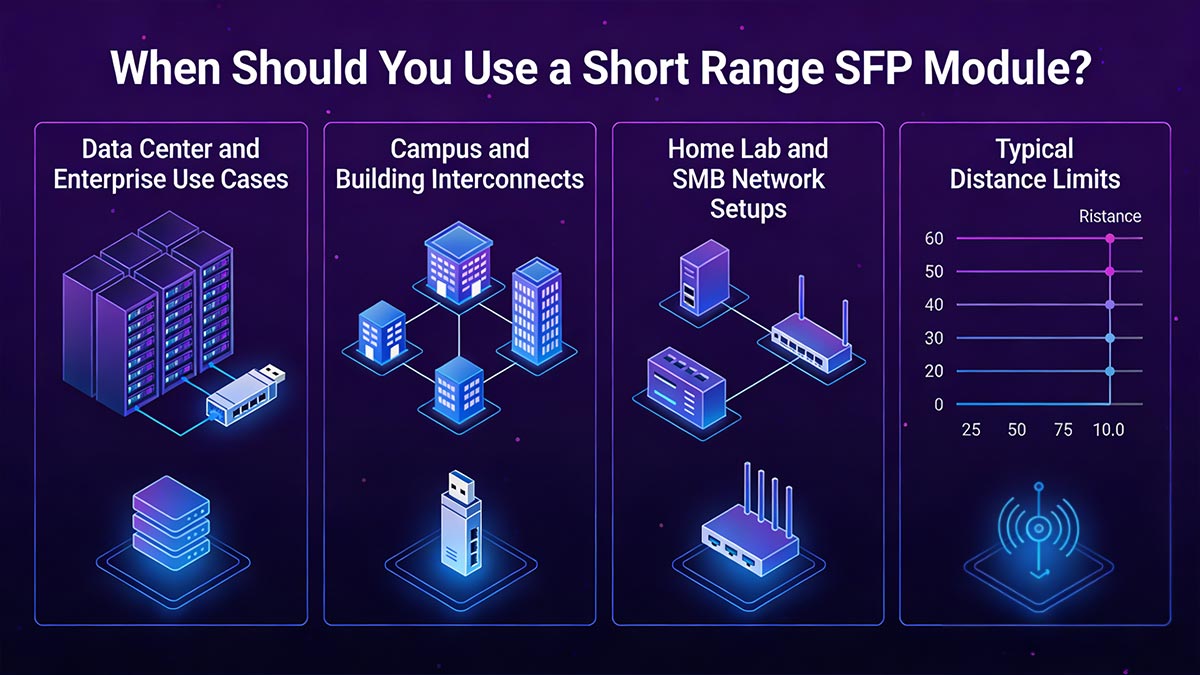
▶ Data Center and Enterprise Use Cases
In data centers and enterprise networks, short-range SFP modules are widely used for intra-building connectivity, where distances are predictable and relatively short.
Typical applications include:
Switch-to-switch links within the same rack or row
Top-of-rack (ToR) to aggregation switches
Server-to-switch fiber uplinks
Wiring closet interconnections across floors
In these environments, using 1000BASE-SX over multimode fiber provides:
Low latency and stable performance
Lower transceiver cost compared to long-range optics
Simplified deployment with existing MMF infrastructure
Because most enterprise cabling systems already use OM3 or OM4 fiber, SX modules integrate seamlessly without requiring major upgrades.
▶ Campus and Building Interconnects
Short range SFP modules are also suitable for campus and multi-building environments, as long as the distance stays within multimode limits.
Common scenarios:
Building-to-building links within the same campus
Distribution layer connections between network closets
Industrial or office park networks with short fiber runs
For distances under ~300–550 meters, multimode SX optics are often more cost-effective than deploying single-mode solutions.
However, if there is any possibility that the link distance may increase in the future, many engineers choose single-mode (LX/LR) instead for scalability.
▶ Home Lab and SMB Network Setups
In smaller-scale environments such as home labs and SMB (small-to-medium business) networks, short-range SFP modules are extremely popular due to their affordability and ease of use.
Typical use cases include:
Connecting switches across rooms or floors
Linking NAS systems or servers via fiber
Building quiet, interference-free network backbones
Experimenting with fiber networking in lab environments
Compared to copper (RJ45), fiber with SX modules offers:
Immunity to electromagnetic interference (EMI)
Lower latency in some scenarios
Cleaner cable management for longer indoor runs
This makes 1G multimode SFP modules an attractive upgrade path from traditional Ethernet cabling.
▶ Typical Distance Limits and Design Rules
To use short range SFP modules effectively, it is important to follow basic distance and design guidelines:
Typical maximum distances for 1000BASE-SX:
OM2: up to ~550 meters
OM3/OM4: up to ~550 meters (with better performance margin)
Key design rules:
Always match SFP type to fiber type (SX → multimode)
Keep total link distance within supported limits
Ensure both ends use compatible modules
Avoid mixing wavelengths (e.g., SX with LX)
Use quality connectors and clean fiber interfaces
A practical rule for network planning:
If your link is under 500 meters and uses multimode fiber, a short range SFP (SX) is usually the best choice.
Final Insight
Short range SFP modules are not just a “budget option”—they are a purpose-built solution for high-efficiency, short-distance networking. When used in the right scenarios, they deliver reliable Gigabit performance with minimal complexity, making them a cornerstone of modern fiber deployments.
🚩 Common SX Optics Compatibility Issues and Real User Mistakes
Even though 1G multimode SFP modules are widely used and relatively easy to deploy, most real-world network failures are not caused by hardware defects—they are caused by compatibility mistakes. These issues often stem from misunderstanding fiber types, wavelengths, or device requirements.
Based on real engineer feedback and field experience, the following are the most common pitfalls you should avoid.
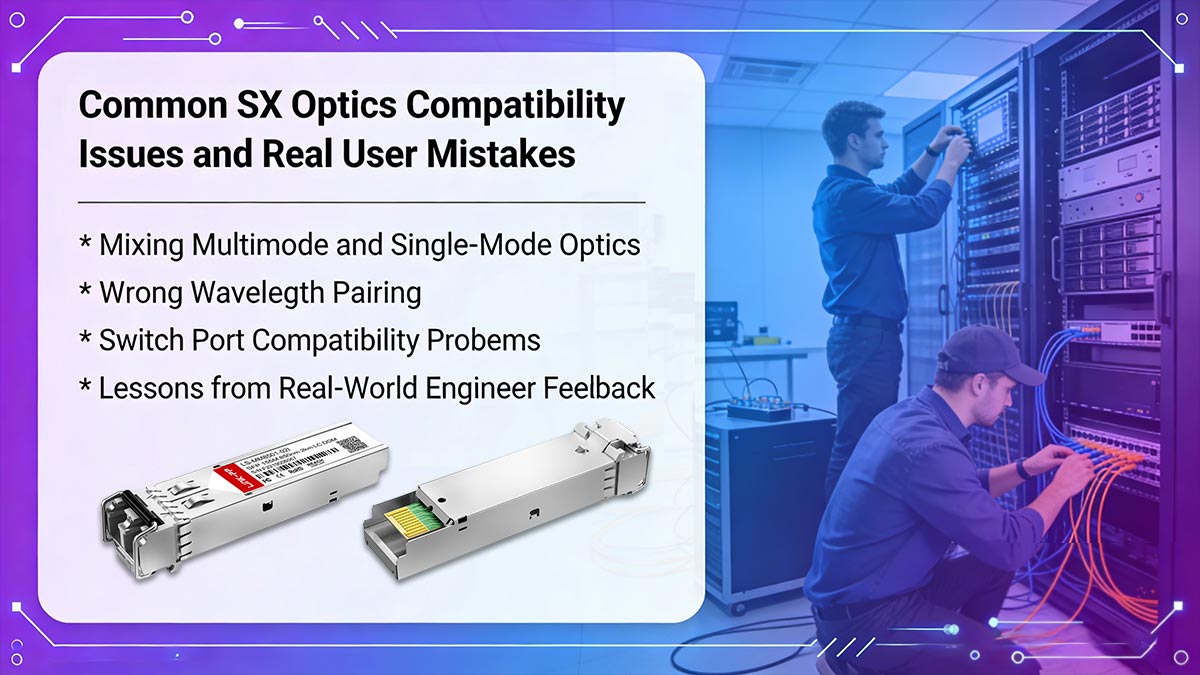
📌 Mixing Multimode and Single-Mode Optics
One of the most frequent mistakes is pairing a multimode SFP (SX) with single-mode fiber (SMF)—or the reverse.
Typical incorrect scenarios:
SX module + single-mode fiber
LX/LH module + multimode fiber (without proper conditioning)
Why this causes problems:
Mismatched core sizes prevent proper light propagation
Signal loss or unstable links
In many cases, the link will not come up at all
While some LX modules can operate over multimode fiber using a mode-conditioning patch cable, this is considered a legacy workaround, not a standard design approach.
Best practice: Always match fiber type and optic type —
SX → Multimode fiber, LX/LH/LX10 → Single-mode fiber
📌 Wrong Wavelength Pairing
Another common issue is using SFP modules with different wavelengths on each end of the link.
For example:
One side: 850 nm (SX)
Other side: 1310 nm (LX)
Since standard SFP modules transmit and receive on fixed wavelengths, mismatched pairs cannot properly communicate.
Common symptoms:
No link light
Intermittent connection
Extremely high error rates
This issue is especially common when mixing modules from different inventories without verifying specifications.
Rule: Both ends must use the same standard and wavelength (e.g., SX ↔ SX).
📌 Switch Port Compatibility Problems
Not all SFP ports are universally compatible, even if they physically accept the module.
Typical issues include:
Vendor-locked ports (requiring approved SFP modules)
Incompatibility between SFP (1G) and SFP+ (10G) ports
Firmware restrictions or unsupported transceiver types
For example:
Some switches do not accept third-party SFP modules
Some SFP+ ports support 1G modules, while others do not
Common results:
Module not recognized
Port disabled or error messages
Link failure despite correct cabling
Best practice: Always verify:
Switch compatibility list
Supported SFP types (1G vs. 10G)
Firmware requirements
📌 Lessons from Real-World Engineer Feedback
Across real deployments and community discussions, a few consistent lessons emerge:
“Fiber is not plug-and-play like Ethernet.”
Every parameter—fiber type, wavelength, module type—must match preciselyMost problems are configuration issues, not hardware failures
Replacing modules rarely fixes a mismatch problemStandardization reduces errors
Many engineers choose to standardize on either multimode (SX) or single-mode (LX) within a networkCheck specs before swapping modules
Assumptions about compatibility often lead to downtime
Practical Takeaway
Nearly all SFP-related issues can be avoided by verifying three things: fiber type, wavelength, and device compatibility.
By understanding these common mistakes, you can prevent costly troubleshooting and ensure your short range SFP module deployment works correctly from the start.
🚩 How to Choose the Right 1G Multimode SFP for Your Network
Selecting the right 1G multimode SFP is not just about picking a “Gigabit module”—it requires aligning fiber type, distance, compatibility, and future scalability. A small mismatch can lead to performance issues or complete link failure, while a well-matched choice ensures stable, long-term operation.
Below is a practical, engineer-focused framework to help you make the right decision.
Fiber Type Verification Checklist
Before selecting any SFP module, the first step is to confirm your existing fiber infrastructure. This avoids the most common deployment mistakes.
Quick checklist:
Fiber type: Multimode (MMF) or Single-mode (SMF)?
Fiber grade: OM2, OM3, or OM4?
Connector type: LC is standard for most SFP modules
Link distance: Actual measured or estimated length
Existing equipment: Switches, NICs, or media converters
For a 1G multimode SFP, your answer should be:
Multimode fiber confirmed
Distance within ~550 meters
Standard LC interface
If any of these do not match, you may need a different SFP type (e.g., LX for single-mode).
OM3 vs. OM4 Selection Guidance
While both OM3 and OM4 multimode fibers support 1G SX transmission up to similar distances, they differ in performance margin and future scalability.
OM3:
Widely deployed and cost-effective
Fully supports 1G (1000BASE-SX) up to ~550 m
Suitable for most enterprise applications
OM4:
Higher bandwidth and better signal integrity
Improved performance in high-density environments
Better suited for future upgrades (e.g., 10G/40G/100G)
Recommendation:
Choose OM3 for standard Gigabit deployments
Choose OM4 if you want future-proofing and higher performance headroom
Even though the difference may not be critical at 1G, it becomes important when upgrading to higher speeds later.
Vendor Compatibility Considerations
One of the most overlooked factors is switch and vendor compatibility. Not all SFP modules work in all devices—even if the specifications match.
Key points to verify:
Does your switch support third-party SFP modules?
Is the port designed for 1G SFP or 10G SFP+?
Are there firmware restrictions or vendor lock-ins?
Some vendors require coded or certified modules, while others allow open compatibility. Using an unsupported module can result in:
Port errors or warnings
Disabled interfaces
Unstable connections
Always check the compatibility matrix or datasheet before purchasing.
Future-Proofing Network Design Decisions
While a 1G multimode SFP may meet your current needs, it is important to consider future network growth.
Key questions to ask:
Will this link need to support higher speeds (10G or above) later?
Could the distance increase beyond multimode limits?
Are you standardizing on a single fiber type across your network?
Future-proofing strategies:
Use OM4 fiber instead of OM3 for new installations
Consider deploying single-mode fiber (SMF) for long-term scalability
Ensure switches support higher-speed SFP+ or SFP28 modules
In many modern designs, engineers choose single-mode fiber for backbone links even if current speeds are only 1G, simply to avoid costly re-cabling later.
Final Decision Framework
To simplify your selection:
Short distance + multimode fiber → 1000BASE-SX (1G multimode SFP)
Long distance or future expansion → consider LX or single-mode
Uncertain environment → prioritize compatibility and scalability
The best choice is not just what works today—but what prevents redesign tomorrow.
If you are evaluating or sourcing reliable optical modules, you can explore verified specifications, datasheets, and compatible 1G multimode SFP solutions at the LINK-PP Official Store, where you can find options tailored for SX short-range fiber applications and enterprise network deployments.