

In modern high-speed optical networks, 40GBASE-ER4 is a widely used QSFP+ optical transceiver standard designed for long-reach 40 Gigabit Ethernet transmission over single-mode fiber (SMF). It is primarily deployed in scenarios where network links must span up to approximately 40 km, making it a critical solution for data center interconnects, metro aggregation, and enterprise backbone networks.
Unlike short-reach or multimode-based 40G optics, 40GBASE-ER4 uses wavelength division multiplexing (WDM) technology to transmit four separate 10G signals over duplex single-mode fiber. This allows it to achieve high bandwidth efficiency while maintaining stable signal integrity over long distances—an essential requirement for modern distributed network architectures.
From a real-world deployment perspective, major vendors such as Cisco Systems and Arista Networks have widely adopted and supported ER4-class optics in their 40G product ecosystems. At the same time, third-party compatible optics manufacturers like LINK-PP also provide interoperable solutions that help reduce deployment costs while maintaining compatibility with mainstream switching platforms.
This guide helps network engineers, procurement teams, and IT architects quickly understand what 40GBASE-ER4 is, where it fits in the network stack, and how to choose the right compatible module for stable long-distance 40G deployment.
✅ What Is 40GBASE-ER4?
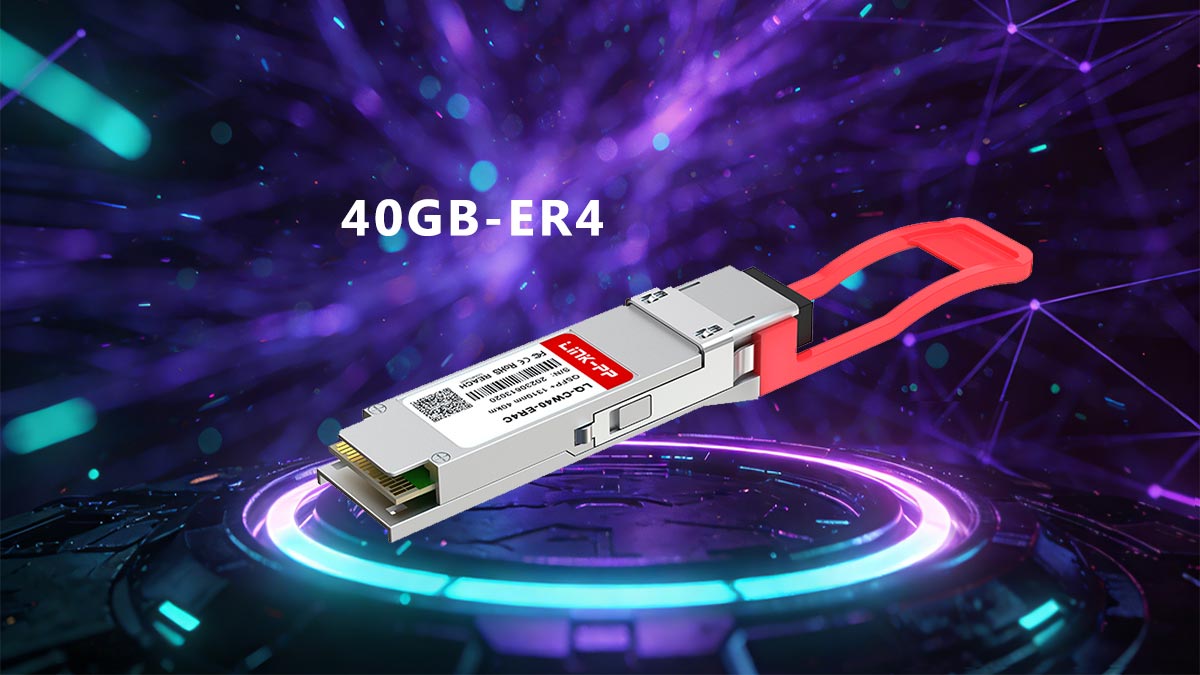
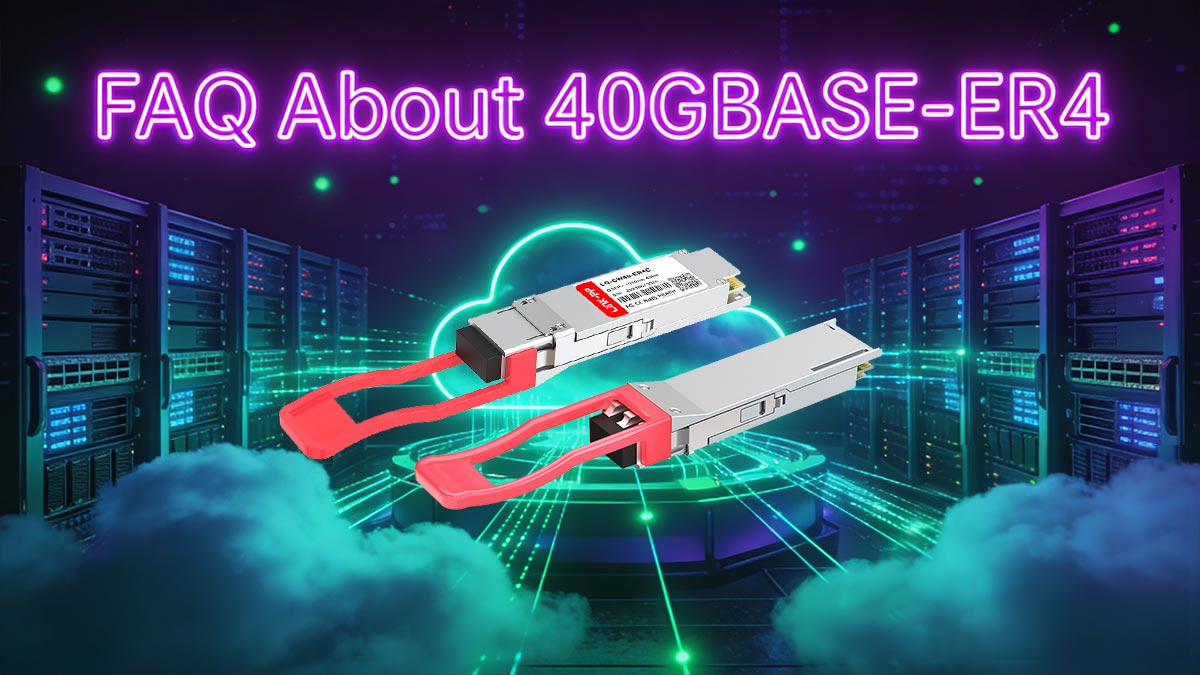
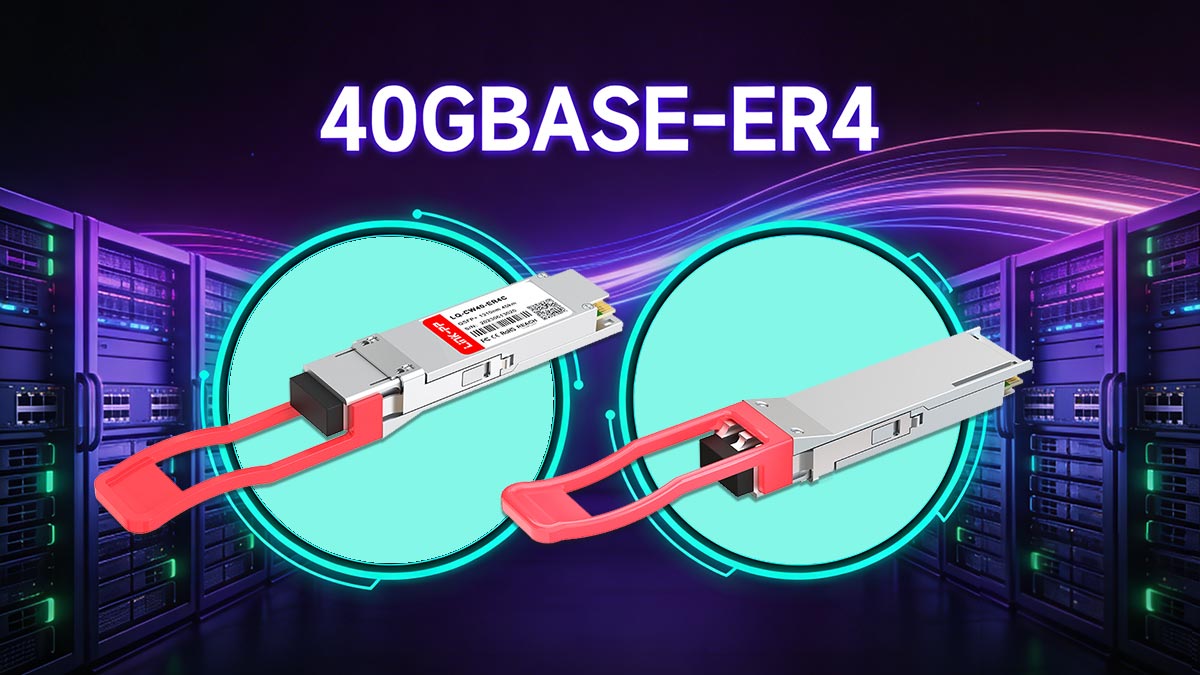
40GBASE-ER4 is a 40 Gigabit Ethernet QSFP+ modules designed for long-distance data transmission over single-mode fiber, typically supporting link distances up to around 40 km.
In simple terms, it is a plug-in fiber optic module used in high-speed network switches and routers to transmit 40G Ethernet signals between two distant locations using duplex single-mode fiber (SMF).
QSFP+ definition
QSFP+ (Quad Small Form-factor Pluggable Plus) is a compact, hot-swappable optical transceiver form factor used for high-speed networking.
It supports 4 independent data channels, each typically carrying 10G of traffic, combining to deliver a total of 40G throughput.
In the case of 40GBASE-ER4, the QSFP+ module uses four wavelengths (WDM technology) instead of four separate physical fibers, allowing efficient long-distance transmission over a standard duplex SMF link.
Plain-language breakdown of 40GBASE-ER4
To understand it quickly:
40GBASE → 40 Gigabit Ethernet standard
ER → Extended Reach (long-distance transmission)
4 → Four optical lanes using WDM technology
So, 40GBASE-ER4 essentially means:
A 40G optical module that can send data over long distances using four combined optical signals over single-mode fiber.
Where it sits in real networks
In practical deployments, 40GBASE-ER4 is commonly used in:
Data center interconnects (DCI)
Metro-area network links
Long-distance enterprise backbone connections
It is typically deployed in high-performance switching environments from vendors such as Cisco Systems and Arista Networks, where stable long-reach optical connectivity is required.
✅ 40GBASE-ER4 Specifications and Reach
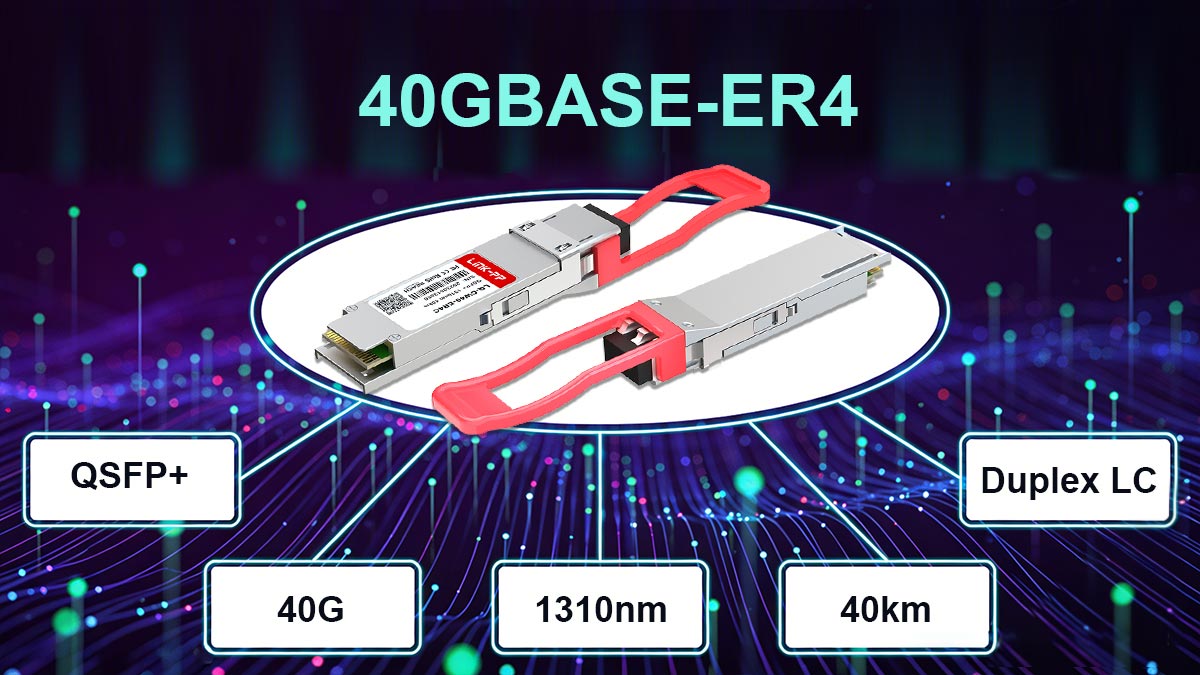
40GBASE-ER4 is designed for long-distance 40G Ethernet transmission over single-mode fiber, and its specifications are optimized for stable performance in metro and inter-data-center environments where link distance and optical budget are critical.
Key specifications overview
Category | Specification |
|---|---|
Standard | 40GBASE-ER4 (40 Gigabit Ethernet) |
Form Factor | QSFP+ (Quad Small Form-factor Pluggable Plus) |
Data Rate | 40Gbps (4 × 10Gbps lanes) |
Transmission Technology | Wavelength Division Multiplexing (WDM) |
Fiber Type | Single-mode fiber (SMF, G.652 recommended) |
Connector Type | |
Wavelengths | 4 wavelengths in the 1310 nm range |
Maximum Reach | Up to 40 km |
Typical Use Case | Data center interconnect, metro networks, enterprise backbone |
Link Type | Point-to-point optical link |
Duplex/Simplex | Duplex (Tx/Rx pair) |
Compatibility | QSFP+ 40G Ethernet ports (vendor-dependent, e.g., Cisco/Arista platforms) |
These specifications make it one of the longest-reach 40G QSFP+ solutions widely deployed in enterprise and service provider networks.
Fiber type: why single-mode is required
40GBASE-ER4 is strictly designed for single-mode fiber (SMF) environments. Unlike multimode fiber (MMF), SMF has a much smaller core diameter, which reduces modal dispersion and allows light signals to travel significantly longer distances with minimal loss.
Because of this design:
It cannot operate on multimode fiber (OM3/OM4)
It requires a clean, low-loss optical path
It is best suited for long-distance structured cabling or telecom-grade infrastructure
Connector type: duplex LC interface
The module uses a duplex LC connector, which is the industry standard for high-density optical networking.
This means:
One fiber strand is used for transmission (Tx)
One fiber strand is used for reception (Rx)
Despite using WDM internally (4 wavelengths), the external interface remains a simple duplex LC connection, which simplifies deployment and cabling design.
Reach and deployment distance
The defining feature of 40GBASE-ER4 is its extended reach capability:
Standard reach: up to ~40 km over SMF
Typical real-world deployment range: 10 km to 40 km (depending on link budget and attenuation)
Optimized for: long-distance point-to-point links
Vendor documentation from major networking manufacturers such as Cisco Systems and Arista Networks consistently classifies ER4 as a 40 km-class optical transceiver, intended for metro connectivity and data center interconnect (DCI) scenarios.
Practical deployment considerations
Although ER4 is rated for long reach, actual performance depends on:
Total optical loss (fiber attenuation + connectors + splices)
Quality of single-mode fiber (G.652 vs. older installations)
Presence of optical amplification (if needed in extended links)
Switch platform compatibility and optical power budget
In engineered networks, ER4 is often used where direct fiber paths exist between sites, eliminating the need for intermediate regeneration equipment.
✅ Where 40GBASE-ER4 Is Used
40G-ER4 is not a general-purpose short-reach data center optic. It is specifically designed for long-distance, high-bandwidth 40G connections, where fiber links must extend far beyond the typical reach of SR4 or LR4 modules. Because of its ability to support up to 40 km over single-mode fiber, it is widely deployed in carrier-grade and enterprise backbone environments.
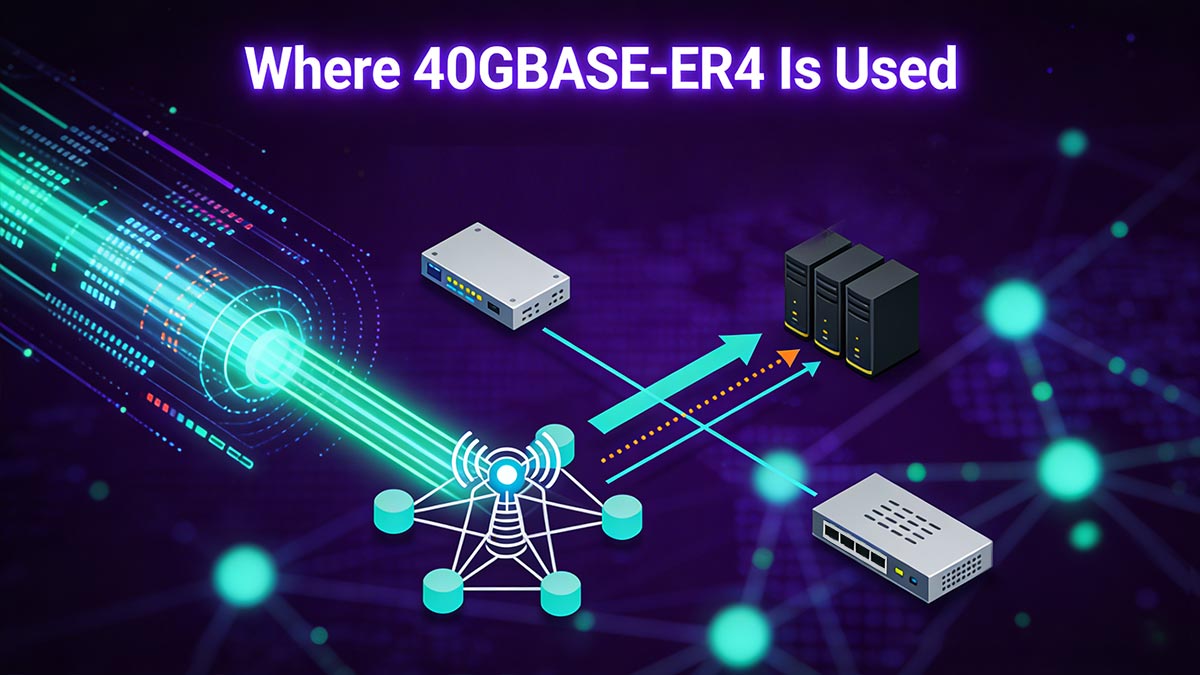
1. Data Center Interconnect (DCI)
One of the most common use cases for 40GBASE-ER4 is Data Center Interconnect (DCI).
In these scenarios, organizations connect two separate data centers located in different buildings, campuses, or even cities.
Typical requirements include:
High bandwidth (40G aggregated traffic)
Stable long-distance transmission
Low latency point-to-point links
Reliable single-mode fiber infrastructure
40GBASE-ER4 is ideal here because it can transmit data over long distances without requiring intermediate signal regeneration equipment, making it cost-efficient for direct site-to-site connectivity.
This is especially common in large-scale deployments from networking ecosystems such as Cisco Systems and Arista Networks.
2. Campus Network Backbone Links
Another important deployment scenario is large enterprise campus networks.
In universities, government facilities, hospitals, and corporate campuses, network nodes are often distributed across multiple buildings separated by hundreds of meters to several kilometers.
40GBASE-ER4 is used for:
Core-to-core switch interconnections
Building-to-building fiber backbones
Aggregation layer uplinks
Its long reach makes it suitable for campuses where standard multimode optics cannot cover the required distance reliably.
3. Metro and Regional Transport Networks
40GBASE-ER4 is also widely used in metro Ethernet and regional transport networks, where service providers and large enterprises need to connect infrastructure across a city or region.
Typical applications include:
Metro aggregation networks
Service provider edge connections
Long-haul enterprise WAN extensions
Because it supports long-distance transmission over SMF, ER4 reduces the need for expensive optical regeneration equipment in intermediate nodes.
4. Enterprise WAN and Disaster Recovery Links
Many enterprises use 40GBASE-ER4 for disaster recovery (DR) and business continuity links between geographically separated sites.
These links are used to:
Replicate critical data between primary and backup data centers
Maintain real-time or near-real-time synchronization
Ensure failover readiness in case of outages
The stability and long reach of ER4 make it suitable for mission-critical infrastructure where downtime is not acceptable.
When ER4 Is the Right Choice
40GBASE-ER4 is the preferred option when:
The distance exceeds standard LR4 limits
Single-mode fiber infrastructure is already in place
A direct point-to-point optical link is required
High reliability over long distances is essential
In short, it is a specialized long-reach 40G solution for backbone-grade connectivity, rather than a general data center access optic.
✅ 40GBASE-ER4 Compatibility Checklist
Before deploying a QSFP+ ER4 module, compatibility verification is critical. Unlike short-reach optics, ER4 operates at long distances and higher optical power budgets, which means incorrect deployment can lead to link instability, receiver overload, or complete incompatibility with switch ports.
This section provides a practical checklist covering switch support, vendor restrictions, DOM monitoring, attenuation requirements, and fiber infrastructure readiness.
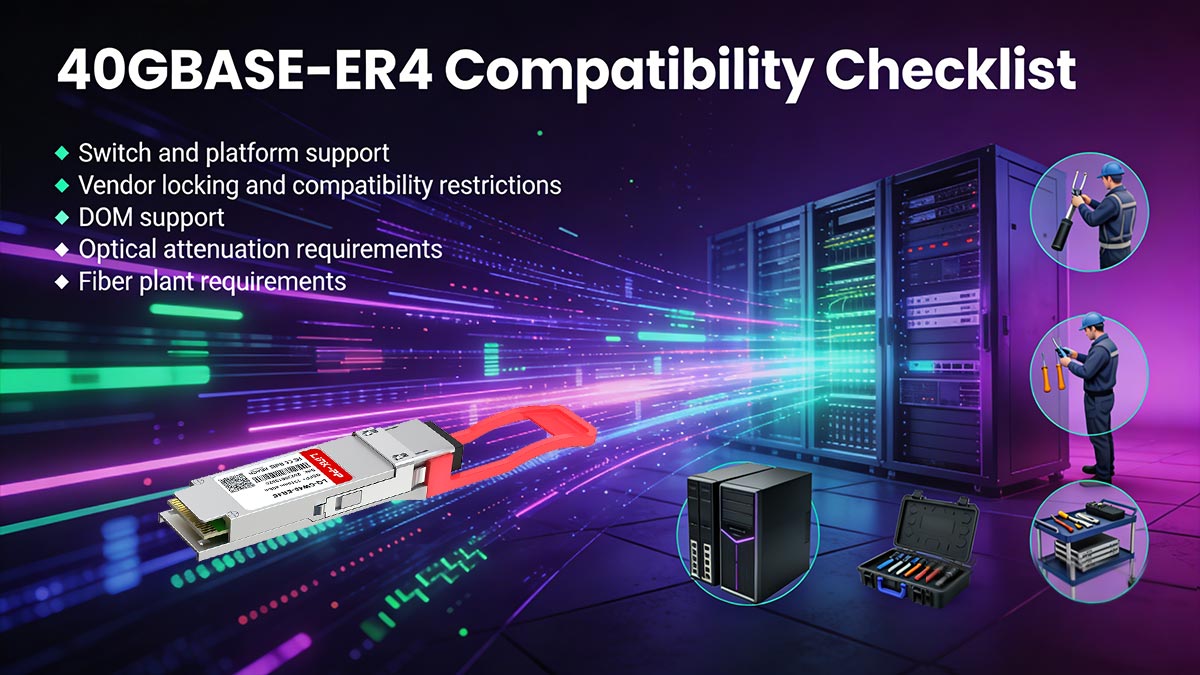
◆ Switch and platform support
The first and most important step is confirming whether your switch supports 40G QSFP+ ER4 optics.
Key considerations include:
QSFP+ 40G port availability (not QSFP28-only ports)
Vendor-specific transceiver compatibility lists
Firmware support for ER4 optics
Explicit support for 40GBASE-ER4 in the platform datasheet
Enterprise-grade vendors such as Cisco Systems and Arista Networks often maintain strict optical compatibility matrices, meaning not all QSFP+ modules are automatically accepted.
◆ Vendor locking and compatibility restrictions
One of the most common deployment challenges is vendor lock-in.
There are three typical compatibility scenarios:
Fully open ports: accept most MSA-compliant QSFP+ optics
Partially restricted ports: require coded or validated optics
Fully locked systems: only accept OEM-branded transceivers
For 40GBASE-ER4, it is essential to verify:
OEM compatibility (Cisco / Arista / Juniper, etc.)
Third-party support (coded or generic MSA optics)
Warranty implications when using non-OEM modules
◆ DOM (Digital Optical Monitoring) support
Modern 40GBASE-ER4 modules typically support DOM (Digital Optical Monitoring), which allows real-time tracking of:
Transmit optical power (Tx)
Receive optical power (Rx)
Temperature
Voltage
Laser bias current
DOM is especially important for ER4 because:
It helps detect overpower or underpower conditions
It ensures stable long-distance signal integrity
It simplifies troubleshooting in metro and DCI environments
Without DOM visibility, diagnosing long-reach optical issues becomes significantly more difficult.
◆ Optical attenuation requirements (critical for ER4)
Unlike short-reach optics, 40GBASE-ER4 has very high transmit power, which can overwhelm receivers on short links.
According to deployment guidelines referenced in vendor documentation from Arista Networks, optical attenuation is required in short-distance scenarios to protect the receiver from saturation.
This means:
ER4 is NOT suitable for short links (e.g., < 2 km) without attenuation
Inline optical attenuators may be required
Proper link budgeting must be calculated before deployment
Failing to apply attenuation can result in:
Receiver overload
High bit error rates (BER)
Unstable or flapping links
◆ Fiber plant requirements
40GBASE-ER4 requires a high-quality single-mode fiber infrastructure.
Checklist for fiber readiness:
Single-mode fiber type: ITU-T G.652 or better
Clean duplex LC connectors (low insertion loss)
Proper splice quality (minimal reflection loss)
Verified end-to-end link budget
No mixed multimode segments (ER4 is not MMF compatible)
Additionally, fiber aging, bending losses, and connector contamination can significantly impact long-reach performance.
Before deployment, confirm:
✔ Switch supports QSFP+ ER4 optics
✔ Vendor compatibility (OEM or MSA-coded) is verified
✔ DOM monitoring is available
✔ Optical attenuation is used for short links
✔ Single-mode fiber plant is clean and properly certified
✅ 40GBASE-ER4 vs. LR4 vs. SR4
When selecting a 40G QSFP+ optical module, one of the most common decision points is choosing between SR4, LR4, and ER4. Although all three support 40 Gigabit Ethernet, they are designed for very different transmission distances, fiber types, and deployment environments.
Understanding these differences is essential for avoiding compatibility issues and ensuring cost-effective network design.
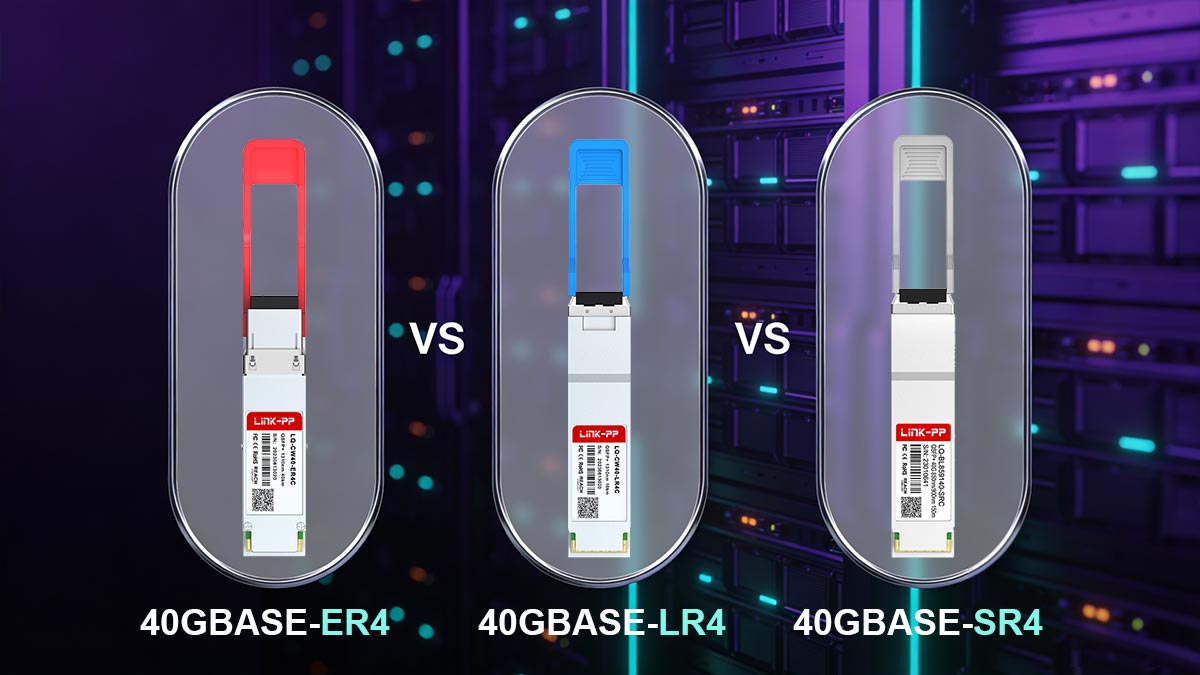
Quick comparison overview
Standard | Fiber Type | Typical Reach | Use Case |
|---|---|---|---|
Multimode fiber (OM3/OM4) | ~100m–150m | Short-reach data center links | |
Single-mode fiber (SMF) | ~10 km | Campus and metro connections | |
Single-mode fiber (SMF) | Up to ~40 km | Long-distance DCI and backbone networks |
40GBASE-SR4: Short-reach data center optic
SR4 (Short Reach) is designed for high-density data center environments where switches are located close together.
Key characteristics:
Uses multimode fiber (OM3/OM4)
Very low cost per link
Short reach (~100–150 meters)
Uses parallel optics (typically MPO/MTP connectors)
Best suited for:
Rack-to-rack connections
Top-of-rack (ToR) to spine switches
High-density data center switching
Limitation:
Not suitable for long-distance transmission or campus networks
40GBASE-LR4: Medium-reach single-mode solution
LR4 (Long Reach) is the most widely used 40G single-mode optic for enterprise and metro networks.
Key characteristics:
Uses single-mode fiber (SMF)
Reach up to 10 km
Uses WDM technology over duplex LC connectors
Balanced cost and performance
Best suited for:
Campus backbone links
Short metro connections
Enterprise inter-building connectivity
LR4 is often the default choice when distances exceed multimode capabilities but do not require extreme reach.
40GBASE-ER4: Extended-reach backbone optic
ER4 (Extended Reach) is designed for the most demanding long-distance applications.
Key characteristics:
Uses single-mode fiber (SMF)
Reach up to 40 km
WDM-based transmission (4 × 10G lanes)
Duplex LC connector interface
Best suited for:
Data center interconnect (DCI)
Metro aggregation networks
Long-haul enterprise WAN links
Compared to LR4, ER4 provides 4× the reach, making it ideal for geographically distributed infrastructure.
Enterprise networking vendors such as Arista Networks clearly separate these optics based on reach and application tier to simplify deployment decisions.
Key decision logic (how to choose quickly)
A practical selection rule:
Additional considerations:
Fiber type (MMF vs. SMF)
Existing cabling infrastructure
Future scalability requirements
Optical budget and attenuation constraints
The choice between SR4, LR4, and ER4 is not just about speed—it is about distance, fiber infrastructure, and network architecture design.
SR4 = short-range, data center inside racks
LR4 = standard enterprise and metro backbone
ER4 = long-distance, high-stability interconnect
Selecting the correct module ensures stable performance, lower operational cost, and fewer compatibility issues in production environments.
✅ How to Choose the Right 40GBASE-ER4 Module
When selecting a 40GBASE-ER4 QSFP+ optical module, it’s not just about finding “any 40G transceiver.” Because ER4 optics are used in long-reach networks, the buying criteria must align with technical compatibility, vendor support, and deployment requirements. Below is a concise, decision-oriented guide to help you choose the right module for your network.
1. Vendor compatibility and coding
Check the host switch/vendor support list: Some switches only accept OEM-coded optics or require specific vendor IDs to enable the port.
MSA compliance: Ensure the module is compliant with the QSFP+ MSA standard so that it supports hot-swap and DOM functions correctly.
Vendor lock-in: OEM optics (e.g., Cisco, Juniper) may have guaranteed support, while third-party modules often require explicit compatibility checks in the switch’s documentation or CLI.
Tip: Modules like the QSFPTEK 40GBASE‑ER4 QSFP+ and FiberMall 40GBASE‑ER4 QSFP+ offer broad compatibility with many Cisco-compatible and generic QSFP+ ports.
2. Host switch model and firmware
Platform support: Verify that your switch model supports 40GBASE-ER4 optics specifically, not just generic QSFP+ modules.
Firmware version: Some platforms require updated firmware to enable long-reach optics or correct DOM readings.
DOM diagnostics: Modules with DOM support allow real-time monitoring of Tx/Rx power, temperature, and voltage — useful for long-distance links.
Modules like the Cisco QSFP-40G-ER4 Compatible Module and Allied Telesis QSFPER4 Compatible Module include DOM support, which can simplify ongoing monitoring.
3. Link budget and fiber infrastructure
Distance and loss: Ensure your single-mode fiber plant can support the full 40 km reach with acceptable loss (connectors, splices, bends).
Optical budget: Confirm the module’s Tx/Rx power and receiver sensitivity meet your link’s attenuation profile.
Attenuation for short links: ER4 optics have high transmit power and may require inline attenuators on short distances to prevent receiver overload.
If your link is significantly shorter than 40 km, verify whether attenuation or a different optic (e.g., LR4) is more appropriate.
4. Support policy and warranty
Warranty coverage: Check whether the module includes a warranty and what it covers (e.g., DOA, lifetime).
Vendor support: OEM or authorized partner modules often come with better support pathways if compatibility issues arise.
Return policy: Especially for third-party optics, a flexible return policy helps mitigate compatibility risk.
Products like the Fortinet FG-TRAN-QSFP+ER Transceiver from reputable distributors often include clear warranty terms and broad support channels.
5. Environmental and operational considerations
Temperature rating: Standard commercial optics are typically rated for 0–70°C. If deployed in harsh environments, choose modules with extended temperature support.
Power consumption: QSFP+ modules have different power draws; ensure your switch can supply adequate power.
DOM telemetry: Real-time diagnostic monitoring helps with preventive maintenance.
Quick decision checklist
✔ Confirm switch/vendor support for ER4 optics
✔ Validate fiber type and link distance with loss calculations
✔ Choose modules with DOM support for easier monitoring
✔ Verify warranty and return policies
✔ Match temperature and operational specs to deployment conditions
✅ FAQ About 40GBASE-ER4
Q1. What is the maximum distance of 40GBASE-ER4?
40GBASE-ER4 supports up to approximately 40 km over single-mode fiber (SMF).
In real deployments, the achievable distance depends on optical loss, fiber quality, and connector/splice conditions.
Q2. Does 40GBASE-ER4 work on multimode fiber?
No. 40GBASE-ER4 only works on single-mode fiber (SMF).
Multimode fiber (OM3/OM4) is not supported due to higher dispersion and signal attenuation over long distances.
Q3. What type of connector does 40GBASE-ER4 use?
It uses a duplex LC connector, meaning:
One fiber for transmit (Tx)
One fiber for receive (Rx)
This makes it compatible with standard SMF patch cabling systems.
Q4. Is 40GBASE-ER4 compatible with all QSFP+ ports?
Not always. Compatibility depends on the switch vendor and firmware.
Some platforms from vendors such as Cisco Systems and Arista Networks may require:
Approved transceiver coding
Vendor-certified optics
Firmware support for ER4 optics
Q5. Is 40GBASE-ER4 backward compatible?
Yes, but only at the protocol level—not the interface type.
It is backward compatible with 40G Ethernet standards
It is not compatible with 1G or 10G ports
It requires a QSFP+ 40G interface
Q6. Can 40GBASE-ER4 be used for short distances?
Technically yes, but it is not recommended without optical attenuation.
Because ER4 has high transmit power:
Short links may overload the receiver
Inline attenuators may be required for safe operation
Q7. What is the difference between ER4 and LR4 in simple terms?
LR4: up to 10 km (standard enterprise/campus links)
ER4: up to 40 km (long-distance metro and DCI links)
ER4 is essentially a longer-reach version of LR4 with higher link budget requirements.
Q8. Does 40GBASE-ER4 support Digital Optical Monitoring (DOM)?
Yes. Most ER4 modules support DOM.
This allows real-time monitoring of:
Optical power (Tx/Rx)
Temperature
Voltage
Laser bias current
DOM is important for maintaining stability in long-distance links.
Q9. When should I choose ER4 instead of SR4 or LR4?
Choose ER4 when:
Distance exceeds 10 km
Single-mode fiber infrastructure is available
A direct point-to-point long-reach link is required
Q10. Is 40GBASE-ER4 still relevant in modern networks?
Yes. Although 100G and 400G are growing, 40GBASE-ER4 is still widely used in legacy upgrades, metro links, and cost-sensitive backbone deployments where existing 40G infrastructure is maintained.
✅ Conclusion: Is 40GBASE-ER4 the Right Choice?
40GBASE-ER4 remains one of the most reliable solutions for long-reach 40G Ethernet connectivity over single-mode fiber, especially in environments where stable performance across extended distances is required. With support for up to 40 km transmission, it fills a critical gap between standard enterprise optics and true metro or data center interconnect requirements.
From a network design perspective, ER4 is the right choice when your deployment meets three key conditions:
The link distance exceeds standard LR4 capabilities (beyond ~10 km)
A duplex single-mode fiber (SMF) infrastructure is already available
A stable point-to-point long-distance connection is required without intermediate regeneration
However, successful deployment depends heavily on proper compatibility validation and optical budget planning. Switch support, vendor coding restrictions, and attenuation requirements must all be confirmed before installation to ensure stable operation and avoid receiver overload or link instability.
In summary, 40GBASE-ER4 is not a general-purpose optic—it is a purpose-built long-reach solution for backbone-grade connectivity, making it ideal for data center interconnects, metro networks, and enterprise-wide transport links where reliability is critical.
If you are planning a 40G deployment and need verified compatibility, stable performance, and cost-effective options, you can explore high-quality compatible transceivers at the LINK-PP Official Store, designed to support a wide range of enterprise networking platforms with consistent optical performance and interoperability.