

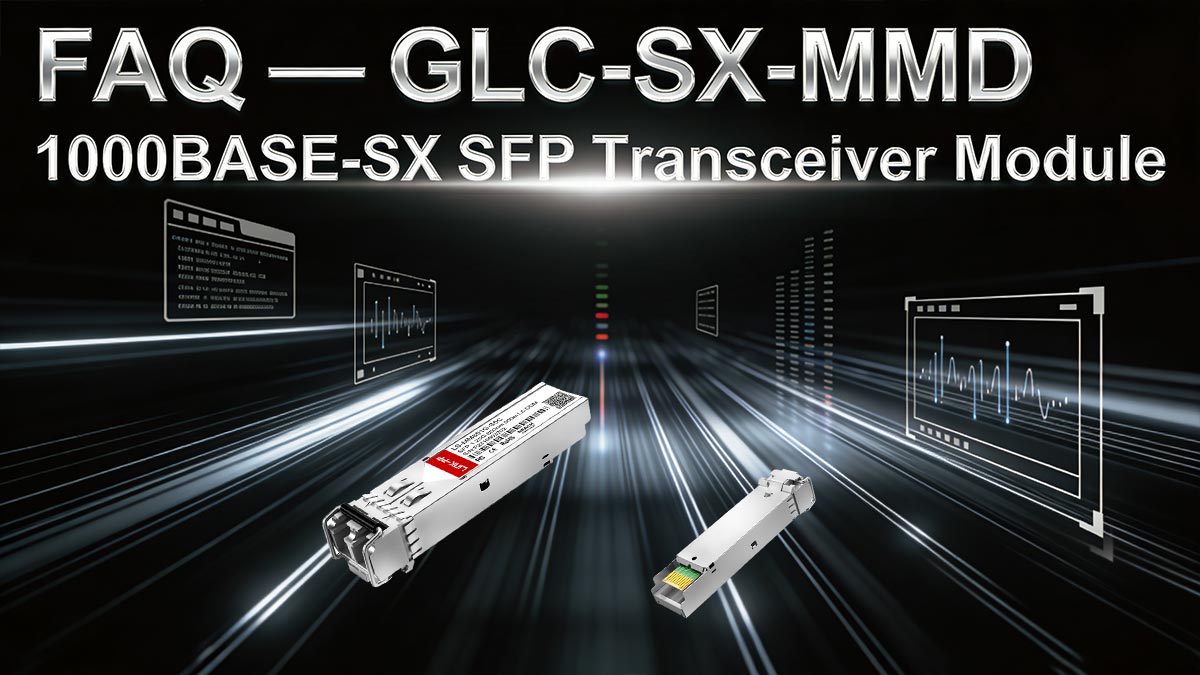
In modern Gigabit Ethernet networks, choosing the right optical transceiver is critical for ensuring stable, cost-effective, and high-performance connectivity. The GLC-SX-MMD 1000BASE-SX SFP transceiver module is one of the most widely deployed solutions for short-distance fiber communication, especially in enterprise LANs, campus networks, and data centers.
At its core, the GLC-SX-MMD is a 1Gbps (not 10G) Small Form-Factor Pluggable (SFP) module designed to operate over multimode fiber (MMF) using an 850nm wavelength, supporting transmission distances of up to 550 meters depending on fiber type (OM2/OM3/OM4). It features a dual LC interface, low power consumption, and—most importantly—the DOM (Digital Optical Monitoring) capability, which allows real-time monitoring of optical performance such as temperature, voltage, and transmit/receive power.
Why GLC-SX-MMD 1000BASE-SX SFP Module Matters
Despite the rise of 10G and higher-speed technologies, 1G SFP modules like GLC-SX-MMD remain essential due to their:
Wide compatibility with legacy and modern network equipment
Lower deployment cost compared to higher-speed optics
Sufficient bandwidth for many enterprise applications
Reliable short-range performance within racks and buildings
For IT professionals, one of the biggest challenges is avoiding costly mistakes—such as confusing SFP (1G) with SFP+ (10G), or selecting the wrong fiber type (multimode vs single-mode). This is exactly where a clear understanding of the GLC-SX-MMD becomes crucial.
What You’ll Learn in This Guide
This comprehensive guide is designed to match real user search intent and answer the most common technical and purchasing questions, including:
What exactly is the GLC-SX-MMD and how does it work?
Is it 1G or 10G, and why does that matter?
Is it multimode or single-mode, and how do you choose correctly?
What’s the difference between GLC-SX-MMD vs. GLC-SX-MM?
How does it compare to 1000BASE-SX vs. 1000BASE-LX modules?
Should you buy Cisco OEM or compatible alternatives?
By the end of this article, you’ll have a clear decision-making framework to confidently select the right SFP module for your network—while minimizing compatibility risks and optimizing cost.
Quick Insight: If your network requires short-range (≤550m), cost-efficient, and highly compatible 1G fiber connectivity, the GLC-SX-MMD is often the best-fit solution.
🔹 What Is GLC-SX-MMD?
The GLC-SX-MMD is a 1000BASE-SX SFP transceiver module designed for 1 Gigabit Ethernet (1Gbps) connectivity over multimode fiber (MMF) using an 850nm wavelength, with a maximum transmission distance of up to 550 meters. It is commonly used in switches, routers, and network interface cards for short-range optical communication.
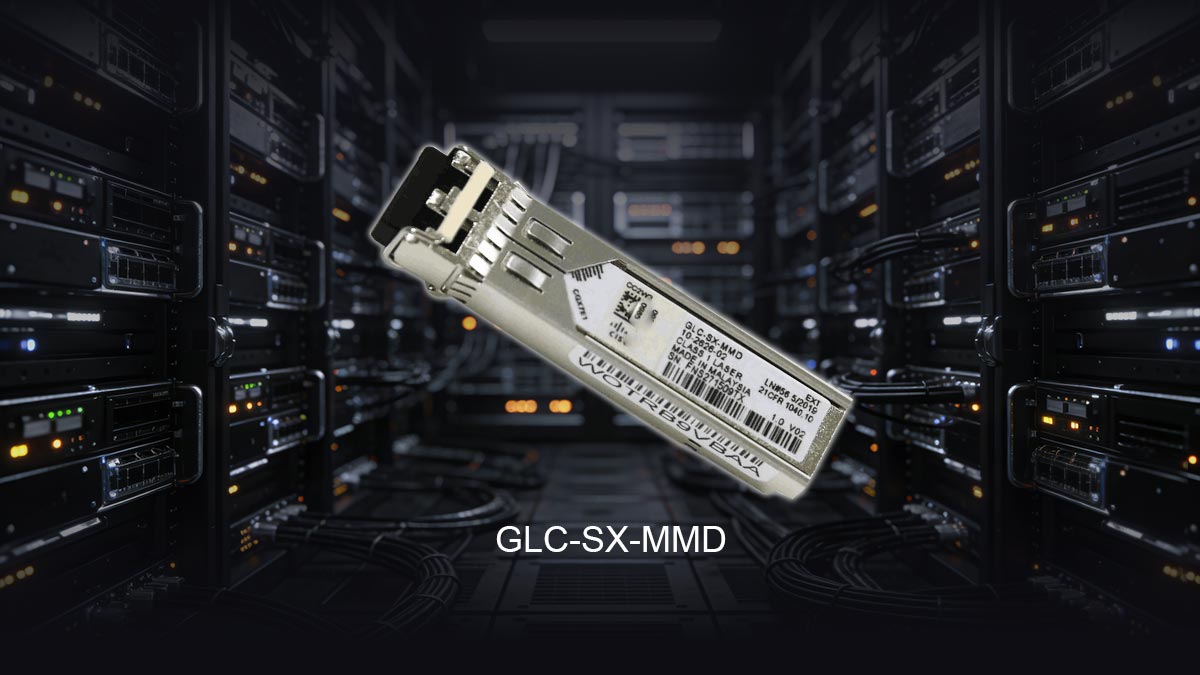
Quick Technical Summary
Standard: 1000BASE-SX
Form Factor: SFP (Small Form-Factor Pluggable)
Data Rate: 1Gbps (Gigabit Ethernet)
Fiber Type: Multimode Fiber (MMF)
Wavelength: 850nm
Max Distance: Up to 550m (OM2/OM3/OM4)
Connector: Duplex LC
Key Feature: DOM (Digital Optical Monitoring)
Hot-Swappable: Yes
What Does “MMD” Mean?
The “MMD” in GLC-SX-MMD stands for Digital Optical Monitoring (DOM), an advanced feature that provides real-time visibility into the module’s operating conditions.
With DOM, network engineers can monitor:
Transmit optical power
Receive optical power
Module temperature
Supply voltage
Laser bias current
This capability significantly improves network reliability, troubleshooting efficiency, and predictive maintenance, making GLC-SX-MMD an upgraded version of earlier non-DOM modules like GLC-SX-MM.
Typical Use Cases
The GLC-SX-MMD is specifically optimized for short-distance, high-efficiency fiber connections in environments such as:
Data Centers
Server-to-switch connections
Top-of-rack (ToR) deployments
Enterprise LANs
Switch-to-switch uplinks
Building-to-building fiber links (short range)
Campus Networks
Distribution layer connectivity
Aggregation switches
Why GLC-SX-MMD 1000BASE-SX SFP Widely Used
The popularity of GLC-SX-MMD comes from its balance of:
✅ Cost efficiency (lower than long-range optics)
✅ High compatibility (widely supported by network devices)
✅ Sufficient performance for most 1G applications
✅ Enhanced monitoring (DOM) for better network control
The GLC-SX-MMD is a 1G multimode SFP module (850nm, up to 550m) with built-in DOM diagnostics, making it a reliable and cost-effective choice for short-range fiber networking.
🔹 GLC-SX-MMD Specifications and Key Features
Understanding the technical specifications of the GLC-SX-MMD is essential for ensuring compatibility, performance, and long-term network reliability. Below is a clear, engineer-friendly breakdown of its core parameters.
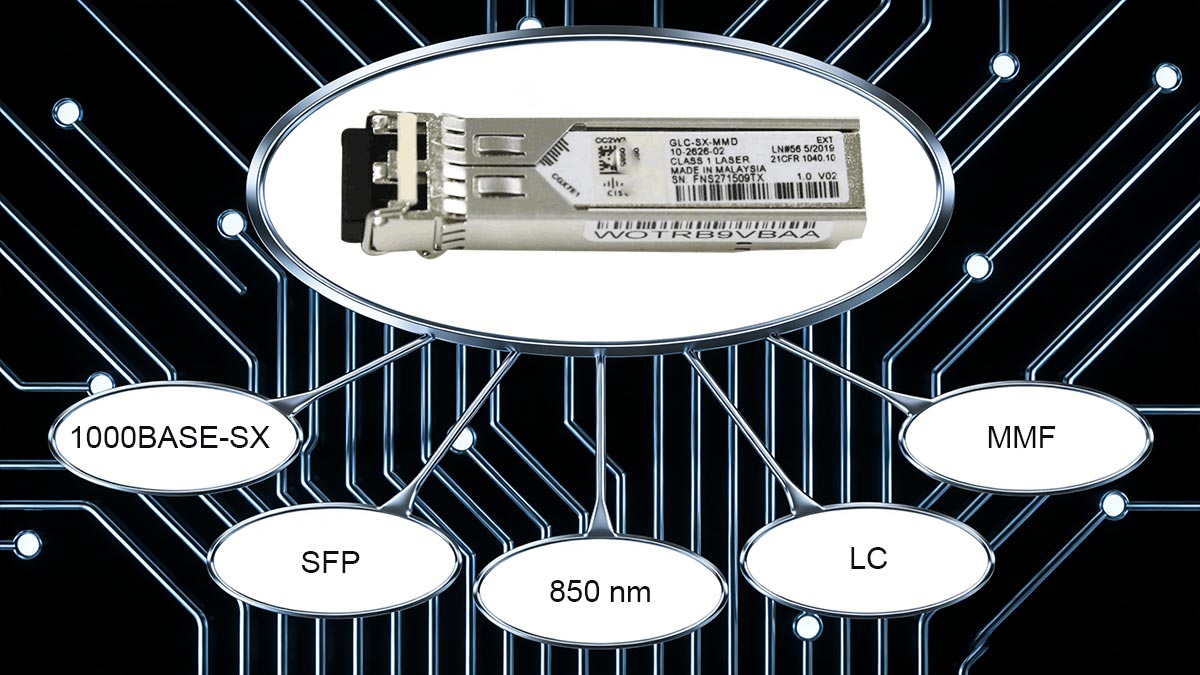
📊 Full Technical Specifications Table
Parameter | Specification |
|---|---|
Form Factor | SFP (Small Form-Factor Pluggable) |
Data Rate | 1Gbps (Gigabit Ethernet) |
Standard | 1000BASE-SX |
Fiber Type | Multimode Fiber (MMF) |
Wavelength | 850nm |
Max Distance | Up to 550 meters (OM2/OM3/OM4) |
Connector | Duplex LC |
Monitoring | DOM (Digital Optical Monitoring) |
Operating Mode | Hot-swappable |
Power Consumption | Low power design (typically <1W) |
📡 DOM (Digital Optical Monitoring) — Why It Matters
One of the most important features of the GLC-SX-MMD is Digital Optical Monitoring (DOM), which provides real-time diagnostics of the transceiver’s operating status.
With DOM, you can monitor:
Transmit (Tx) optical power
Receive (Rx) optical power
Module temperature
Supply voltage
Laser bias current
Practical Value:
Detect fiber degradation before failure
Troubleshoot link issues faster
Improve uptime in mission-critical networks
Compared to non-DOM modules, this adds a layer of intelligence and predictability to your network infrastructure.
🔌 Hot-Swappable Design (Zero Downtime Maintenance)
The GLC-SX-MMD supports hot-swapping, meaning you can insert or remove the module without powering down the device.
Benefits:
No network downtime during replacement
Faster maintenance and upgrades
Ideal for data centers and enterprise environments
This feature is especially critical in high-availability networks where uptime is non-negotiable.
⚡ Power Efficiency and Thermal Performance
The module is designed for low power consumption (typically under 1 watt), making it highly efficient for large-scale deployments.
Why this matters:
Reduces overall energy costs
Minimizes heat generation inside switches
Improves hardware lifespan
In dense environments like data centers, using energy-efficient SFP modules like GLC-SX-MMD helps maintain stable thermal conditions and reduces cooling requirements.
The GLC-SX-MMD combines standard 1G performance (1000BASE-SX) with modern operational advantages such as DOM diagnostics, hot-swappability, and low power consumption—making it a reliable and scalable choice for short-range fiber networks.
🔹 GLC-SX-MMD vs. GLC-SX-MM — What’s the Difference?
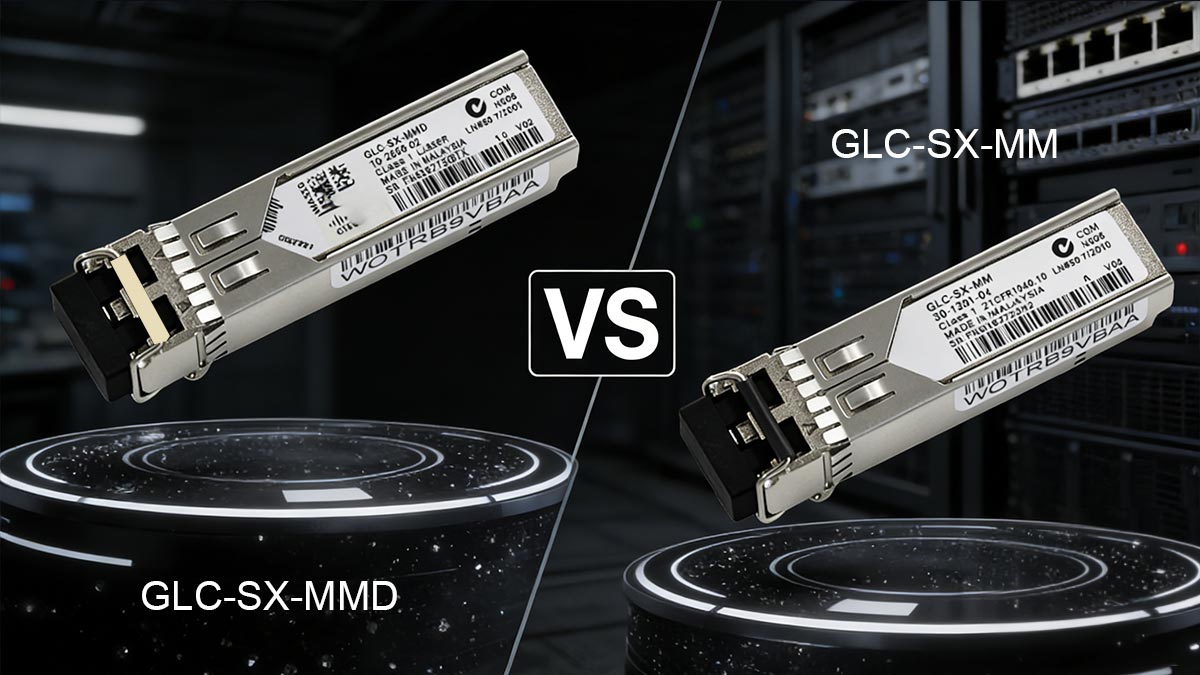
Although both GLC-SX-MMD and GLC-SX-MM are 1000BASE-SX SFP modules designed for 1Gbps multimode fiber (MMF) communication at 850nm, there is one critical difference that directly impacts network visibility and maintenance:
GLC-SX-MMD includes DOM (Digital Optical Monitoring), while GLC-SX-MM does not.
Core Difference at a Glance
Feature | GLC-SX-MM (Legacy) | GLC-SX-MMD (Enhanced) |
|---|---|---|
Standard | 1000BASE-SX | 1000BASE-SX |
Data Rate | 1Gbps | 1Gbps |
Fiber Type | MMF | MMF |
850nm | 850nm | |
Max Distance | Up to 550m | Up to 550m |
DOM Support | ❌ No | ✅ Yes |
Diagnostics Visibility | Basic | Advanced (real-time metrics) |
Deployment Era | Older generation | Modern standard |
Monitoring vs. Non-Monitoring Modules
The biggest limitation of GLC-SX-MM is the lack of visibility into real-time optical performance.
GLC-SX-MM (Non-DOM)
No insight into optical signal levels
Harder to troubleshoot fiber issues
Reactive maintenance only
GLC-SX-MMD (With DOM)
Real-time monitoring of Tx/Rx power
Early detection of signal degradation
Enables proactive maintenance
In modern networks, lack of monitoring = higher risk of unexpected downtime.
Why GLC-SX-MMD Is the Upgraded Version
The “D” in GLC-SX-MMD stands for Digital Optical Monitoring, making it a next-generation replacement for GLC-SX-MM.
Key advantages of MMD:
Operational transparency (live performance data)
Faster fault isolation
Reduced troubleshooting time
Lower long-term maintenance costs
Because of these benefits, most vendors and network engineers now treat GLC-SX-MMD as the default standard for 1G multimode SFP deployments.
🔹 Is GLC-SX-MMD Single Mode or Multimode?
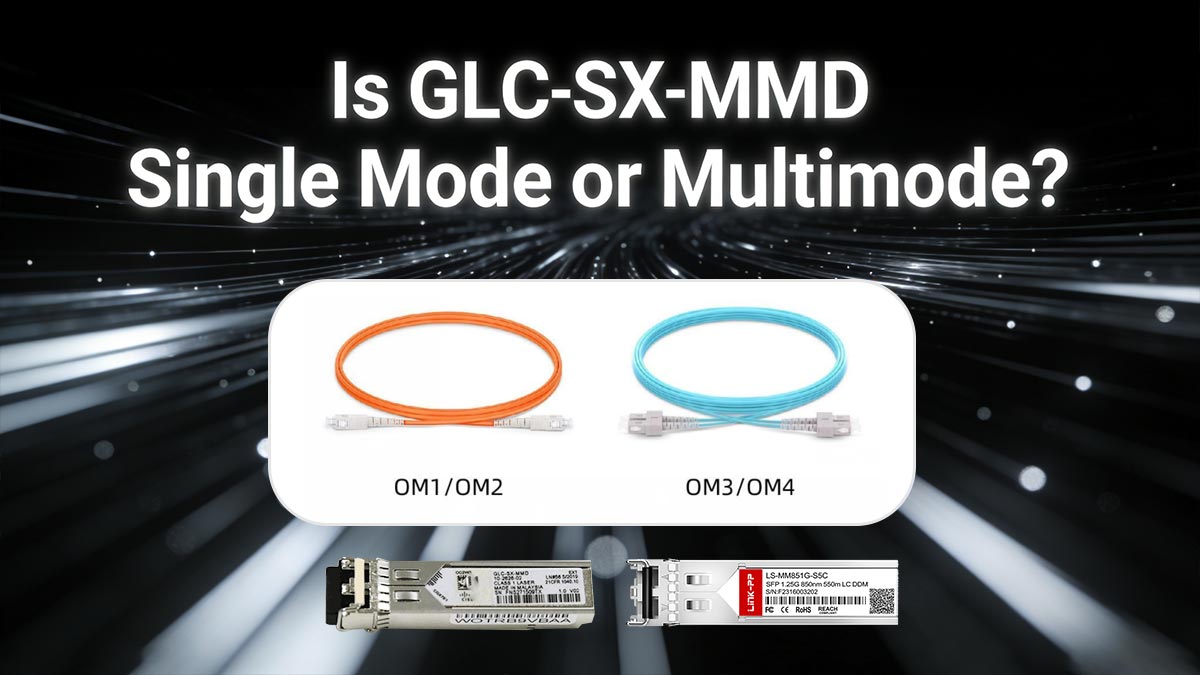
The GLC-SX-MMD is designed for multimode fiber (MMF)—not single-mode fiber (SMF). It operates at an 850nm wavelength, which is specifically optimized for short-distance transmission over multimode cabling.
Supported Fiber Types (OM2 / OM3 / OM4)
GLC-SX-MMD works with standard multimode fiber grades commonly used in enterprise and data center environments:
OM2 (orange) – older generation MMF
OM3 (aqua) – laser-optimized MMF (most common)
OM4 (aqua/violet) – enhanced bandwidth MMF for improved performance
These fiber types differ mainly in bandwidth capacity and maximum transmission distance, which directly affects network design.
Distance Differences by Fiber Grade
Fiber Type | Core Size | Max Distance (GLC-SX-MMD) | Typical Use Case |
|---|---|---|---|
OM2 | 50/125 µm | Up to ~275 meters | Legacy systems |
OM3 | 50/125 µm | Up to ~300–550 meters | Data centers, LAN |
OM4 | 50/125 µm | Up to ~400–550+ meters | High-performance networks |
Why This Matters in Real Networks
Choosing the wrong fiber type is one of the most common (and costly) mistakes in fiber deployments.
Key risks if misconfigured:
❌ Using single-mode fiber with SX module → link will fail
❌ Exceeding MMF distance limits → signal degradation
❌ Mixing fiber grades → inconsistent performance
Practical Deployment Insights
Short-range (within racks / rooms): OM3 or OM4 + GLC-SX-MMD is ideal
Building-to-building (short campus links): OM3/OM4 can still work within 550m
Long-distance (>550m): You must switch to 1000BASE-LX (single-mode)
💡 Expert Tip
If your network uses aqua-colored fiber cables, you are almost certainly working with multimode fiber (OM3/OM4)—which is exactly what GLC-SX-MMD is designed for.
The GLC-SX-MMD is strictly a multimode (MMF) SFP module, supporting OM2, OM3, and OM4 fibers, with distances up to 550 meters. Ensuring the correct fiber type is essential for achieving stable, high-performance network connectivity.
🔹 1000BASE-SX vs. 1000BASE-LX — Which One Should You Choose?
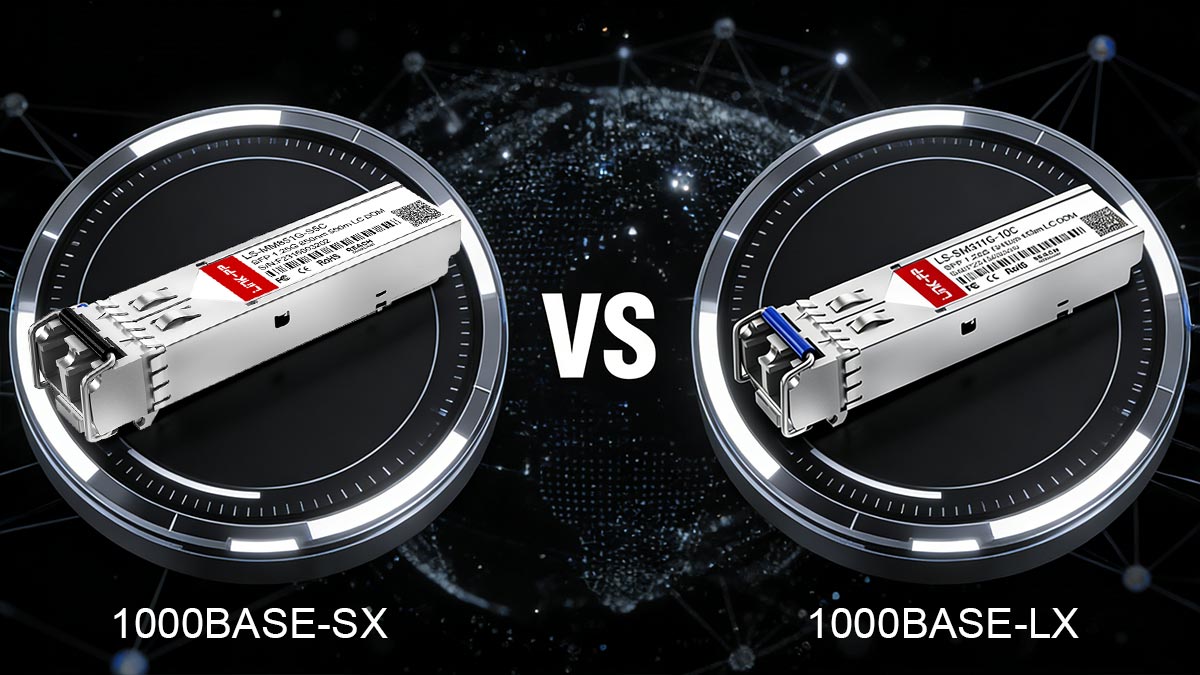
Choosing between 1000BASE-SX and 1000BASE-LX is one of the most important decisions when deploying fiber networks. While both support 1Gbps Ethernet, they differ significantly in fiber type, transmission distance, and overall cost.
Multimode vs. Single-Mode — Core Differences
Feature | 1000BASE-SX (GLC-SX-MMD) | 1000BASE-LX |
|---|---|---|
Fiber Type | Multimode (MMF) | Single-mode (SMF) |
Wavelength | 850nm | 1310nm |
Max Distance | Up to 550 meters | Up to 10 km |
Cable Cost | Lower | Higher |
Module Cost | Lower | Higher |
Typical Use | Short-range | Long-range |
Distance: 550m vs. 10km
1000BASE-SX:
Optimized for short distances up to 550m
Ideal for in-building or campus environments
1000BASE-LX:
Designed for long-distance transmission up to 10km
Suitable for inter-building or metro networks
Key Insight: Distance is the primary deciding factor. If your link exceeds 550 meters, SX is no longer viable.
Cost Difference (Critical Buying Factor)
Cost Element | SX (MMF) | LX (SMF) |
|---|---|---|
Fiber Cable | Lower cost | Higher cost |
Transceiver | Cheaper | More expensive |
Installation | Easier | More complex |
For most enterprise users, SX solutions can reduce total deployment cost by 30–70% compared to LX.
Deployment Scenarios
✅ Choose 1000BASE-SX (GLC-SX-MMD) if you need:
Data center interconnects (rack-to-rack)
Switch-to-switch connections inside buildings
Campus LAN links under 550m
Cost-sensitive deployments
✅ Choose 1000BASE-LX if you need:
Building-to-building connections over long distances
Metro or WAN fiber links
Future-proof long-range infrastructure
Single-mode fiber environments
Practical Decision Framework
Ask yourself these 3 questions:
What is the distance?
≤ 550m → SX
longer than 550m → LX
What fiber do you already have?
MMF → SX
SMF → LX
What is your budget?
Limited → SX
Flexible → LX
Expert Recommendation
For most enterprise and data center environments:
1000BASE-SX (GLC-SX-MMD) is the preferred choice due to its lower cost, sufficient range, and widespread compatibility.
Use 1000BASE-LX only when distance requirements demand it.
SX = Short-distance, low-cost, multimode
LX = Long-distance, higher-cost, single-mode
Choosing the right one ensures optimal performance, cost efficiency, and network reliability.
🔹 Compatibility — Will GLC-SX-MMD Work with Your Cisco Device?
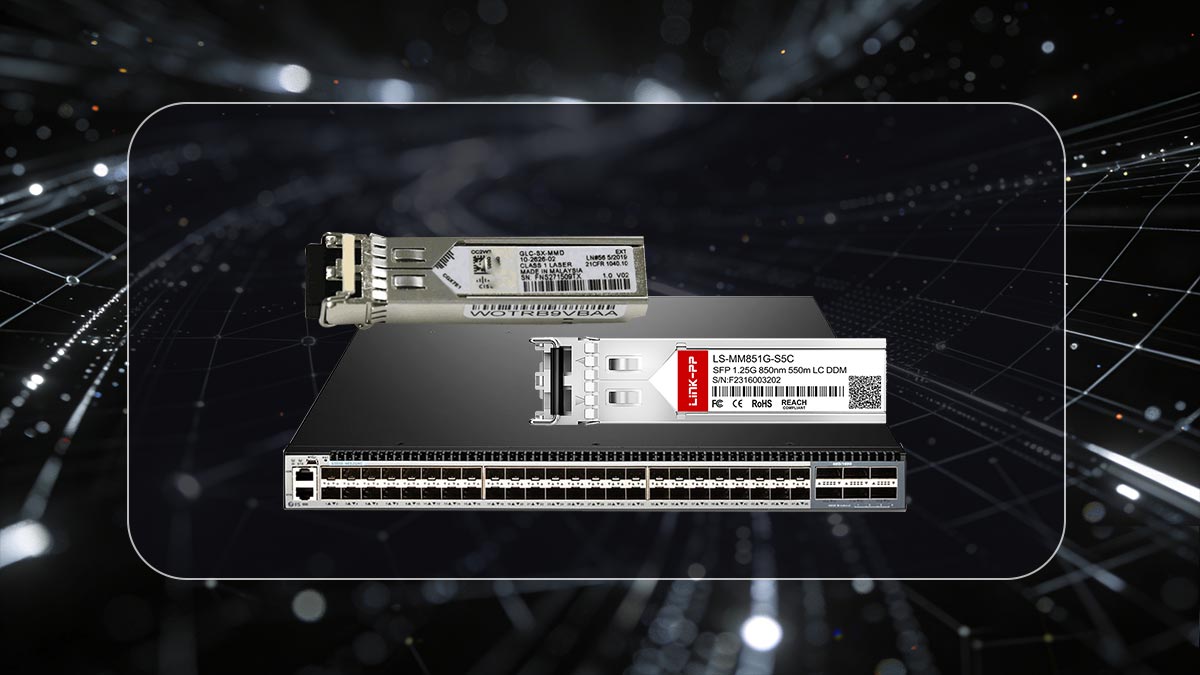
One of the most critical questions before purchasing any SFP module is compatibility. The GLC-SX-MMD is originally designed for Cisco switches and routers, but in real-world deployments, compatibility depends on device support, firmware policies, and module coding.
Cisco Switches & Routers Compatibility
The GLC-SX-MMD is widely supported across a broad range of Cisco platforms, including:
Catalyst series switches (e.g., access and distribution layers)
Nexus series switches (data center environments)
Cisco routers with SFP ports
Network Interface Cards (NICs) supporting SFP
In most cases, if your device supports 1G SFP (1000BASE-SX), it will support GLC-SX-MMD.
Coding & Firmware Considerations
Cisco devices often use vendor-specific coding (EEPROM programming) to identify and authenticate transceivers.
Key factors to understand:
OEM Cisco modules → Always recognized and supported
Compatible (third-party) modules → Must be properly coded for Cisco
Firmware restrictions → Some devices may block unsupported modules
Example issue:
“Unsupported transceiver” error
Port shutdown or limited functionality
Third-Party Compatibility Risks
Using third-party or compatible modules can significantly reduce cost—but comes with potential risks if not sourced correctly.
Common risks:
❌ Incompatibility with specific switch models
❌ Firmware blocking after updates
❌ Lack of DOM accuracy
❌ Unstable link performance
However, high-quality compatible modules can:
✅ Work seamlessly with Cisco devices
✅ Provide identical performance
✅ Reduce cost by up to 80–90%
👉 The key is choosing a reliable vendor with strict compatibility testing.
How to Verify Compatibility (Step-by-Step)
To avoid costly mistakes, follow this simple validation workflow:
1. Check Device Specifications
Confirm your switch/router supports:
SFP (1G), NOT SFP+ (10G) only
1000BASE-SX standard
2. Review Vendor Compatibility List
Check:
Cisco official datasheet
Third-party vendor compatibility matrix
3. Confirm Module Coding
Ensure the module is:
“Cisco-compatible” or “Cisco-coded”
Tested with your exact model
4. Validate Firmware Behavior
Some Cisco devices require:
service unsupported-transceiver(in certain environments)
Always verify firmware policies before deployment
5. Perform Pre-Deployment Testing
Insert module in a test environment
Check:
Link status
DOM readings
Stability under load
💡 Expert Insight
In modern networks, compatibility is not just about “working” — it’s about:
Long-term stability
Accurate diagnostics (DOM)
Firmware resilience
A low-cost module that fails after a firmware update can cost far more in downtime than it saves upfront.
GLC-SX-MMD is broadly compatible with Cisco devices, but success depends on correct coding and firmware alignment
OEM modules guarantee compatibility, while high-quality compatible modules offer significant cost savings with proper validation
Always verify before deployment to ensure stable, risk-free network operation
🔹 OEM vs. Compatible GLC-SX-MMD Modules Comparison
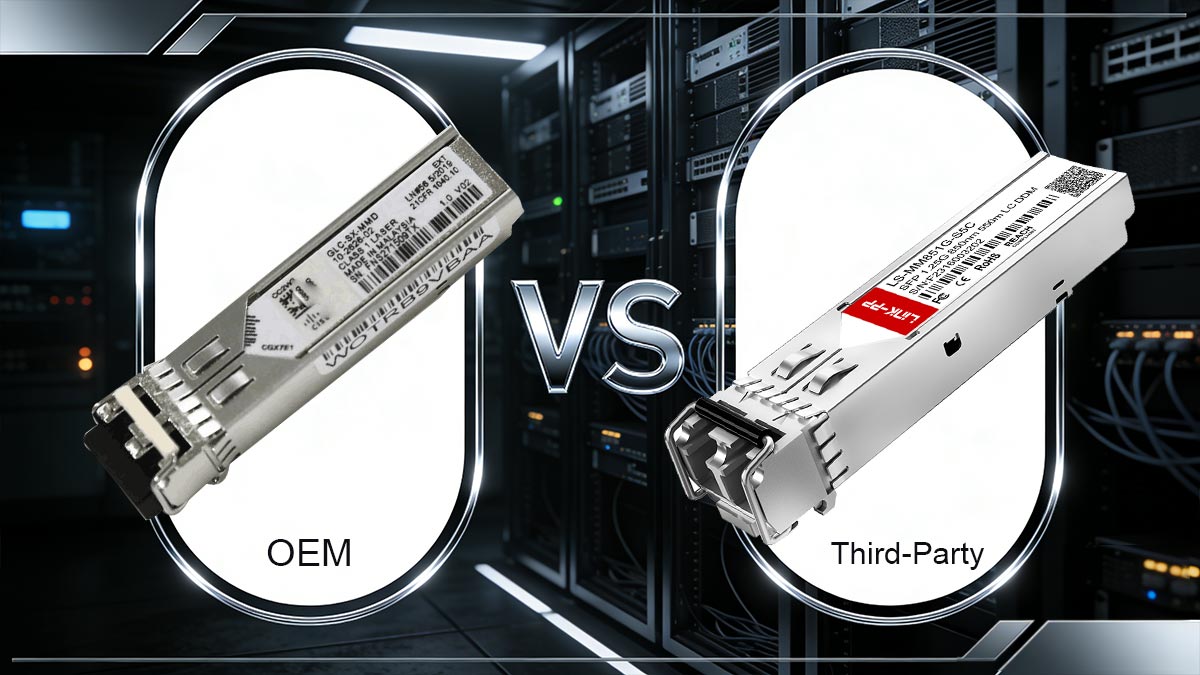
When selecting a GLC-SX-MMD 1000BASE-SX SFP transceiver module, one of the most important purchasing decisions is choosing between OEM (Original Cisco) modules and compatible (third-party) alternatives. While both can deliver the same 1Gbps optical performance, they differ significantly in price, branding, coding, and long-term flexibility.
OEM (Original Equipment Manufacturer):
The original Cisco-branded GLC-SX-MMD module, manufactured or certified by Cisco.Compatible Module:
A third-party SFP module engineered to match Cisco specifications, often Cisco-coded to ensure device recognition and full functionality.
Side-by-Side Comparison
Feature | OEM Cisco GLC-SX-MMD | Compatible GLC-SX-MMD |
|---|---|---|
Brand | Cisco | Third-party (e.g., LINK-PP, FS, etc.) |
Performance | Identical (1Gbps, 850nm, MMF) | Identical (if high-quality) |
DOM Support | Fully supported | Fully supported (if properly coded) |
Device Recognition | 100% native | May require proper coding |
Price | High ($100–$300+) | Low ($6–$40 typical range) |
Firmware Risk | None | Possible in restrictive Cisco systems |
Warranty Support | Cisco official warranty | Vendor-dependent warranty |
Availability | Limited supply chain | Widely available |
Cost Difference (Major Decision Factor)
One of the biggest reasons users consider compatible modules is cost efficiency:
OEM Cisco GLC-SX-MMD: High premium pricing
Compatible modules: Up to 70–90% cost reduction
👉 In large-scale deployments (data centers or enterprise networks), this cost difference can translate into thousands of dollars in savings per project.
Performance and Reliability
A common misconception is that compatible modules perform worse—but this is not necessarily true.
When quality is high:
Same optical components
Same 850nm laser specification
Same 1Gbps throughput
Same DOM monitoring capability
The real difference is:
Branding
Firmware coding
Quality control consistency (varies by vendor)
⚠️ Risks of Compatible Modules
While cost-effective, compatible modules can introduce risks if poorly manufactured:
Cisco device rejection (“unsupported transceiver”)
Inaccurate DOM readings
Firmware update blocking
Reduced long-term reliability
These risks are vendor-dependent, not inherent to all compatible modules.
When Should You Choose Each?
✅ Choose OEM Cisco GLC-SX-MMD if:
You require 100% guaranteed Cisco support
Your environment is mission-critical (finance, telecom, government)
Budget is not a primary concern
✅ Choose Compatible GLC-SX-MMD if:
You want cost optimization at scale
You are deploying large networks (data centers, campuses)
You choose a trusted, tested vendor with Cisco coding
💡 Expert Insight
In modern enterprise deployments, the trend is shifting toward:
Validated compatible modules + strict testing = same performance at significantly lower cost
As long as compatibility is verified, many organizations now adopt compatible GLC-SX-MMD modules as a standard procurement strategy, especially for non-critical infrastructure layers.
OEM = maximum assurance, highest cost
Compatible = same performance potential, much lower cost
The real deciding factor is not performance—but trust in the supplier and compatibility validation process
🔹 FAQ — GLC-SX-MMD 1000BASE-SX SFP Transceiver Module
❓ Can GLC-SX-MMD be mixed with non-DOM SFP modules in the same network?
Yes. GLC-SX-MMD can operate in the same network alongside non-DOM modules, as long as both ends of the link support 1000BASE-SX over multimode fiber (MMF). However, only the MMD side will provide diagnostic visibility, which may create asymmetric monitoring capability.
❓ Does GLC-SX-MMD require special configuration after installation?
In most cases, no manual configuration is required. The module is designed to be plug-and-play (hot-swappable). Once inserted into a compatible port, the device will automatically detect and activate the link—assuming fiber type and speed settings are correct.
❓ What happens if I use the wrong fiber patch cable with GLC-SX-MMD?
If a single-mode fiber (SMF) cable is mistakenly used instead of multimode fiber:
The link may fail to establish
Signal loss will occur immediately or intermittently
Optical power levels will be incorrect (DOM alarms if supported)
This is a physical-layer mismatch and cannot be corrected via software.
❓ Can GLC-SX-MMD work in non-Cisco switches?
Yes, it may work in non-Cisco devices that support standard 1000BASE-SX SFP modules, but success depends on:
Vendor coding acceptance
EEPROM compatibility
Whether the switch enforces vendor lock policies
Some platforms may reject the module even if the optical specs are identical.
❓ Does DOM affect network performance or introduce latency?
No. DOM (Digital Optical Monitoring) is a passive diagnostic feature and does not affect:
Data transmission speed
Latency
Packet loss
Bandwidth performance
It only provides real-time telemetry data from the transceiver.
❓ Is GLC-SX-MMD suitable for high-density data center environments?
Yes. It is commonly used in high-density 1G access layers, especially for:
Top-of-rack (ToR) switching
Server-to-switch connectivity
Aggregation layer links
However, for higher bandwidth requirements, organizations typically migrate to 10G or 25G SFP+ / SFP28 modules.
❓ Can GLC-SX-MMD be reused after decommissioning?
Yes. The module is hot-swappable and reusable, provided:
It has not been physically damaged
It remains within optical power specifications
It is compatible with the new target device
Proper handling ensures multiple deployment cycles across infrastructure upgrades.
❓ What is the typical failure reason for GLC-SX-MMD modules in practice?
Most real-world failures are not electronic but environmental or installation-related:
Dirty or contaminated fiber connectors
Incorrect fiber type (SMF vs. MMF)
Excessive bend radius in cabling
Mismatched optical budget in long runs
Proper fiber hygiene and design validation significantly reduce failure rates.
🔹 Conclusion — How to Choose the Right 1000BASE-SX SFP Module
Selecting the right 1000BASE-SX SFP module (such as GLC-SX-MMD or compatible alternatives) is not just about meeting basic link requirements—it directly impacts network stability, long-term maintenance cost, and deployment scalability. A structured selection approach helps ensure reliable performance in enterprise and data center environments.
Best Practices for Choosing a Reliable GLC-SX-MMD Module
To ensure consistent performance and compatibility, follow these core best practices:
1. Compatibility checklist
Before purchasing, verify:
Switch vendor compatibility (Cisco, multi-vendor environments, etc.)
1000BASE-SX standard support
DOM / non-DOM requirements
Port coding restrictions or firmware lock policies
2. Performance validation
Ensure the module meets real-world operating conditions:
Optical power within acceptable budget range
Stable link over intended fiber distance (MMF OM2/OM3/OM4)
No packet loss under sustained traffic load
Temperature stability under full port utilization
3. Vendor selection strategy
Choose suppliers based on:
Proven interoperability testing
Consistent EEPROM coding quality
Warranty and replacement support
Transparent specification compliance (MSA standards)
4. Avoiding overheating / failure
Although 1G SX modules generate lower heat than high-speed optics, failure risks still exist:
Maintain proper airflow in high-density switches
Avoid mixed poor-quality third-party modules in the same chassis
Ensure clean optical interfaces to reduce signal degradation
5. Testing before deployment
Always validate modules in a controlled environment:
Loopback or short-reach fiber testing
Switch-side interface diagnostics (DOM readings if available)
Stress testing under peak traffic load
Cross-vendor interoperability checks (if applicable)
Decision framework
Use this practical framework when selecting your module:
Distance → Match SR reach limits (typically up to 550m on OM4)
Fiber type → Ensure multimode fiber (OM2/OM3/OM4), never SMF
Budget → Balance OEM vs. compatible module cost-performance ratio
Compatibility → Confirm switch acceptance and EEPROM coding behavior
Risk reduction checklist
✔ Confirm MMF cable type before installation
✔ Avoid mixing untested vendors in critical links
✔ Validate DOM readings after installation
✔ Keep fiber connectors clean and protected
✔ Document module placement for troubleshooting
✔ Perform pre-deployment testing in staging environment
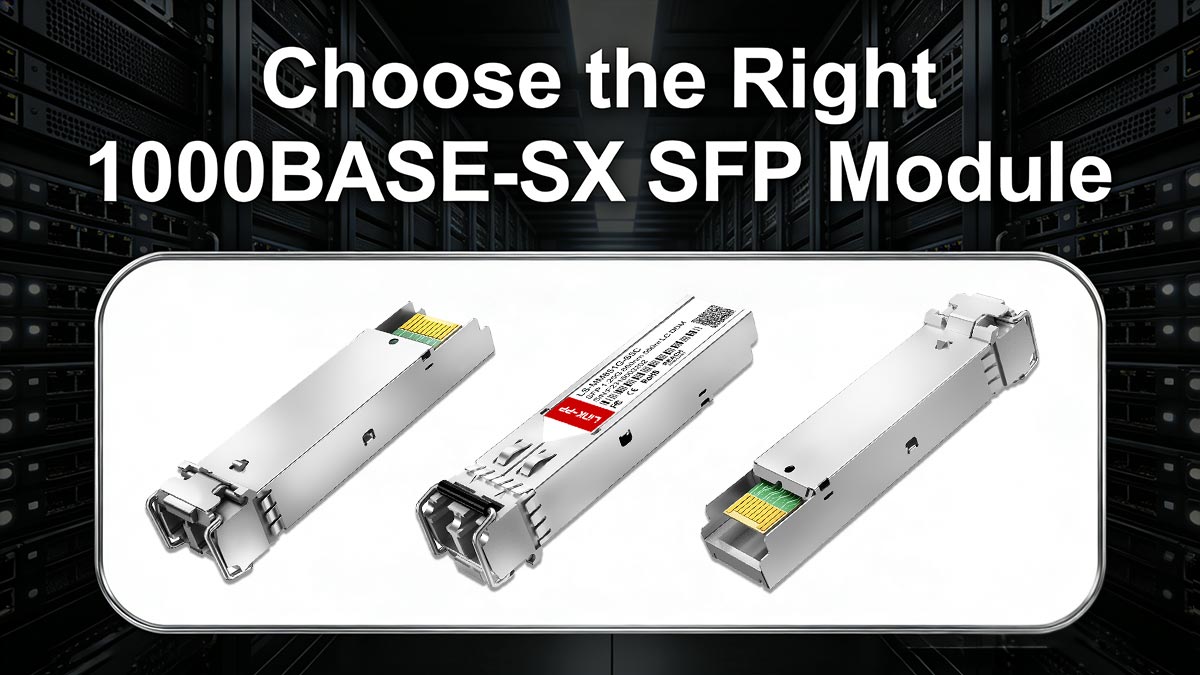
For enterprises seeking stable, cost-effective, and fully tested 1000BASE-SX SFP solutions, choosing a trusted supplier is critical to reducing long-term network risk.
Explore reliable and compatibility-tested options from the LINK-PP Official Store, where modules are designed for multi-vendor interoperability, consistent performance, and large-scale deployment reliability.