

Netgear AGM731F Datasheet means precise technical verification. This includes fiber type compatibility, transmission distance, connector type, power consumption, and whether the module will work reliably with their existing switch infrastructure.
The NETGEAR AGM731F is a 1000BASE-SX (1G) SFP fiber transceiver designed for short-range multimode fiber (MMF) applications. It is commonly used in enterprise networks, campus environments, and access-layer switching where stable 1G optical links are required. Unlike generic overviews, a proper datasheet-focused guide helps answer critical deployment questions such as:
Which fiber types (OM1, OM2, OM3, OM4) are supported?
What is the maximum transmission distance for each fiber grade?
Does it use LC duplex connectors?
Is it compatible with your specific NETGEAR switch model?
What are the environmental and power constraints?
This article is structured to deliver datasheet-level clarity with real-world usability, combining official specifications with practical interpretation. By the end of this guide, you will clearly understand not only the raw specs of the AGM731F, but also how to apply them correctly in your network design or upgrade decision.
Whether you are replacing an existing SFP module, planning a new fiber link, or verifying compatibility before purchase, this guide is built to match your exact search intent—fast, accurate, and deployment-ready information.
🔷 What Is the Netgear AGM731F SFP Module?
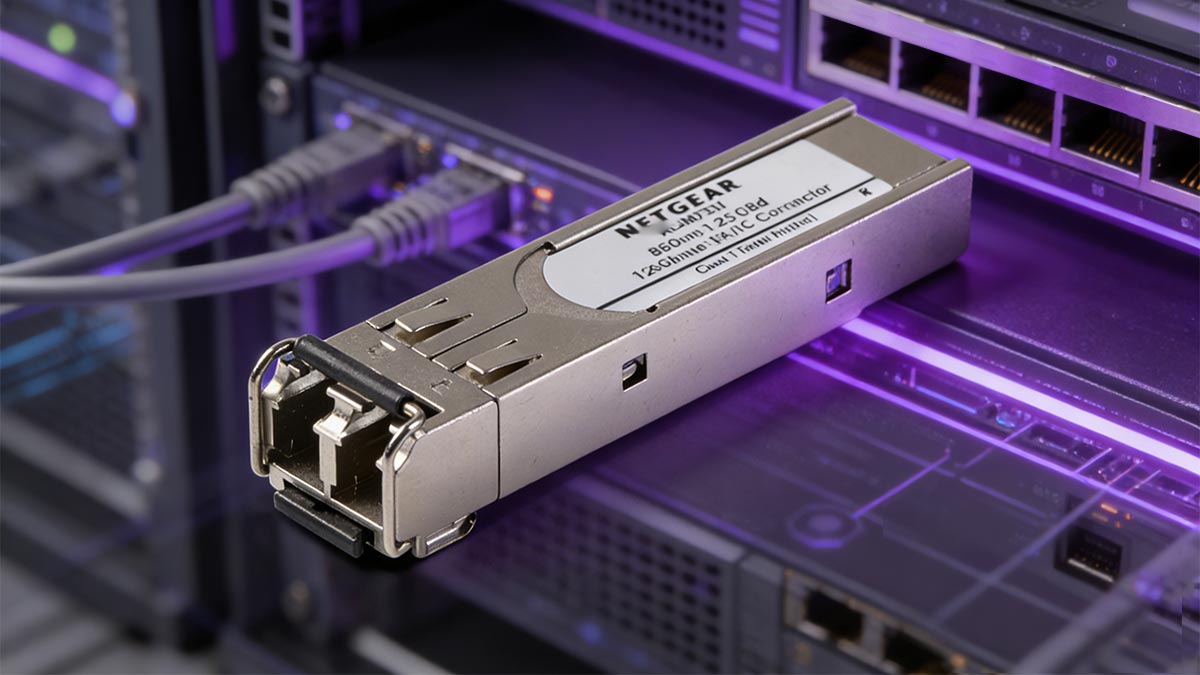
The NETGEAR AGM731F is a 1G (Gigabit) SFP fiber transceiver designed for use in NETGEAR switch environments, enabling high-speed data transmission over multimode fiber (MMF) using the 1000BASE-SX standard.
In simple terms, it acts as a plug-in optical interface that converts electrical signals from a switch into optical signals for transmission over fiber cables—and vice versa. This allows network devices to communicate over longer distances than traditional copper connections, while maintaining stable Gigabit performance.
Key Functional Characteristics
Standard: Based on IEEE 802.3z (1000BASE-SX)
Speed: 1 Gigabit per second (1Gbps)
Connector type: LC duplex for multimode fiber
Application: Short-range fiber links within buildings, campuses, or data rooms
Where AGM731F is Typically Used
The AGM731F is commonly deployed in:
Enterprise access-layer switches
Campus network fiber uplinks
Server-to-switch connections
Network expansion scenarios requiring reliable 1G optical links
Because it is specifically designed for NETGEAR-compatible SFP ports, it ensures seamless integration with a wide range of managed and smart switches. This makes it a practical choice for users who need a cost-effective, standards-compliant fiber module without moving to higher-cost 10G solutions.
In the next section, we’ll break down the full AGM731F datasheet specifications so you can evaluate its performance, limits, and deployment requirements in detail.
🔷 Netgear AGM731F Datasheet Specs at a Glance
To match the intent behind searching “Netgear AGM731F Datasheet,” this section provides a clean, datasheet-style specification summary of the NETGEAR AGM731F, focusing on the core parameters engineers and buyers need for quick validation.
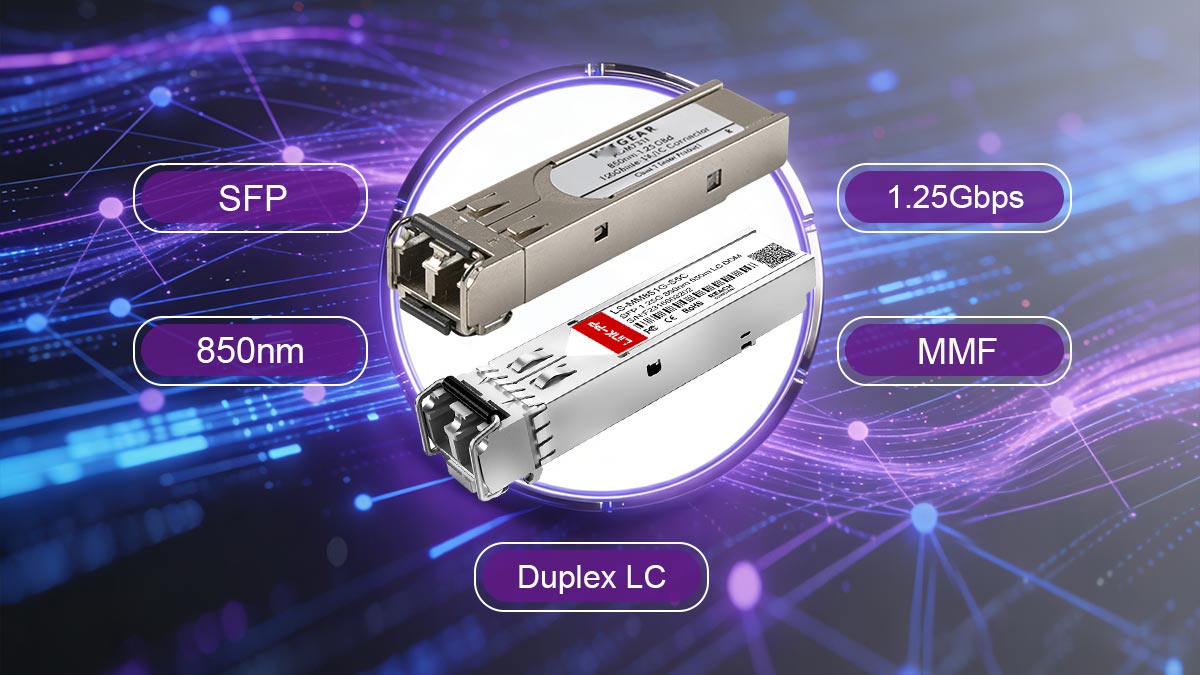
AGM731F Core Specifications Overview
Category | Specification |
|---|---|
Standard | IEEE 802.3z (1000BASE-SX) |
Connector | LC duplex (for 50/125µm and 62.5/125µm MMF) |
Data rate | Up to 1.25 Gbps |
Power consumption | ~1.1W |
Dimensions (H × W × D) | 2.23 × 0.53 × 0.34 in (56.8 × 13.6 × 8.6 mm) |
Weight | 0.58 oz (16.3 g) |
MTBF (reliability) | >10 years |
Operating temperature | –5°C to 70°C (23°F to 158°F) |
Storage temperature | –40°C to 85°C |
Humidity | 85% at 25°C |
Safety certifications | UL 60950-1, CSA-C22.2 No.60950-1 |
Environmental compliance |
These specifications come directly from official installation guides and product documentation, which define AGM731F as a short-range multimode fiber SFP module optimized for stable 1G Ethernet links.
Key Takeaways from the AGM731F Datasheet
Standards-based reliability: Compliance with IEEE 802.3z ensures interoperability with standard Gigabit Ethernet infrastructure.
Low power consumption: At around 1.1W, it is energy-efficient for dense switch deployments.
Compact SFP form factor: Designed for hot-pluggable use in standard SFP ports without interrupting operations.
Enterprise-grade durability: With >10 years MTBF and industrial temperature tolerance, it supports long-term network stability.
Why this Spec Block Matters
For most users, this section answers the core datasheet intent immediately:
Can it work in my switch? → Yes, if it supports SFP and 1000BASE-SX
Is it energy efficient? → Yes, low power (~1.1W)
Is it reliable for long-term deployment? → Yes, high MTBF and certified safety standards
Does it meet compliance requirements? → Yes, UL + RoHS
In the next section, we’ll go deeper into AGM731F compatibility with NETGEAR switches, which is one of the most critical decision factors before deployment.
🔷 AGM731F Compatibility With NETGEAR Switches
One of the most important reasons users search for the Netgear AGM731F Datasheet is to confirm switch compatibility before purchase. Even though SFP modules follow standardized formats, real-world deployment depends heavily on vendor support, port type, and firmware recognition.
Native Compatibility with NETGEAR Switch Families
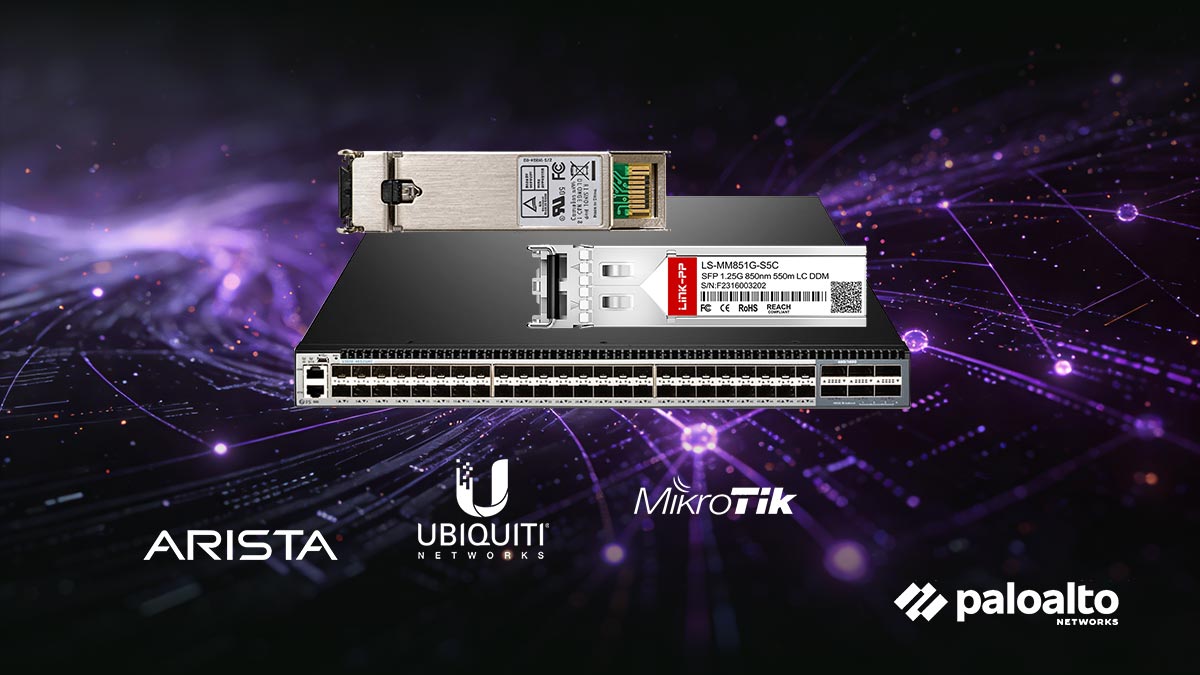
The NETGEAR AGM731F is designed specifically for NETGEAR environments and is officially supported across multiple switch categories:
Fully Managed Switches
Smart Managed (Smart) Switches
Specific models such as JGS524F
According to official product documentation, the module fits into any SFP GBIC-compliant slot, making it broadly usable across NETGEAR’s Gigabit switch lineup.
Additionally, support documentation confirms that AGM731F is also compatible with certain higher-end platforms, including models like XS708T, XS712T, XS716T, XS728T, and XS748T, further expanding its deployment range.
Why SFP Compatibility is not “Universal”
Although SFP modules follow industry standards, compatibility is not always guaranteed across vendors or even across all models. Here’s why:
Vendor coding / firmware checks: Some switches only recognize approved modules
Speed mismatch: AGM731F is strictly 1G (1000BASE-SX) and will not operate in 10G-only SFP+ ports
Fiber type dependency: Designed for multimode fiber (MMF)—not single-mode
Port type limitation: Requires standard SFP slots (not SFP+ for 10G operation)
This is why checking the datasheet—and your switch’s supported module list—is critical before deployment.
Practical Compatibility Checklist
To avoid deployment issues, verify the following:
Switch port type → Must support SFP (1G), not SFP+ only
Switch model support list → Confirm AGM731F is listed or supported
Fiber type → Must be multimode (OM1 / OM2 / OM3 / OM4)
Connector type → LC duplex compatibility
Speed requirement → Ensure your network is operating at Gigabit (1G)
The AGM731F is highly compatible within the NETGEAR ecosystem, especially for Gigabit fiber uplinks. However, compatibility should never be assumed—it must be verified against your specific switch model and network setup.
For most users, this step is the difference between a smooth plug-and-play installation and a non-functional link.
In the next section, we’ll break down AGM731F fiber types and transmission distances, helping you choose the right cable and understand real-world performance limits.
🔷 AGM731F Fiber Type and Distance Limits
Understanding fiber type and transmission distance is a core part of the Netgear AGM731F datasheet search intent. The NETGEAR AGM731F is a 1000BASE-SX multimode fiber (MMF) module, meaning its performance depends directly on the grade of fiber used.
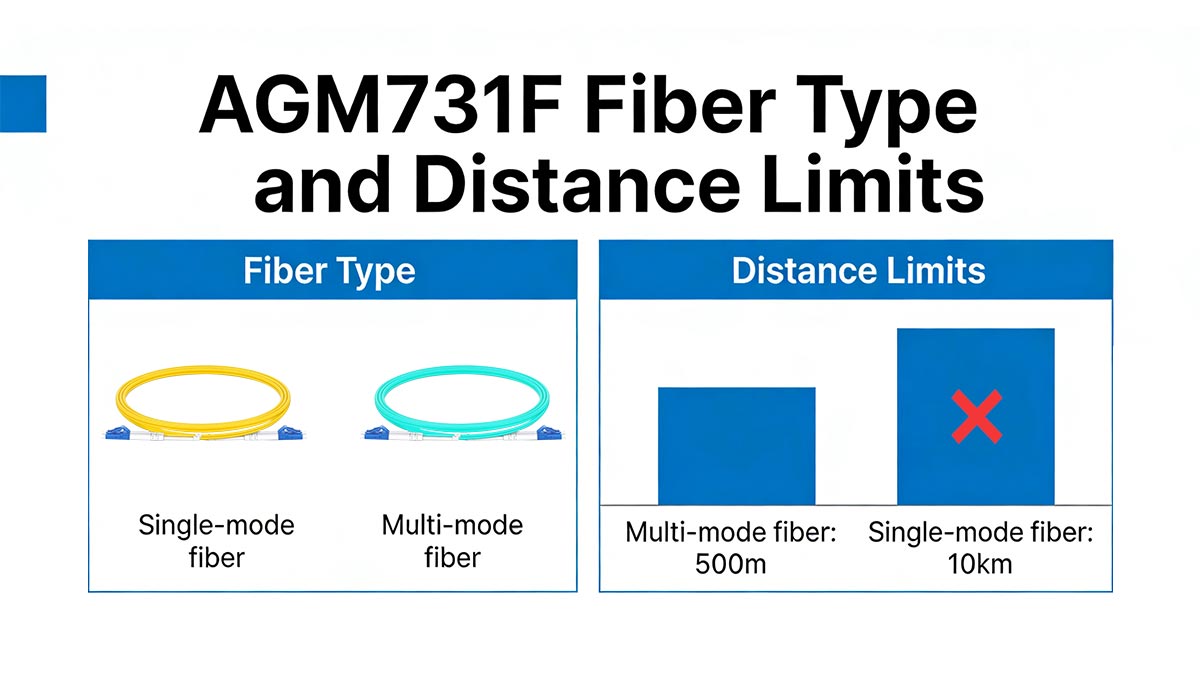
Supported Fiber Types and Maximum Distances
The table below provides a clear comparison of supported MMF types and their typical reach:
Fiber Type | Core Size | Maximum Distance | Typical Use Case |
|---|---|---|---|
OM1 | 62.5 µm | Up to 275 m (900 ft) | Legacy building infrastructure |
OM2 | 50 µm | Up to 550 m (1,800 ft) | Moderate-distance enterprise links |
OM3 | 50 µm (laser-optimized) | Up to 550 m (1,800 ft) | Modern campus/backbone links |
OM4 | 50 µm (enhanced) | Up to 550 m+ (typical) | High-performance MMF deployments |
How to Choose the Right Fiber
Short distances (<300 m): OM1 or OM2 is sufficient, especially in older installations
Medium distances (300–550 m): OM2 or OM3 is recommended for stable performance
New deployments: OM3 or OM4 is preferred for better signal quality and future scalability
Important Limitations to Understand
❌ Not compatible with single-mode fiber (SMF)
❌ Not suitable for long-distance (10km+) transmission
✔ Optimized for short-range, high-reliability 1G links
Because the AGM731F uses short-wavelength optics (SX), it relies on multimode fiber characteristics to maintain signal integrity. Using the wrong fiber type is one of the most common causes of link failure.
Quick Decision Summary
Already have legacy MMF? → AGM731F works well with OM1/OM2
Building a new network? → Choose OM3 or OM4 for better performance
Need long-distance links? → Consider LX (single-mode) modules instead
This section is critical for both deployment planning and troubleshooting, as fiber mismatch can directly impact link stability and achievable distance.
In the next section, we’ll cover installation, power consumption, and operating environment, helping you ensure reliable real-world performance.
🔷 Netgear AGM731F Installation, Power, and Operating Environment
Beyond specifications and compatibility, real-world deployment depends on how the module is installed and the conditions it operates in. The NETGEAR AGM731F is designed for plug-and-play operation, but following best practices ensures stable performance and long service life.
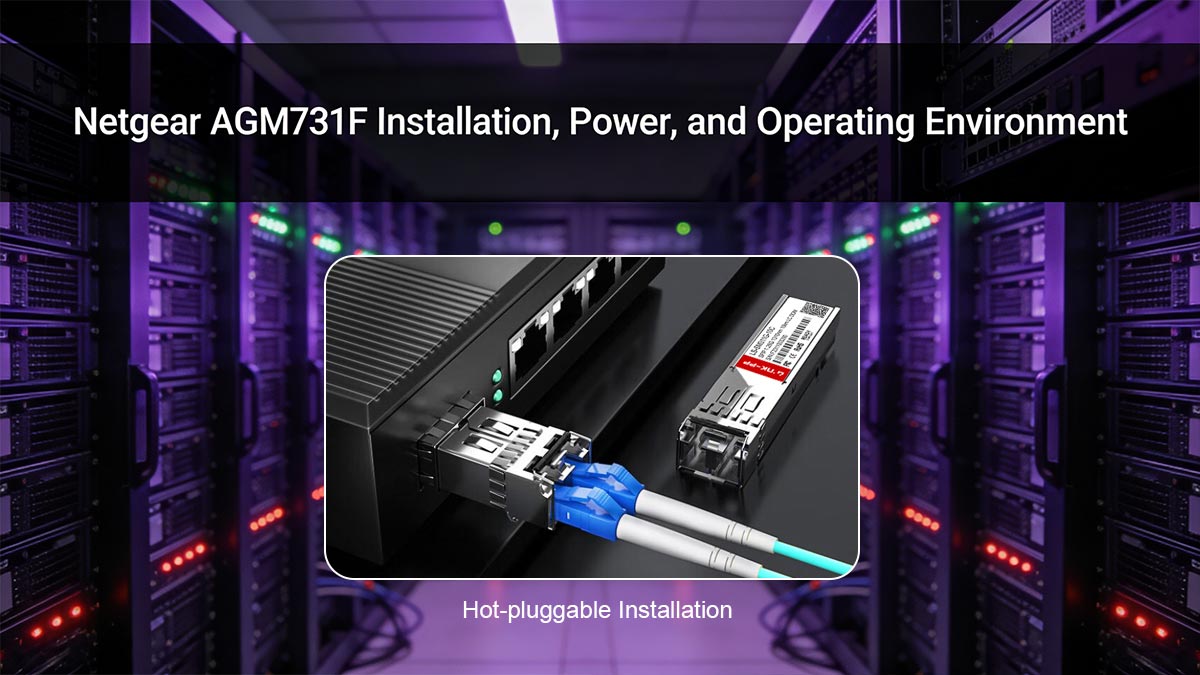
Hot-pluggable Installation (plug-and-play)
The AGM731F uses a standard SFP (Small Form-Factor Pluggable) design, which means it supports hot-plugging:
✔ Can be inserted or removed without powering off the switch
✔ Automatically detected by compatible NETGEAR switches
✔ Minimal downtime during upgrades or replacements
Installation tips:
Insert the module gently until it clicks into place
Use LC duplex fiber cables for connection
Avoid touching optical interfaces to prevent contamination
Common Installation Mistakes to Avoid
❌ Using single-mode fiber (SMF) instead of multimode
❌ Plugging into unsupported or disabled SFP ports
❌ Ignoring dust protection caps, leading to optical contamination
❌ Exceeding recommended temperature ranges in poorly ventilated racks
Power Consumption and Efficiency
Typical power usage: ~1.1W
Low power design makes it suitable for high-density switch deployments
Helps reduce overall heat generation inside network racks
For most enterprise environments, this level of power consumption is considered efficient and stable for 1G optical modules.
Operating and Storage Environment
The AGM731F is built to operate reliably under typical enterprise conditions:
Operating temperature: –5°C to 70°C (23°F to 158°F)
Storage temperature: –40°C to 85°C
Operating humidity: Up to 85% at 25°C
These ranges make it suitable for:
Data rooms and wiring closets
Enterprise IT environments
Controlled industrial or edge deployments
Practical Deployment Best Practices
To maximize performance and lifespan:
Ensure proper airflow inside switch enclosures to prevent overheating
Use clean, high-quality fiber cables to avoid signal loss
Match fiber type (OM1–OM4) with required distance
Avoid frequent unplugging, which can wear connectors over time
The AGM731F is designed for simple, reliable deployment, but optimal performance depends on correct installation and environmental control. With proper handling and conditions, it delivers stable 1G fiber connectivity with minimal maintenance requirements.
In the next section, we’ll examine compliance, safety certifications, and long-term reliability, which are critical for enterprise and regulated environments.
🔷 AGM731F Compliance, Safety, and Reliability
For enterprise deployments, a datasheet is not complete without compliance, safety certifications, and reliability metrics. These factors are critical for IT teams, system integrators, and procurement specialists who must meet regulatory standards and ensure long-term network stability.
The NETGEAR AGM731F is built to meet widely recognized safety and environmental requirements, reinforcing its suitability for professional networking environments.
Safety Certifications
The AGM731F complies with key international safety standards:
UL 60950-1
CSA-C22.2 No.60950-1
These certifications confirm that the module meets strict electrical safety requirements for IT and networking equipment, reducing risks related to overheating, electrical faults, or component failure.
Environmental Compliance (RoHS)
RoHS compliant
RoHS compliance ensures that the AGM731F is manufactured without hazardous materials such as lead, mercury, and cadmium. This is especially important for:
Organizations with environmental policies
Companies operating in regions with strict regulatory requirements (EU, global markets)
Long-term sustainability and responsible electronics disposal
Reliability and MTBF
MTBF (Mean Time Between Failures): >10 years
A high MTBF rating indicates that the AGM731F is designed for long operational life with minimal failure risk, making it suitable for:
Continuous enterprise network operation
Mission-critical infrastructure
Environments where downtime must be minimized
Why Compliance and Reliability matter
✔ Safety certifications ensure regulatory compliance
✔ RoHS compliance supports environmental responsibility
✔ High MTBF reduces maintenance and replacement costs
✔ Proven standards alignment guarantees predictable performance
The AGM731F is not just a standards-based SFP module—it is a certified, enterprise-ready component designed for safe, reliable, and compliant operation. For organizations that prioritize network uptime, regulatory adherence, and long-term investment protection, these attributes are just as important as speed and distance.
Next, we’ll answer the most common user questions in a dedicated AGM731F FAQ section.
🔷 FAQ About Netgear AGM731F Datasheet
1. What speed does the AGM731F support?
The NETGEAR AGM731F supports 1 Gigabit Ethernet (1Gbps) based on the IEEE 802.3z (1000BASE-SX) standard.
It is not compatible with 10G (SFP+) speeds.
2. What type of fiber does AGM731F use?
AGM731F is designed for multimode fiber (MMF) only.
Supported fiber types include:
OM1 (62.5 µm)
OM2 (50 µm)
OM3 / OM4 (laser-optimized 50 µm)
It does not support single-mode fiber (SMF).
3. What is the maximum transmission distance?
The maximum distance depends on the fiber type:
OM1: up to 275 m (900 ft)
OM2: up to 550 m (1,800 ft)
OM3 / OM4: up to 550 m (typical)
For best performance, OM3 or OM4 is recommended in modern deployments.
4. What connector type does AGM731F use?
The module uses an LC duplex connector, which is standard for most Gigabit multimode fiber connections.
5. Is AGM731F compatible with all NETGEAR switches?
No. While it is designed for NETGEAR SFP ports, compatibility depends on the specific switch model.
Works with many managed and smart switches
Requires a 1G SFP port (not 10G SFP+ only)
Always check your switch’s supported module list before purchase
6. Can AGM731F be hot-swapped?
Yes. AGM731F is hot-pluggable, meaning you can insert or remove it without shutting down the switch.
7. What is the power consumption of AGM731F?
The module consumes approximately 1.1W, making it energy-efficient for dense network deployments.
8. Is AGM731F suitable for long-distance connections?
No. AGM731F is a short-range (SX) module designed for distances up to ~550 meters.
For longer distances (e.g., 10 km), a single-mode LX SFP module would be required instead.
9. What certifications does AGM731F have?
AGM731F complies with:
UL 60950-1
CSA-C22.2 No.60950-1
RoHS environmental standards
These certifications ensure safety, compliance, and environmental responsibility.
10. How do I know if AGM731F is the right choice?
Choose AGM731F if:
You need 1G fiber connectivity
Your network uses multimode fiber (MMF)
Your switch supports SFP 1000BASE-SX modules
Your required distance is within 550 meters
🔷 Conclusion: Is Netgear AGM731F the Right 1G SFP Module?
Choosing the right SFP module ultimately comes down to matching your network requirements with the AGM731F’s technical capabilities. The NETGEAR AGM731F is a reliable, standards-based solution for short-range Gigabit fiber connectivity—but it is not a one-size-fits-all module.
Final Decision Framework
Before selecting AGM731F, evaluate these four key factors:
1. Fiber type
✔ Best suited for multimode fiber (OM1 / OM2 / OM3 / OM4)
❌ Not compatible with single-mode fiber (SMF)
2. Transmission distance
✔ Ideal for short-range links up to 550 meters
❌ Not designed for long-distance (10 km+) applications
3. Switch compatibility
✔ Works with NETGEAR SFP-enabled switches (1G ports)
❌ Not suitable for SFP+ (10G-only) ports
✔ Always verify your switch model before deployment
4. Deployment scenario
✔ Enterprise access networks
✔ Campus fiber uplinks
✔ Server-to-switch connections
✔ Cost-effective 1G infrastructure upgrades
When AGM731F is the Right Choice
AGM731F is an excellent option if you need:
Stable and cost-efficient 1G fiber connectivity
Short-distance optical links within buildings or campuses
A plug-and-play module with low power consumption (~1.1W)
A standards-compliant, certified solution with proven reliability
When to Consider Alternatives
You may need a different module if:
You require long-distance transmission (LX, EX, or ZX modules)
Your network is upgrading to 10G or higher speeds
Your infrastructure uses single-mode fiber
For networks built on Gigabit Ethernet and multimode fiber, the AGM731F delivers reliable performance, strong compatibility within the NETGEAR ecosystem, and long-term operational stability. It remains a practical choice for organizations prioritizing cost efficiency and dependable short-range fiber links.
Find AGM731F-Compatible Alternatives
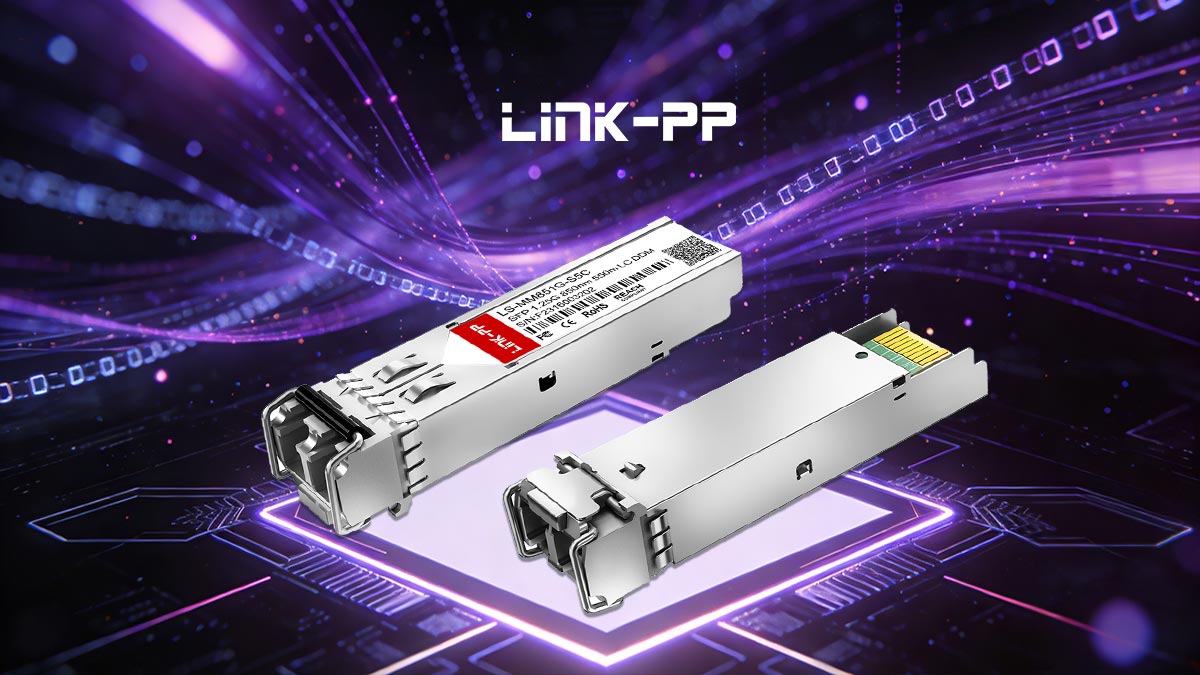
If you are looking for AGM731F-compatible SFP modules with competitive pricing and broad switch compatibility, explore trusted options at the LINK-PP Official Store. A reliable supplier can help you ensure seamless interoperability, stable performance, and faster deployment across your network infrastructure.