

In fiber optic networking, choosing the right optical transceiver is not just a technical preference—it is a critical decision that directly impacts link stability, transmission distance, deployment cost, and long-term scalability. Among the most frequently compared options in Ethernet and data center environments is SFP 850nm vs. 1310nm, a topic that continues to generate high search volume and strong “People Also Ask” engagement across Google.
At a basic level, the difference between 850nm SFP and 1310nm SFP modules refers to the wavelength of light used to transmit data through fiber optic cables. However, behind this simple definition lies a much deeper engineering decision: whether your network is designed for short-range multimode fiber (MMF) or long-range single-mode fiber (SMF) transmission. This distinction affects everything from cable infrastructure selection to module compatibility and total deployment cost.
In real-world deployments, 850nm SFP modules are widely used in data centers, enterprise LANs, and short-reach switch-to-server connections, where cost efficiency and high-density connectivity are priorities. In contrast, 1310nm SFP modules are typically chosen for campus networks, inter-building links, and metro-scale connections, where signal integrity over longer distances is essential.
Despite their clear technical differences, confusion remains common among network engineers, IT buyers, and system integrators. Many compatibility issues—such as link failure, unexpected attenuation, or incorrect module selection—stem from misunderstanding whether 850nm and 1310nm optics can be interchanged or paired with the wrong fiber type.
This guide is designed to eliminate that uncertainty. In the following sections, we will break down the key differences between 850nm and 1310nm SFP modules, including fiber compatibility, transmission distance, cost structure, and real deployment scenarios. You will also learn how to avoid common mistakes and how to choose the correct optical module based on modern network design requirements.
By the end of this article, you will have a clear, engineering-level understanding of which SFP wavelength is right for your network—helping you make faster, safer, and more cost-effective deployment decisions.
🔴 What Does 850nm vs. 1310nm Mean in SFP Modules?
To understand the difference between SFP 850nm vs. 1310nm, it is essential to first understand what “850nm” and “1310nm” actually represent in fiber optic communication. These values refer to the wavelength of light used by the SFP (Small Form-factor Pluggable) optical transceiver to transmit data through fiber cables.
Although the difference may seem like a small numerical variation, in optical engineering it determines how far the signal can travel, what type of fiber can be used, and how the system behaves in real-world environments.
Optical Wavelength Basics
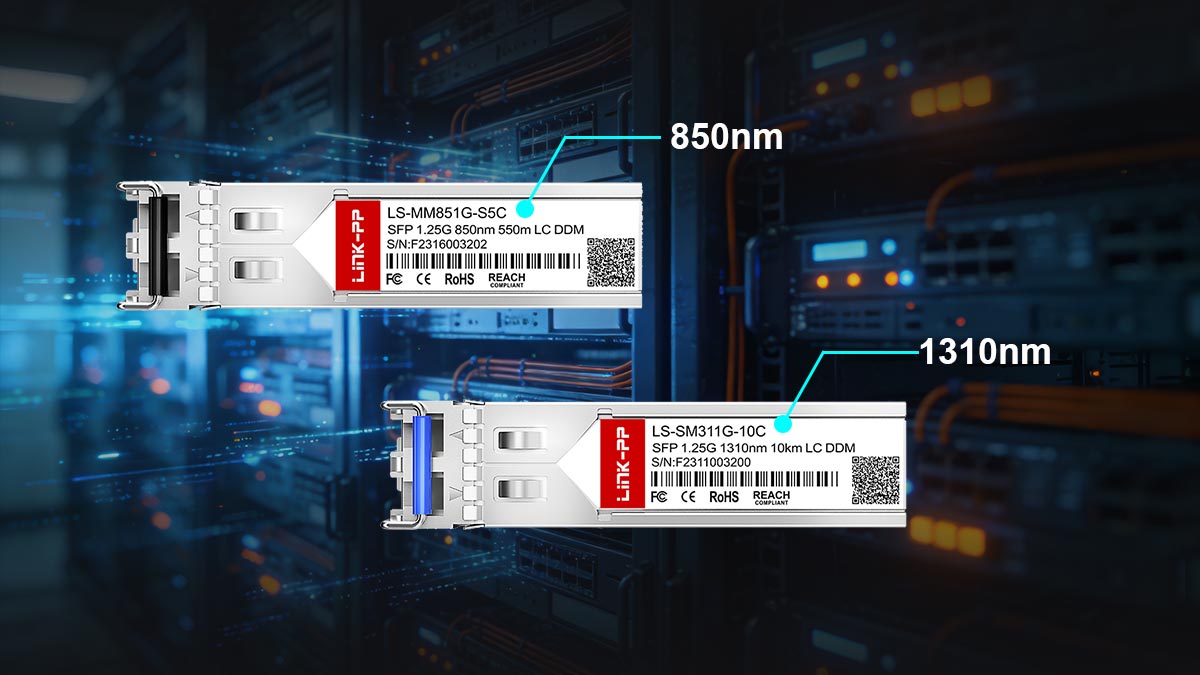
In fiber optics, data is transmitted using light signals instead of electrical signals. These light signals are measured in nanometers (nm), which define the wavelength of the laser inside the SFP module.
850nm wavelength: Near-infrared light, typically used with multimode fiber (MMF)
1310nm wavelength: Longer infrared wavelength, typically used with single-mode fiber (SMF)
The key principle is simple:
Different wavelengths interact differently with fiber structures, which directly impacts signal loss and transmission distance.
Shorter wavelengths like 850nm tend to disperse more quickly in fiber, making them suitable for shorter distances. Longer wavelengths like 1310nm experience lower attenuation, allowing the signal to travel much farther with less degradation.
How Laser Wavelength Affects Transmission
The wavelength inside an SFP module influences three major performance factors:
1. Attenuation (Signal Loss)
850nm experiences higher attenuation in fiber compared to 1310nm
1310nm maintains signal strength over longer distances
2. Modal Dispersion
850nm is commonly used in multimode fiber, where multiple light paths can cause dispersion
1310nm is used in single-mode fiber, where light travels in a single path, reducing distortion
3. Maximum Reach
850nm: optimized for short-range communication (typically up to ~550 meters in Ethernet applications)
1310nm: optimized for medium to long-range communication (commonly 10km, 20km, or more depending on optics)
In simple terms, the wavelength determines how “clean” and “far” the signal can travel before it becomes unusable.
Why SFP Modules Use Different nm Values
SFP modules are not universal optical devices—they are engineered for specific network environments. Different wavelengths exist because no single optical design can efficiently cover all fiber types and distances.
The use of different nm values allows manufacturers and network designers to optimize performance in three key ways:
1. Matching Fiber Infrastructure
850nm is optimized for multimode fiber (large core size, cost-efficient, short reach)
1310nm is optimized for single-mode fiber (small core size, high precision, long reach)
2. Balancing Cost vs Performance
850nm modules use VCSEL lasers, which are cheaper and suitable for high-density environments
1310nm modules use more precise laser sources (e.g., DFB lasers), which are more expensive but deliver higher performance
3. Supporting Different Network Scales
850nm = local connectivity (data centers, rack-to-rack links)
1310nm = extended connectivity (campus, metro, inter-building networks)
This wavelength separation is a fundamental design choice in optical networking. It ensures that engineers can select the right module based on distance requirements, fiber type, and cost constraints, rather than relying on a one-size-fits-all solution.
In the next section, we will break down the core technical differences between SFP 850nm and 1310nm modules, including fiber compatibility, distance performance, and cost structure in real-world deployments.
🔴 SFP 850nm vs. 1310nm: Key Technical Differences
When comparing SFP 850nm vs. 1310nm, the most important distinction is not just the wavelength itself, but how that wavelength interacts with fiber infrastructure, transmission distance, and overall network performance. These differences determine whether a module is suitable for short-range data center links or long-range campus and metro networks.
Fiber Type (MMF vs. SMF)
One of the most critical differences between 850nm and 1310nm SFP modules is the type of optical fiber they are designed to work with.
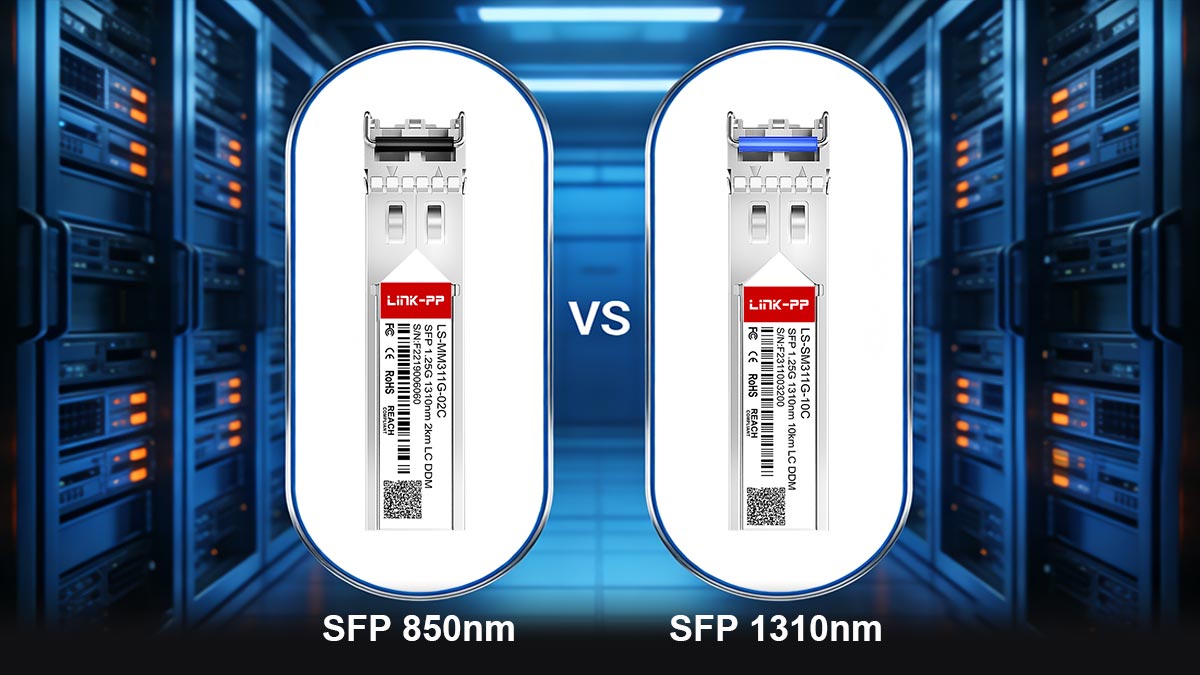
850nm SFP modules → Multimode Fiber (MMF)
Typically used with OM2, OM3, or OM4 fiber
Larger core size (50/62.5 μm)
Allows multiple light paths to travel simultaneously
Ideal for short-distance, high-density environments
1310nm SFP modules → Single-Mode Fiber (SMF)
Typically used with OS1 or OS2 fiber
Very small core size (around 9 μm)
Allows only one light path (single mode transmission)
Designed for long-distance, high-precision communication
In simple terms:
850nm = wider “highway” with multiple light paths
1310nm = single-lane highway with minimal interference
Distance Capability Comparison
Distance is one of the most practical factors influencing SFP selection, and here the difference is significant.
Category | 850nm SFP (Multimode Fiber) | 1310nm SFP (Single-Mode Fiber) |
|---|---|---|
Typical Distance Range | 300m – 550m (depending on fiber grade) | 10km – 40km+ (depending on module type) |
Fiber Type | Multimode Fiber (OM2 / OM3 / OM4) | Single-Mode Fiber (OS1 / OS2) |
Common Standards | ||
Transmission Purpose | Short-range, high-density connections | Long-range backbone connectivity |
Ideal Use Cases | Data centers, rack-to-rack, intra-building links | Campus networks, inter-building links, metro access |
Signal Behavior | Higher dispersion over distance | Lower attenuation, stable long-distance transmission |
Key takeaway: 850nm is short-range by design, while 1310nm is built for extended reach.
Signal Attenuation and Performance
Signal attenuation (loss of signal strength over distance) is another major technical differentiator.
850nm wavelength
Higher attenuation rate in fiber
More affected by modal dispersion in multimode fiber
Performance is highly dependent on fiber quality and installation conditions
1310nm wavelength
Lower attenuation over distance
More stable transmission due to single-mode propagation
Better suited for maintaining signal integrity over kilometers
In practical deployments, this means that 1310nm links are generally more stable over long distances, while 850nm links are optimized for cost-effective short-range performance where loss is minimal.
Cost Differences in Real Deployments
Cost is often a decisive factor when choosing between 850nm and 1310nm SFP modules, especially in large-scale deployments.
850nm SFP modules (lower cost)
Use VCSEL laser technology, which is cheaper to manufacture
Multimode fiber infrastructure is less expensive
Ideal for high-port-density environments like data centers
1310nm SFP modules (higher cost)
Use more advanced laser technology (e.g., DFB lasers)
Single-mode fiber installation is more expensive
Higher cost per link but enables long-distance connectivity
From a total cost perspective:
850nm = lower CAPEX for short-range networks
1310nm = higher CAPEX but better long-distance ROI
The difference between 850nm and 1310nm SFP modules is fundamentally a trade-off between:
Distance vs cost
Multimode flexibility vs. single-mode precision
Short-range efficiency vs. long-range stability
Understanding these trade-offs is essential for designing a network that is both cost-efficient and performance-optimized.
In the next section, we will explore fiber compatibility in detail—why multimode (MMF) and single-mode (SMF) cannot be treated as interchangeable in real deployments, and what happens when mismatches occur.
🔴 Fiber Compatibility: Multimode vs. Single Mode Explained
One of the most important (and most misunderstood) aspects of SFP 850nm vs. 1310nm is fiber compatibility. In real-world deployments, most connectivity failures are not caused by the SFP module itself, but by incorrect pairing between wavelength and fiber type. Understanding the difference between multimode fiber (MMF) and single-mode fiber (SMF) is essential for stable optical network design.

Why 850nm Requires Multimode Fiber (OM2/OM3/OM4)
850nm SFP modules are designed to operate with multimode fiber (MMF) such as OM2, OM3, and OM4. This is because of how light behaves inside a larger fiber core.
Multimode fiber characteristics:
Core size: 50 or 62.5 microns
Allows multiple light paths (modes) to propagate simultaneously
Designed for short-distance transmission
At 850nm, most optical transceivers use VCSEL (Vertical-Cavity Surface-Emitting Laser) technology, which is well-suited for multimode transmission. The wider fiber core allows the light to enter at different angles and reflect internally.
However, this also introduces a limitation:
Multiple light paths cause modal dispersion, which limits distance and increases signal distortion over longer runs.
That is why 850nm is primarily used in:
Rack-to-rack switching
High-density LAN environments
Typical fiber pairings:
OM2 → legacy short-range
OM3 / OM4 → modern high-speed data center networks
Why 1310nm Is Optimized for Single-Mode Fiber (OS1/OS2)
1310nm SFP modules are engineered for single-mode fiber (SMF), typically OS1 and OS2 grades.
Single-mode fiber characteristics:
Core size: ~9 microns
Only one optical path (single propagation mode)
Designed for long-distance and high-precision transmission
At 1310nm, the light is more focused and travels in a straight, narrow path through the fiber core. This eliminates most of the modal dispersion issues found in multimode fiber.
Key advantages of 1310nm + SMF combination:
Very low attenuation over long distances
High signal stability
Supports long-haul transmission (10km–40km+ depending on optics)
This makes 1310nm ideal for:
Campus backbone networks
Inter-building connections
Metro and access networks
Common fiber types:
OS1 → indoor, shorter single-mode runs
OS2 → outdoor, long-distance optimized deployments
What Happens When Fiber and Wavelength Mismatch
One of the most critical real-world issues in fiber deployments is incorrect matching between SFP wavelength and fiber type. This can lead to partial performance issues or complete link failure.
❌ Scenario 1: 850nm SFP on Single-Mode Fiber (SMF)
The optical signal is not properly aligned with the fiber core design
Light coupling efficiency is extremely low
Result:
Weak or no link signal
Unstable connection
High insertion loss
❌ Scenario 2: 1310nm SFP on Multimode Fiber (MMF)
Multimode fiber core is too large for single-mode optics
Light dispersion becomes unpredictable
Result:
Reduced performance or intermittent connectivity
Increased signal degradation over distance
Potential link flapping in sensitive environments
⚠️ Important Note from Real Deployments
While some edge cases may appear to “work” temporarily, they are:
Not standards-compliant
Not stable under load
Not recommended for production networks
The relationship between wavelength and fiber type is not interchangeable—it is a strict engineering pairing rule:
850nm → Multimode fiber (OM2/OM3/OM4)
1310nm → Single-mode fiber (OS1/OS2)
Correct matching ensures:
Stable optical power budget
Minimal signal loss
Long-term network reliability
In the next section, we will analyze distance and performance differences in real deployment scenarios, including how 850nm and 1310nm behave in enterprise, data center, and campus network environments.
🔴 Distance and Performance Comparison (Real Deployment Guide)
In real network deployments, the choice between SFP 850nm vs. 1310nm is often decided less by theory and more by distance requirements and performance stability under real operating conditions. While both wavelengths are widely used in Ethernet networks, their practical behavior differs significantly when applied to data centers, enterprise campuses, and metropolitan links.
Understanding these differences is essential for avoiding over-design (unnecessary cost) or under-design (unstable links or failed connections).
850nm Typical Reach (Up to ~550m)
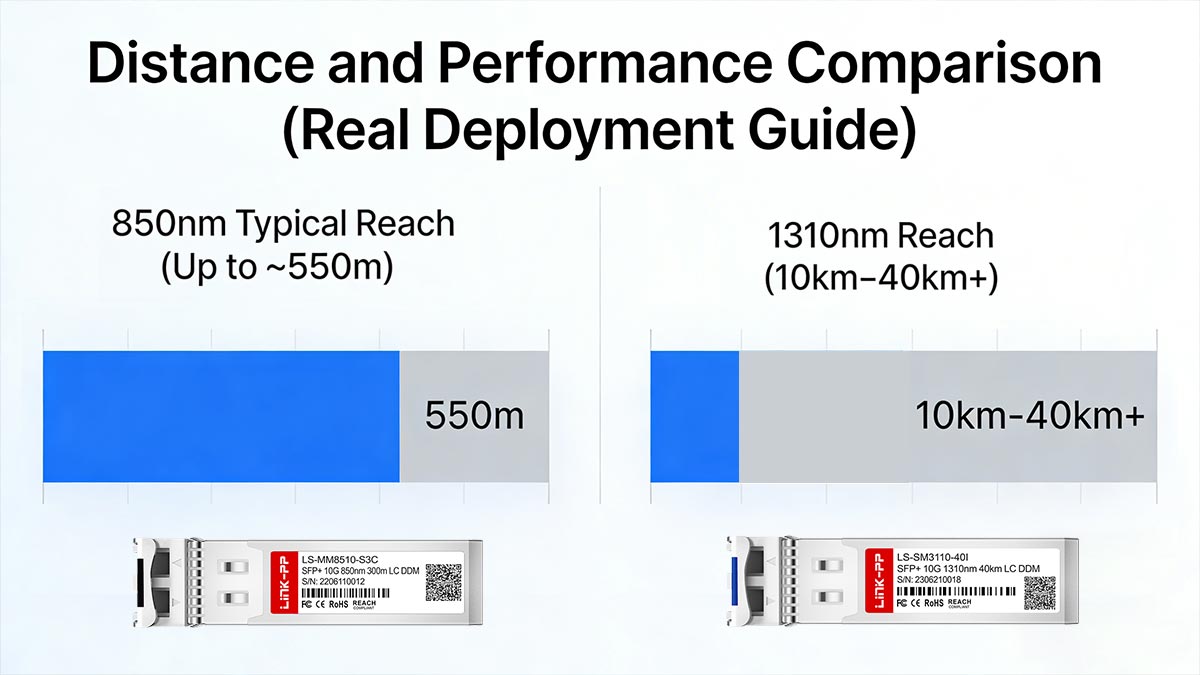
850nm SFP modules are designed for short-range communication over multimode fiber (MMF), and their performance is optimized for high-density environments rather than long-distance transmission.
Typical characteristics:
Effective range: 10m to ~550m
Best performance within short intra-building links
Works with OM2 / OM3 / OM4 fiber types
In real-world deployments, 850nm modules are widely used in environments where:
Switches and servers are located within the same rack or room
Data center leaf-spine architectures require high port density
Short-distance aggregation is needed with minimal latency impact
However, performance degradation becomes noticeable when:
Fiber quality is inconsistent
Cable runs approach maximum supported distance
Excessive patching or connectors are introduced
Key takeaway: 850nm is highly efficient, but only within controlled short-range environments.
1310nm Reach (10km–40km+)
1310nm SFP modules are designed for single-mode fiber (SMF), enabling significantly longer transmission distances with much lower optical loss.
Typical characteristics:
Effective range: 10km, 20km, 40km+ (depending on module class)
Used in LX / LR optical standards
Optimized for OS1 / OS2 fiber infrastructure
Lower attenuation and higher signal stability
In real-world deployments, 1310nm modules are commonly used for:
Campus backbone networks connecting multiple buildings
Enterprise WAN or metro access links
Data center interconnect (DCI) scenarios
ISP and telecom aggregation networks
Because single-mode fiber supports a single light path, 1310nm signals maintain higher integrity over long distances, even in complex outdoor or multi-building environments.
Key takeaway: 1310nm is the preferred standard when distance and signal stability are critical design factors.
Real-World Enterprise and Data Center Scenarios
To better understand how these technologies are applied, consider the following deployment patterns:
🏢 Data Center Environment (850nm Dominant)
High-speed switches connected within the same room or rack row
Short optical links between leaf and spine switches
Cost-efficient high-port-density architecture
Multimode fiber simplifies internal cabling
Example: 10G SR (850nm) used for switch-to-switch links within 100–300 meters
🏙 Enterprise Campus Environment (Mixed Usage)
850nm used inside buildings (server rooms, floors)
1310nm used between buildings
Hybrid fiber infrastructure combining MMF + SMF
Example:
Building A internal network → 850nm (MMF)
Building A to Building B → 1310nm (SMF)
🌐 Metro / Inter-Building Networks (1310nm Dominant)
Long-distance fiber routes
Higher requirement for signal integrity
Fewer physical access points, but higher distance coverage
Example: 1310nm LR modules used for 10km+ campus or metro links
When Distance Becomes a Deciding Factor
In optical network design, distance is often the first and most important constraint when selecting between 850nm and 1310nm SFP modules.
A simple decision framework:
If your link is under ~300–550m → 850nm (MMF) is typically sufficient
If your link is over 1km or spans multiple buildings → 1310nm (SMF) is required
If future expansion is expected → 1310nm provides better scalability
However, real engineering decisions also consider:
Fiber availability in existing infrastructure
Installation cost (MMF vs. SMF)
Network topology (flat LAN vs distributed campus)
In practice, distance defines not only performance, but also infrastructure strategy.
In the next section, we will explore cost and deployment considerations in networks, including total cost of ownership (TCO), infrastructure investment, and long-term scalability differences between 850nm and 1310nm solutions.
🔴 Cost and Deployment Considerations in Networks
In modern network planning, the decision between SFP 850nm vs. 1310nm is no longer driven only by technical performance. In enterprise and data center environments, cost structure, infrastructure strategy, and scalability planning play an equally important role.
While both options are widely deployed, they represent two fundamentally different investment models: short-range cost optimization (850nm) versus long-range infrastructure scalability (1310nm).

Why 850nm SFP Modules Are More Cost-Efficient
850nm SFP modules are generally the preferred choice in cost-sensitive, high-density environments such as data centers and enterprise LANs. The main reason is the combination of cheaper optics and lower fiber installation cost.
Key cost advantages include:
Lower transceiver cost due to VCSEL laser technology
Cheaper multimode fiber (MMF) cabling
Simplified installation and termination
Reduced need for long-distance optical power budgeting
Because 850nm systems are designed for short-range communication, they eliminate the need for expensive long-haul optical components, making them highly efficient for:
Rack-to-rack connectivity
Switch-to-server links
High-port-density leaf-spine architectures
In short: 850nm minimizes upfront CAPEX in controlled environments.
Infrastructure Cost Differences (MMF vs. SMF)
One of the most important cost drivers in optical networking is not just the SFP module itself, but the underlying fiber infrastructure.
Cost Factor | Multimode Fiber (MMF – 850nm) | Single-Mode Fiber (SMF – 1310nm) |
|---|---|---|
Cable Cost | Lower | Higher |
Installation Complexity | Easier | More complex |
Connector Precision | Less strict | High precision required |
Optical Components | Lower cost VCSEL optics | Higher cost DFB/advanced lasers |
Deployment Scope | Short-range internal networks | Long-distance campus / metro links |
In practice:
MMF (850nm systems) reduces initial deployment cost
SMF (1310nm systems) increases initial investment but enables long-distance scalability
This creates a clear trade-off: lower upfront cost vs. higher infrastructure capability.
Total Cost of Ownership (TCO) Perspective
From a enterprise IT strategy perspective, evaluating Total Cost of Ownership (TCO) is more important than focusing only on initial purchase cost.
850nm TCO Profile:
Lower initial CAPEX (optics + cabling)
Limited scalability beyond short-range links
May require future re-cabling if network expands
Ideal for stable, localized environments
1310nm TCO Profile:
Higher initial CAPEX due to SMF infrastructure and optics
Lower risk of future redesign or reinstallation
Better long-term scalability for distributed networks
More cost-efficient over lifecycle in large campus deployments
Key insight: 850nm saves money now, 1310nm saves money later.
Scaling Implications for Modern Networks
As enterprise networks evolve toward cloud integration, distributed campuses, and higher bandwidth demands, scalability becomes a central design requirement.
850nm Scaling Characteristics:
Efficient within data centers and localized clusters
Limited by multimode fiber distance constraints
Scaling often requires additional switching layers rather than fiber extension
1310nm Scaling Characteristics:
Supports inter-building and campus-wide expansion
Enables long-distance backbone consolidation
Reduces need for intermediate networking equipment
Better aligned with modern distributed architectures
Many organizations are shifting toward hybrid architectures, where:
850nm is used for high-density internal switching
1310nm is used for backbone and inter-site connectivity
The cost decision between 850nm and 1310nm SFP modules is no longer purely about price per transceiver. It is about network architecture strategy:
Choose 850nm when optimizing for short-range efficiency and low initial cost
Choose 1310nm when designing for long-term scalability and distributed infrastructure
The most cost-effective networks are not those that are cheapest upfront, but those that minimize future migration and redesign costs.
In the next section, we will examine common compatibility mistakes and deployment failures, including real-world issues caused by wavelength mismatches and incorrect fiber selection.
🔴 Common Compatibility Mistakes and How to Avoid Them
In real-world optical network deployments, performance issues are often mistakenly attributed to faulty SFP modules. However, in most cases, failures related to SFP 850nm vs. 1310nm come from compatibility mistakes—especially incorrect wavelength pairing, fiber mismatch, and assumptions about interoperability.
Understanding these common pitfalls is essential for avoiding downtime, troubleshooting delays, and unnecessary hardware replacement.

Mixing 850nm and 1310nm Modules
One of the most frequent mistakes in fiber deployments is attempting to connect 850nm SFP modules with 1310nm SFP modules.
This issue typically occurs when:
Teams reuse existing hardware without checking specifications
Different procurement batches are mixed in the same network
Engineers assume SFP modules are universally compatible
What actually happens:
The optical wavelengths are incompatible
Transmit and receive signals cannot be properly detected
The link will usually fail to establish a connection
Result:
❌ No link light (link down)
❌ No data transmission
❌ False assumption of hardware failure
Key rule: SFP modules must always match in wavelength and standards on both ends of the link.
Using the Wrong Fiber Type
Another critical deployment error is pairing the correct SFP module with the wrong fiber infrastructure.
Common mismatches:
850nm SFP used with single-mode fiber (SMF)
1310nm SFP used with multimode fiber (MMF)
Why this causes problems:
Fiber core size and light propagation method do not match the optical design
Light is not properly guided through the fiber
Signal degradation increases sharply over distance
Real-world impact:
⚠️ High insertion loss
⚠️ Unstable or intermittent connectivity
⚠️ Reduced transmission distance far below expected values
Key rule:
850nm → Multimode fiber (OM2 / OM3 / OM4)
1310nm → Single-mode fiber (OS1 / OS2)
Misunderstanding SFP Interchangeability
A common misconception in many deployments is that all SFP modules are interchangeable as long as the form factor fits.
This is incorrect.
While SFP modules share the same physical interface, they differ in:
Wavelength (850nm, 1310nm, etc.)
Optical power levels
Fiber type compatibility
Transmission standards (SR, LR, LX, etc.)
Why this misunderstanding happens:
SFP modules are physically identical in size
Vendors often emphasize form factor compatibility
Lack of awareness about optical specifications
Result:
Incorrect module selection
Network instability
Inconsistent performance across links
Key rule: Physical compatibility does not guarantee optical compatibility.
Real-World Failure Cases (Link Down, High Loss)
In practical enterprise and data center environments, compatibility mistakes often lead to predictable failure patterns.
Case 1: Complete Link Failure (Link Down)
Cause: 850nm ↔ 1310nm mismatch or incorrect standard pairing
Symptom: No link light, no connectivity
Resolution: Replace with matching wavelength SFP modules
Case 2: High Signal Loss Over Short Distance
Cause: Using 1310nm optics on multimode fiber or poor-quality MMF
Symptom: Link works intermittently or drops under load
Resolution: Correct fiber type or switch to appropriate optics
Case 3: Intermittent Connectivity (Link Flapping)
Cause: Marginal compatibility between fiber and wavelength or excessive connectors
Symptom: Network instability, packet loss, unpredictable downtime
Resolution: Reduce patch points, verify fiber type, standardize optics
To prevent these issues in production environments:
✔ Always verify wavelength compatibility (850nm vs. 1310nm)
✔ Match SFP type to correct fiber (MMF vs. SMF)
✔ Avoid mixing standards across the same link
✔ Validate fiber infrastructure before deployment
✔ Standardize optical modules across network tiers
Most “SFP failures” are not hardware failures—they are configuration and compatibility failures.
By strictly aligning:
Wavelength (nm)
Fiber type (MMF/SMF)
Transmission standard (SR/LR/LX)
network engineers can eliminate the majority of optical connectivity issues before they occur.
In the next section, we will explore use cases: when to choose 850nm vs. 1310nm SFP modules, with practical deployment recommendations for data centers, enterprise networks, and campus environments.
🔴 850nm and 1310nm SFP Modules Use Cases
In real-world network design, the choice between SFP 850nm vs. 1310nm is best understood not as a technical preference, but as a scenario-driven engineering decision. Each wavelength serves a distinct role in modern infrastructure, and selecting the right one depends on topology, distance, and scalability requirements.
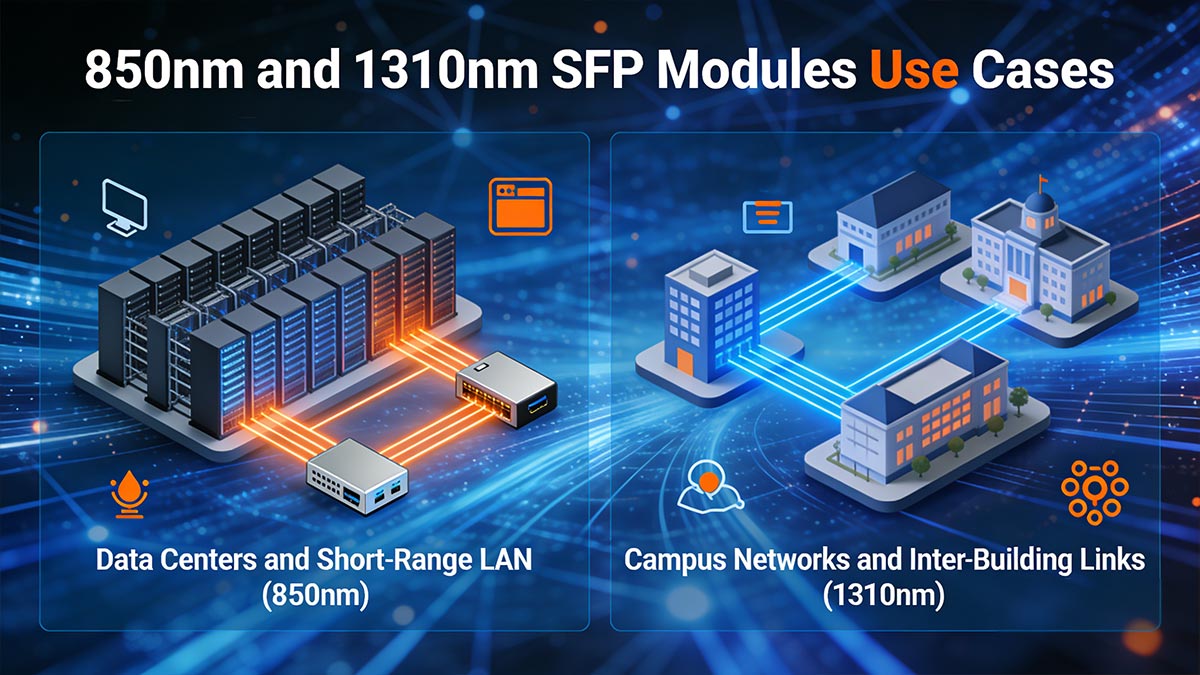
Data Centers and Short-Range LAN (850nm)
850nm SFP modules are the dominant choice in data center environments and short-range LAN architectures due to their cost efficiency and high-density deployment advantages.
Typical deployment scenarios include:
Switch-to-switch connections within the same rack or row
Leaf-spine architectures in modern data centers
Server-to-top-of-rack (ToR) switch links
High-speed short-reach Ethernet connections
Why 850nm fits these environments:
Works with multimode fiber (MMF), which is easier to install in structured cabling systems
Supports high port density at lower cost
Optimized for short distances (typically up to ~550m)
Reduces overall cabling complexity in confined environments
In summary: 850nm is ideal where speed, density, and cost efficiency matter more than distance.
Campus Networks and Inter-Building Links (1310nm)
1310nm SFP modules are designed for environments where distance becomes a critical factor, especially across multiple buildings or distributed sites.
Typical use cases include:
Building-to-building connections within enterprise campuses
University or hospital network backbones
Metro access networks and edge aggregation points
Inter-building fiber backbone infrastructure
Why 1310nm is preferred:
Supports single-mode fiber (SMF) for long-distance transmission
Maintains signal integrity over 10km, 20km, or more
Lower attenuation compared to multimode solutions
More stable performance in outdoor or extended fiber routes
In summary: 1310nm is the standard choice for long-distance, high-reliability backbone connectivity.
Enterprise Backbone Design Guidance
In enterprise network architecture, backbone design plays a critical role in determining performance, scalability, and long-term operational cost.
A typical structured approach is:
Access Layer: May use 850nm for short-range connections
Distribution Layer: Often mixed depending on building layout
Core Backbone: Primarily 1310nm for stability and distance
Key design principles:
Use 850nm only within contained environments (rooms, racks, floors)
Use 1310nm for inter-segment or inter-building connectivity
Avoid extending multimode fiber beyond its optimal range
Standardize wavelengths per network layer to simplify maintenance
This layered approach ensures both cost efficiency and scalability.
Hybrid Network Scenarios
Modern enterprise and data center networks rarely rely on a single wavelength. Instead, hybrid architectures combining 850nm and 1310nm are becoming the industry standard.
Common hybrid deployment model:
850nm (MMF): Inside data centers and server rooms
1310nm (SMF): Between buildings, campuses, or regional nodes
Benefits of hybrid design:
Optimized cost per layer of infrastructure
Better performance alignment with physical distance
Easier scalability for future expansion
Reduced risk of over-engineering or under-designing network segments
Example: A large enterprise campus may use:
850nm for internal data center switching
1310nm for connecting multiple buildings across a campus fiber ring
The decision between 850nm and 1310nm SFP modules is not binary—it is architectural.
Choose 850nm for short-range, high-density environments
Choose 1310nm for long-range, backbone connectivity
Combine both in hybrid architectures for optimal efficiency
The most efficient networks are not uniform—they are layer-optimized optical ecosystems.
In the next section, we will provide a FAQ section, addressing the most common user questions about 850nm vs. 1310nm SFP modules.
🔴 FAQ – SFP 850nm vs. 1310nm
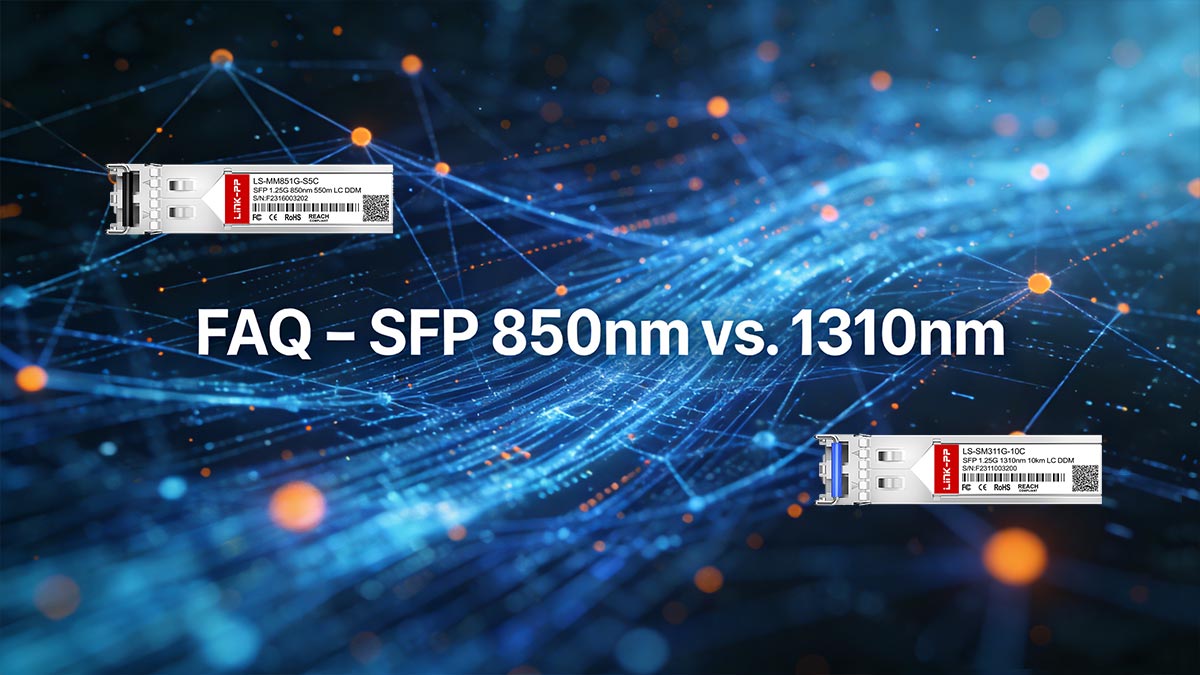
1. Can I visually distinguish 850nm and 1310nm SFP modules?
Yes, but only indirectly. Most SFP modules do not display wavelength prominently on the housing, but you can often identify them through:
Label markings (e.g., SR usually indicates 850nm, LR usually indicates 1310nm)
Fiber type context (MMF vs SMF cabling already installed)
Vendor datasheet specifications
In practice, identification should always be confirmed through documentation rather than appearance.
2. Are 850nm and 1310nm SFP modules hot-swappable?
Yes. Most modern SFP modules, including both 850nm and 1310nm types, are hot-swappable.
However:
Hot-swapping does NOT guarantee compatibility
The optical parameters must still match the network design
Physical insertion is supported, but optical interoperability is not automatic.
3. Why do some SFP modules use “SR” and “LR” instead of wavelength?
These labels represent transmission standards rather than just wavelength:
SR (Short Range) → typically 850nm, multimode fiber
LR (Long Range) → typically 1310nm, single-mode fiber
This naming system is widely used because it is easier for engineers to select modules based on distance requirements rather than wavelength numbers.
4. Can fiber patch cable color indicate SFP type?
Yes, in many structured cabling systems, fiber color is used as a visual indicator:
Orange / Aqua → usually multimode fiber (850nm systems)
Yellow → usually single-mode fiber (1310nm systems)
However:
Color coding is a convention, not a technical standard
Always verify fiber type before deployment decisions
5. Is one wavelength more future-proof than the other?
Neither is universally “future-proof”—they serve different network layers:
850nm is evolving with higher-speed short-reach data center standards
1310nm continues to scale for long-distance and backbone networks
Future-proofing depends on network architecture, not wavelength alone.
6. Do higher-speed SFP modules still follow the same 850nm vs 1310nm logic?
Yes. Even at higher speeds such as 10G, 25G, and beyond:
850nm is still used for short-range multimode links (SR variants)
1310nm is still used for long-range single-mode links (LR variants)
The wavelength principle remains consistent across generations of Ethernet standards.
🔴 Conclusion – Which SFP Should You Choose?
Choosing between 850nm and 1310nm SFP modules is ultimately not about which one is “better,” but about which one correctly matches your network environment, distance requirement, and fiber infrastructure. A wrong selection can lead to unnecessary cost, unstable links, or complete incompatibility—while the right choice ensures long-term stability and predictable performance.

Decision Summary Framework
To make a fast and reliable decision, engineers and buyers should evaluate the following four core factors:
1. Distance
850nm (Multimode): Best for short-range links, typically within a single building or rack-to-rack connections (up to ~550m)
1310nm (Single-mode): Designed for medium to long-range transmission, from 10km to 40km+
If your link crosses buildings or campuses, 1310nm is usually the safe choice.
2. Fiber Type
MMF (OM2/OM3/OM4) → requires 850nm SFP modules
SMF (OS1/OS2) → requires 1310nm SFP modules
Fiber infrastructure is the strongest constraint—wavelength must match it exactly.
3. Cost
850nm systems typically have lower initial cost due to:
Cheaper multimode fiber cabling
Lower-cost transceivers
1310nm systems involve higher infrastructure cost but offer:
Greater scalability
Longer transmission distance
Short-term savings vs long-term scalability is the key trade-off.
4. Application Scenario
850nm: Data centers, intra-building LANs, server racks, short uplinks
1310nm: Campus backbone, enterprise interconnection, metro access links
Your network topology determines the correct optical strategy.
Final Recommendation
A simple decision flow:
If your fiber is multimode + distance is short → choose 850nm (SR)
If your fiber is single-mode + distance is long → choose 1310nm (LR)
If planning a new deployment → prioritize future scalability with 1310nm where possible
If upgrading an existing short-range LAN → 850nm is usually the most cost-efficient option
A well-designed optical network is built on matching wavelength, fiber type, and real deployment distance—not just module specifications. Correct alignment at the planning stage prevents most field failures and ensures stable long-term performance.
For engineers, distributors, and enterprise buyers looking for stable, fully compatible optical transceivers, choosing a reliable supplier is just as important as selecting the right wavelength.
👉 Explore high-quality, tested optical modules at the LINK-PP Oficial Store for dependable deployment across data center and enterprise networks.