

In modern enterprise data centers, storage performance is no longer just about capacity — it is about speed, reliability, low latency, and nonstop availability. This is exactly where the Fiber Channel Transceiver plays a critical role. Designed specifically for high-speed Storage Area Networks (SANs), Fiber Channel (FC) transceivers enable servers, switches, and storage systems to communicate with ultra-low latency and highly stable optical connectivity.
A Fiber Channel Transceiver is a hot-swappable optical module used to transmit Fibre Channel signals over fiber optic cabling. These modules are commonly deployed in mission-critical environments such as enterprise SAN infrastructures, cloud storage platforms, financial databases, healthcare systems, virtualization clusters, and AI-ready data centers. Compared with traditional Ethernet networking, Fibre Channel technology is engineered specifically for storage traffic, offering deterministic performance, lossless transport, and exceptional reliability.
As enterprise workloads continue to grow rapidly in 2025 and beyond, organizations are upgrading from legacy 8G and 16G Fibre Channel networks to higher-speed 32G, 64G, and emerging 128G FC infrastructures. At the same time, technologies such as NVMe over Fibre Channel (NVMe/FC), hybrid cloud storage, and AI-driven analytics are increasing demand for scalable SAN optical connectivity solutions.
Understanding real-world Fiber Channel Transceiver use cases has therefore become increasingly important for IT architects, storage administrators, and procurement teams. Whether deploying a new SAN fabric, upgrading existing storage switches, troubleshooting FC link issues, or selecting compatible FC SFP modules for Cisco, Brocade, Dell EMC, or HPE systems, choosing the correct transceiver directly impacts network stability and storage performance.
In this guide, you will learn:
What a Fiber Channel Transceiver is and how it works
The most common SAN and enterprise storage use cases
Differences between FC optics and Ethernet transceivers
How to choose compatible 8G/16G/32G/64G FC modules
Common troubleshooting methods for Fibre Channel links
Future trends in high-speed SAN optical networking
By the end of this article, you will have a practical understanding of how Fiber Channel transceivers support modern storage infrastructures and how to select the right FC optics for your deployment requirements.
🟧 What Is a Fiber Channel Transceiver?
A Fiber Channel Transceiver (FC transceiver) is a high-speed, hot-swappable optical module used in Storage Area Networks (SANs). It converts electrical signals into optical signals for transmission over fiber optic cabling, enabling reliable communication between servers, storage arrays, and SAN switches.
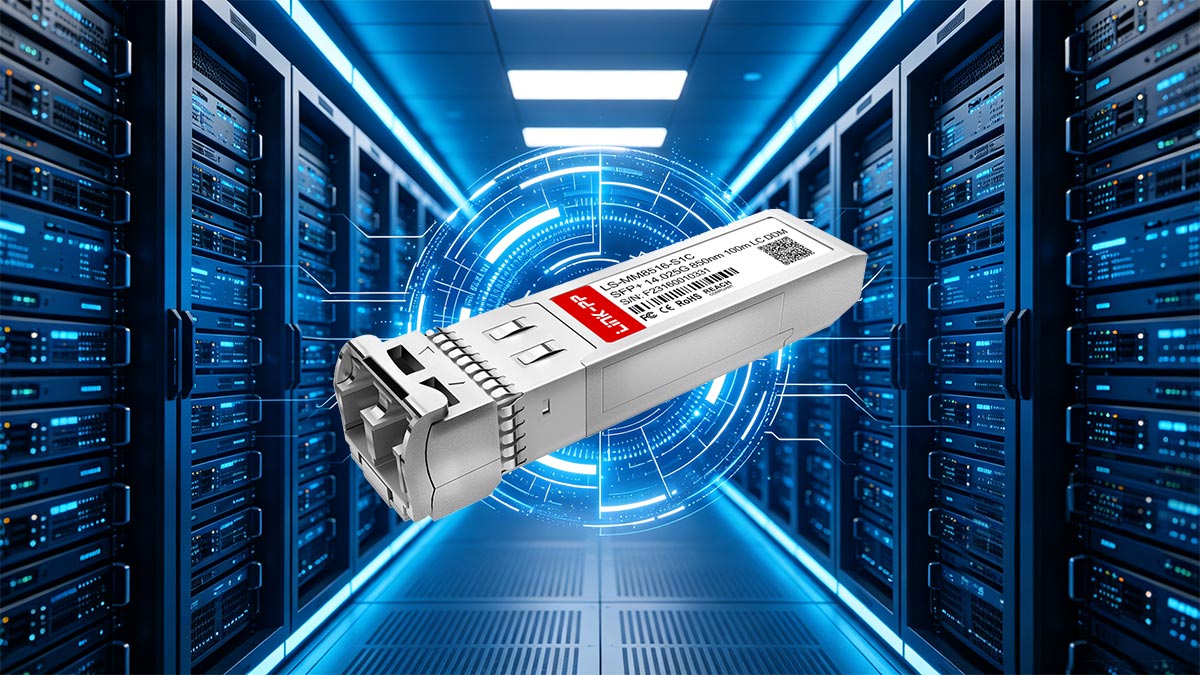
Unlike standard Ethernet optics, Fibre Channel transceivers are specifically designed for storage traffic that requires ultra-low latency, high reliability, and continuous uptime. They are commonly deployed in enterprise data centers, virtualization clusters, cloud storage platforms, and disaster recovery systems.
Modern FC transceivers support multiple Fibre Channel speeds, including:
8G FC
16G FC
32G FC
64G FC
They are typically available in SFP, SFP+, and QSFP form factors depending on the network architecture and bandwidth requirements.
How Fiber Channel Differs from Ethernet Optics
Although FC optics may look similar to Ethernet transceivers, they are optimized for different purposes.
Feature | Fiber Channel | Ethernet |
|---|---|---|
Primary Use | SAN storage networking | General data networking |
Latency | Very low | Moderate |
Protocol | Fibre Channel | Ethernet/IP |
Focus | Storage performance | Network flexibility |
Fibre Channel networks prioritize stable, loss-sensitive storage communication, making them ideal for mission-critical applications such as databases, virtualization, and enterprise storage.
Why SAN Environments Use FC Optics
SAN infrastructures use Fiber Channel transceivers because they provide:
Ultra-low latency for storage traffic
High reliability and minimal packet loss
Scalable bandwidth for growing storage workloads
Long-distance optical connectivity
Dedicated storage networking separate from LAN traffic
These advantages make FC optics widely used in finance, healthcare, cloud computing, and enterprise data centers.
Common FC Transceiver Form Factors
Fiber Channel transceivers are available in several form factors depending on speed requirements, switch architecture, and hardware platform compatibility.
SFP (Small Form-factor Pluggable)
SFP modules are commonly used for lower-speed Fibre Channel deployments such as 1G, 2G, 4G, and some 8G FC applications.
Typical use cases include:
Legacy SAN infrastructure
Older storage arrays
Entry-level Fibre Channel switches
SFP+ (Enhanced Small Form-factor Pluggable)
SFP+ is the most common FC transceiver form factor in modern enterprise SANs.
It supports:
8G FC
16G FC
32G FC
SFP+ modules are widely deployed in:
Cisco MDS switches
Brocade SAN switches
HPE storage platforms
Dell EMC storage networks
QSFP and QSFP28
QSFP-based Fibre Channel optics are used for higher-density and ultra-high-speed SAN environments.
These modules support:
64G FC
128G FC
High-density director-class switches
They are increasingly adopted in:
AI-ready storage infrastructures
Hyperscale data centers
Enterprise core SAN fabrics
🟧 Main Fiber Channel Transceiver Use Cases
Fiber Channel transceivers are widely used in enterprise environments that require fast, stable, and low-latency storage connectivity. Their ability to deliver reliable optical communication makes them essential for mission-critical SAN infrastructures and modern data centers.
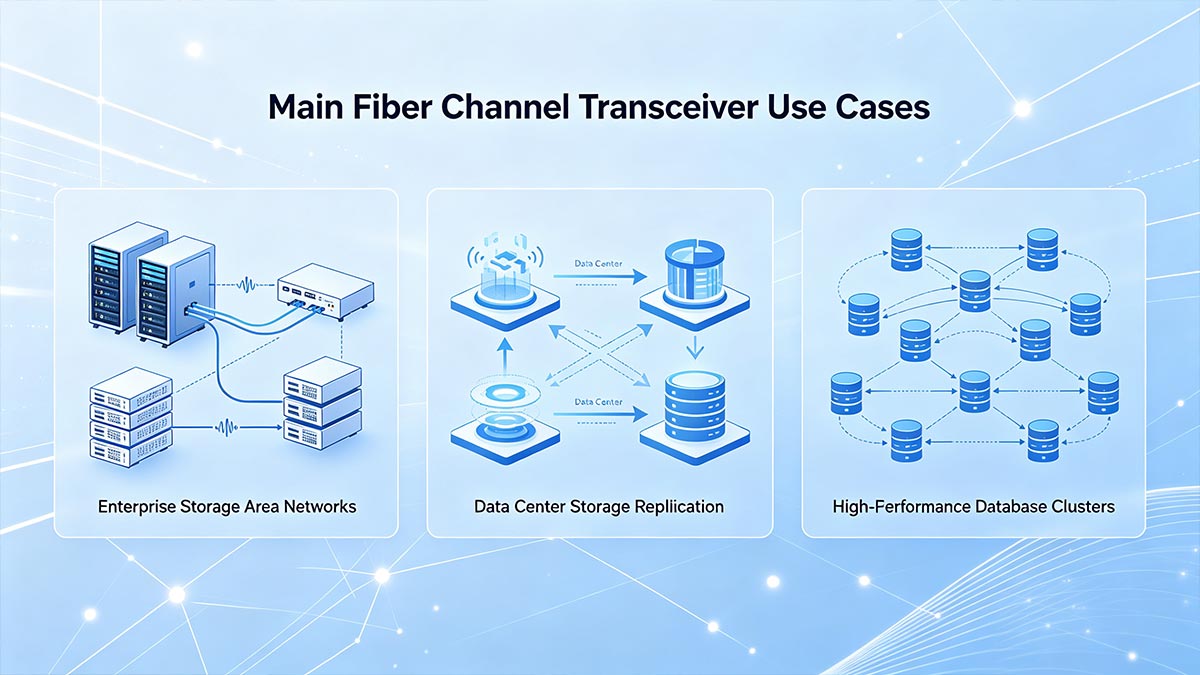
Below are the most common Fiber Channel transceiver use cases in real-world deployments.
1. Enterprise Storage Area Networks (SANs)
The primary use case for Fiber Channel transceivers is within Storage Area Networks (SANs). In a SAN environment, FC transceivers connect:
SAN switches
Enterprise storage arrays
Rack servers
Blade systems
Backup appliances
Fibre Channel technology provides dedicated storage networking separate from traditional Ethernet LAN traffic. This improves storage performance, reduces congestion, and ensures stable communication between servers and centralized storage systems.
Industries such as banking, healthcare, telecommunications, and government rely heavily on FC SANs because they require continuous access to critical data with minimal downtime.
2. Data Center Storage Replication
Modern data centers often use Fiber Channel transceivers for high-speed storage replication between storage arrays or across multiple facilities.
Replication traffic requires:
Low latency
High bandwidth
Reliable transmission
Minimal packet loss
Long-wave singlemode FC transceivers are commonly deployed for:
Inter-building SAN connectivity
Metro-distance storage replication
Active-active data center architectures
Business continuity infrastructure
This enables organizations to maintain synchronized copies of critical data for operational resilience and rapid failover.
3. High-Performance Database Clusters
Enterprise databases generate extremely high storage I/O workloads. FC transceivers help support these environments by providing fast and predictable storage communication.
Common deployments include:
Oracle database clusters
Microsoft SQL Server environments
SAP HANA infrastructures
Financial transaction systems
Because Fibre Channel SANs are optimized for block-level storage access, they help reduce storage latency and improve database responsiveness under heavy workloads.
4. VMware and Virtualization Environments
Virtualized infrastructures depend heavily on shared storage performance. Fiber Channel transceivers are commonly used in VMware, Hyper-V, and enterprise virtualization platforms to connect hosts to centralized SAN storage.
Typical use cases include:
VMware vSphere clusters
Virtual machine migration (vMotion)
Shared datastore access
High-availability virtualization environments
FC SANs help maintain stable performance when large numbers of virtual machines simultaneously access shared storage resources.
As virtualization density continues to increase, many organizations are upgrading from 8G and 16G FC to 32G and 64G Fibre Channel networks to support higher throughput demands.
5. Backup and Disaster Recovery Infrastructure
Backup systems and disaster recovery platforms also rely on Fibre Channel transceivers for secure, high-speed data movement.
FC optics are commonly used for:
Enterprise backup servers
Tape library systems
Snapshot replication
Offsite disaster recovery links
Continuous data protection (CDP)
Because backup operations often involve transferring massive datasets, Fibre Channel networks help reduce backup windows and improve recovery performance.
Long-distance FC transceivers also support disaster recovery sites located several kilometers away from the primary data center.
6. AI and High-Performance Computing (HPC) Storage
As AI workloads and large-scale analytics continue to grow, Fiber Channel transceivers are increasingly used in high-performance storage architectures supporting:
AI model training
Scientific computing
Real-time analytics
Large-scale enterprise data processing
These environments require extremely fast access to shared storage with minimal latency. High-speed 32G and 64G FC optics help deliver the bandwidth needed for modern AI-ready storage infrastructure.
7. Cloud and Hybrid Storage Infrastructure
Many enterprises now operate hybrid storage environments combining on-premises SAN infrastructure with cloud-based services.
Fiber Channel transceivers help support:
Private cloud storage
Hybrid cloud backup systems
Multi-site storage fabrics
Enterprise cloud migration projects
Even in cloud-first architectures, Fibre Channel remains widely used because of its reliability, predictable performance, and compatibility with existing enterprise storage systems.
🟧 Fiber Channel Transceiver Speeds and Standards
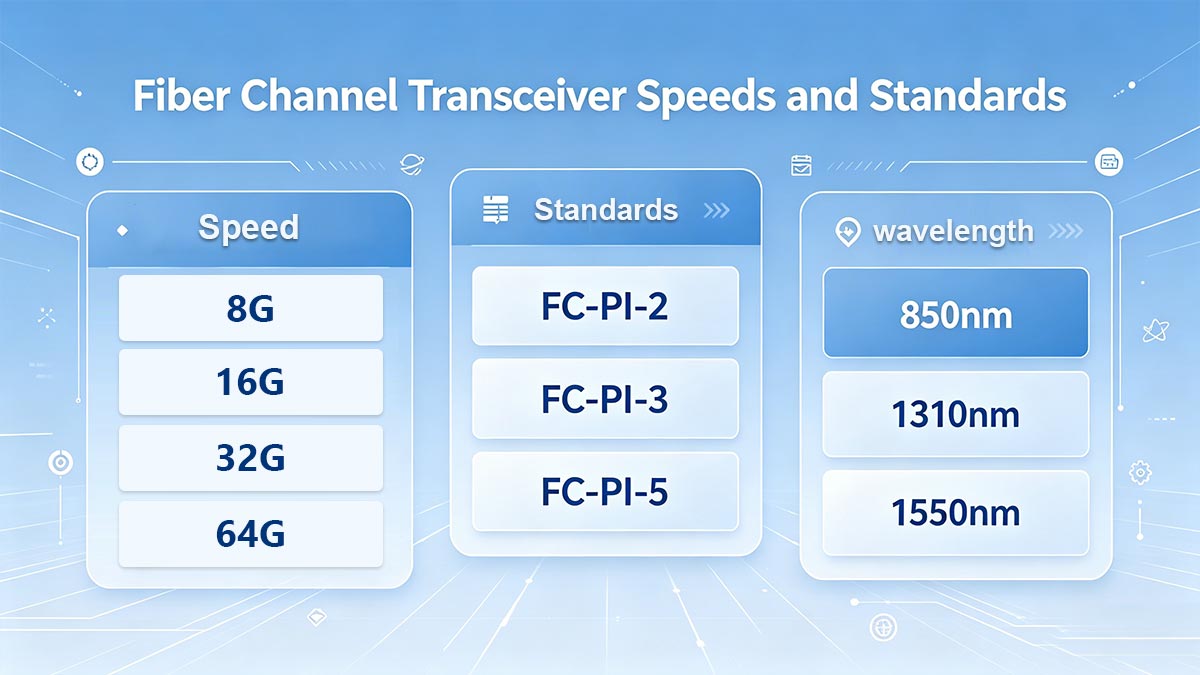
Fiber Channel transceivers are available in multiple speed grades and optical specifications to support different SAN architectures, transmission distances, and storage performance requirements. Selecting the correct FC optic depends on bandwidth demands, fiber type, switch compatibility, and future scalability plans.
Modern enterprise SANs commonly use 8G, 16G, 32G, and 64G Fibre Channel transceivers, with higher-speed standards continuing to evolve for AI-driven and high-performance storage environments.
8G vs. 16G vs. 32G vs. 64G FC Transceivers
Each generation of Fibre Channel technology delivers higher throughput, lower latency, and improved SAN efficiency.
FC Standard | Typical Speed | Common Form Factor | Typical Use Cases |
|---|---|---|---|
8G FC | 8.5 Gb/s | SFP+ | Legacy SANs, SMB storage |
16G FC | 14.025 Gb/s | SFP+ | Enterprise virtualization |
32G FC | 28.05 Gb/s | SFP28 | Modern data centers |
64G FC | 57.8 Gb/s | QSFP / SFP-DD | AI and high-performance storage |
Short-Wave vs. Long-Wave Optics
Fiber Channel transceivers are typically divided into two main optical categories: short-wave (SWL) and long-wave (LWL).
Type | Fiber Type | Wavelength | Typical Distance |
|---|---|---|---|
Short-Wave (SWL) | Multimode Fiber (MMF) | 850nm | Up to ~300m |
Long-Wave (LWL) | Singlemode Fiber (SMF) | 1310nm | Several kilometers |
Transmission Distance and Wavelength Comparison
Transmission distance depends on both the optical wavelength and the fiber type being used.
FC Optic Type | Wavelength | Fiber Type | Typical Distance |
|---|---|---|---|
SWL FC Optics | 850nm | Multimode | 100–300m |
LWL FC Optics | 1310nm | Singlemode | 10km+ |
In most enterprise SAN deployments:
850nm multimode optics are preferred for cost-effective short-range connectivity inside data centers.
1310nm singlemode optics are selected for long-distance links and disaster recovery infrastructure.
When selecting a Fiber Channel transceiver, IT teams should evaluate:
Required SAN bandwidth
Existing fiber infrastructure
Transmission distance
Switch compatibility
Future upgrade plans
Choosing the correct FC optical standard helps ensure stable SAN performance, lower latency, and better long-term scalability for enterprise storage networks.
🟧 How to Choose the Right FC Transceiver
Selecting the correct Fiber Channel transceiver is critical for SAN stability, storage performance, and long-term scalability. A mismatched FC optic can lead to compatibility issues, signal loss, or reduced network reliability.
When choosing an FC transceiver, IT teams should evaluate switch compatibility, fiber type, transmission distance, bandwidth requirements, and overall deployment cost.
Compatibility with Cisco, Brocade, and HPE
Compatibility is one of the most important factors when selecting a Fiber Channel transceiver. Many SAN switches and storage systems use vendor-specific firmware validation, meaning not all optical modules are universally supported.
Common enterprise platforms include:
Cisco MDS SAN switches
Brocade Fibre Channel switches
HPE Storage and BladeSystems
Dell EMC SAN infrastructure
IBM storage environments
Before deployment, verify:
Supported FC speed (8G/16G/32G/64G)
Form factor compatibility (SFP+, SFP28, QSFP)
Supported wavelengths
Vendor coding requirements
Firmware interoperability
Many organizations choose compatible third-party FC transceivers that are pre-programmed for Cisco, Brocade, or HPE systems to reduce costs while maintaining interoperability.
Multimode vs. Singlemode Fiber Selection
Fiber type directly affects transmission distance, deployment cost, and SAN architecture.
Fiber Type | Typical Optics | Distance | Common Use |
|---|---|---|---|
Multimode Fiber (MMF) | Short-Wave (850nm) | Up to ~300m | Data centers |
Singlemode Fiber (SMF) | Long-Wave (1310nm) | Several km | Long-distance SAN links |
Distance and Bandwidth Requirements
FC transceivers should always match both the required transmission distance and SAN bandwidth demands.
Questions to consider include:
How far does the SAN link need to travel?
What storage workloads will run on the network?
Will the environment require future speed upgrades?
Is the infrastructure designed for virtualization or AI workloads?
For example:
Environment | Recommended FC Speed |
|---|---|
Legacy SAN | 8G FC |
Enterprise virtualization | 16G FC |
All-flash storage | 32G FC |
AI/HPC infrastructure | 64G FC |
Organizations planning long-term growth often deploy higher-speed FC optics to avoid future SAN redesigns.
OEM vs. Third-Party Compatible Modules
One of the most common purchasing decisions is whether to choose OEM-branded FC transceivers or third-party compatible modules.
OEM Transceivers
OEM optics are supplied directly by switch or storage vendors such as Cisco, Brocade, or HPE.
Advantages:
Official vendor support
Guaranteed compatibility
Easier warranty management
Disadvantages:
Higher pricing
Limited sourcing flexibility
Third-Party Compatible Transceivers
Compatible FC transceivers are manufactured by independent optical vendors and programmed for specific platforms.
Advantages:
Lower cost
Faster procurement
Broad platform compatibility
Disadvantages:
Quality varies between suppliers
Some vendors restrict unsupported optics
High-quality third-party modules are widely used in enterprise SAN environments because they can significantly reduce optical infrastructure costs without sacrificing performance.
When evaluating compatible FC optics, look for:
MSA compliance
Enterprise testing certifications
DOM/DDM monitoring support
Compatibility guarantees
Lifetime warranty options
Key Considerations Before Deplyment
Before purchasing a Fiber Channel transceiver, verify the following:
FC speed compatibility
Fiber type (MMF or SMF)
Required transmission distance
SAN switch compatibility
Operating temperature requirements
OEM or compatible preference
Future scalability plans
Choosing the correct FC transceiver helps ensure reliable SAN performance, lower maintenance costs, and better long-term storage infrastructure stability.
🟧 Common Fiber Channel Transceiver Problems
Although Fiber Channel transceivers are designed for highly reliable SAN environments, optical connectivity issues can still occur due to hardware mismatches, cabling problems, firmware conflicts, or incorrect deployment practices. Even minor FC link problems can affect storage performance, virtualization stability, and database operations.
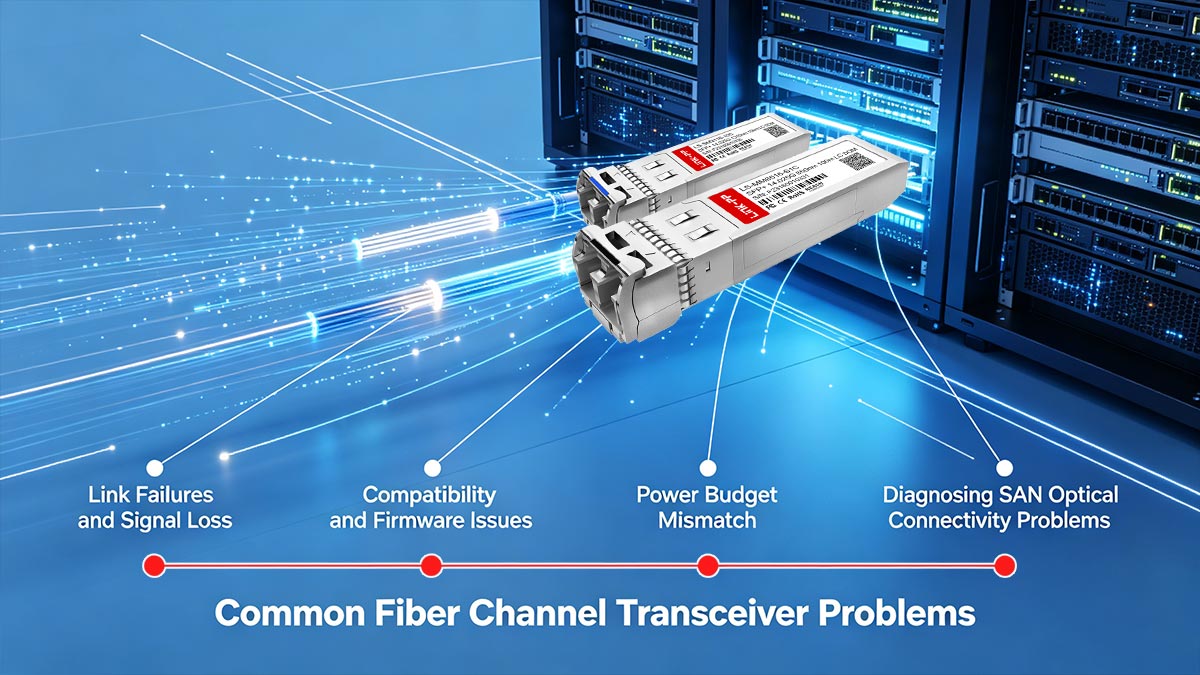
Understanding the most common Fibre Channel transceiver issues helps IT teams reduce downtime and maintain stable SAN performance.
Link Failures and Signal Loss
One of the most common SAN issues is Fibre Channel link failure or unstable optical connectivity.
Typical symptoms include:
SAN ports staying offline
Intermittent disconnects
CRC errors
Slow storage access
Link flapping between up and down states
Common causes include:
Damaged fiber optic cables
Dirty LC connectors
Incorrect transceiver installation
Excessive transmission distance
Mismatched fiber type (MMF vs. SMF)
To reduce signal loss:
Clean fiber connectors regularly
Verify proper cable polarity
Use certified optical cabling
Match wavelength and fiber type correctly
Confirm supported transmission distance
Compatibility and Firmware Issues
Compatibility problems are another major cause of FC transceiver failures.
Many SAN switches and storage platforms — including Cisco, Brocade, and HPE systems — validate optical modules through firmware. Unsupported or incorrectly coded transceivers may trigger:
Port shutdowns
Warning alarms
Reduced link stability
Optical recognition failures
Common compatibility issues include:
Incorrect EEPROM coding
Unsupported FC speed
Vendor lock restrictions
Firmware interoperability conflicts
Before deployment, always verify:
SAN switch compatibility lists
Supported transceiver models
Firmware versions
Required FC standards
Using enterprise-tested compatible transceivers can help reduce deployment issues while lowering overall optical costs.
Power Budget Mismatch
Optical power budget mismatch occurs when transmitted optical power does not align with the receiver’s supported operating range.
This problem can lead to:
Weak signal reception
High bit error rates
Intermittent SAN failures
Link instability over long distances
Power budget issues are often caused by:
Excessive fiber attenuation
Poor splice quality
Incorrect optic type
Using long-wave optics for short-distance links
Too many patch panels or connectors
Long-distance singlemode deployments are especially sensitive to optical power calculations.
Best practices include:
Measuring insertion loss
Checking optical Tx/Rx levels
Following vendor distance specifications
Using proper attenuation where required
Diagnosing SAN Optical Connectivity Problems
Troubleshooting Fibre Channel SAN links requires both physical-layer and protocol-level diagnostics.
Common diagnostic methods include:
Check Switch Logs
SAN switches often provide error counters and optical alerts that help identify failing ports or unstable links.
Verify Optical Levels
Use DOM/DDM monitoring to check:
Transmit power
Receive power
Temperature
Voltage
Abnormal optical readings may indicate cabling or transceiver issues.
Inspect Fiber Cabling
Physical inspection should include:
Connector cleanliness
Fiber bends or damage
Proper cable polarity
Correct fiber type
Test with Known-Good Optics
Replacing suspected transceivers with verified working modules is one of the fastest ways to isolate failures.
Confirm Speed Negotiation
Mismatched FC speeds between switches and transceivers can prevent proper link initialization.
Preventive Best Practices
To improve SAN optical reliability:
Use certified FC transceivers
Maintain proper cable management
Clean connectors during maintenance
Monitor optical power levels regularly
Keep firmware updated
Validate compatibility before deployment
Proactive SAN monitoring and proper optical planning can significantly reduce Fibre Channel network downtime and improve long-term storage infrastructure stability.
🟧 Fiber Channel vs. Ethernet Transceivers
Fiber Channel and Ethernet transceivers may look similar, but they are designed for different purposes. Fibre Channel optics are optimized for Storage Area Networks (SANs), while Ethernet transceivers support general IP networking and data communication.
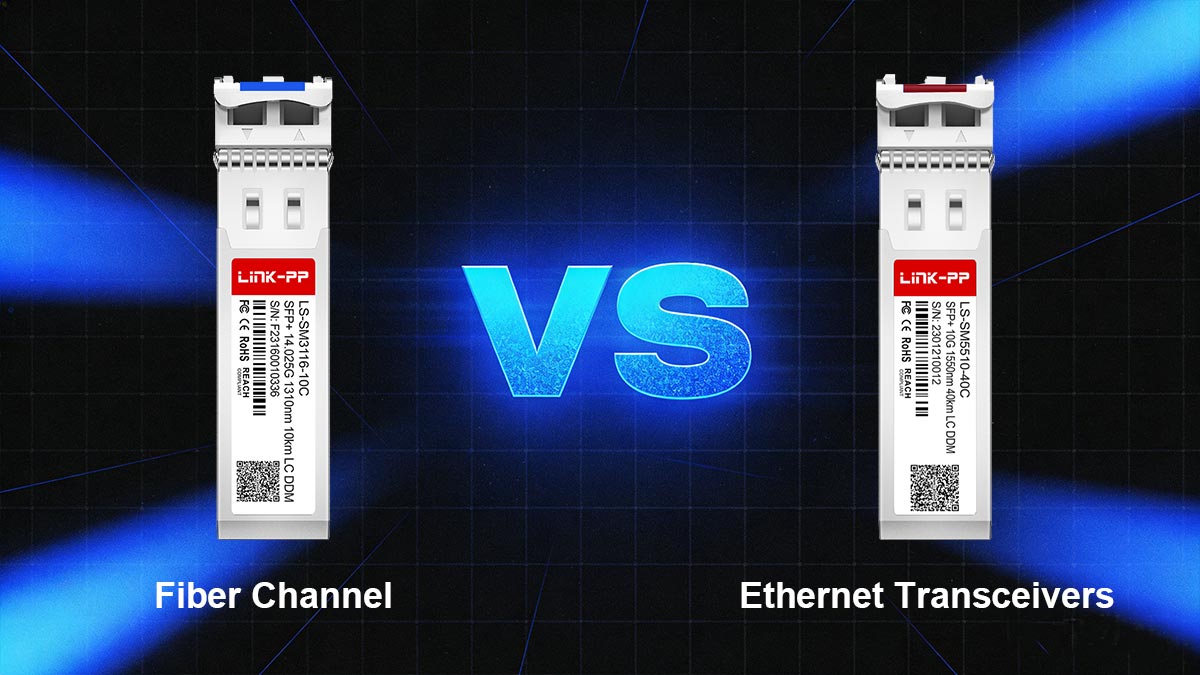
Choosing between them depends on storage performance requirements, latency sensitivity, scalability, and budget.
Performance Differences
Fiber Channel transceivers are purpose-built for storage traffic and provide highly stable, low-latency communication for enterprise SAN environments.
Feature | Fiber Channel | Ethernet |
|---|---|---|
Primary Use | SAN storage networking | General data networking |
Protocol | Fibre Channel | Ethernet/IP |
Latency | Very low | Moderate |
Reliability | High | Variable |
FC SANs are designed to minimize packet loss and maintain predictable storage performance under heavy workloads.
Latency and Reliability Comparison
Fibre Channel networks deliver:
Ultra-low latency
Stable throughput
High availability
Reliable block-level storage access
These advantages make FC optics ideal for:
Ethernet technologies such as iSCSI and NVMe/TCP have improved significantly, but Ethernet networks still handle mixed traffic that can introduce congestion and latency fluctuations.
FC SAN vs. IP Storage Networking
Fibre Channel SAN
Best for:
High-performance enterprise storage
Virtualization
Large-scale SAN infrastructures
Advantages:
Dedicated storage networking
Low latency
High reliability
IP Storage Networking
Common protocols:
iSCSI
NVMe/TCP
Advantages:
Lower cost
Easier scalability
Simplified management
Best for:
SMB environments
Hybrid cloud infrastructure
Cost-sensitive deployments
When Ethernet Optics May Be a Better Choice
Ethernet transceivers are often preferred when:
Existing infrastructure is Ethernet-based
Budget is limited
Cloud-native applications dominate workloads
Simpler deployment is required
Fibre Channel remains the preferred option for enterprise SANs that require maximum storage performance, stability, and low latency.
🟧 Future Trends in Fiber Channel Transceivers
As enterprise storage workloads continue to grow, Fiber Channel technology is evolving to support higher bandwidth, lower latency, and more scalable SAN architectures. Modern data centers increasingly rely on advanced FC transceivers to handle AI workloads, flash storage, and next-generation virtualization platforms.
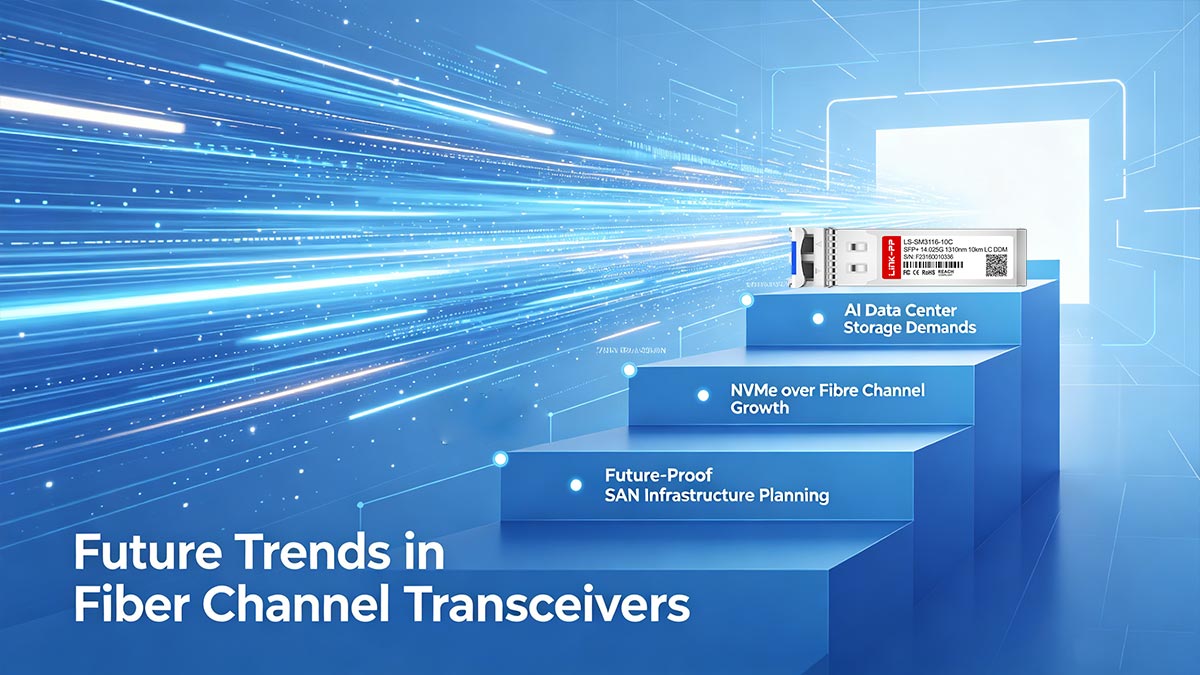
Several major trends are shaping the future of Fibre Channel transceivers.
128G Fiber Channel Evolution
Fibre Channel standards continue advancing toward higher-speed storage networking. After the widespread adoption of 32G and growing deployment of 64G FC, the industry is now moving toward 128G Fibre Channel for ultra-high-performance SAN environments.
Benefits of 128G FC include:
Higher storage throughput
Lower latency
Better support for AI and HPC workloads
Improved scalability for all-flash data centers
128G FC is expected to play an important role in large enterprise SAN fabrics and hyperscale storage infrastructure over the next several years.
AI Data Center Storage Demands
AI and machine learning workloads are dramatically increasing storage bandwidth requirements. GPU clusters and large-scale analytics platforms require extremely fast access to shared datasets with minimal latency.
As a result, organizations are deploying:
Higher-speed FC optics
Low-latency SAN fabrics
High-density storage interconnects
Scalable flash storage architectures
64G and future 128G Fibre Channel transceivers are becoming increasingly important for AI-ready data centers that demand predictable storage performance under heavy workloads.
NVMe over Fibre Channel Growth
NVMe over Fibre Channel (NVMe/FC) is one of the fastest-growing enterprise storage technologies.
NVMe/FC combines:
The low latency of NVMe storage
The reliability of Fibre Channel SANs
Compared with traditional SCSI-based storage protocols, NVMe/FC significantly improves:
IOPS performance
Application responsiveness
Flash storage efficiency
Many organizations are upgrading existing 16G FC SANs to 32G and 64G infrastructure to support NVMe workloads more effectively.
Future-Proof SAN Infrastructure Planning
Modern enterprises are increasingly designing SAN infrastructures with long-term scalability in mind.
Key considerations include:
Migrating from legacy 8G/16G FC environments
Supporting higher-density virtualization
Preparing for AI and analytics growth
Reducing SAN bottlenecks
Improving disaster recovery capabilities
To future-proof storage networks, many IT teams now deploy:
Higher-speed FC transceivers
Modular SAN architectures
Singlemode fiber infrastructure
Scalable director-class switches
Investing in modern Fibre Channel optics helps organizations extend SAN lifecycle performance while supporting next-generation enterprise storage demands.
🟧 Best Practices for Deploying FC Transceivers
Proper deployment of Fiber Channel transceivers is essential for maintaining stable SAN performance, minimizing downtime, and ensuring long-term scalability. Whether building a new storage network or upgrading an existing SAN fabric, following best practices can significantly improve reliability and operational efficiency.
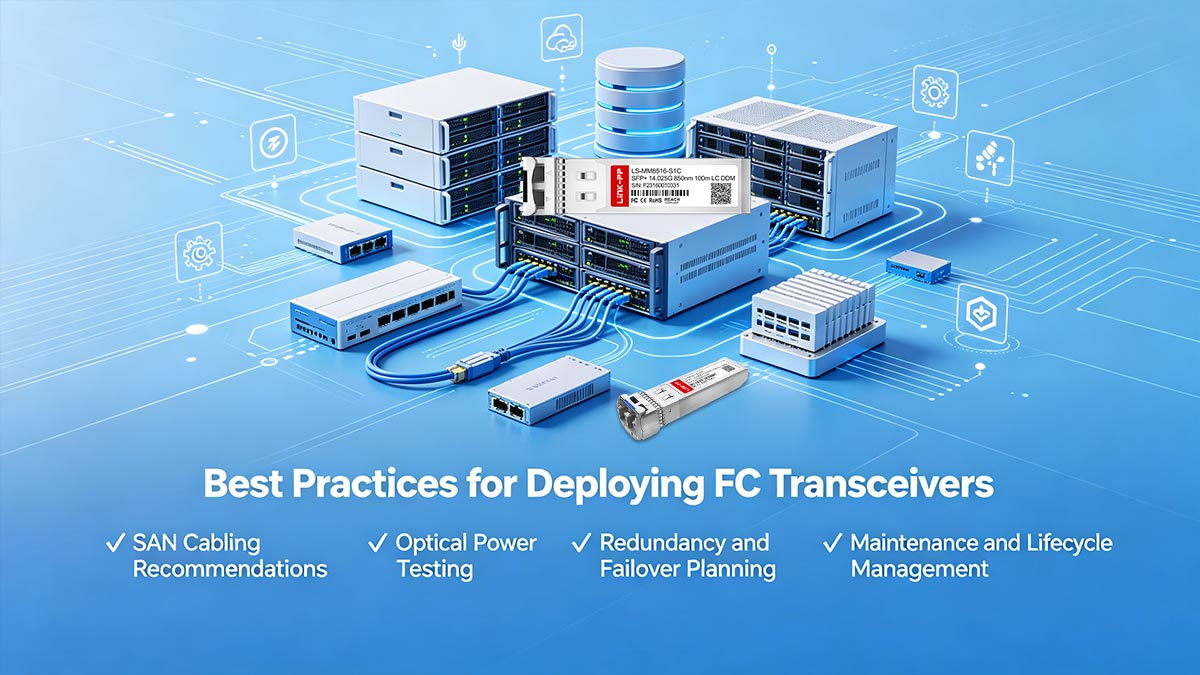
SAN Cabling Recommendations
High-quality fiber infrastructure is critical for stable Fibre Channel connectivity.
Best practices include:
Use certified multimode or singlemode fiber
Match optics correctly with fiber type
Avoid excessive cable bending
Maintain proper cable labeling and management
Keep LC connectors clean to reduce signal loss
For most short-distance data center deployments, multimode fiber with short-wave FC optics is the most cost-effective solution. Long-distance SAN links and disaster recovery environments typically require singlemode fiber and long-wave transceivers.
Optical Power Testing
Regular optical power testing helps prevent SAN link instability and unexpected downtime.
IT teams should monitor:
Transmit (Tx) optical power
Receive (Rx) optical power
Temperature and voltage levels
Using FC transceivers with DOM/DDM monitoring capabilities can simplify diagnostics and improve visibility into SAN health.
Routine testing is especially important in:
High-density data centers
Long-distance FC deployments
Mission-critical enterprise storage environments
Redundancy and Failover Planning
Enterprise SAN infrastructures should always include redundancy planning to ensure continuous storage availability.
Common best practices include:
Dual SAN fabric architecture
Redundant FC switches
Multiple storage paths
Failover-capable storage arrays
Diverse optical routing paths
Redundant Fibre Channel connectivity helps prevent single points of failure and improves business continuity for critical applications.
Maintenance and Lifecycle Management
FC transceivers require ongoing monitoring and maintenance to ensure long-term reliability.
Recommended practices include:
Regular fiber cleaning and inspection
Firmware compatibility verification
Monitoring error counters and optical levels
Replacing aging optics proactively
Maintaining spare transceiver inventory
As organizations migrate toward 32G, 64G, and future 128G SAN infrastructures, lifecycle planning becomes increasingly important for maintaining scalability and performance.
Conclusion
Fiber Channel transceivers remain a core component of modern SAN infrastructure, delivering the low latency, reliability, and high-speed optical connectivity required for enterprise storage networks. From virtualization and database clusters to AI-ready data centers and disaster recovery systems, FC optics continue to power mission-critical storage environments worldwide.
As storage demands grow, organizations are increasingly adopting higher-speed 32G and 64G Fibre Channel solutions to support flash storage, NVMe over Fibre Channel, and large-scale data processing workloads. Choosing the right FC transceiver — including the correct speed, fiber type, transmission distance, and compatibility — is essential for ensuring stable SAN performance and long-term scalability.
Whether you are upgrading an existing SAN fabric or building a new enterprise storage network, investing in reliable and compatible Fibre Channel optics can significantly improve operational efficiency and reduce infrastructure risk.
For enterprise-grade FC optical modules, compatible SAN transceivers, and high-performance networking solutions, explore the LINK-PP Official Store for a wide range of Fibre Channel transceivers designed for Cisco, Brocade, HPE, Dell EMC, and other leading storage platforms.