

At first glance, Fibre Channel (FC) SFP modules and Ethernet SFP modules look almost identical. Both use the same Small Form-factor Pluggable (SFP) design, both can fit into similar-looking ports, and both are widely deployed in modern data centers. This physical similarity is exactly why many IT engineers, system integrators, and enterprise buyers search for terms like “FC SFP vs. Ethernet SFP”, “Can FC SFP work in Ethernet ports?”, or “Are Fibre Channel and Ethernet transceivers interchangeable?”
The short answer is: they are not the same technology, even if the hardware appears similar.
In simple terms, Fibre Channel SFPs are built for dedicated Storage Area Networks (SANs) that require low latency and lossless data transmission, while Ethernet SFPs are used for general LAN, WAN, cloud, and data center networking.
Although the modules often share the same physical form factor, they are not always compatible. Differences in protocols, signal encoding, EEPROM programming, and switch firmware can prevent an FC SFP from working in an Ethernet port, especially on enterprise hardware from companies like Cisco Systems and Hewlett Packard Enterprise.
In this guide, you will learn:
What FC SFP and Ethernet SFP modules actually do
The protocol-level differences between Fibre Channel and Ethernet
Why some modules cannot be used interchangeably
How FC switches differ from Ethernet switches
When to choose FC optics instead of Ethernet optics
How FCoE and converged networking impact modern deployments
Which solution is better for enterprise storage, AI infrastructure, and future-ready data centers
Whether you are designing a SAN, upgrading a data center, troubleshooting SFP compatibility issues, or comparing storage networking technologies for a new deployment, this article will help you make the right decision with confidence.
⭐ What Is an FC SFP?
An FC SFP (Fibre Channel Small Form-factor Pluggable) is an optical transceiver module designed for high-speed Fibre Channel storage networking. These modules are primarily used in Storage Area Networks (SANs) to connect servers, storage arrays, and Fibre Channel switches with low latency and highly reliable data transmission.
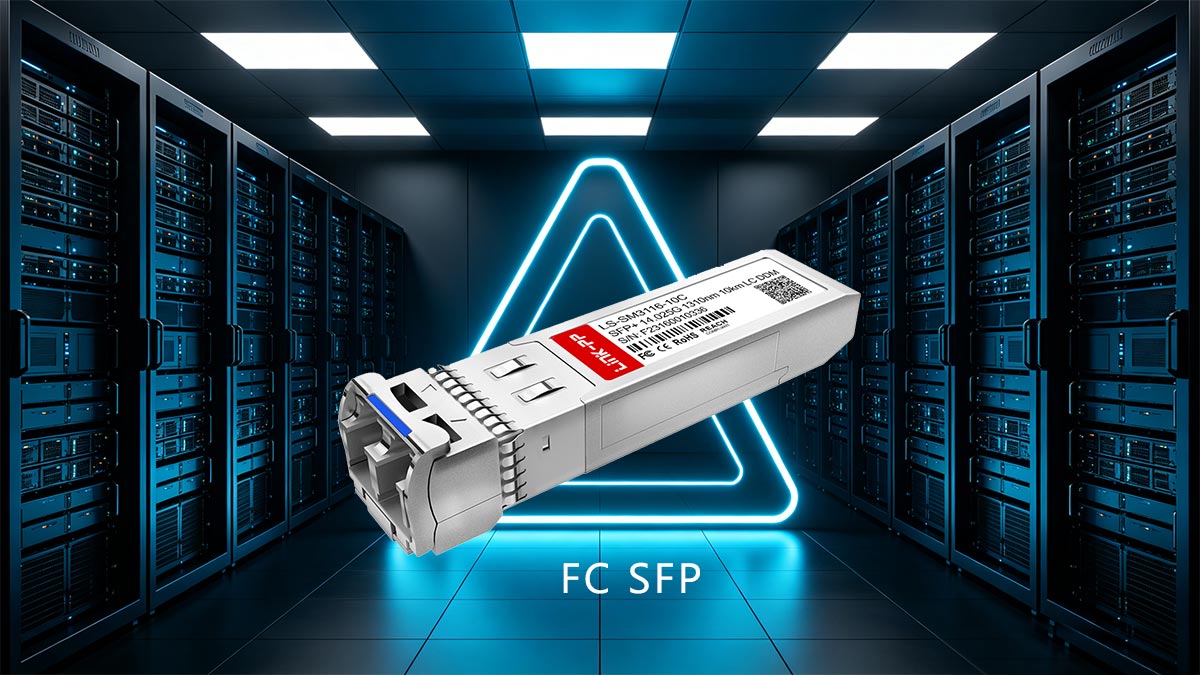
Unlike standard Ethernet SFP modules that handle general IP network traffic, FC SFPs are optimized for block-level storage communication. They are commonly deployed in enterprise environments where stable, lossless performance is critical, such as financial systems, healthcare databases, virtualization clusters, and AI storage infrastructure.
One reason FC SFPs often confuse buyers is that they physically resemble Ethernet SFP or SFP+ modules. However, the underlying protocols, signaling methods, and switch compatibility are different, meaning they are not always interchangeable.
Definition of Fibre Channel SFP Modules
A Fibre Channel SFP module converts electrical signals from a Fibre Channel switch, Host Bus Adapter (HBA), or storage controller into optical signals for fiber transmission. These transceivers are specifically engineered for SAN protocols such as:
SCSI over Fibre Channel
NVMe over Fibre Channel (NVMe/FC)
Enterprise block storage communication
FC SFP modules are available in multiple form factors, including:
SFP
SFP+
SFP28
QSFP-based Fibre Channel optics
Most enterprise Fibre Channel deployments use LC duplex fiber connectors and multimode or single-mode optical fiber depending on transmission distance requirements.
Common FC Speeds: 8G, 16G, 32G, and 64G
Fibre Channel networking follows dedicated speed standards that differ from Ethernet generations. The most common FC SFP speeds include:
FC Standard | Typical Name | Common Use Case |
|---|---|---|
8G FC | 8G Fibre Channel SFP+ | Legacy SAN infrastructure |
16G FC | 16G Fibre Channel SFP+ | Enterprise storage networks |
32G FC | 32G Fibre Channel SFP28 | High-performance SANs |
64G FC | 64G Fibre Channel | Modern AI and NVMe storage |
Among these, 16G FC and 32G FC remain widely deployed in enterprise data centers because they offer a strong balance between bandwidth, latency, and infrastructure cost.
Unlike Ethernet speeds such as 10GbE or 25GbE, Fibre Channel standards are purpose-built for storage traffic and deterministic performance.
Typical SAN and Enterprise Storage Applications
FC SFP modules are commonly used in environments where storage reliability and predictable performance are more important than general network flexibility.
Typical deployment scenarios include:
Enterprise SAN fabrics
All-flash storage arrays
VMware and Hyper-V virtualization clusters
Mission-critical databases
Backup and disaster recovery systems
AI and machine learning storage clusters
Large enterprises often deploy Fibre Channel SANs because they provide dedicated storage traffic isolation and extremely stable latency under heavy workloads.
Although newer technologies such as RoCE, NVMe/TCP, and FCoE are expanding Ethernet-based storage networking, Fibre Channel remains a trusted choice for organizations that prioritize mature SAN architecture and lossless storage communication.
⭐ What Is an Ethernet SFP?
An Ethernet SFP (Small Form-factor Pluggable) is a hot-swappable optical transceiver used for Ethernet communication in LAN, WAN, cloud, and data center networks. These modules allow switches, routers, servers, and network interface cards (NICs) to transmit data over fiber optic or copper cabling at various Ethernet speeds.
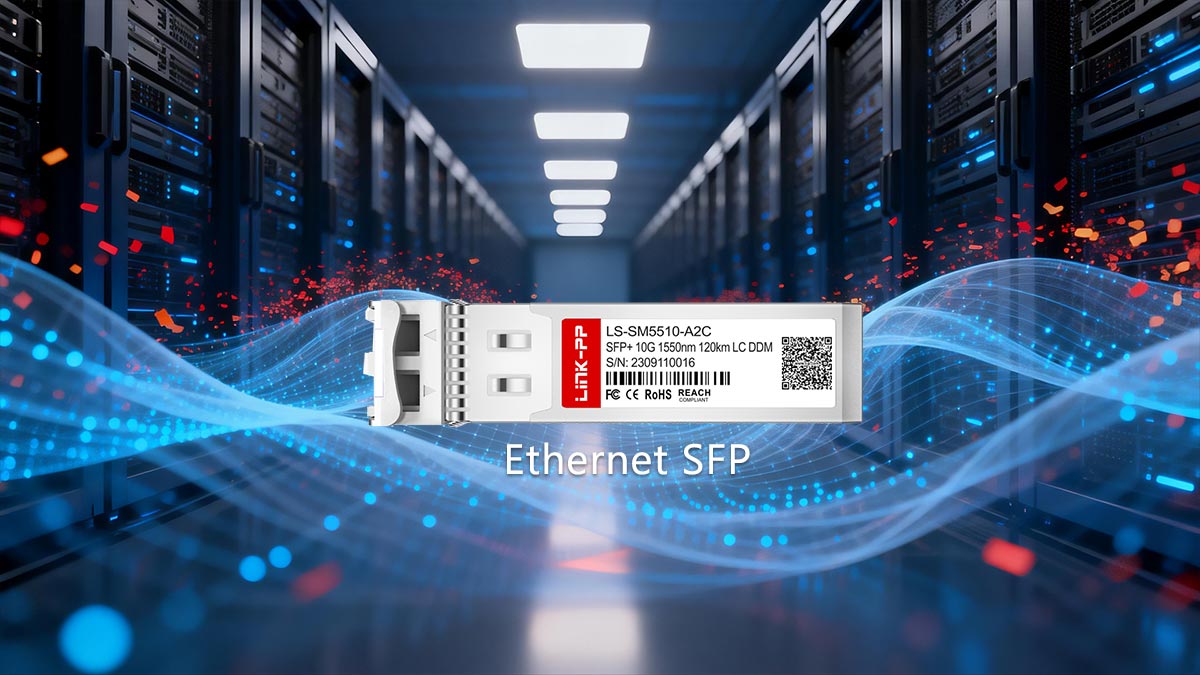
Unlike Fibre Channel SFPs that are optimized for dedicated storage traffic, Ethernet SFP modules are designed for general-purpose IP networking. They are widely used in enterprise networks, hyperscale data centers, telecom infrastructure, and AI computing environments.
Because Ethernet SFPs share the same physical form factor as many FC SFP modules, users often assume they are interchangeable. However, Ethernet transceivers use different protocols, signaling standards, and compatibility coding.
How Ethernet SFP Modules Work
An Ethernet SFP module converts electrical Ethernet signals into optical signals for transmission across fiber optic cables, then converts incoming optical signals back into electrical data at the receiving device.
These modules are typically installed in:
Data center spine-leaf architectures
Depending on the deployment, Ethernet SFPs may support:
Most Ethernet SFP modules operate using standard IP-based communication protocols, making them suitable for general networking, cloud connectivity, internet traffic, and virtualization environments.
Common Ethernet Speeds: 1G, 10G, 25G, 100G
Ethernet networking supports a wide range of speed standards, allowing organizations to scale bandwidth based on infrastructure requirements.
Ethernet Standard | Common Module Type | Typical Application |
|---|---|---|
1G Ethernet | Enterprise access networks | |
10G Ethernet | Data center and server uplinks | |
25G Ethernet | Modern cloud infrastructure | |
40G Ethernet | Spine aggregation | |
100G Ethernet | AI and hyperscale networking |
Among these, 10G and 25G Ethernet remain the most widely deployed in enterprise and cloud data centers due to their balance of performance and cost efficiency.
Compared with Fibre Channel speeds such as 16G FC or 32G FC, Ethernet standards are more flexible and support a broader range of applications beyond storage networking.
Typical LAN, WAN, and Data Center Applications
Ethernet SFP modules are used across nearly every type of modern IP network. Their flexibility, scalability, and broad vendor compatibility make them the dominant choice for general networking infrastructure.
Typical applications include:
Enterprise LAN networks
Internet and WAN connectivity
Cloud computing platforms
Spine-leaf data center architectures
AI and GPU clusters
NAS storage environments
Virtualization infrastructure
Telecom and ISP backbone networks
In modern AI and hyperscale environments, high-speed Ethernet technologies such as 25G, 100G, 400G, and RoCE are increasingly replacing traditional architectures for large-scale distributed computing.
While Fibre Channel continues to dominate many dedicated SAN environments, Ethernet networking offers greater scalability and convergence for organizations seeking unified infrastructure and cloud-native deployment models.
⭐ FC SFP vs. Ethernet SFP: Core Differences
Although FC SFP and Ethernet SFP modules often share the same physical form factor, they are built for different network architectures and communication protocols. The main differences involve how data is transmitted, the type of network they support, latency behavior, reliability expectations, and switch compatibility.
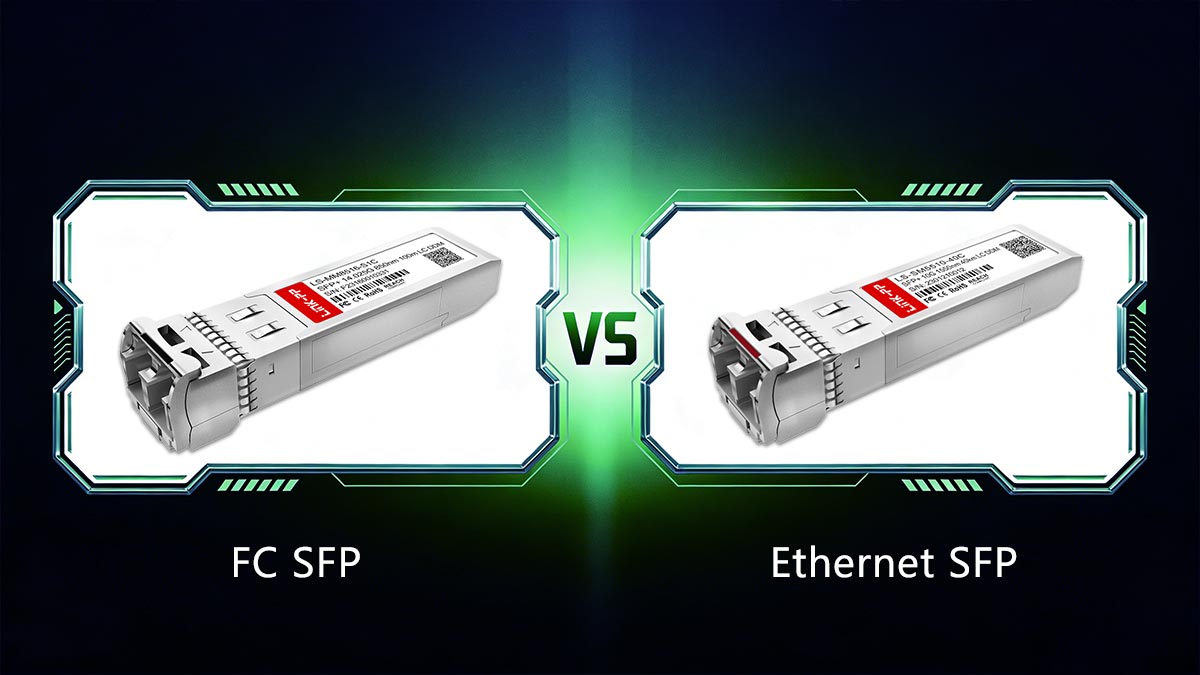
In simple terms, Fibre Channel SFPs are optimized for dedicated storage networking, while Ethernet SFPs are designed for general-purpose IP communication.
1. Protocol and Network Architecture
The biggest difference between FC SFP and Ethernet SFP modules is the protocol they support.
Fibre Channel SFPs operate within a dedicated SAN (Storage Area Network) architecture. They are specifically designed for storage communication protocols such as:
SCSI over Fibre Channel
NVMe over Fibre Channel (NVMe/FC)
Ethernet SFPs, on the other hand, are built for IP-based networking and support standard Ethernet traffic used in:
LAN networks
WAN infrastructure
Cloud computing
Internet communication
Virtualization platforms
Because the signaling and protocol stack are different, an FC transceiver usually cannot communicate properly in a standard Ethernet switch port unless the hardware explicitly supports converged networking technologies like FCoE.
2. SAN vs. LAN Deployment
FC SFP modules are mainly deployed in SAN environments where storage traffic is isolated from normal network traffic. This dedicated architecture helps maintain stable performance and predictable latency for enterprise storage systems.
Typical FC SAN deployments include:
Enterprise storage arrays
Financial databases
Healthcare systems
Mission-critical virtualization
Ethernet SFP modules are primarily used in LAN and data center networking environments where flexibility and scalability are priorities.
Typical Ethernet deployments include:
Enterprise office networks
Cloud data centers
AI clusters
NAS storage
Internet infrastructure
Today, many modern enterprises combine both technologies by using Fibre Channel for high-performance storage while using Ethernet for general network communication.
3. Lossless Fibre Channel vs. Traditional Ethernet
One major reason enterprises continue using Fibre Channel is its lossless design.
Fibre Channel networks are engineered to deliver:
Deterministic traffic flow
In-order frame delivery
Extremely low packet loss
Stable storage performance under congestion
Traditional Ethernet networks were originally designed with a different philosophy, where packet drops and retransmissions are considered acceptable under congestion conditions.
However, modern Ethernet technologies such as:
Data Center Bridging (DCB)
RoCE
FCoE
Priority Flow Control (PFC)
have significantly improved Ethernet’s ability to support loss-sensitive workloads in AI and storage environments.
Even so, many enterprises still trust Fibre Channel for applications where storage reliability is absolutely critical.
4. Speed Standards and Encoding Differences
Another important difference involves speed standards and signal encoding.
Fibre Channel follows dedicated SAN speed generations, including:
Fibre Channel | Ethernet Equivalent Era |
|---|---|
8G FC | 10GbE era |
16G FC | 10G/25G transition |
32G FC | 25G Ethernet era |
64G FC | 100G+ infrastructure |
Ethernet networking uses broader standards such as:
1G Ethernet
10G Ethernet
25G Ethernet
40G Ethernet
100G Ethernet
400G Ethernet
Although some FC and Ethernet modules may use similar optical wavelengths or connectors, their encoding schemes and protocol signaling are different. This is why a 16G FC SFP+ module often cannot function correctly inside a 10G Ethernet switch port.
5. Latency, Reliability, and Performance Comparison
Fibre Channel is designed for environments where low latency and stable performance are critical. In enterprise SANs, FC networks provide highly predictable traffic behavior with minimal jitter and congestion-related packet loss.
Key Fibre Channel advantages include:
Low and deterministic latency
Stable throughput
High storage reliability
Mature SAN ecosystem
Ethernet networks offer greater scalability and flexibility, especially in cloud and hyperscale environments.
Key Ethernet advantages include:
Lower infrastructure cost
Easier scalability
Converged networking support
Massive ecosystem compatibility
Better support for AI and cloud-native architectures
In modern data centers, the choice between FC SFP and Ethernet SFP often depends on workload priorities:
Choose FC for dedicated enterprise storage and mission-critical SANs
Choose Ethernet for scalable cloud, AI, and converged infrastructure environments
As technologies like NVMe/TCP, RoCE, and AI networking continue evolving, Ethernet is becoming increasingly competitive in high-performance storage environments, while Fibre Channel remains a strong choice for organizations prioritizing proven SAN reliability.
⭐ Can FC SFP and Ethernet SFP Be Used Interchangeably?
In most cases, the answer is no. Although FC SFP and Ethernet SFP modules often share the same physical form factor, they are designed for different protocols, signaling standards, and network architectures.
Fibre Channel SFPs are optimized for SAN storage communication, while Ethernet SFPs are built for standard IP networking. Because of these protocol differences, a Fibre Channel transceiver may not function correctly in an Ethernet switch port, and vice versa.
Compatibility problems are commonly caused by:
Different signal encoding standards
EEPROM vendor coding restrictions
Switch firmware validation
Port protocol limitations
Hardware compatibility checks from vendors like Cisco Systems and Hewlett Packard Enterprise
Special Cases: FCoE and Converged Networks
However, there are some exceptions. Certain converged networking technologies, such as FCoE (Fibre Channel over Ethernet), allow storage traffic to run across Ethernet infrastructure. Some multi-protocol switches and Converged Network Adapters (CNAs) may also support both FC and Ethernet optics depending on firmware and hardware configuration.
Even so, interoperability is never guaranteed. Before reusing or mixing transceivers, enterprises should always verify:
Switch and NIC compatibility
Supported protocols
Vendor-approved optics lists
FC or Ethernet port specifications
Firmware and EEPROM requirements
In enterprise deployments, using the correct transceiver type for the intended protocol remains the safest and most reliable approach.
⭐ FC Switch vs Ethernet Switch: What’s the Difference?
Although Fibre Channel switches and Ethernet switches may look similar externally, they are built for different network purposes. Fibre Channel switches are designed for dedicated SAN storage communication, while Ethernet switches handle general IP network traffic such as LAN, WAN, cloud, and internet connectivity.
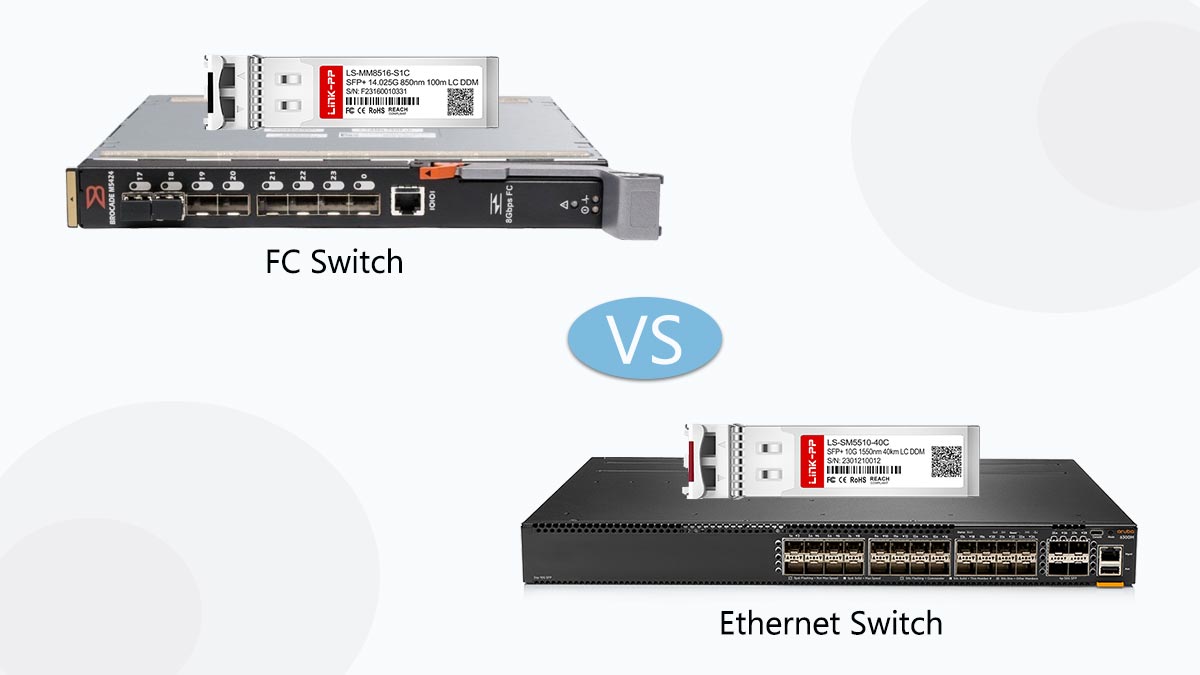
Understanding the difference is important when selecting SFP modules, designing storage infrastructure, or planning modern data center deployments.
Fibre Channel Switch Architecture
Fibre Channel switches are purpose-built for Storage Area Networks (SANs). Their architecture focuses on:
Low and predictable latency
Lossless data transmission
In-order frame delivery
High storage reliability
These switches are commonly used to connect:
Enterprise storage arrays
Servers with HBAs
Backup systems
High-performance databases
FC switches operate using Fibre Channel protocols instead of standard Ethernet/IP networking.
Ethernet Switching for Modern Networks
Ethernet switches are designed for flexible, scalable networking across enterprise and cloud environments.
Typical Ethernet switch applications include:
Enterprise LAN networks
Cloud data centers
AI and GPU clusters
Internet and WAN infrastructure
Virtualization platforms
Modern Ethernet switches support technologies such as:
10G/25G/100G Ethernet
RoCE
VXLAN
EVPN
Because Ethernet supports a broader ecosystem, it has become the dominant networking architecture for hyperscale and AI infrastructure.
Why FC Switches Cannot Replace Ethernet Switches
A common misconception is that Fibre Channel switches can function as regular Ethernet switches because they often use similar SFP ports and optical cables.
In reality, FC switches do not process standard Ethernet traffic. They use different:
Protocol stacks
Frame structures
Signaling methods
Network services
As a result, plugging Ethernet devices into a Fibre Channel switch usually will not work unless the hardware specifically supports converged networking technologies like FCoE.
Likewise, standard Ethernet switches cannot automatically function as Fibre Channel SAN switches.
Mixed Infrastructure in Enterprise Data Centers
Many enterprise data centers use both Fibre Channel and Ethernet networks together.
A common architecture includes:
Fibre Channel SANs for mission-critical storage
Ethernet networks for server, cloud, and internet traffic
This hybrid approach allows organizations to maintain reliable storage performance while benefiting from Ethernet scalability and flexibility.
Today, technologies such as FCoE, NVMe/TCP, and RoCE are helping bridge the gap between storage and Ethernet networking, especially in AI and cloud-native environments. However, traditional Fibre Channel SANs remain widely used in enterprises that prioritize proven storage reliability and predictable performance.
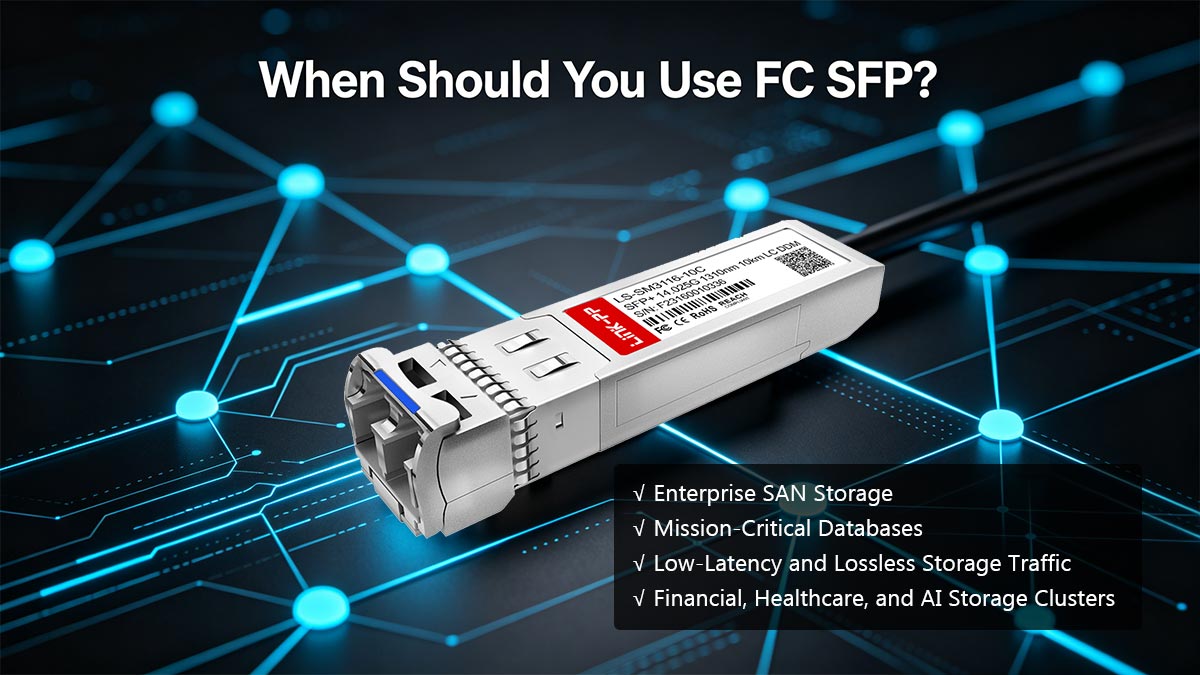
⭐ When Should You Use FC SFP?
Fibre Channel SFP modules are best suited for environments that require highly reliable, low-latency, and lossless storage communication. They are commonly deployed in enterprise SANs where storage traffic must remain isolated from normal network traffic.
Enterprise SAN Storage
FC SFPs are widely used in enterprise Storage Area Networks (SANs) to connect:
Storage arrays
SAN switches
Servers with HBAs
Backup infrastructure
Because Fibre Channel networks are purpose-built for storage, they provide stable and predictable performance under heavy workloads.
Mission-Critical Databases
Organizations running business-critical applications often prefer Fibre Channel for database environments that cannot tolerate interruptions or inconsistent latency.
Typical examples include:
Oracle databases
SAP systems
Large virtualization clusters
Real-time transaction systems
Low-Latency and Lossless Storage Traffic
Fibre Channel is designed for lossless data transmission and deterministic traffic flow. This makes FC SFPs ideal for workloads requiring:
Consistent low latency
Minimal packet loss
Stable storage throughput
Reliable block-level communication
Financial, Healthcare, and AI Storage Clusters
Industries that depend on high-performance storage infrastructure frequently deploy Fibre Channel SANs, including:
Financial trading platforms
Healthcare data systems
Government infrastructure
AI and machine learning storage clusters
Although Ethernet-based storage technologies continue evolving, many enterprises still rely on Fibre Channel for proven SAN reliability and long-term operational stability.
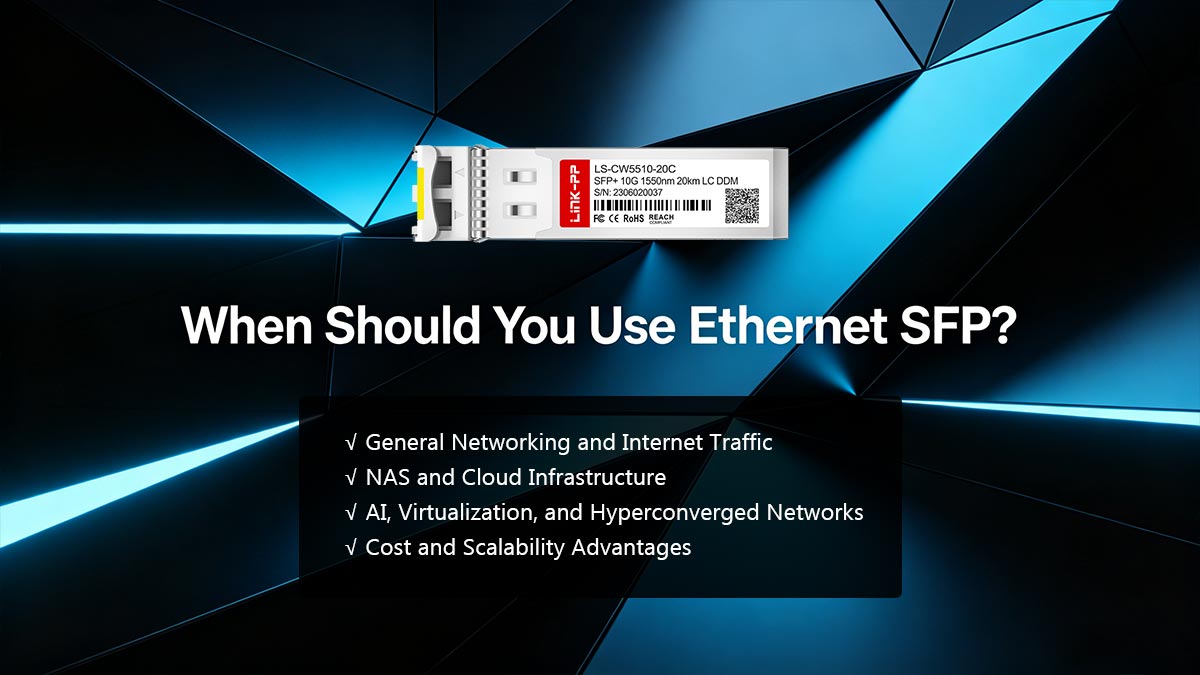
⭐ When Should You Use Ethernet SFP?
Ethernet SFP modules are the preferred choice for general-purpose networking, cloud infrastructure, and scalable modern data centers. They support flexible IP networking across LAN, WAN, and hyperscale environments.
General Networking and Internet Traffic
Ethernet SFPs are commonly used for:
Enterprise LAN networks
Internet connectivity
Router and switch uplinks
Telecom and ISP infrastructure
Their broad compatibility makes Ethernet the standard for most networking deployments worldwide.
NAS and Cloud Infrastructure
Ethernet SFP modules are widely deployed in:
NAS storage environments
Cloud computing platforms
Edge computing systems
Data center spine-leaf networks
Technologies such as 10G, 25G, and 100G Ethernet allow organizations to scale bandwidth efficiently.
AI, Virtualization, and Hyperconverged Networks
Modern AI and cloud-native infrastructure increasingly rely on high-speed Ethernet networking for:
GPU clusters
Hyperconverged infrastructure (HCI)
VMware and virtualization platforms
Distributed AI workloads
Ethernet technologies such as RoCE and NVMe/TCP are also expanding Ethernet’s role in storage networking.
Cost and Scalability Advantages
Compared with Fibre Channel, Ethernet infrastructure typically offers:
Lower deployment costs
Easier scalability
Larger vendor ecosystems
Simplified network management
Greater flexibility for converged networking
For many modern enterprises, Ethernet provides the best balance between performance, scalability, and operational efficiency.
⭐ Common Questions About FC SFP and Ethernet SFP
1. Can I Use a 16G FC SFP in a 10G Ethernet Port?
Usually, no. Although a 16G Fibre Channel SFP+ module may physically fit into a 10G Ethernet port, the protocols and signal encoding are different. Most Ethernet switches cannot recognize or communicate with FC optics unless the hardware specifically supports converged networking technologies such as FCoE.
2. Are FC SFP and Ethernet SFP Physically the Same?
In many cases, yes. Both often use the same SFP or SFP+ form factor, which is why users frequently confuse them. However, similar physical appearance does not mean protocol compatibility.
3. Why Are Some FC and Ethernet Modules Not Compatible?
Compatibility issues are commonly caused by:
Different communication protocols
EEPROM vendor coding
Switch firmware restrictions
Port-specific hardware validation
Enterprise vendors like Cisco Systems and Hewlett Packard Enterprise may lock ports to approved optics or supported protocols.
4. Is Fibre Channel Faster Than Ethernet?
Not necessarily. Fibre Channel focuses on low-latency, lossless storage communication, while Ethernet focuses on scalability and broader networking flexibility.
Modern Ethernet speeds such as 100G and 400G can exceed many FC deployments in raw bandwidth, but Fibre Channel often provides more predictable storage performance in dedicated SAN environments.
5. Should I Use FC or Ethernet for Storage Networking?
It depends on your infrastructure goals.
Choose FC SFP if you need:
Dedicated SAN storage
Lossless storage traffic
Mission-critical reliability
Predictable low latency
Choose Ethernet SFP if you need:
Scalable cloud infrastructure
Converged networking
AI and virtualization support
Lower deployment cost
Many enterprise data centers use both technologies together to balance storage performance and network flexibility.
⭐ How to Choose Between FC SFP and Ethernet SFP
Choosing between Fibre Channel SFP and Ethernet SFP modules depends on your network architecture, storage requirements, scalability goals, and long-term infrastructure strategy. While Fibre Channel remains a trusted solution for dedicated SAN environments, Ethernet continues to dominate modern cloud, AI, and converged data center networking.
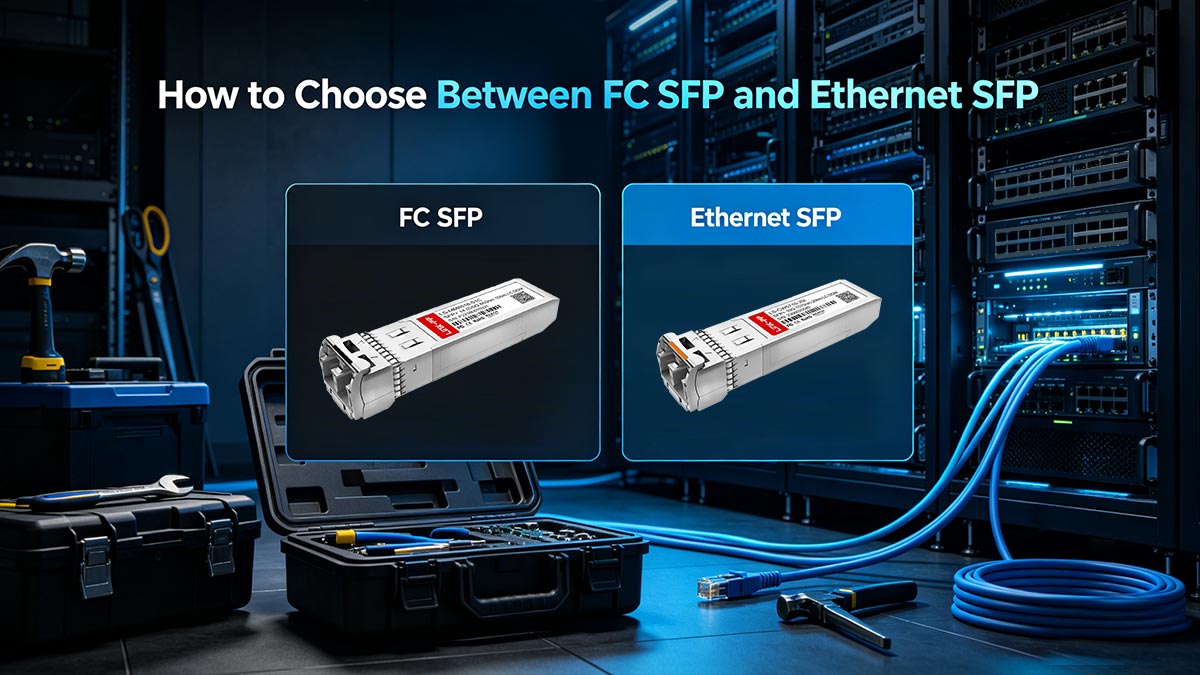
The right choice is not simply about speed—it is about selecting the correct protocol and ecosystem for your workload.
Decision Matrix Based on Network Type
Here is a simple guideline for choosing the right SFP type:
Environment | Recommended SFP Type |
|---|---|
Enterprise SAN storage | FC SFP |
Mission-critical databases | FC SFP |
AI and cloud infrastructure | Ethernet SFP |
General LAN/WAN networking | Ethernet SFP |
NAS and virtualization | Ethernet SFP |
Low-latency dedicated storage | FC SFP |
Hyperscale data centers | Ethernet SFP |
In many enterprise environments, both technologies coexist. Fibre Channel handles dedicated storage traffic, while Ethernet manages general network communication and cloud connectivity.
Compatibility Checklist Before Purchase
Before purchasing any optical transceiver, always verify compatibility with your hardware and network requirements.
Important checks include:
Switch and NIC compatibility
Supported protocol (FC or Ethernet)
SFP/SFP+/SFP28 form factor
Transmission distance requirements
Multimode or single-mode fiber support
EEPROM/vendor coding restrictions
Supported data rates
Firmware compatibility
Even if two modules appear physically identical, incompatible protocols or vendor validation rules may prevent proper operation.
Budget vs. Performance Considerations
Fibre Channel infrastructure typically offers:
Stable low latency
Lossless storage traffic
Proven SAN reliability
However, FC deployments often involve higher infrastructure costs and more specialized hardware.
Ethernet infrastructure usually provides:
Lower deployment cost
Easier scalability
Larger ecosystem compatibility
Better support for cloud and AI networking
For many organizations, Ethernet delivers the best balance between flexibility and cost efficiency, while Fibre Channel remains valuable for storage environments where predictable performance is critical.
Choosing the Right Optical Module Vendor
Optical module quality and compatibility can significantly impact network stability and long-term reliability. Enterprises should select vendors that provide:
Strict compatibility testing
Enterprise-grade manufacturing
Broad switch interoperability
Technical support and customization
Compliance with industry standards
For businesses deploying SAN, Ethernet, AI, or data center infrastructure, the LINK-PP Official Store offers a wide range of compatible optical transceivers, including Fibre Channel SFPs, Ethernet SFPs, DAC cables, and high-speed data center connectivity solutions designed for enterprise networking environments.
As modern infrastructure continues evolving toward AI, cloud-native computing, and converged networking, understanding the difference between FC SFP and Ethernet SFP is essential for building scalable, reliable, and future-ready networks.